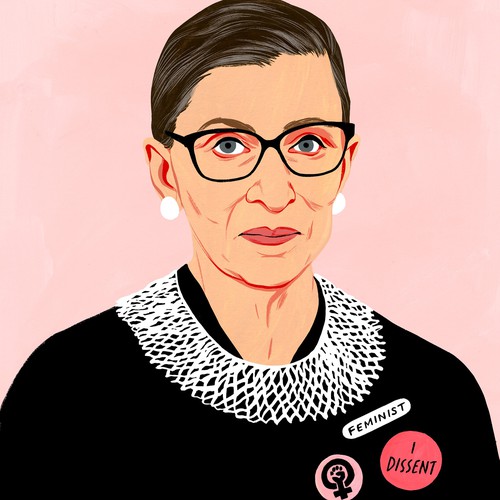
Ruth Bader Ginsburg’s not entirely unexpected death is the liberals’ worst nightmare. For how many months have we dreaded turning on our devices to see the news that Ruth Bader Ginsburg had passed away? Nonetheless, Mitch McConnell is going to have to play this one very carefully. The President will likely want to ram through a conservative nominee to mobilize his base believing that he will benefit from a heated nomination battle. Moreover, if his plan is to contest the election in the courts Should he lose, he will want a reliable conservative vote on the court as insurance. McConnell is also licking his chops at another appointment opportunity. However with less than two months before a presidential election, McConnell’s notorious word from 2016 are echoing in the air, “ The American people should have a voice in the selection of the next Supreme Court Justice. Therefore, the vavacancy should not be filled until we have a new president.” The American people are many things and believe in many. But most of all what they are is fair and believe rules should be applied equally. I think if he tries to ram it through before the election there will be a terrible backlash. I think that even those who may not have a strong feeling about the court, but believe what is good for the goose is good for the gander, will see such an attempt as patently unfair. Ultimately it will lead to the loss of the presidency and control of the Senate for the GOP.
Moreover, it’s not clear McConnell has the votes to get a nomination through the Senate. Several GOP Senators are behind in the polls. Some by a big margins others in a close fight. These include Susan Collins in Maine, Martha McSally in Arizona, Corey Gardner in Colorado, Tom Tillis in North Carolina, Steve Daines in Montana, Joni Ernst in Iowa and Leslie Graham is tied in South Carolina. Graham is also record as being against replacing a Supreme Court Justice in an election year. As Senate Judiciary Committee Chairman, he would be responsible for the running the nomination hearing and his hypocrisy would be on parade front and center should he deviate from his word. These candidates are going to be loathe to cast a vote that will put their reelection at risk. Look at the Cavanaugh hearing in 2018, everyone though the nomination battle would benefit the GOP in the mid term elections. The wound up losing 40 seats in the House of Representatives and all kind of elections at the state level. Additionally other senators like Lisa Murkowski, and Charles Grassley are on record making similar statements as Graham. And then there is always Mitt Romney.
LINDSEY GRAHAM on Oct. 3, 2018:
"If an opening comes in the last year of President Trump's term, and the primary process has started, we'll wait to the next election.”pic.twitter.com/WjmIiWbTeo
Assume that Biden wins, McConnell could try to fill the seat in the lame duck period after the election. However, if he goes this route there will be tremendous pressure on President-Elect Biden to expand the size of the Supreme Court, presuming the Democrats win control of the Senate, from his base. The Democrats will end the Senate filibuster and increase the size of the court to 13 to balance things out. I don’t think Biden wants to go this route, but he will find it difficult to resist the pressure under these circumstances.
If Trump wins re-election all bets are off.
Safe to say, buckle in now because the battle is just beginning.
It’s time we stop. Hey, what’s that sound? Everybody look what’s going down!
It was a mid-September morning in 1862 along the Antietam creek in Western Maryland. The sun was beginning to rise as the nighttime sky slowly gave way to the blue and orange hues of the morning. An overnight rain ended and a morning ground fog was dissipating as the first Union soldiers broke camp and began moving south toward the Miller family’s cornfield. Confederate artillery from the high ground on the Union right opened fire as the the Yankees trampled through the cornfield, warning both sides that a battle had commenced. At the opposite end of the cornfield two brigades of battle-hardened Confederate veterans, patiently waited, poised to stem the advance. As the first blue coats emerged from the cornfield, the Confederates rose from the ground unleashing a thunderous volley, ripping through the Union ranks in what would become the opening engagement in the bloodiest day in American history.
At Antietam, close to 23,000 American soldiers were either killed or wounded in a roughly twelve hour period. The casualties from Gettysburg, Shiloh, Chancellorsville, Chickamauga and Spotsylvania exceed those of Antietam but these battles were multi-day affairs. If Shiloh was a loss of innocence, a demonstration that war was not some kind of lark or noble adventure that one entered into lightly, then Antietam was another wake-up call for both sides.
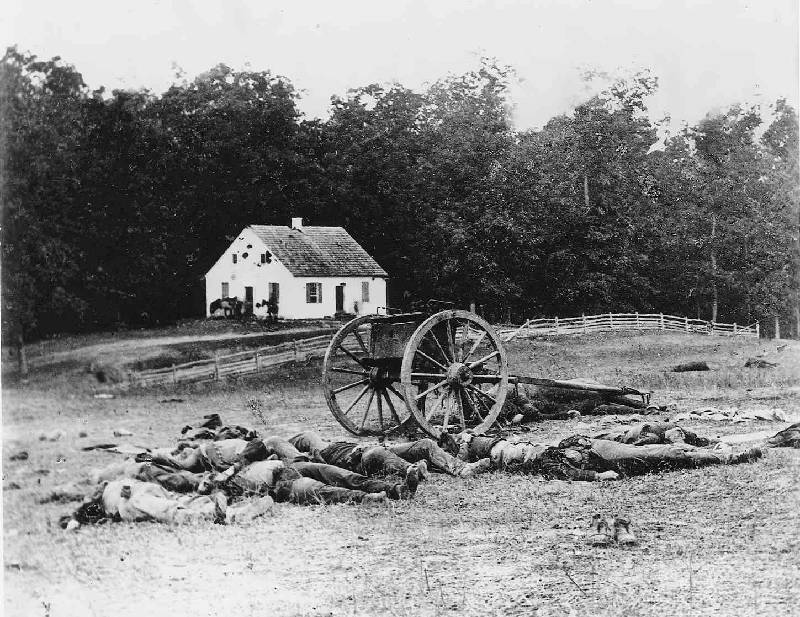
Antietam is an epic battle in every sense of the word. It is one both in terms of it’s importance and consequences. One that is epic in the sense that key points of the battle— the cornfield, Bloody Lane, and Burnside’s Bridge—are forever etched in U.S. military history. It is a battle where the men of both sides were pushed to their limits and beyond. On the Union side alone, 20 Medals of Honor were awarded for acts of bravery during the battle. It is also the first time where the battlefield carnage is recorded by photograph for the American public to see.
Confederate dead near the Dunker Church and along the Hagerstown Pike.
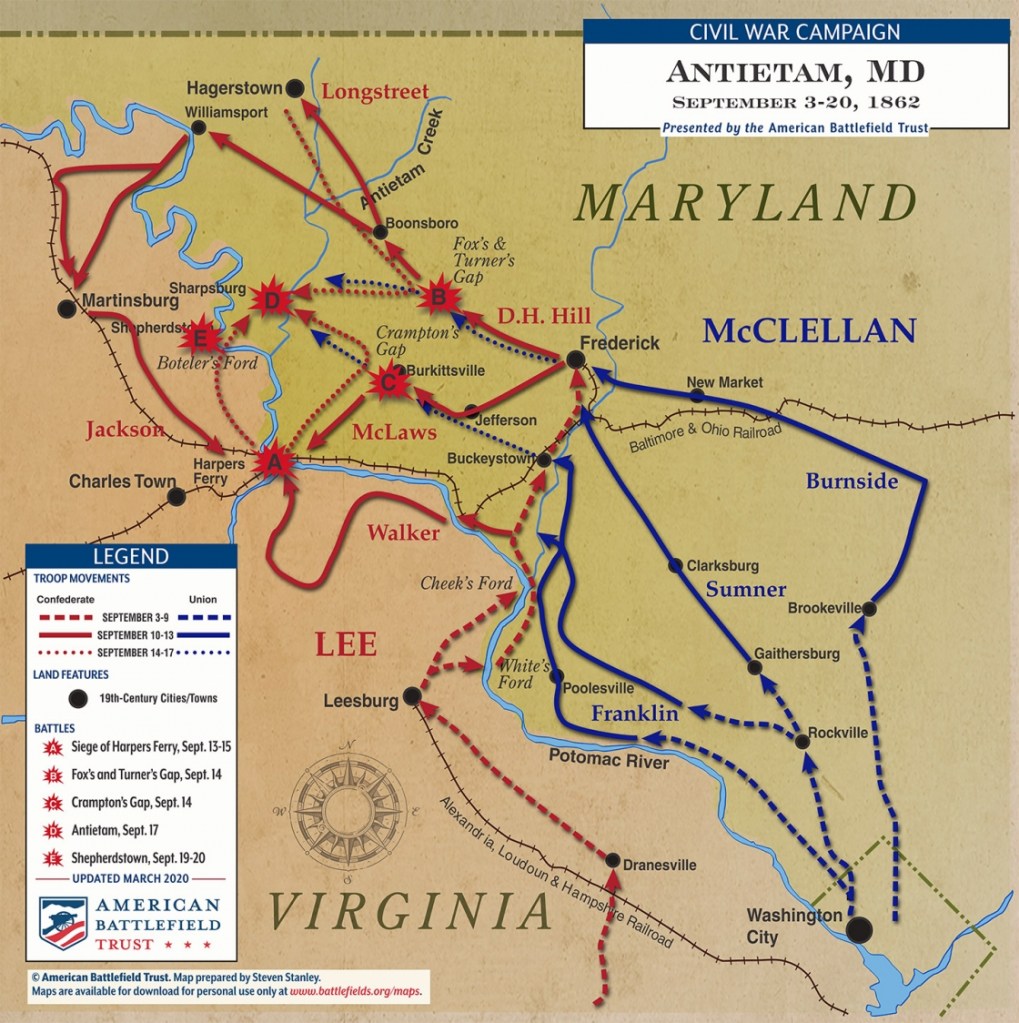
The drama of that fateful September morning was set in motion less than a month earlier. At the end of August, General Robert E. Lee and the Army of Northern Virginia soundly defeated Union forces at the Second Battle of Manassas while scoring a tactical victory at the Battle of Chantilly, that sent the Yankees scurrying back behind the defenses of Washington. With only 55,000 troops under his command, Lee’s army posed no serious threat to Washington DC. Moreover, his army was badly in need of food and other supplies and the Virginia countryside had been ravaged by the war. Faced with this reality, Lee opted to take the war North. He would invade Maryland and if possible Pennsylvania with goal of securing supplies, undermining Northern morale, and encouraging Maryland to join the Confederacy. Lee also calculated that his advance into Maryland would draw out the Union army from its defenses and supply base in Washington DC where he could deliver a decisive blow.
On September 4, his rag-tag Confederate army crossed over the Potomac River into Maryland near Leesburg Virginia and advanced rapidly north toward Frederick, Maryland. However, things began to go wrong immediately for the rebel invaders. A large number of confederate forces refused to crossover into Maryland claiming that they joined the army to defend the South against Northern aggression, not to invade the North. Confederate forces also did not receive the warm welcome they expected. Unlike Baltimore and southern Maryland where there were a considerable number of Southern sympathizers and slaveholders, Western Maryland was a center of pro-Union sentiment. Lee also expected that when he entered Frederick, that the supply line to the Federal garrison at Harpers Ferry would be cut and force the 14,000 troops there to withdrawal. They did not and the garrison posed a continuing threat to Southern supply lines. Consequently, Lee was forced to divide his already depleted army. He ordered General Stonewall Jackson and his Corps to seize Harpers Ferry. He then sent General James Longstreet and 10,000 men ahead to Hagerstown, leaving a smaller contingent of forces behind at South Mountain to guard the army’s rear and protect the mountain passes at Fox, Turner, Crampton gap.
News that the Confederates had crossed the Potomac into Maryland, set off alarm bells in Washington but the Union commander, General George McClellan was slow to respond. On September 7, the 87,000 strong Army of the Potomac began their pursuit of the Confederate Army but did not reach Frederick until six days later. As luck would have it soldiers from the 27th Indiana infantry regiment found a copy of Lee’s plans wrapped around three cigars in a field. Emboldened by his good fortune, McClellan boasted, “Here is a paper with which if I cannot whip Bobbie Lee, I will be willing to go home.” With that critical information, McClellan knew that Lee’s army was divided and their locations. He ordered his army to advance West with all deliberate speed toward the mountain passes, near South Mountain. He would now destroy Lee’s divided army piecemeal.
On 14 September, the advancing Union army clashed with the rear guard of Lee’s army for control of the three mountain passes — Fox, Turner, and Crampton’s Gap, at South Mountain. The fighting was fierce as the Union army moved up the jagged rocks against determined Confederate resistance. The smaller Confederate detachment held firm against repeated Union assaults. The fighting would continue non-stop into the evening with the outnumbered rebels eventually retreating and ceding the passes to the Union army. When the battle ended a combined 4,000 Union and Confederate soldiers were killed including Federal Ninth Corps commander, General Jesse Lee Reno, and Confederate Brigadier General Samuel Garland. The next day Harpers Ferry succumbed to Confederate forces.
Having dislodged Confederate forces from the mountain passes, McClellan and his army passed over South Mountain and were within striking range of Lee’s vulnerable army. However, McClellan continued to operate with his customary lack of urgency. He failed to press the vulnerable Confederates and allowed Lee time to regather his divided army and assume a defensive position behind Antietam creek, just east of Sharpsburg. Stonewall Jackson and his men rejoined Lee on the 16th after securing the surrender of Harpers Ferry. However, Jackson left behind a division under Major General A.P. Hill to complete the turnover. Longstreet and his men had begun their return march from Hagerstown after hearing the sounds of battle echoing from South Mountain. Union forces continued to outnumber the Confederates by a 2:1 margin but McClellan still erroneously believed he was outnumbered.
The Battle Begins
Lee expected that the overly cautious McClellan would not attack before September 17 and McClellan did not disappoint. The Union commander diligently spent all day September 16 carefully developing his battle plan around Antietam Creek’s three crossings: the Upper, Middle, and Lower bridges. McClellan’s opening attack would use the Upper Bridge to strike Lee’s left flank followed up by a coordinated attack on his right across the Lower Bridge. These two attacks were expected to thin out the Confederate Center, where Union forces would cross over the Middle Bridge and strike a final blow. With the flank attacks cutting off his avenues of retreat, Lee would be compelled to surrender. That evening, two Union I and XII corps crossed over the Upper Bridge with orders to strike Lee’s left early the next day. Despite McClellan’s meticulous preparation, few things would go as planned.
Shortly after daybreak on the morning of September 17th, Major General Joseph Hooker and his three divisions of the I Corps emerged from their bivouacs on the Poffenberger farm and moved south toward the North end of the Miller family’s 30-acre cornfield. At the opposite end of the field, in unknown strength and location, waited the Confederate forces of Major General Thomas “Stonewall” Jackson for their expected attack. Over the next four hours, this cornfield would become ground zero for some of the worst carnage in U.S. history. The battle here would be marked by a series of attacks and counter attacks in which neither side was able to gain the upper hand. The field would change hands no fewer than six times but when all was said and done the fighting ended in a stalemate as the focus of the battle shifted south.
1.) Hooker’s brigades begin their attack on the cornfield; 2.) Hood’s division counter attacks; 3.) General D.H. Hill sends reinforcements from the Sunken Road; 4.) Mansfield’s Twelfth Corps drives Hood’s men from the field
Hooker’s battle plan was simple and uncomplicated. There was no deception or complex maneuvering involved. The I Corps would carry out a direct assault on the Confederate left flank and drive it back past a small white stone structure on raised ground known as the Dunker Church. Hooker positioned his forces for battle in the shape of an inverted pyramid. He deployed Brigadier General James Ricketts’ division on the left, Brigadier General Abner Doubleday’s division on the right and placed Brigadier General George Meade’s division behind the two in reserve.
General Ricketts’ division would lead the attack and around 6:00 am Brigadier General Abram Duryee’s brigade deployed into a double line and entered the cornfield. Moving forward, they disappeared amongst the head-high cornstalks, unsupported but undaunted. As Duryee’s men neared the end of the cornfield, a brigade of Georgians, under the command of Colonel Marcellus Douglass, rose from the ground about 200 yards away and unleashed a deafening volley, knocking dozens from the ranks. Duryee’s brigade stood toe to toe with the Georgians firing behind the for cover of an old wooden fence. Men in the ranks of both sides fell rapidly but after 30 minutes of intense fighting and 300 casualties Duryee’s men slowly began to fall back.
Three regiments from Douglass’ brigade pursued the retreating Federals and they were soon joined by Brigadier General Harry Hay’s brigade from Louisiana, whom Jackson sent to bolster the Georgians. As Hays’ brigade advanced, they crashed into one of Ricketts’ other brigades under the command of Colonel Richard Coulter. Coulter’s brigade just emerged from the East Woods and was moving to support Duryee’s men. In some of the fiercest fighting of the battle, Hay’s men drove Coulter’s brigade back into the East Woods, where it rallied, strengthened by reinforcements. Exhausted and running low on ammunition Hays’ brigade was forced to retreat.
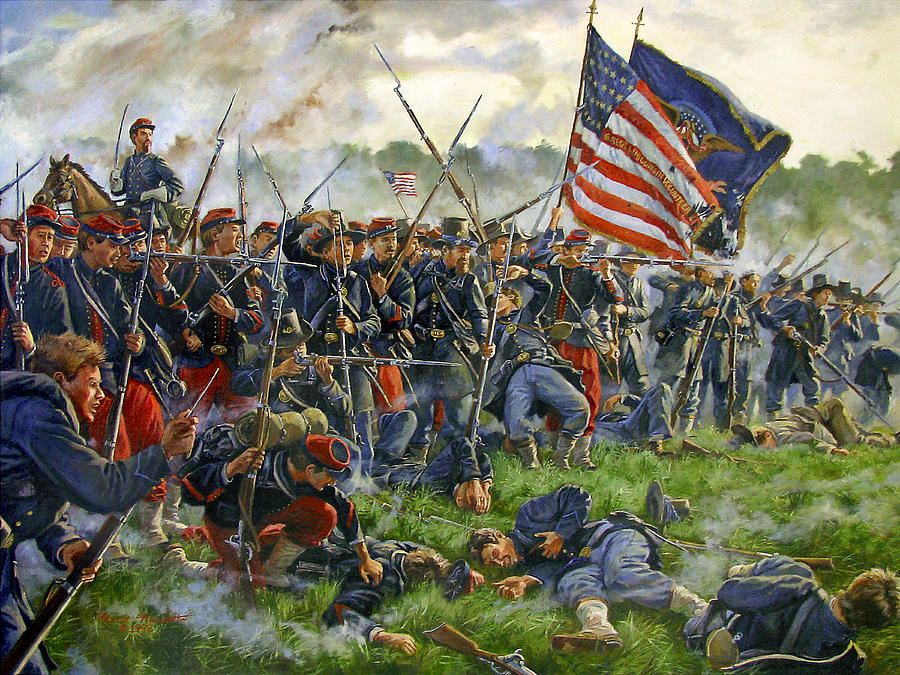
On the Union right, Doubleday’s division began its attack about the same time as Duryee’s men were falling back. Brigadier General John Gibbon’s “Iron Brigade” led the attack with the brigades of Colonel Walter Phelps and Brigadier General Marsena Patrick close behind on the left and right. Gibbon’s men were all Midwesterners of hearty stock and earned their sobriquet as reliable and determined fighters the previous month at Manassas. Advancing south along the Hagerstown Pike, Gibbon’s brigade entered the cornfield around 6:30 am led by the 6th Wisconsin regiment with the 2nd Wisconsin regiment following on its left. Behind them were the 7thWisconsin and the 19th Indiana. Pushing its way through the dense corn, the 6th Wisconsin was suddenly hit by an unexpectedly strong volley from its right flank. A battle line of Virginians emerged from the West Woods and delivered a second volley tearing into the 6th Wisconsin, killing and wounding dozens. Both the 2nd and 6th Wisconsin wheeled to meet this new threat, taking cover behind a wooden rail fence. Gibbon also redeployed the 7th Wisconsin and the 19thIndiana west of the turnpike to drive the Virginians from the field, while Doubleday sent Patrick’s brigade in support. The Virginians were soon pushed back.
With the immediate threat to their right eliminated, the 2nd and 6th Wisconsin, along with Phelps’ brigade, continued to move forward toward the Dunker Church. As they approached the end of the cornfield, they were met with the same deadly fire that Duryee’s brigade received 30 minutes earlier. Three regiments of Georgians, from Douglass’ brigade rose up and unleashed a powerful volley. The men of Gibbon and Phelps’ brigades closed ranks behind a wooden fence and returned fire with equally devastating effect. Pressed hard by Doubleday’s division, the Georgians began to fall back opening the door to the Dunker Church. Suddenly, two brigades of Louisianans and Virginians emerged from the depths of the West Woods under Brigadier General William Starke. Starke’s men took up positions along a wooden rail fence on the east side of the Hagerstown Pike and fired into the Union flank, slowing their advance. Gibbon and Phelps’ men pivoted to meet the new threat. At one point the two battle lines were only 30 yards apart blazing away at each other. They fell by the score, including Starke who was shot three times and would die within the hour. The 7th Wisconsin and the 19th Indiana, which had earlier driven the Confederates from the Northern edge of the West Woods now appeared on Starke’s left inflicting heavy damage. Their position no longer tenable, the rebels retreated back behind the West Woods.
As the Confederate line began to crumble, Jackson turned to only remaining reserve, Brigadier General John Bell Hood’s Division. Hood’s division was made up of three brigades of Texans and two from Georgia and South Carolina, who had proven themselves in previous battles to be reliable and tenacious fighters. Shortly after 7:00 am Hood’s men poured out of the West Woods behind the Dunker Church howling their dreaded rebel yell. They drove Hooker’s First Corps back across the Cornfield, to just about where the Union attack began. Hood, however, was unable to consolidate his gains. Around 8:00 am, Mansfield’s twelfth corps, with its 7000 troops entered the battle. They pushed Hood’s men and additional reinforcements from General Daniel Harvey Hill’s command back across the field, south to the Dunker Church. Hood’s Division suffered grievously with 1,380 dead and wounded, about 60 percent of its strength. Mansfield’s command also paid dearly for the ground it reclaimed at the cost of over 1500 casualties, including Mansfield himself who was mortally wounded.
Around 9:30 am, the Union Second Corps under General Edwin Summer, entered the battle, launching one last assault to smash Lee’s left flank. Sumner sent General John Sedgwick’s division forward towards the West Woods. As Sedgwick’s men advanced into the woods, they collided with Confederate Major General Lafayette McClaws division that was rushing to bolster the Confederates reeling left flank. Instead of delivering a crushing blow, Sedgwick’s men found themselves catching fire from three sides and were ripped apart. In less than 20 minutes, Sedgwick’s division suffered over 2,200 casualties and forced to retreat.
With Sedgwick’s retreat, fighting around Miller’s cornfield and the West Woods began to wane with both sides exhausted from the ordeal. Over 8,000 dead and wounded from both sides littered the ground around what remained of the cornfield, West Woods and the Dunker Church. General Hooker would later somberly write, “It was never my fortune to witness a more bloody, dismal battlefield.” That evening, after the battle concluded, General Lee would ask Hood where his division was. He responded, “They are lying on the field where you sent them. My division has been almost wiped out.”
The Sunken Road
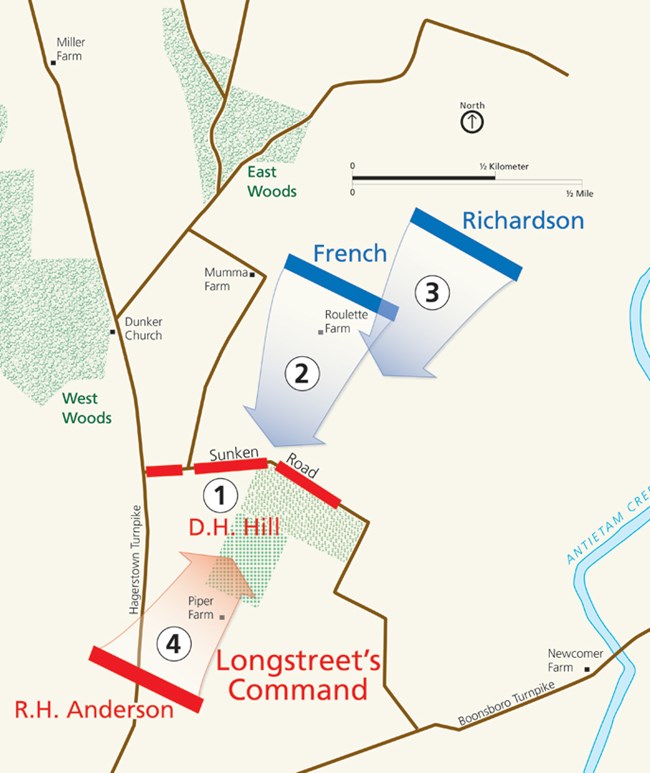
The focus of the battle soon shifted from the left to the center of the Confederate line. Here 2,600 Confederate troops from Alabama and North Carolina hunkered down in a fence-lined sunken road waiting for a Union attack. The road had been worn down from years of wagon use and formed a natural trench. Nevertheless, despite these formidable defenses, the center was the weakest part of the Confederate line. For the next, three hours, Confederate forces here fought back repeated assaults by 10,000 Union troops in what would become known as “Bloody Lane.”
Shortly after Sedgwick’s attack on the West Woods, Summer ordered a second division under General William French forward to support him but upon learning of Sedgwick’s predicament, French was ordered to turn south and attack the Confederate center. French directed a series of brigade level attacks beginning around 9:30am. Two of the attacks were carried out by relatively inexperienced brigades and were beaten back. A third attack was launched by a more veteran brigade but met with similar results. In one hour, French’s division suffered over 1,700 casualties.
1.) 2,600 Alabama and North Carolina troops under the command of General D.H. Hill, 2.) French’s three assaults, 3.) Richardson’s division arrives, 4.) Anderson’s reinforcements arrive.
Both sides began to send in reinforcements demonstrating the gravity of the situation. Around 10:30, Lee sent his last reserves, Major General R.H. Anderson’s division, to extend the Confederate line on the right. About the same time, 4,000 men of General Israel Richardson’s division arrived on French’s left. The fourth attack on the Confederate position would come from Richardson’s Division and led by the Irish Brigade of Brigadier General Thomas Meagher. Armed with obsolete smooth bore muskets that had limited range and their distinctive emerald flags waving in the wind, the Irish Brigade was cut down by heavy volleys losing over 500 men before withdrawing.
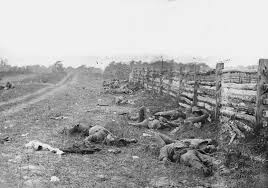
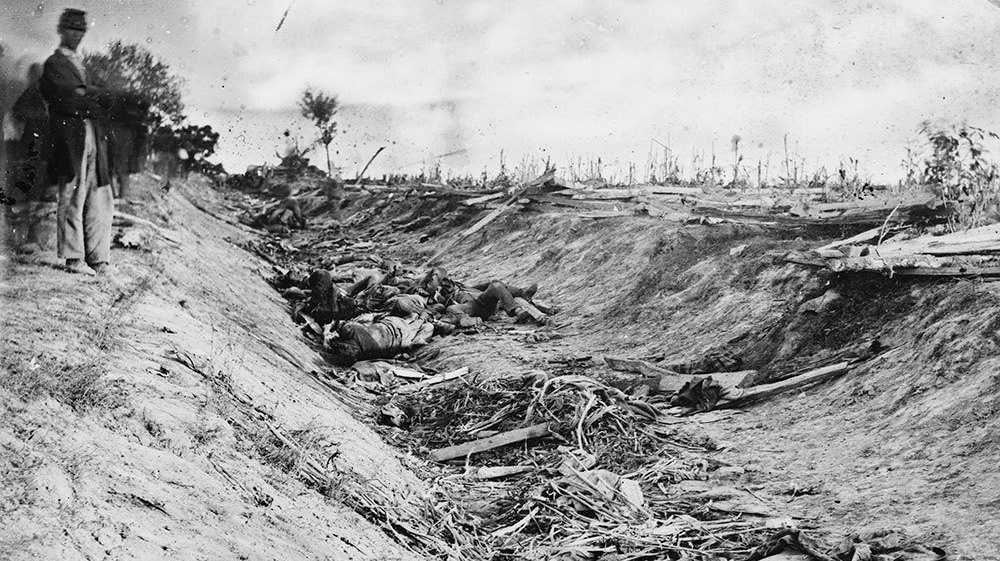
Confederate Dead in the Sunken Road
Increasingly desperate, Richardson sent General John Caldwell’s veteran brigade to attack Anderson’s men on the Confederates’ right. Two regiments of Caldwell’s brigade managed to swing around the right of the Confederate line and seized an elevated position that allowed them to pour a murderous fire down upon the entire Confederate line. The effect was devastating. Several Confederate brigade and regimental commanders went down causing havoc in the ranks. The Confederate line began to break under the sheer weight of the Union attack and a broken command structure. Soon the Confederates were fleeing back towards Sharpsburg with Richardson’s forces in hot pursuit. Scrambling to stop the Union advance, Confederate First Corps Commander General James Longstreet hastily massed an artillery barrage sending Richardson’s forces back reeling. The situation was so dire that Longstreet and his staff manned one of the rebel artillery pieces. Longstreet would later remark, “We were already badly whipped and were only holding our ground by sheer force of desperation.” This is a critical moment in the battle. The center of Lee’s army is broken and on the ropes but McClellan fails to recognize the opportunity. Sumner’s corps is spent but McClellan still has two extra corps in reserve. McClellan, still believing he is outnumbered by Lee, refuses to commit his reserves. When the action around this portion of the battle finally ended, over 2500 Confederate dead and wounded lined the sunken road. Union casualties totaled just under 3,000.
The Battle for Burnside’s Bridge
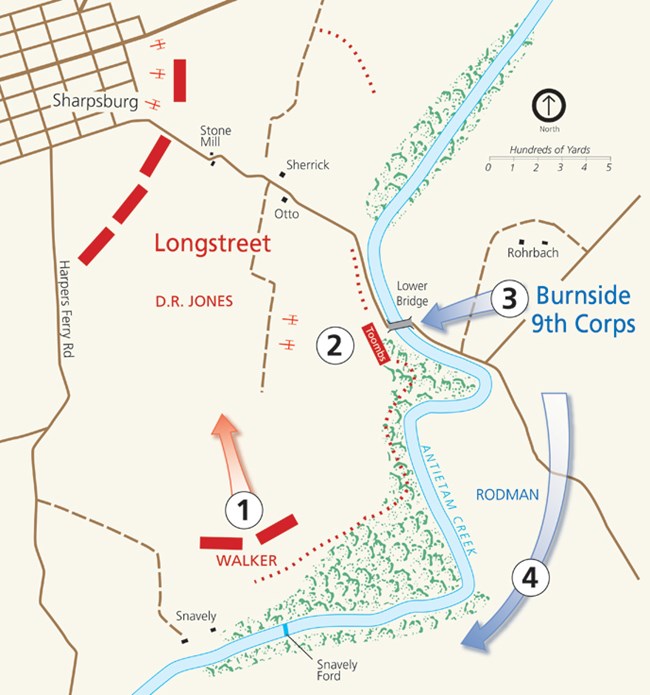
After the fighting around the sunken road subsided, the focus of the battle shifted further south for the final action of the day. Under McClellan’s battle plan, Major General Ambrose Burnside and his 12,000 strong IX corps were tasked with launching a diversionary attack on Confederate forces behind Antietam Creek that comprised the right flank of the Confederate line to prevent Lee from reinforcing his left. However, Burnside didn’t receive his orders to begin his assault until close to 10am, after most of the action against Lee’s left had finished.
Confederate forces in this sector of the battlefield consisted of four thin brigades totaling only 3,000 and were badly out numbered by Burnside’s Corps. An entire division and a brigade were pulled from here as reinforcements during earlier fighting in the cornfield and the sunken road. Nevertheless, the Confederates occupied a formidable position commanding the heights overlooking a small stone bridge, the southern most crossing point over Antietam Creek. Here were deployed two Georgian regiments, under Brigadier General Robert Toombs with a clear line of fire from above targeting the bridge.
The third Union assault on the Rohrbach Bridge
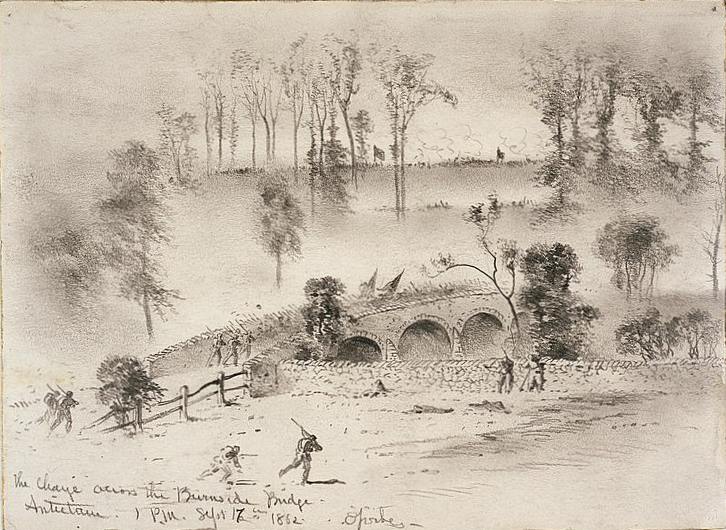
Burnside’s plan was to storm the bridge while enacting a crossing further downstream to attack the Confederate right flank. Around 10am, he launched the first out of what would be three attempts, to seize the bridge. At the same time he ordered General Isaac Rodman’s division South in search of an identified crossing point at Snavely’s Ford. The first attempt to take the bridge was a fiasco. According to Burnside’s plan, skirmishers from the 11th Connecticut Regiment were supposed to clear out rebel sharpshooters from the heights allowing the 8th Ohio Regiment to storm across the bridge. The Connecticut regiment, marched down an exposed road that paralleled the creek and came under a withering fire from the 500 Confederates occupying the bluff. Within 15 minutes the regiment lost 139 men, a third of its overall combat strength. The Ohio regiment became lost and got caught in a firefight further upstream. The second attack came shortly thereafter with the 2nd Maryland and 6th New Hampshire regiments leading the way. They followed the same exposed path as the first attack with the same results.
1.) In the early hours of the battle, Lee moved soldiers from this part of his line north toward the Cornfield and the West Woods. This shift resulted in one division, numbering about 3,000 men protecting his right; 2.) Fewer than 500 Confederate troops, commanded by Gen. Robert Toombs, lined Antietam Creek from this point southward to Snavely Ford; 3.) Here Burnside carried out three assaults to take the bridge; 4.) Burnside sends Rodman’s division to flank the Confederates.
In two hours, Burnside’s corps made little progress and the Union high command was growing impatient. McClellan sent an aide to Burnside instructing him to take the bridge at all cost. He next turned to Brigadier General Edward Ferrero’s brigade to lead the next assault. Ferrero selected his two best regiments the 51st New York and the 51st Pennsylvania to lead the attack. The Pennsylvania regiment was a raucous unit of hard-drinking men who loved their whiskey. Ferrero had suspended their whiskey ration in an earlier disciplinary action but promised to restore it if they succeeded. The Confederates, who had fended off attack after attack, were starting to run low on ammunition. Around 12:30, Confederate volleys began to slack off as the troops exhausted their ammunition. Sensing an opportunity, the New York and Pennsylvania regiments stormed the bridge under a cover of heavy canister and musket fire. With their ammunition depleted and word that Rodman’s division was crossing at Snavely’s Ford, the Confederates withdrew. Burnside had won his bridge and the 51st Pennsylvania their whiskey.
Up Came Hill: The Final Attack
Burnside had finally taken the bridge but failed to press his advance with the necessary urgency. Burnside spent two hours moving three of his divisions, his artillery and supply wagons across Antietam Creek before resuming his offensive. This delay provided Lee with valuable time to reorganize his beleaguered defenses. It also bought time for Major General A.P. Hill’s division, which had been left behind at Harpers Ferry to complete the Union surrender, to reach the battlefield and save the day. Once the battle began, Lee sent word to Hill and his division to begin the 17 mile march to Sharpsburg as quickly as possible.
1.) The Confederates lone under strength division under General D.R. Jones; 2.) Burnside’s Corps advances; 3.) Hill’s counter attack
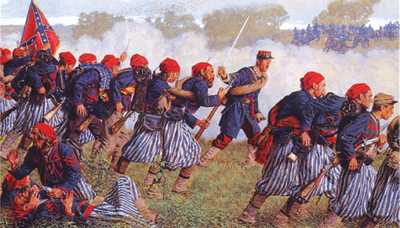
Around 3:00 pm, 8,000 Union soldiers, under Burnside’s command swept forward in a mile-wide battle line across the undulating fields south of Sharpsburg. Their objective was to roll up the Confederate flank and cut Lee’s army off from Boteler’s Ford, their only escape route across the Potomac River. The only thing in the way of their advance was Brigadier General D.R. Jones under strength 2,500 men division and 28 pieces of artillery. As Burnside’s three divisions continued to advance forward, led by the colorful Zouaves of the 9th New York Regiment, the rebels’ flank was collapsing. Lee and his staff were trying desperately to rally their broken forces and stave off a rout but just then, in a most dramatic fashion, A.P. Hill’s division arrived from Harpers Ferry, exhausted but ready for a fight. Approximately, 3:30, the lead element of Hill’s division, Brigadier General Maxcy Gregg’s brigade of South Carolinians, slammed into Burnside’s exposed left flank. The relatively inexperienced troops of Burnside’s left flank proved no match for Hill’s grizzled veterans and they were sent reeling back down the hills and across Antietam Creek. One Union soldier from the 4th Rhode Island Regiment later described Hill’s counter attack, “They were pouring in a sweeping fire as they advanced, and our men fell like sheep at the slaughter.” By 5:30pm the Battle was over.
Gathering the Dead
Both sides fell back that evening battered and bruised. The end of the fighting brought the grim reality of that day sharply into focus as both sides tallied their loses. For the next 24 hours, pitiful groans of agony from the wounded still on the battlefield and the fetid smell of death filled the air. Surgeons, stretcher-bearers, and burial details worked feverishly around the clock attending to the dead and wounded. On the Union side, casualties totaled approximately 12,400 including 2,100 killed in action and another 10,300 wounded, missing, or captured. Confederate loses reached 10,300 to include roughly 1,560 dead and 8,770 wounded, missing or captured. These totals represented 25% of the Federal force and 31% of the Confederates.
The next morning, Lee’s army prepared to defend against a Federal assault that never came. After an improvised truce for both sides to recover and exchange their wounded, Lee’s forces began withdrawing across the Potomac that evening to return to Virginia. On September 19 elements of General Fitz John Porter’s V corps, which were held entirely in reserve during the battle, crossed over the Potomac River at Boteler’s Ford and attacked Lee’s rearguard. The following day Porter sent additional forces across the river to establish a bridgehead. General A.P. Hill’s division counterattacked while many of the Federals were crossing the river, inflicting heavy casualties. Porter pulled back to the Maryland side of the river. This rearguard battle near Shepherdstown, Virginia discouraged further Federal pursuit of Robert E. Lee’s defeated army back to Virginia.
The Importance of Leadership
In many ways, Antietam is a tale of failed opportunities, mostly for the Union. The Battle was in effect a draw but is generally considered a Union victory because the South was turned back and denied it’s overall strategic objectives. It’s become fashionable today to re-examine Lee’s record to find fault with his military leadership and decision making to compensate for the myth making of the Lost cause era. However, as Stephen Sears argues in his account of the battle, “Landscape Turned Red,” one would be hard pressed to find fault with how Lee and the rest of the Confederate high command conducted the battle or could have better employed all the means at their disposal.
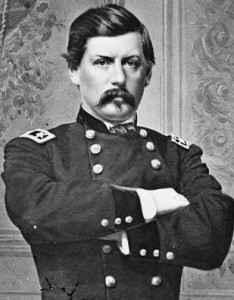
Left: General Robert E. Lee; Right: General George B. McClellan
The same cannot be said for the Union and it’s commander George McClellan who proved woefully inadequate. McClellan, in his typical self-important fashion, cabled a situation report back to Washington the day after the battle writing, “Those in whose judgment I rely tell me I fought the battle splendidly and that it was a masterpiece of art.” In reality, he fought the battle not to lose rather than trying win. As a result, he squandered opportunity after opportunity to inflict a decisive and catastrophic defeat on the rebel army. Throughout, the battle McClellan had kept two army corps, between 20,000-30,000 troops, in reserve. He mistakenly feared he was badly outnumbered by Lee and that should he be defeated he would need a reserve force to prevent Lee from moving further North. Had McClellan deployed those reserves in support of the attack on the Sunken Road, Burnside’s efforts to roll up the Confederate right flank, or even to launch a series of new attacks the following day most likely would have resulted in a decisive Union victory and possibly shortening the war by two years. McClellan would pay a steep price for his timidity. Two months later he would be relieved of his command by President Lincoln.
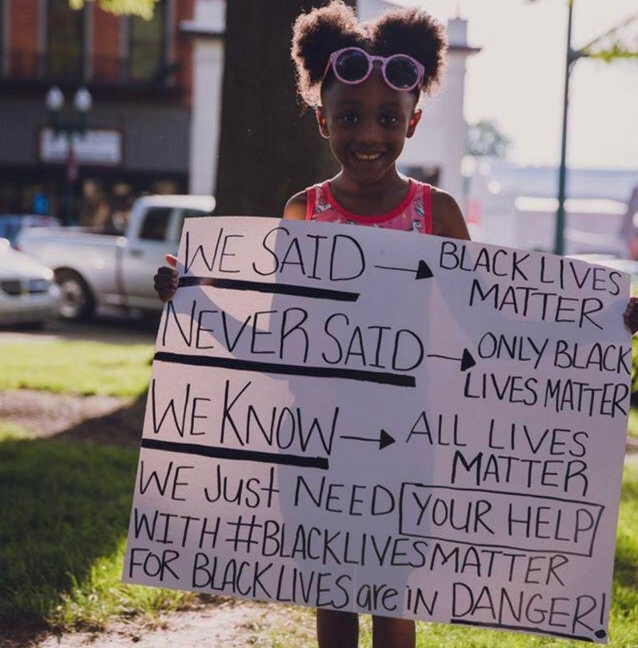
“All lives matter!” or so they say. On the surface it’s reasonable claim. One that is hard to deny or argue with, especially for a nation that was conceived on the premise that all men are created equal. But that’s not really the point, is it? Of course all lives matter, but do they matter equally? History would suggest otherwise. In reality, the phrase “All lives matter” has become a trope to reject and deny the increasingly disturbing trend of unarmed African-Americans killed by police under dubious circumstances and the fact that throughout our country’s history, black lives have been devalued systematically. It’s an expression of fear, based on the erroneous perception that Black Lives Matter is a zero-sum movement that seeks racial advantage rather than the equality promised in the Constitution and Declaration of Independence, a redress of historical grievances and a more equitable system of justice.
The Peculiar Institution
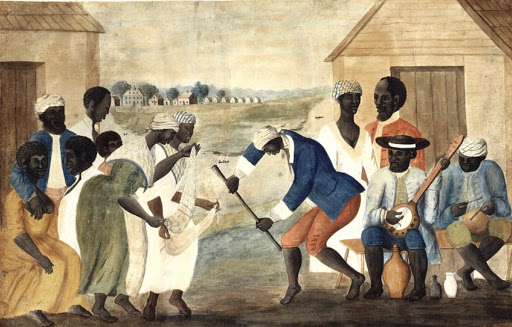
The African-American experience has been one of exploitation and marginalization. Since the first ship arrived in the Jamestown colony in 1619, carrying some 20 plus Angolans against their will, black lives have been devalued. Over the next two hundred years, more than 400,000 additional Africans would be kidnapped from their homes, brought to North America in the squalid hulls of slave ships, and forced into bondage as a source of cheap and captive labor. Often toiling in dangerous and inhospitable conditions, where few would do so of their own choosing, these slaves brought tremendous wealth not only to those that enslaved them but the entire country through the large scale cultivation of rice, tobacco, indigo and cotton. Slavery became so woven into the economic fabric of the country that by 1860, 80 percent of the U.S. GDP was tied to the “peculiar institution.” Yet as Carole Anderson points out in her book White Rage, that in return for almost 250 years of forced labor, African Americans received nothing but rape, whippings, murder, the destruction of families, illiteracy, and poverty.
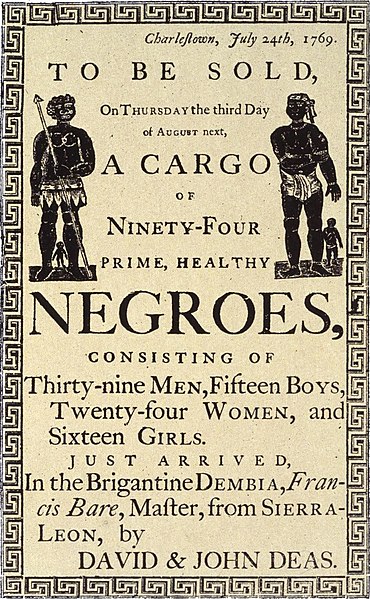
As slaves, African-Americans were a commodity to be bought and sold and once purchased their lives ceased to be their own. They were the property of the slave owner. Slaves had no legal or occupational safety protections, no rights to education, healthcare or religious instruction. They labored six days a week from sun-up to sun-down, with a reprieve on Sundays for rest and worship. They were at the whim and mercy of their owners, who were free to do as they pleased with their property. Disobedience was punished brutally and severely, often at the end of the whip. And if a slave was killed while being “corrected,” the owner was free of any responsibility for their death. Marriages between slaves were not considered legally binding and traditional family ties were not respected. Owners were free to split up families as they liked often with tragic consequences for the slaves involved. Husbands and wives, parents and children were separated, sold elsewhere for profit or some times gifted or transferred for other reasons without any restrictions.
A slave auction advertisement in Charleston, SC
Adding insult to injury, the slave’s subordinate status was given legal standing in the disastrous 1857 Dred Scott decision in which the U.S. Supreme Court ruled that slaves were indeed property and therefore had no rights which the white man was bound to respect. Chief Justice Roger Taney, who delivered the majority opinion, argued that at the time the constitution was adopted, blacks were regarded as “beings of an inferior order and unfit to associate with the white race.” He further added that the words in the Declaration of Independence, “all men were created equal,” were never intended to apply to blacks and that “the negro might justly and lawfully be reduced to slavery for his benefit.”
Even amongst those who believed slavery to be immoral and unjust there was still a strong tendency to view blacks as inferior. For example, President Abraham Lincoln, at least initially, did not believe in racial equality. During the 1858 Lincoln-Douglas debates, Lincoln argued, “I will say then that I am not, nor ever have been, in favor of bringing about in any way the social and political equality of the white and black races,” Lincoln further added that he opposed blacks having the right to vote, to serve on juries, to hold office and to intermarry with whites. Lincoln’s views were consistent with those of the times. However, they would evolve and by the end of the Civil War he was openly speaking of limited black suffrage for the “very intelligent” and those who fought for the Union cause.
The Civil War and Reconstruction
The Union victory in the Civil War brought peace and an end to the four year conflict. It did not lead to a new racial reckoning, atonement for past sins or level the playing field for blacks and whites going forward. For if the North won the Civil War, the South surely won the peace. Over the next ten or so years following the Civil War, embittered former Confederates waged a guerilla style war against Federal Government efforts to grant equal rights to blacks, while seeking to resurrect the plantation economy, perpetuate slavery under another name, and reassert white supremacist rule in the South. Aided and abetted by an openly racist President Andrew Johnson and a U.S. Supreme Court that would undercut major legislative acts and protections for blacks, the end result was not racial equality but segregation, exploitation, oppression and intimidation or what would become known as the “Jim Crow South.”
“This is a country for white men, and by God, as long as I’m President, it shall be a government for white men.”
President Andrew Johnson
To continue exploiting the newly freed African-Americans as a captive source of cheap labor, the Southern states passed restrictive laws called “Black Codes.” These laws required that blacks sign annual labor contracts with plantation, mill, or mine owners to work for pitifully low wages. If they refused and had no other gainful employment, which was impossible because blacks were only allowed to work as laborers or domestics, they would be charged with vagrancy and rented out as laborers to pay off their fines. Apprenticeship laws forced many minors (either orphans or those whose parents were deemed unable to support them by a judge) into unpaid labor for white planters. After ratification of the 14th Amendment, these laws were replaced by another odious form of peonage, sharecropping, which consigned African-Americans in the South to a life of abject poverty for most of the 19th and 20th century. Fewer than 20 percent of sharecroppers ever made a profit and challenging the system could easily result in being lynched.
Unrepentant southerners violently resisted the Federal Government’s efforts to protect and expand the civil rights of former slaves and to extend the franchise to black men, through the 14th and 15th Amendments. They opposed the idea of political and legal equality between the races and regarded black suffrage as a threat to their political power that would lead to “nigger domination.” In all fairness, the 15th Amendment also encountered considerable resistance in the North as well for similar reasons. Nevertheless, groups such as the Ku Klux Klan, the White League, Red Shirts and simple mobs carried out acts of terror and violence to intimidate African-Americans and their white Republican allies and to prevent them from holding political office or exercising their right to vote. Lynchings, with the blessing and involvement of local law enforcement, rose dramatically and would persist as a means of intimidation and control long after the failure of Reconstruction. At the same time, large scale violence such as the 1873 Colfax Louisiana Massacre achieved or overturned what couldn’t be won at the ballot box. By 1880, all Federal troops were withdrawn from the South and the Southern white elite were in control again. The antebellum social, political, and economic order in the South was restored as if the Civil War never happened.
A lynching in Texas
Several important U.S. Supreme Court decisions in the later-half of the 19th century eviscerated the 14th and 15th Amendment protections for African-Americans, opening the door to an extended period of legally sanctioned racial discrimination that would endure for almost a century. In United States v. Cruickshank (1876), United States v. Reese (1876) and United States v. Harris (1883) the court essentially hollowed out the federal government’s ability to prosecute hate crimes committed against African-Americans, allowed state governments to implement poll taxes, literacy tests and other means to disqualify black voters, and gave a greenlight to acts of terror and violence while limiting freedmen’s ability to enforce their rights in federal court, the only forum where they stood a chance of a fair hearing. In Plessy v. Ferguson (1898) the court established its infamous separate but equal standard, ensuring that segregation would increase and endure at least till 1964. These rulings would essentially allow blacks to be segregated lynched, and disenfranchised without anyone ever being brought to justice. African-Americans were once again at the mercy of southern whites and relegated to second class citizens.
“By narrow and ingenious interpretation [the Supreme Court’s] decisions over a period of years had whittled away a great part of the authority presumably given the government for protection of civil rights.”
C. Van Woodward
Life in the Jim Crow South was increasingly bleak and brutish for African-Americans and in many respects was no better if not worse than slavery. Blacks were trapped in a vicious racial hierarchy that denied them the most basic human dignity and freedoms. Deprived of control over the means to earn a living, Southern blacks were still forced to toil for white landowners under a sharecropping system that became a form of debt slavery and offered no economic mobility. Segregation increasingly took hold and Blacks were systematically excluded from everything from schools to residential areas to public parks to theaters to pools to hospitals, asylums, jails and residential homes. Almost every aspect of Southern society was segregated to the disadvantage of blacks and served as a constant reminder of their inferior status. Effectively stripped of their right to vote and denied protection at the Federal level by the U.S. Supreme Court, African-Americans were at the mercy of a legal system stacked against them with former Confederates working as police and judges making it difficult win court cases and gain a fair hearing.
Violence against blacks in the South also increased in frequency and cruelty, uninhibited by the legal system. Lynchings became a public spectacle and the preferred method of southern whites to intimidate blacks and to assert their dominance over political and economic power. Southern whites often showed little mercy. Records include at least one incident where two brothers in Texas were burnt at the stake and one in Georgia in which a pregnant woman was hanged, her belly slashed open and the head of her unborn child crushed under a boot. An estimated two or three blacks were lynched each week in the late 19th and early 20th centuries. In Mississippi alone, 581 blacks were lynched from the late 1800s to 1955. Nationwide, the figure climbed to nearly 5,000. This tragic combination of violent repression, a lack of economic opportunity and no legal recourse ensured blacks would remain impoverished, endangered, and without rights or hope in the South.
A family of Texas sharecroppers, the Arthurs, arrive in Chicago homeless and without money fleeing Paris, Texas after two of their sons were burned alive, at the Lamar County Fairgrounds, on July 6, 1920.
The Great Migration,World War I, and the Red Summer
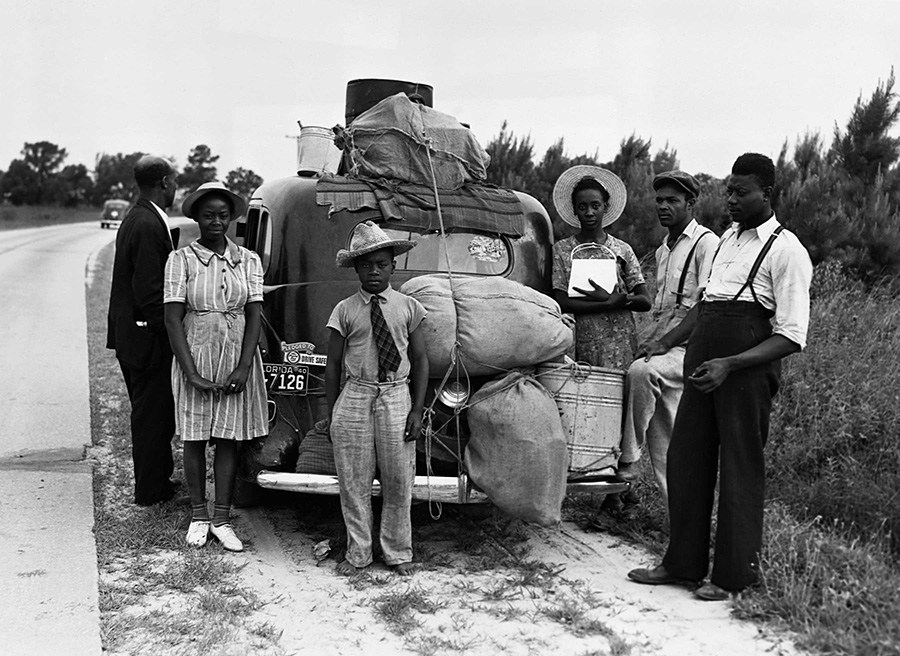
Up until the end of the 19th century, 9 out of every 10 African-Americans lived below the Mason-Dixon Line. As a result, most racism towards blacks was concentrated in the South. That’s not to say that whites in the north were free of prejudice and racist sentiment. In fact, the callous and cowardly attacks on African-Americans during the 1863 New York City draft riots showed otherwise. Nonetheless, things began to change around 1916 as African-Americans began leaving the South en mass, fueled by poor economic conditions, an increasing availability of jobs in the North’s booming manufacturing industry and a desire to escape the pain of Jim Crow. Over one million African-Americans from the South would make the long journey northward by the end of 1919. That number would reach 6 million by the year 1970.
An African-American family leaving Florida for New Jersey
African-Americans would soon find that the North was not the promised land they hoped and in the summer of 1919, racial violence exploded throughout the country, in what would become known as “The Red Summer.” It was some of the worst white on black violence in U.S. history and demonstrated that racism was not simply a regional problem indigenous to the South but a national one. Race riots erupted in Chicago, Arkansas, Washington DC, New York City, Omaha, Charleston, Memphis, Philadelphia, Texas and elsewhere. Hundreds if not thousands of African-American men, women, and children were brutally shot, hanged, and beaten to death by angry white mobs threatened by black advancement and intent on preventing them from asserting their equality. As one black sharecropper remarked, “they just hated to see niggers livin like people.”
The outbreak of violence was the result of competing social forces: Black men were returning from World War I expecting the same rights they had fought and bled for in Europe, and African Americans were moving north to escape the brutal Jim Crow laws of the South. Whites saw blacks as competition for jobs, homes and political power. In Chicago, riots broke out in late July after a 17 year old African-American boy was attacked by a white mob for violating the unofficial segregation of the city’s beachfront. Four days of fighting between black and white mobs in Chicago’s predominantly black south side left 15 whites and 23 Blacks dead, and an additional 1,000 Black families were left homeless after rioters torched their residences. Newspapers reporting the events would claim that blacks were rioting and that anarchists were allegedly operating in the black neighborhoods, but there is not real evidence of any of that. These actions were overwhelmingly by white mobs.
In Elaine, Arkansas, over 200 poor black sharecroppers were killed in a police-led white rampage because they dared to unionize and break free from unscrupulous white landowners who cheated them out of cash and crop. In Washington DC white mobs — many made up of members of the military — rampaged through the city beating any black they could find after false rumors of a white woman being assaulted by black men spread. Black military veterans organized and retaliated The Washington Times newspaper described the situation as such, “Bands of whites and blacks hunted each other like clansmen throughout the night, the blood-feud growing steadily. From nightfall to nearly dawn ambulances bore their steady stream of dead and wounded to hospitals.” These scenes were repeated elsewhere throughout the country in the summer.
Racial tensions and white mob violence continued and did not really begin to wane until 1923. Two of the most heinous acts of racial violence against African-American communities occurred shortly after the Red Summer. In May of 1921, a race riot broke out in Tulsa, Oklahoma after a young black man allegedly assaulted a white woman. Hundreds of white people descended upon the Black neighborhood of Greenwood. Whites killed more than 300 African-Americans. The Tulsa police did nothing to quell the violence and some actively participated in it. It was also reported that white men flew airplanes above Greenwood, dropping kerosene bombs. More than a hundred businesses and other buildings were destroyed, including a school, a hospital, a library, and dozens of churches. More than 1,200 Black-owned houses burned. The economic losses in the Black community were stunning, amounting to more than $1 million. In January 1923, more than 10,000 angry white men from across the state of Florida rampaged through the prosperous black community of Rosewood after a white women claimed she was raped by a black man. The number of deaths from the massacre remains unknown but the town was entirely destroyed by the violence, and the residents never returned.
Covenants and Redlining
The rapid influx of African-Americans in northern cities prompted a white backlash in other less menacing but still disturbing ways. Although there was no official policy of racial segregation in the North, unofficial segregation existed, especially in the housing market, which exacerbated racial tensions. In the major northern cities, African-Americans were often funneled into areas of the cities that were overcrowded ramshackle slums, through the deliberate policies of restrictive covenants and redlining, which prohibited blacks from owning or renting property in certain neighborhoods and discouraged banks from investing in predominantly black areas. These policies inhibited any upward mobility for African-American families, relegating them to a life of urban poverty. Any efforts to escape these confines and relocate to better and more prosperous white suburban neighborhoods met with violent resistance. As Richard Rothstein points out in his book, The Color of Law, white families sent their children to college with their home equities; they were able to take care of their parents in old age. They were able to pass on their wealth to their children. None of these advantages were available to African-Americans who were prohibited from owning homes in the suburbs.
Returning Home from World War II
Approximately 1.2 African-American men again answered their nation’s call to service, putting life and limb at risk in the fields of Europe and the islands of the South Pacific, only to face an even greater danger when they returned home. Black soldiers returning home from the war found the same socioeconomic ills and racist violence that they faced before. Despite their sacrifices overseas, they still struggled to get well-paying jobs, encountered segregation and endured targeted brutality, designed to eliminate any expectation of racial equality.
In February 1946, Isaac Woodard, a Black veteran who served in the Pacific theater, got into a heated argument with a bus driver while traveling from Georgia to South Carolina. Woodard, in his uniform, was ordered off the bus in a town now known as Batesburg-Leesville, S.C., and beaten so terribly with a billy club by the local police chief that he was permanently blinded. John C. Jones, a Black veteran, was lynched in Louisiana after he was accused of looking at a young white woman through a window of her family’s house. Two other Black veterans, Richard Gordon and Alonza Brooks, were murdered in Marshall, Texas, after a labor dispute with their employers. The violence became so pervasive and brutal that civil rights activists lobbied President Truman for a federal anti-lynching law, but Southern Democrats shut down Truman’s efforts.
African-Americans Veterans also struggled to benefit from the G.I. Bill, upon their return. Many black veterans were denied access to a college education and were largely relegated to vocational programs. By comparison, 28 percent of white veterans went to college on the G.I. Bill, compared with 12 percent of Blacks. Of that number, upward of 90 percent of Black veterans attended historically Black colleges and universities — institutions mainly in the South that were already underfunded with limited resources. During the summer of 1947, Ebony magazine surveyed 13 cities in Mississippi and discovered that of the 3,229 V.A. home loans given to veterans, two went to African-Americans.
Civil Rightsand the Death of Jim Crow
In the late 1940s, cracks began to appear in the legal foundation of Jim Crow segregation. In 1948, President Truman issued an executive order to begin the integration of the United States’ armed forces, a process that would be accelerated by the Korean War. Earlier that year, Truman, a native Missourian, delivered a civil rights speech before a joint session of Congress. He called on Congress to adopt a civil rights package that included federal protection against lynching, better protection of the right to vote, and a permanent Fair Employment Practices Commission, despite strong opposition from he southern wing of the Democratic Party. The Supreme Court, which was complicit in the enactment of the Jim Crow system with its earlier rulings, also began to re-examine it’s separate but equal doctrine that served as the foundation of legal segregation. On May 17, 1954, the Supreme Court turned the country upside down with its ruling in the landmark case of Brown v. Board of Education of Topeka. In a unanimous opinion, Chief Justice Earl Warren wrote, “in the field of public education the doctrine of ‘separate but equal’ has no place,” as segregated schools are “inherently unequal.” As a result, the Court ruled that the plaintiffs were being “deprived of the equal protection of the laws guaranteed by the 14th Amendment.” The ruling drove a stake through the heart of Jim Crow but it would take a decade long struggle for civil rights to bring about its demise.
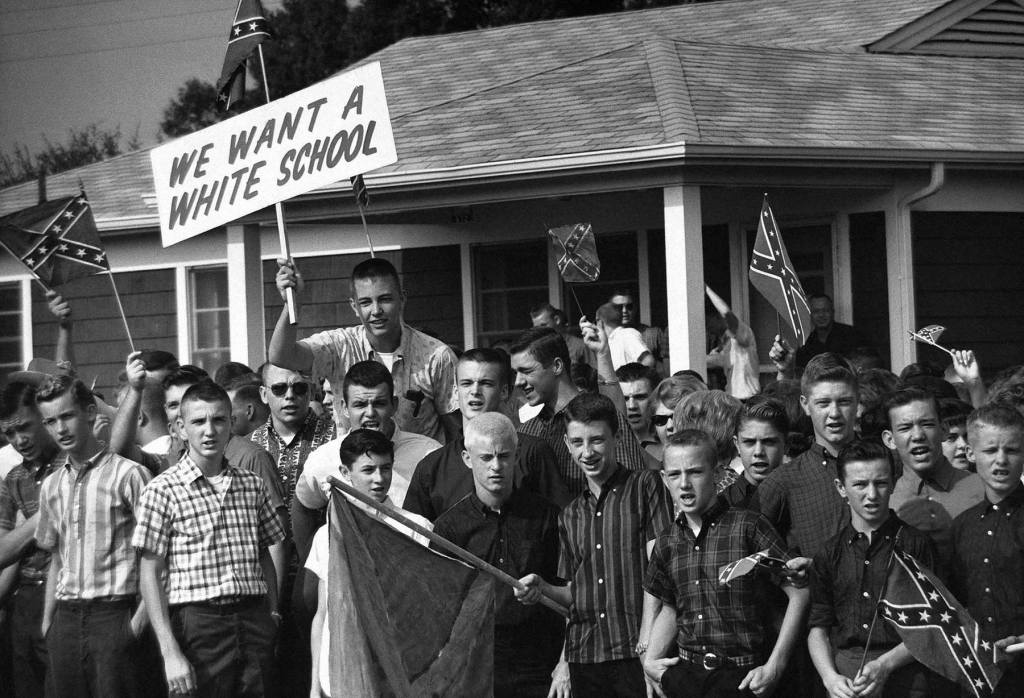
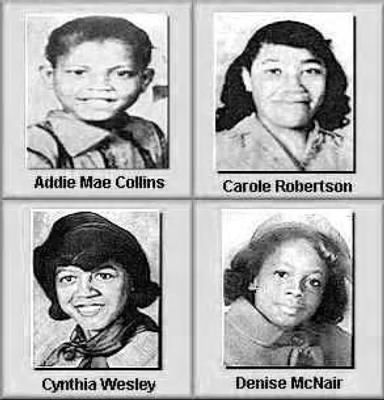
The Supreme Court’s ruling outraged segregationists through out the South while energizing civil rights activists. Over the course of the next ten years, African-Americans waged a campaign of non-violent civil disobedience to end institutionalized discrimination, disenfranchisement, and segregation but were repeatedly beaten, bombed, shot, imprisoned, humiliated and degraded by a southern power structure determined to resist their efforts at all costs. Fourteen year-old Emmett Till would pay with his life for no reason other than allegedly whistling at a white woman. In Greensboro North Carolina, four young African-American men staged a sit-in at an all white lunch counter, enduring heckling and harassment from white patrons, sparking similar actions across the city and rest of the South. Freedom Riders protesting against segregated interstate travel were beaten and shot at by the Ku Klux Klan in Alabama. Four young African-American girls lost their lives in the despicable 16th Street Baptist Church bombing in Birmingham Alabama. James Meredith’s desire to attend the University of Mississippi touched off a brutal battle on the streets of Oxford between Federal Marshals and segregationists. Six hundred protestors were beaten by the police on the Edmund Pettus bridge in Selma Alabama for simply demanding their constitutional right to vote. These are just some of the individual and collective acts of bravery and the suffering that helped lead to the 1964 Civil Rights Act and the 1965 Voting Rights Act that closed the curtain on the Jim Crow era.
Clockwise: White youths protesting protesting the Brown ruling; Protestors at a Greensboro sit-in being heckled and harassed by whites; Freedom Riders in 1961 protesting segregation of interstate travel were savagely beaten and bombed by the Klu Klux Klan in Alabama; the four young black girls murdered in the 16th Street Baptist Church bombing in Birmingham, Alabama; Demonstrators in Selma Alabama are beaten by the Alabama State Police for demanding to exercise their right to vote.
All Lives Don’t Matter!
There is probably no other idea or concept more central to the American identity or ethos than the notion of equality. It’s at the forefront of the Declaration of Independence and it is the foundation of the American dream, the idea that we all have equal access and opportunity to better ourselves. It is also a key feature of our legal system, the idea we are all equal under the law. Yet when we peel away the onion, that is our history and when we are honest with ourselves, can we really say that there is racial equality in modern American society. We would all like to believe that 13th Amendment outlawing slavery leveled the playing field for blacks and whites while the 1964 Civil Rights Act and the 1965 Voting Rights Act purged racial discrimination from our society but that is not the truth. We still want to see ourselves as that “ the city upon a hill” that John Winthrop wrote about in the 17th century but we continued to fall short of our aspirations.
Today, in America we are at another historical crossroads regarding race. We have another opportunity to confront our past, warts and all, to make amends, and to lay the foundation for a new racial reckoning, a third Reconstruction if you like. When we defiantly say, “All lives matter,” we refuse to acknowledge that past. When we say “All lives matter,” we deny and delegitimize all the pain, suffering and indignity that African-Americans have endured for the past 400 years. When we say, “All lives matter,” we are saying aren’t listening and African-American concerns are not valid. At a time when racial tensions are being deliberately inflamed maybe we should stop talking and start putting some meaning behind that empty phrase.











 Tragedy and Farce