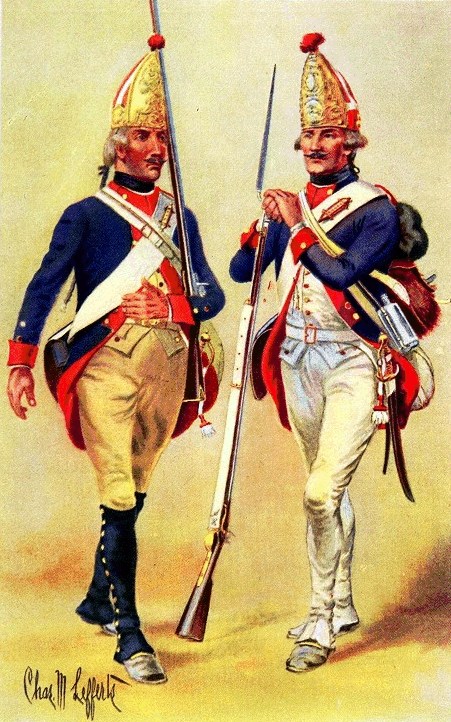
In the cold night air of December 25, 1776, General George Washington and his rag tag Continental Army crossed the icy Delaware River and surprised 1500 of King George’s Hessian mercenaries at Trenton, scoring a much needed victory after a string of disastrous defeats earlier in the year.
By the end of 1776, the Continental Army was in bad straits. The year began with great promise. In March, the Continentals drove the British out of Boston and on July 4, the thirteen colonies declared their independence. However, a series of disastrous defeats in and around New York City forced Washington to flee the city and retreat all across New Jersey to Pennsylvania, putting the whole revolution in doubt. Moreover, the enlistments of many of the Continental soldiers were set to expire at the end of the year. Washington needed a bold move to keep his Amy together and restore faith and confidence in the revolutionary enterprise.
After much contemplation and consideration of alternatives, Washington decided he would cross the Delaware River and carry out a surprise attack on the Hessian garrison at Trenton while they were celebrating Christmas. Washington’s plan required the crossing to begin as soon as it was dark enough to hide his army’s movements on the river. However, most of the troops did not reach the crossing point until about 6 pm, about ninety minutes after sunset, putting the operation behind schedule. Moreover, the weather was growing progressively worse, turning from drizzle to rain to sleet and snow.
Washington with the Virginians crossing the Delaware
Washington was among the first of the troops to cross, going with Virginia troops. During the crossing, several men fell overboard but no one died. By 3 am all of his forces and artillery—2400 men in all— were across the river in New Jersey. Around 4 am Washington’s Army began their March toward Trenton. Many of the troops did not have boots and wore rags around their feet in the snow but Washington rode up and down the column urging his men to persevere.
Behind schedule because of the storm, the Americans arrived on the outskirts of Trenton around daybreak on the 26th. Washington split his force into two columns. One, commanded by Nathaniel Greene attacked from the north, while a second under John Sullivan advanced from the west to cut the line of retreat. The Hessians were completely surprised. They attempted to rally but their commander Colonel Johan Rall was fatally wounded and they quickly surrendered. Hessian casualties included 22 killed, 92 wounded, 918 captured. Four hundred would manage to escape. The Americans suffered two frozen to death and five wounded.
Hessian mercenaries
Washington had won a much needed victory. The army that the British thought was all but defeated had destroyed a major garrison with very light casualties, capturing critical supplies in the process. Recognizing he could not hold Trenton, Washington slipped back across the river to Pennsylvania. However, over the next ten days Washington would cross and recross the Delaware again fighting a delaying action at the Battle of the Assunpink and winning another stunning victory at the Battle of Princeton before settling down for winter at Morristown.
On December 13, 1862, the Army of the Potomac under Major General Ambrose Burnside conducted a direct frontal assault on entrenched Confederate positions in the Virginian town of Fredericksburg in what would become one of the most lopsided defeats in the civil war.
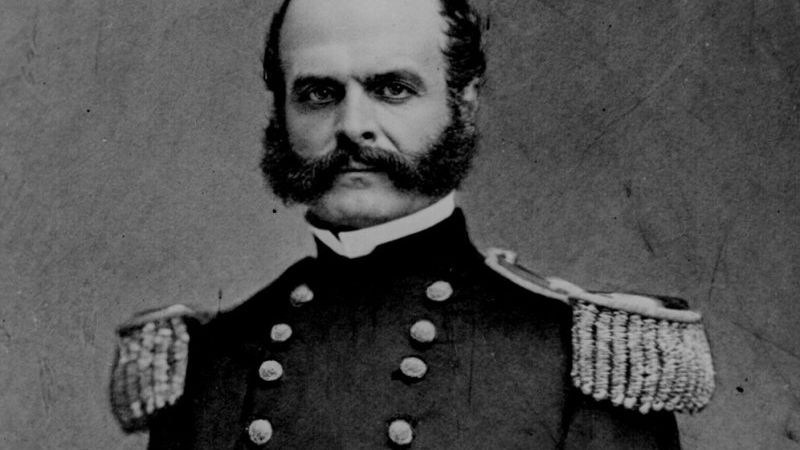
Early November of 1862 was a dark time in Washington. Almost two months since the Army of the Potomac turned back the Confederate invasion of the North at the battle of Antietam, President Lincoln remained haunted by the missed opportunity to destroy the rebel army in one decisive battle. Lincoln put his trust in army commander Major General George B. McClellan twice, only to be disappointed by the general’s excessive caution and annoyed by his repeated insolence. On November 7, Lincoln relieved McClellan of his command once and for all turning to Major General Ambrose Burnside as his successor. Burnside clearly was not McClellan’s equal in terms military skill and even he himself thought he was ill-suited for the job. Nonetheless, his greatest selling point was that he was generally well liked by most of his peers, something that could not be said about the rest of the Union general officer corps. Lincoln now had himself a new army commander, one who was more cooperative and congenial if not less capable.
Lincoln urged Burnside to carry out a late fall offensive against the rebels before winter set in, hoping to prevent the Northern public from losing confidence in his administration and the war effort. Stuck behind the Rappahannock river, Burnside intended to conduct a pontoon crossing of the river and rapidly move towards Richmond before the Confederates could get between him and the rebel capital.
Major General Ambrose Burnside
Burnside began moving his forces toward the river on 15 November but his plans began to go awry almost immediately. The pontoons he hoped to use to affect the crossing were delayed and did not arrive for almost another month. Confederate commander General Robert E. Lee expected that Burnside would beat him across the Raphanock and was prepared to engage the Union army further South. However, when it became clear that Burnside was delayed he directed his army to Fredericksburg. Lee moved Major General James Longstreet’s corps toward Fredericksburg from Culpeper while Major General Thomas J. “Stonewall” Jackson’s men followed from the Shenandoah Valley.
The pontoons that Burnside was expecting had finally arrived and the Union army made preparations to cross the river on 11 December. Burnside originally planned to cross the river at a location south of town but intelligence reporting convinced him that the rebels had anticipate his move and were gathering forces in the area to oppose the crossing. Instead, Burnside decided to cross the river immediately in town where only a Mississippi regiment was thought to be occupying Fredericksburg
Union engineers began to assemble the pontoon bridges shortly before dawn on 11 December. The engineers immediately came under fire from Mississippi and Florida sharpshooters hiding in the town buildings along the river. In response, Union artillery pounded the city. When the bombardment failed to drive the Confederates back, Burnside sent the 7th Michigan and 19th Massachusetts Infantry regiments across the river in pontoon boats to secure a small bridgehead and rout the sharpshooters. Union forces advanced up the narrow streets and alleys of Fredericksburg but continued to take casualties from well hidden Confederate sharpshooters. Darkness and the arrival of fresh Union troops compelled the Confederates to withdraw to the heights West of town, but they had bought the Army of Northern Virginia precious time to prepare for the main Union assault that was soon to come.
Union forces clearing the rebel sharpshooters from Caroline street
Burnside spent the next day moving the remainder of his army across the river. He issued attack orders early on the morning of December 13. His plan was simple. The Union left, under Major General William Franklin would strike Stonewall Jackson’s corps just south of town. On the Union right, the Major General Edwin Sumner’s II Corps would cross almost a thousand yards of open fields and attack General Longstreet’s corps which was deployed on a series of five hills west of town known as Mayre’s Heights. There they hunkered down behind a stonewall and a sunken road posing an even more formidable challenge for Sumner’s men.
The Slaughter Pens
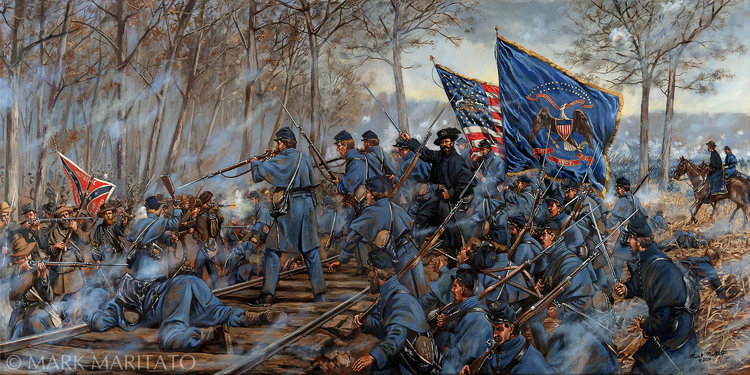
In the morning fog on December 13, Franklin ordered a single corps, Maj. Gen. Joseph Reynolds’ 1st Corps, to move into place south of the city along the railroad. After adjusting his lines, Reynolds had the Confederate line heavily shelled for an hour, though with little effect or response from Jackson, who had ordered his gunners to hold their fire until the Federal infantry advanced. As the Union soldiers approached Jackson’s line for a more direct attack, the Confederates responded, pushing them back. An artillery duel ensued, with Union guns now landing hits on their targets. In the early afternoon, Reynolds ordered his two remaining infantry divisions to approach the Confederate line, where they found a hole in the line left by Jackson, who wrongly assumed the terrain—swampy woodland—was impassable. Finding the advantage in attacking the Confederates, Union major general George Meade began to roll up the Confederate lines. Jackson ordered his reserves to counterattack, while Meade sent word to Brig. Gen. David Birney for reinforcements that would never come; Birney refused to coordinate efforts with Meade. Left unsupported and facing an overwhelming onslaught, Meade retreated, with the Confederates pushing their advantage. The area of intense fighting would become known as the Slaughter Pens. By late afternoon, Jackson had readjusted his lines and tried to goad the Union into attacking, but Meade refused to respond. With darkness approaching, the battle south of Fredericksburg came to an end.
The battle to the north, with Longstreet on Marye’s Heights and Sumner emerging from the city streets, was even less successful for the Union. Sumner’s men had to cross about half a mile of open ground that included a mill race (a trench five feet deep, 15 feet wide, and filled with three feet of water) before approaching a stone wall, behind which Longstreet had his men entrenched, with artillery on the heights behind them. As the fog lifted and artillery booms from the battle downriver were heard, Sumner began ordering wave after wave of divisions to advance toward Marye’s Heights. Throughout the day, the Union divisions advanced and were cut down by Confederate artillery and gunfire. Late in the day, the 9th Corps of Maj. Gen. Joseph “Fighting Joe” Hooker’s Grand Division attempted to flank the sunken road but only succeeded in adding more blue-clad casualties to the heaps that lay in the fields.
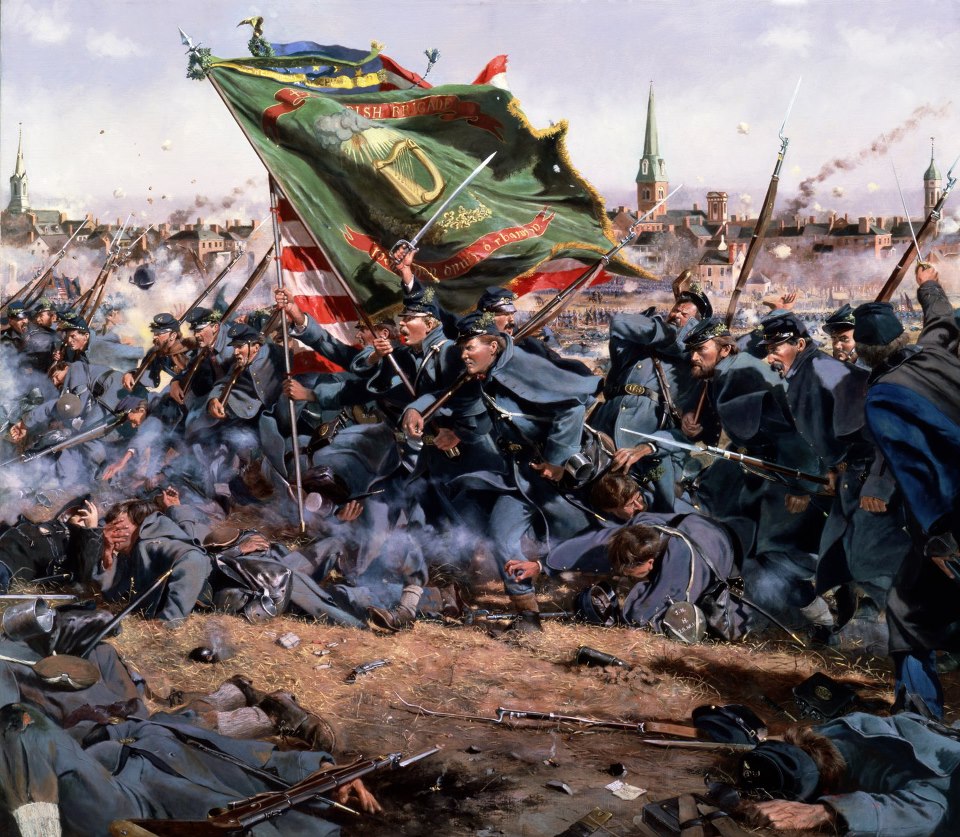
The Irish Brigade coming under heavy fire attacking Mayre’s Heights
That night, a Confederate soldier from South Carolina, Richard Kirkland, risked his life to take water and warm clothing over the stone wall to the wounded and dying of the enemy; the “Angel of Marye’s Heights” is an enduring symbol of humanitarianism. Kirkland would be killed at the Battle of Chickamauga the following autumn.
Burnside intended to renew the frontal assaults the next morning, but the commanders of his three grand divisions convinced him not to. The following two days were filled with the misery and suffering of the wounded between the two lines. The night of December 15, Burnside retreated to winter camp in Stafford County.
The battle was an undeniable disaster for the Union army and only served fo further depress Union morale heading into the winter. Union casualties at Fredericksburg almost reached 13,000 troops. Confederate losses were less than 5500.




 Tragedy and Farce