
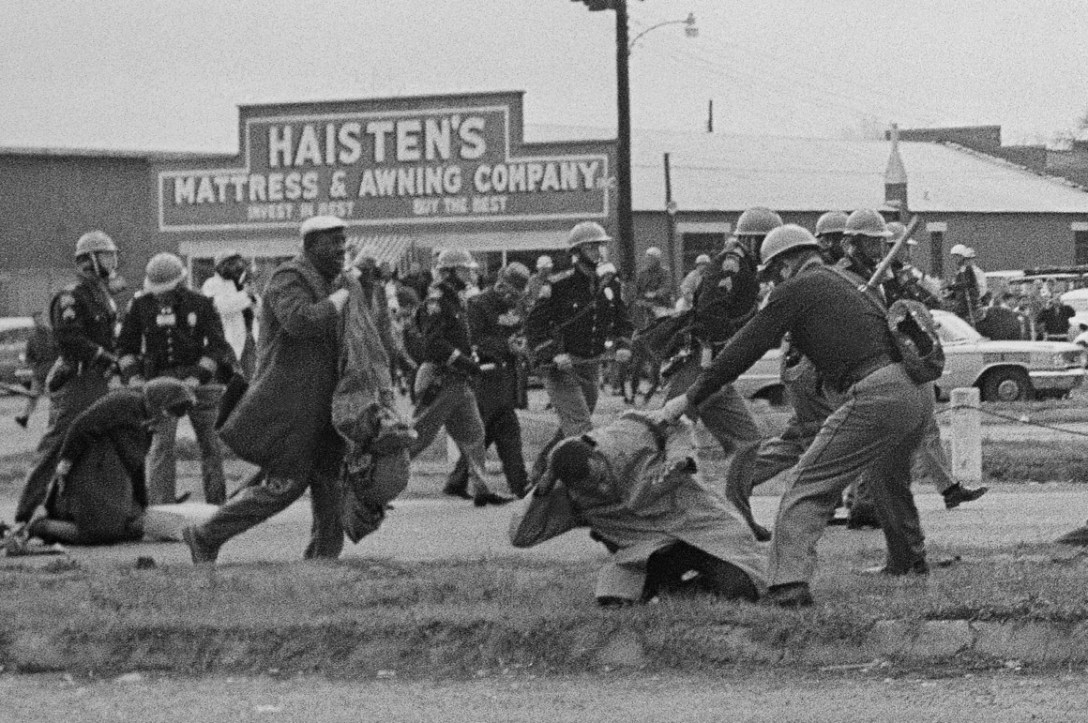
On 7 March 1965, a day that would become forever known as “Bloody Sunday”, Alabama State Police savagely beat 600 civil rights demonstrators who were marching from Selma to Montgomery, Alabama to protest the murder of Jimmy Lee Jackson, a young African-American civil rights activist, by the police two weeks earlier and the disenfranchisement of African-American voters. The sheer brutality of the violence and the broadcast of these images on television network news would galvanize a collective national outrage and mobilize Congress to pass the landmark 1965 Voting Rights Act, which prevented states and local municipalities from enacting discriminatory practices to disenfranchise African-American voters.
Since the end of Reconstruction in 1876, states of the former Confederacy instituted numerous legal barriers and obstacles to prevent African-Americans from exercising their constitutional right to vote and preserve white supremacist rule. The 15th Amendment to the Constitution, ratified in 1870, prohibited states from denying a male citizen the right to vote based on “race, color or previous condition of servitude? Nevertheless, poll taxes, literacy tests, subjective application of the law and outright violence and coercion, among other means, were all used to prevent African-Americans from registering to vote and exercising that right.
In early 1965, a broad array of civil rights groups decided to turn their attention towards ending these injustices and Alabama, under the rule of the firebrand segregationist Governor, George C. Wallace, became ground zero for these efforts. The Student Non-Violent Coordinating Committee (SNCC) began a voter registration drive in the town of Selma where the majority African-American population had consistently been denied their right to vote. When SNCC’s efforts were repeatedly hamstrung by law enforcement officials and the courts, they persuaded Dr. Martin Luther King, Jr. and his Southern Christian Leadership Conference (SCLC) to make Selma’s intransigence to black voting a national concern. King chose to bring SCLC to the region because he was aware of the brutality of local law enforcement officials, led by the sheriff of Dallas County, Jim Clark, a rabid and merciless white supremacist. King thought that unprovoked and overwhelming violence by whites against nonviolent blacks would capture the attention of the nation and pressure Congress and President Lyndon Johnson to pass voting rights legislation.
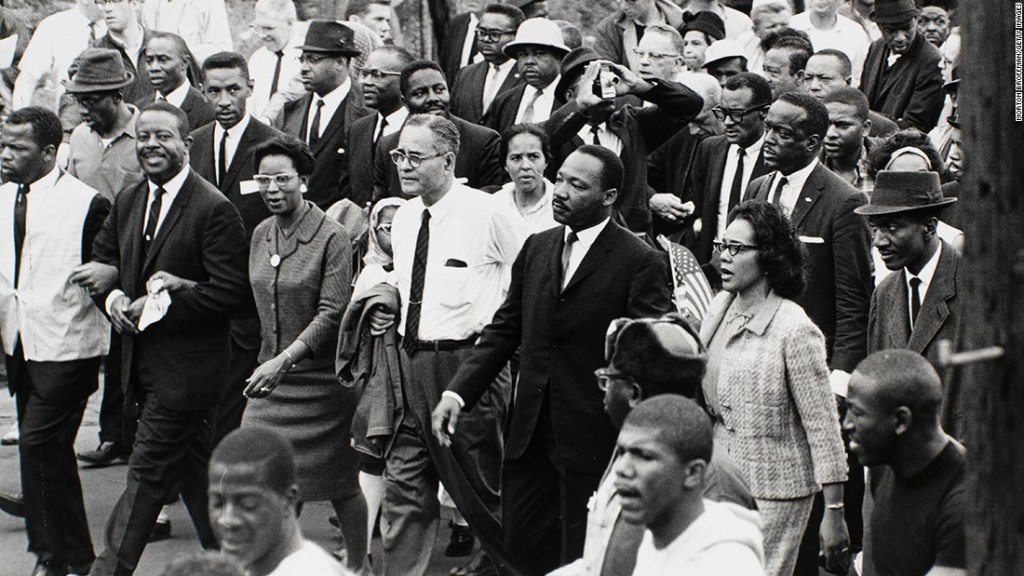
During January and February 1965, King and SCLC led a series of peaceful demonstrations to the Dallas County Courthouse, in which African-Americans attempted to register to vote but were forcefully turned away or arrested by Clarke and his police. The Dallas County courthouse designated two days a month for voter registration, but the SCLC’s plan pushed people to register every day beginning in the middle of January 1965. The first day’s protest ended without arrests, but on the second day, the police detained 66 individuals. Each day following, black men and women waited in line at the courthouse in Selma, and each day more were arrested. By the first week of February, the number of jailed protestors in Selma had swelled to 3,300, including King, who wrote to the New York Times, “This is Selma, Alabama. There are more Negroes in jail with me than there are on the voting rolls.”

On 18 February, the situation in Dallas County became deadly. In the neighboring town of Marion, police violently broke up a peaceful nighttime vigil for an imprisoned SCLS leader. Moments into gathering the street lights went dark and state troopers descended on the demonstrators while local whites attacked the press covering the event. In the melee, 26-year-old Army veteran Jimmie Lee Jackson ran to a local eatery with his mother and grandfather. Jackson was shot and killed attempting to protect his mother and 82-year old grandfather from being beaten.
In the wake of Jackson’s murder, SCLC leaders called for a 54-mile march to the state capital in Montgomery to demand equal treatment under the law and to bring attention to the continued violations of their voting rights by marching to the capital. They hoped to refocus the anger and pain of the people of Marion and Selma toward a nonviolent goal, as many were so outraged they wanted to retaliate with violence.

Governor Wallace was not one to be cowed. He denounced the march as a threat to public safety and defiantly declared that he would take all measures necessary to prevent it from happening. “There will be no march between Selma and Montgomery,” Wallace boasted on March 6, 1965, citing concern over traffic violations. He then ordered Alabama Highway Patrol Chief Col. Al Lingo to “use whatever measures are necessary to prevent a march”
On Sunday March 7, 600 marchers gathered in Selma to begin their march to the capital led by Hosea Williams of the SCLC and 25 year old John Lewis of the SNCC. The demonstrators made their way through downtown Selma largely undisturbed but as they crested the Edmund Pettus Bridge, named after a Confederate general and reputed grand dragon of the Alabama Ku Klux Klan, the picture of what awaited them came into view. A wall of Alabama state troopers, wearing white helmets and armed with billy clubs was stretched across Route 80 at the base of the bridge blocking their way forward. Behind them were deputies of county sheriff Jim Clark, some on horseback, and dozens of white spectators waving Confederate flags and giddily anticipating a showdown. Knowing a confrontation awaited, the marchers pressed on in a thin column down the bridge’s sidewalk until they stopped about 50 feet away from the authorities.
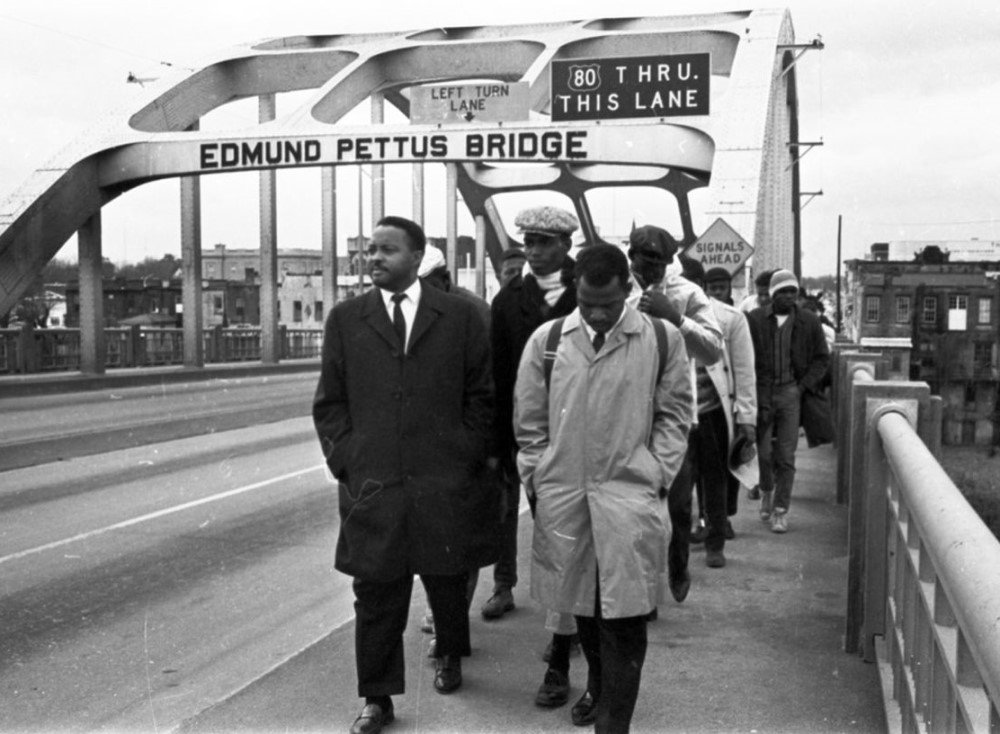
Commanding officer Major John Cloud told the demonstrators to disband at once and go home. Rev. Hosea Williams tried to speak to the officer, but Cloud curtly informed him there was nothing to discuss. “It would be detrimental to your safety to continue this march,” Major John Cloud called out from his bullhorn. “This is an unlawful assembly. You have to disperse, you are ordered to disperse.”
Williams and Lewis stood their ground at the front of the line undaunted. After a few moments, the troopers, with gas masks affixed to their faces and billy clubs at the ready, descended upon the marchers They pushed back Lewis and Williams. Then the troopers paced quickened. They knocked the marchers to the ground. They struck them with sticks. Clouds of tear gas mixed with the screams of terrified marchers and the cheers of reveling bystanders. Deputies on horseback charged ahead and chased the gasping men, women and children back over the bridge as they swung clubs, whips and rubber tubing wrapped in barbed wire. Although forced back, the protestors did not fight back.


Television coverage of “Bloody Sunday,” as the event became known, triggered national outrage. That evening King and other SCLC leaders began planning for a second march on Tuesday March 9. They issued a call for clergy and citizens from across the country to join them in Selma. issued a call for all civil rights activist and religious leaders to come to Selma for a second march he planned to lead on Tuesday March 9. Civil rights leaders demanded federal protection and sought a court order to prevent the police from interfering. John Lewis, who was severely beaten and suffered a skull fracture said: “I don’t see how President Johnson can send troops to Vietnam—I don’t see how he can send troops to the Congo—I don’t see how he can send troops to Africa and can’t send troops to Selma”
While King and Selma activists made plans to march again two days later, Federal District Court Judge Frank M. Johnson issued a restraining order prohibiting the march until at least 11 March, and President Johnson pressured King to call off the march until a federal court order could provide protection to the marchers. King now faced the difficult decision of whether to comply with the court order or to satisfy the demands of the movement’s supporters who wanted to march across the bridge again to show they would not be cowed or intimidated.
King proceeded to the Edmund Pettus Bridge on the afternoon of 9 March. He led more than 2,000 marchers, including hundreds of clergy who had answered King’s call on short notice, to the site of Sunday’s attack, then stopped and asked them to kneel and pray. After prayers they rose and turned the march back to Selma, avoiding another confrontation with state troopers and skirting the issue of whether to obey Judge Johnson’s court order. Many marchers were critical of King’s unexpected decision not to push on to Montgomery, but the restraint gained support from President Johnson, who issued a public statement: “Americans everywhere join in deploring the brutality with which a number of Negro citizens of Alabama were treated when they sought to dramatize their deep and sincere interest in attaining the precious right to vote” Johnson promised to introduce a voting rights bill to Congress within a few days.
That evening, several local whites attacked James Reeb, a white Unitarian minister who had come from Massachusetts to join the protest. His death two days later contributed to the rising national concern over the situation in Alabama. Johnson personally telephoned his condolences to Reeb’s widow and met with Governor Wallace, pressuring him to protect marchers and support universal suffrage.
A little over a week later on March 17, Judge Johnson , issued a ruling in favor of the demonstrators. “The law is clear,” the judge wrote, “that the right to petition one’s government for the redress of grievances may be exercised in large groups … and these rights may be exercised by marching, even along public highways.” On Sunday, March 21, about 3,200 marchers set out for Montgomery with the protection of federalized National Guard troops, walking 12 miles a day and sleeping in fields. By the time they reached the capital on Thursday, March 25, they were 25,000-strong. Less than five months after the last of the three marches, President Lyndon Johnson signed the Voting Rights Act of 1965–the best possible redress of grievances.
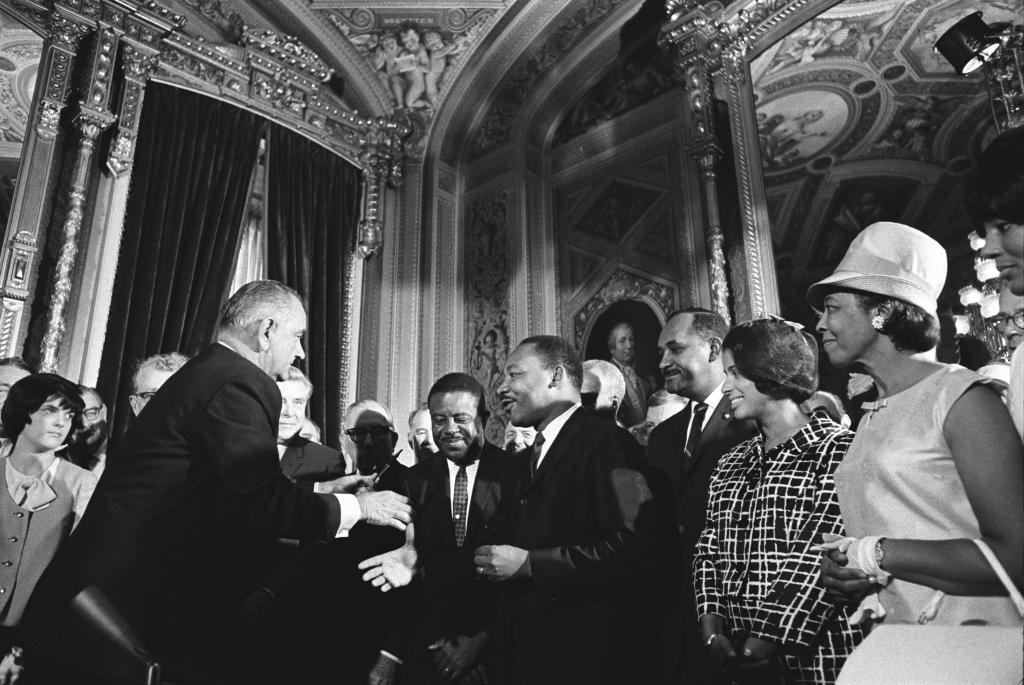
The 1965 Voting Rights Act was one of the most important pieces of US legislation in the modern era, shifting the power to register voters from state and local officials to the federal government. The act reaffirmed the principles laid out in the 15th Amendment that no person should be denied the right to vote on the basis race, color, or previous conditions of servitude. It also prohibited the use of poll taxes, literacy tests and other subjective application of the law to disqualify people from voting. The law also required certain jurisdictions with a history of voting discrimination to pre-clear any changes to voting practices and procedures with either the U.S. Attorney General or the District Court for Washington, DC. The impact of the law was immediate. By the end of 1965, a quarter of a million new black voters had been registered. By the end of 1966, only 4 out of the 13 southern states had fewer than 50 percent of African Americans registered to vote.
Today voting rights are under siege again. Much like the U.S. Supreme Court of the 1870s that eviscerated the 14th and 15th Amendment protections for African-Americans, with their disastrous rulings in United States v. Cruickshank (1876), United States v. Reese (1876) and United States v. Harris (1883), the current conservative Supreme Court is doing the same again. It has struck do key provisions of the Voting Rights Act of 1965 that were previously ruled constitutional and threatens to further weaken these protections. Call your representative in Congress and tell them to support H.R. 1.


 Tragedy and Farce