On April 26, 1986, the Number Four reactor of the Soviet nuclear power plant at Chernobyl, Ukraine, suffered a catastrophic explosion during a routine maintenance check, exposing the nuclear core and releasing 50 tons of radioactive material into the atmosphere in what would become the worst nuclear accident in history. The accident was largely the result of a faulty reactor design and bureaucratic incompetence.
Soviet authorities tried to conceal that something catastrophic had occurred as emergency crews tried desperately to contain the fires and radiation leaks. Helicopters dumped tons of sand and boron on the reactor to try and squelch the fires and prevent further radioactive emissions to no avail. After telling residents nothing about the disaster for some 36 hours, Soviet officials finally begin evacuating roughly 115,000 people from nearby towns and villages. Residents were informed it would be temporary and they were told nothing more than they should pack only vital documents and belongings, plus some food. The Kremlin continued to try and hide the extent of the problem but on April 28, Swedish monitoring stations reported abnormally high levels of wind-transported radioactivity in the atmosphere and pressed Moscow for an explanation. The Soviet Union finally acknowledged the extent of the accident had occurred.
The consequences of the Chernobyl accident would be far reaching but perhaps none as important as the political fall out from the Soviet authorities attempt to hide and cover up the accident from their own people. The Chernobyl accident and the attempted cover-up would prove to be a wake up call for Soviet society. It would accelerate a loss of faith and trust in the country’s leaders and the entire Soviet system, which had been building for decades. Chernobyl would prove to be a catalyst for Gorbachev’s Glasnost and Perestroika reforms leading to a new level of debate and grass roots activism never seen before in the USSR. Gorbachev once described the disaster as a “turning point” for the USSR, one that “opened the possibility of much greater freedom of expression, to the point that the system as we knew it could no longer continue”. Pro-independence movements would emerge from Chernobyl protests in the Ukrainian and Belorussian Soviet Socialist Republics, with the ineffectiveness of the Soviet system a key factor. These protests would ultimately lead to the collapse of the USSR five years later.
On the misty Spring morning of April 19, 1775, a band of rebellious New England colonists gathered in the small village of Lexington 12 miles outside of Boston to challenge a column of 400 British soldiers secretly dispatched to confiscate a large cache of gun powder and muskets rumored to be stored in the villages of Lexington and Concord. Unbeknownst to the Redcoats, the colonists had been warned of their approach the night before by Paul Revere, William Dawes and Samuel Prescott.
As the British neared Lexington, they were confronted by 80 militiamen under Captain John Parker, a French and Indian War veteran gathered on the village common to prevent their advance toward Concord. What happened next was sheer confusion. Neither side was really spoiling for a fight. Parker knew he was outnumbered and his poorly trained militia were no match for British regulars. He had hoped that this small demonstration of resistance would compel the British to return to Boston. The British commander equally preferred to avoid all the troubles that would come with a bloody confrontation with the colonials.
When the vanguard of the British force advanced toward them across the town green, they ordered the militia to lay down their arms and disperse. Parker immediately orders his company to fall out but to keep their muskets.Both commanders also ordered their men not to fire their weapons. Nevertheless, in what Ralph Waldo Emerson would call “the shot heard around the world” a musket shot rang out—and its still not clear who fired it—prompting the Redcoats to fire a deadly volley into the ranks of the retreating rebels leaving eight dead.
After this unintended altercation the British Redcoats reformed and resumed their advance. Around 8:00 am the British arrived in Concord and occupied the town. They found very little in the town after searching exhaustively. The armaments which were previously stored in Concord were relocated. As the British awaited the arrival of expected reinforcements, an American force of about 400 militiamen assembled and began moving toward the village. During the advance, a brief firefight at the Old North Bridge resulted in two American deaths. When reinforcements did not arrive as expected, the British decided to evacuate Concord, and make their way back toward Boston. On the return march back to Boston, the British were harassed and ambushed by sniping militiamen, firing from behind trees and fences resulting in casualties of 73 killed, 174 wounded and 23 missing soldiers. American losses were 49 killed, 39 wounded and five missing. While not a major victory in military terms, the overall success of the events on April 19, 1775 embarrassed the British army and provided a significant morale boost for Americans as the American Revolution had begun.
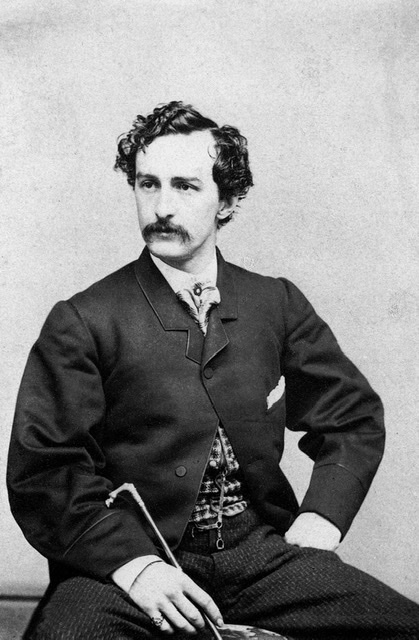
On April 14, 1865, President Abraham Lincoln was assassinated by John Wilkes Booth at Ford’s Theater in Washington DC while attending the play, “Our American Cousin.” Booth, a popular actor at the theater and southern sympathizer, had free access to all areas of the theater. Around 10 pm, He quietly slipped into the box where Lincoln and his wife were sitting and fired his single shot Derringer pistol into the back of the head of the President at point blank range with deadly effect. Booth quickly leaped from the box onto the stage, where he shouted “Sic semper tyrannis,” (Thus always to Tyrants) before bowing and fleeing into the night. Lincoln’s body was brought to a house across the street from the theater, where he would succumb to his wound around 7:30 am the following day. Lincoln’s assassination would forever alter the course of history, thrusting the woefully inept Vice President Andrew Johnson into the presidency. Johnson would prove ill-tempered and ill-suited for the challenge of putting the country back together after four years of civil war.
Portrait of an Assassin
Booth was born into a well known family of Maryland thespians in 1838. His father, Junius Brutus Booth, was a widely regarded British Shakespearean actor who immigrated to the United States with his mistress, Booth’s mother, in 1821 and is considered by many, the greatest tragic actor in the first half of the 19th century. His older brother Edwin followed in his father’s footsteps and was judged by many to be the greatest American Shakespearean actor of the 19th century. Thus it was not surprising that John Wilkes Booth would be drawn to the theater. He made his stage debut at the age of 17 in a production of Richard III by Baltimore’s Charles Street Theater. Although his initial performance was underwhelming he soon joined a Shakespeare production company in Richmond, Virginia where he earned rave reviews for his acting talents. Some critics called Booth “the handsomest man in America” and a “natural genius.”
Nevertheless, like many Maryland families, the Booths were politically divided. Junius and Edwin were staunch Unionist while the younger Booth harbored strong southern sympathies. He supported the institution of slavery and despised abolitionists. After the 1860 election and the beginning of the Civil War he would develop an intense hatred for Lincoln. There has been much speculation that John Wilkes Booth’s embrace of the southern cause was part of a larger sibling rivalry with his older brother Edwin and to step outside the shadow of his famous father. In 1860, Booth joined a national touring company performing in all the major cities north and south, where he soon began to equal if not surpass his more famous brother in terms of popularity and acclaim. One Philadelphia drama critic remarked, “Without having [his brother] Edwin’s culture and grace, Mr. Booth has far more action, more life, and, we are inclined to think, more natural genius.” He was also becoming quite a wealthy actor, earning $20,000 a year (equivalent to about $569,000).
With the outbreak of the Civil War in April 1861, Booth found it increasingly more difficult to conceal his Southern sympathies or his hatred for Lincoln. Booth, like most southerners abhorred Lincoln. He saw him as a “sectional candidate” of the North and a tool of the abolitionists to crush slavery. Lincoln’s suspension of habeas corpus and the imposition of martial law in Maryland in May 1861, outraged Booth. He saw these actions as evidence of Lincoln’s treacherous and duplicitous nature and his intent to overturn the republic and make himself king. Booth increasingly quarreled with his brother Edwin, who declined to make stage appearances in the South and refused to listen to his brother’s fiercely partisan denunciations of the North and Lincoln. In early 1863, Booth was arrested in St. Louis while on a theatre tour, when he was heard saying that he “wished the President and the whole damned government would go to hell.” He was charged with making “treasonous” remarks against the government, but was released when he took an oath of allegiance to the Union and paid a substantial fine.
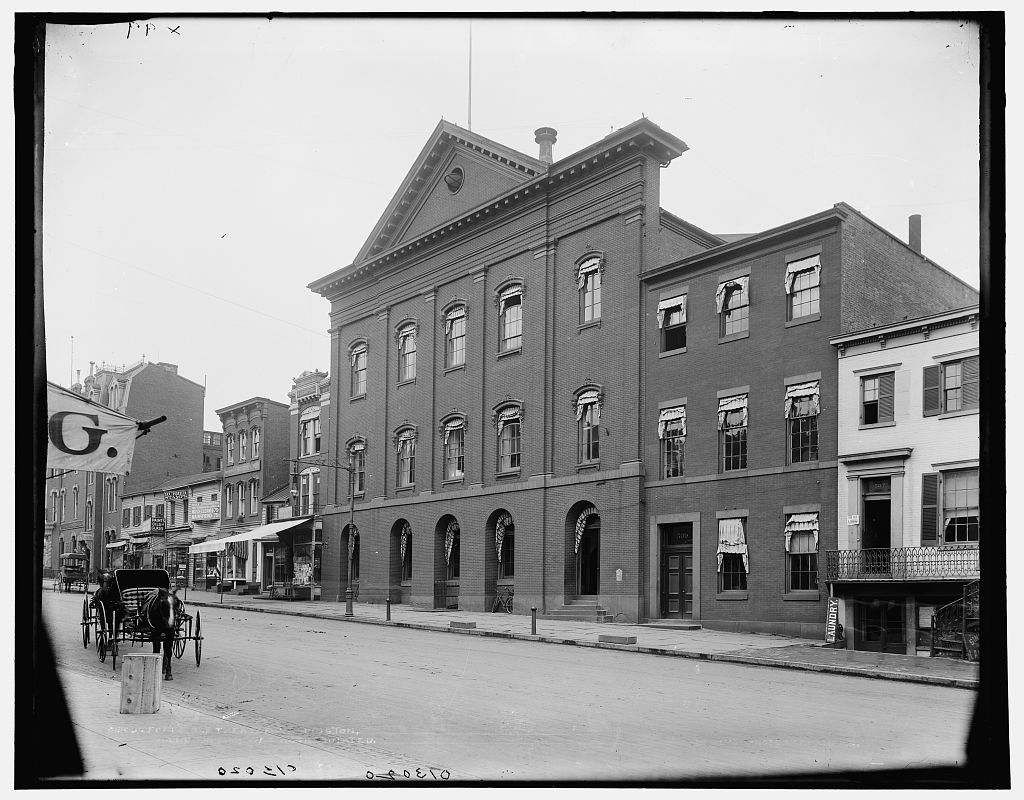
In November of 1863, A family friend John T. Ford opened 1,500-seat Ford’s Theater in Washington, D.C. Booth was one of the first leading men to appear there while Lincoln became one of the theater’s more prominent patrons. In his first role, Booth played a Greek sculptor making marble statues came to life. One evening when Lincoln was watching the play from his box, Booth was said to have shaken his finger in Lincoln’s direction as he delivered a line of dialogue. Lincoln’s sister-in-law, who was sitting with him turned to him and said, “Mr. Lincoln, he looks as if he meant that for you.”The President replied, “He does look pretty sharp at me, doesn’t he?” An admirer of Booth’s acting talents, Lincoln would invite Booth to visit the White House several times but Booth demurred.
Ford’s Theater
A Turn for the Worse
By 1864 the Confederacy’s hopes for victory were diminishing rapidly which only served to intensify Booth’s hatred of Lincoln whom he blamed for he war. After the battle of Gettysburg the previous summer, the Confederacy was hemorrhaging manpower with fewer and fewer options to replace its diminishing ranks. The situation became particularly acute after General Ulysses S. Grant, commander of the Union armies, suspended the exchange of prisoners of war with the Confederate Army to increase pressure on the manpower-starved South. It became absolutely dire following the terrible Confederate loses at the battles of the Wilderness, Spotsylvania, and Cold Harbor in the Spring of 1864. As the hopes of the Confederacy ebbed, Booth became increasingly distraught. Booth had promised his mother at the outbreak of war that he would not enlist as a soldier, but he increasingly chafed at not fighting for the South, writing in a letter to her, “I have begun to deem myself a coward and to despise my own existence.”
To assuage his own guilt and to reverse the declining fortunes of the Southern Confederacy, Booth began to conceive of a plan to kidnap Lincoln and take him to Richmond, believing he could ransom the President back to the Federal Government to free Southern troops. Lincoln’s re-election in November 1864 only further infuriated Booth and created an additional sense of urgency. Booth began to assemble a team of co-conspirators, a mix of Southern sympathizers and likely Confederate agents, who would assist him with the deed.
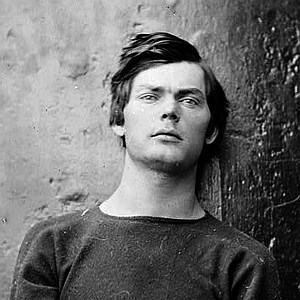
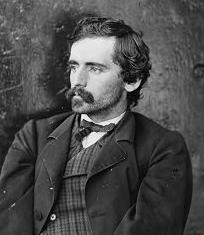
Booth’s accomplices: Samuel Arnold, George Azterodt, David Herod, Lewis Powell, John Surrat, and Michael O’Laghlen.
After Lincoln’s inauguration on March 4, 1865, Booth learned that the President would be attending the play Still Waters Run Deep at the Campbell Hospital on March 17 and considered it a perfect opportunity to kidnap Lincoln. His plan was to intercept the president’s carriage on his way to the play. Booth’s plan this day was spoiled by Lincoln’s change of plan. Instead he decided to speak to the 140th Indiana Regiment.
Murder Most Foul
With his initial plans thwarted, Booth and his conspirators went back to the drawing board. However, the fall of Richmond on April 2nd and Lee’s surrender a week later at Appomattox made Booth’s kidnapping plot impractical and irrelevant. The collapse of the Confederacy filled Booth with despair but a speech Lincoln would give would drive Booth in a more deadly direction. On April 11, two days after Lee’s surrender, Lincoln addressed a large assembly of people outside the White House. Among those in the group were Booth and his accomplices David Herold and Lewis Powell. Lincoln’s speech focused largely on healing and putting the fractured nation back together. During his speech, Lincoln called for limited Negro suffrage—giving the right to vote to those who had served in the military during the war, for example. Hearing those words, Booth muttered to companions, “That means nigger citizenship. That is the last speech he will ever make.” He tried to convince one of those companions to shoot the president then and there.
By this time an angry Booth was completely fixated on assassinating Lincoln. He told a friend that he was done with the stage. and that the only play he wanted to present henceforth was Venice Presseved, a play about an assassination. On the morning of Good Friday, April 14, 1865, Booth went to Ford’s Theater to get his mail. While there, he was told by The owner’s brother that the President and Mrs. Lincoln would be attending the play, Our American Cousin that evening, accompanied by Gen. and Mrs. Ulysses S. Grant. He immediately set about making plans for the assassination, which included making arrangements with the livery stable owner for a getaway horse and an escape route. Later that night, at 8:45 pm, Booth informed Powell, Herold, and Atzerodt of his intention to kill Lincoln. He assigned Powell to assassinate Secretary of State William Seward and Atzerodt to do the same to Vice President Andrew Johnson. Herold would assist in their escape into Virginia.
A modern day photo of Lincoln’s box as it looked in 1865
Booth entered Ford’s Theater one last time at 10:10 pm. In the theater, he slipped into Lincoln’s box at around 10:14 p.m. as the play progressed and shot the President in the back of the head with a .41 caliber Deringer pistol. Booth’s escape was almost thwarted by Major Henry Rathbone who was in the presidential box with Mary Todd Lincoln and his fiancée Clara Harris. Rathbone and Harris were guests of Mrs. Lincoln and last minute replacements for General Grant and his wife who opted to visit family in New Jersey instead. Booth stabbed Rathbone when the startled officer lunged at him before jumping from the box onto the stage. Rathbone would suffer from serious mental issues the rest of his life because of his failure to stop Booth.
Booth’s Deringer pistol
Booth was the only one of the assassins to succeed. Posing as a pharmacy delivery man, Powell entered Seward’s home where he forced his way upstairs, stabbing the Secretary of State,who was bedridden as a result of an earlier carriage accident, before being subdued. Although Seward was seriously wounded, he would survive. Atzerodt lost his nerve and spent the evening drinking alcohol, never making an attempt to kill Johnson.
Manhunt
After jumping onto the stage, Booth fled by a stage door into an alley, where his getaway horse was waiting for him. He and David Herold rode off into southern Maryland, planning to take advantage of the sparsely settled area’s lack of telegraphs and railroads, along with its predominantly Confederate sympathies. He thought that the area’s dense forests and the swampy terrain made it ideal for an escape route before crossing the Potomac River back into rural Virginia.
Federal troops combed the rural area’s woods and swamps for Booth in the days following the assassination. The hunt for the conspirators quickly became the largest in U.S. history, involving thousands of federal troops and countless civilians. Secretary of War, Edwin M. Stanton, personally directed the operation.
On April 26, soldiers of the 16th New York Cavalry tracked Booth and Herold to a farm in Virginia, just south of the Rappahannock River, where they were sleeping in a barn. The soldiers surrounded the barn and threatened to light it on fire if they did not come out and surrender. Herold surrendered, but Booth cried out, “I will not be taken alive!” The soldiers set fire to the barn and Booth scrambled for the back door with a rifle and pistol.
Sergeant Boston Corbett shot Booth in the back of his head, severing his spinal chord. Paralyzed, the soldiers carried Booth to the steps of the barn. As he lay dying, he told his captors to tell his mother that he died for his country. Two hours later he was dead. By the end of the month, all of Booth’s co-conspirators were arrested except for John Surrat who fled to Canada and would be arrested a year later in Egypt.
After a seven week long military tribunal, four of Booth’s co-conspirators, Herold, Powell, Azterodt and Mary Surrat (John Surrat’s mother) were convicted and sentenced to death by hanging. Surrat would become the first woman executed by the Federal Government. Dr. Samuel Mudd, Samuel Arnold, and Michael O’Laughlen were sentenced to life in prison while Edmund Spangler was sentenced to six years. O’Laughlen died in prison in 1867 but Mudd, Arnold, and Spangler were pardoned in February 1869 by Johnson.
News of Linoln’s death was met with an outpouring of grief across the country. On April 18, Lincoln’s body was carried to the Capitol rotunda to lay in state on a catafalque. Three days later, his remains were boarded onto a train that conveyed him to Springfield, Illinois where he had lived before becoming president. Tens of thousands of Americans lined the railroad route and paid their respects to their fallen leader during the train’s solemn progression through the North. Frederick Douglass called the assassination an “unspeakable calamity” while General Ulysses S. Grant, called Lincoln “incontestably the greatest man I ever knew.” In the South Lincoln’s assassination was met with both joy and trepidation. Some believed Lincoln got what he deserved and saw Booth as a hero. South Carolina diarist Emma Le Conte wrote,”Hurrah! Old Abe Lincoln has been assassinated! It may be abstractly wrong to be so jubilant, but I just can’t help it. After all the heaviness and gloom… This blow to our enemies comes like a gleam of light.” Still others worried that all Southerners would be implicated, complicating efforts to heal the nation and put the divided country back together.
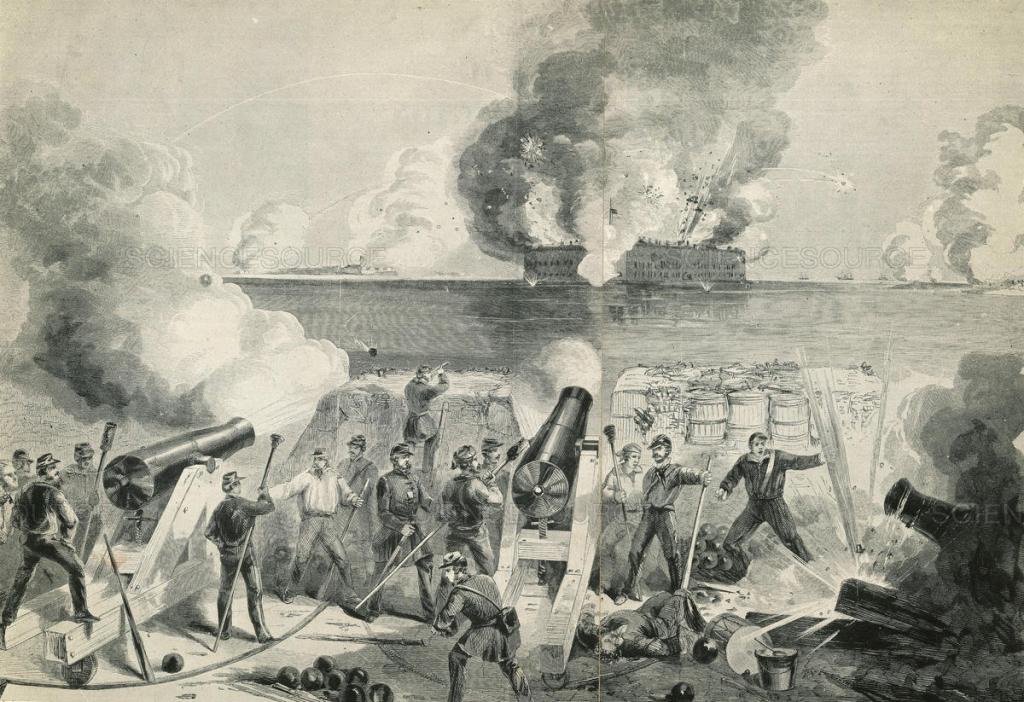
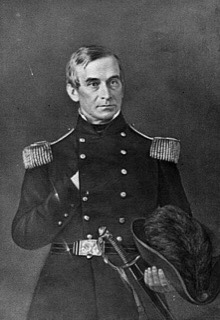
Early on the morning of April 12, 1861, South Carolina militia forces opened fire on the Federal garrison, Fort Sumter, in the middle of Charleston harbor. After a sustained heavy bombardment of the fort, garrison commander, United States Army Major Robert Anderson, reluctantly surrendered the following afternoon. This brazen attack would prove to be the opening spark of the American Civil War, a four year conflict that would claim the lives of over 600,000 Americans and leave an indelible mark on the historical development of the nation.
A Nation on the Brink
The United States in the decade before the Civil War was a country fraying apart at the seams. It was an increasingly polarized nation bitterly divided over the issue of slavery, which permeated all political discourse and debate. The Founding Fathers largely sidestepped the issue of slavery at the Constitutional Convention in order to create a document acceptable to all. However, in doing so they left a number of questions unanswered, most importantly the extension of slavery. In a number of compromises designed to placate slaveholders, the Constitution implicitly endorsed the institution of slavery where it already existed, but it said nothing about whether slavery would or would not be allowed in any new territories or states that might enter the union subsequently. As the nation steadily expanded its frontiers in the first half of the 19th century, that question alone tore the nation asunder, especially because with the admission of each slave or non-slave state the existing balance of power between pro-slavery and anti-slavery forces shifted. As such, American politics became a constant struggle between pro-slavery and anti-Slavery forces for political power and what side would gain the upper hand. The tension inside the country was summed up succinctly by the New York Tribune publisher, Horace Greeley, in 1854, “”We are not one people. We are two peoples. We are a people for Freedom and a people for Slavery. Between the two, conflict is inevitable.”
The 1850s were a particularly tumultuous decade that only served to sharpen the dividing lines between those who supported slavery and its unlimited expansion and those who did not. For the opponents of slavery, the decade was a series of setbacks that only served to increase their anger. In 1850, Congress adopted a controversial Fugitive Slave Law as part of a larger compromise to admit California to the union as a free state. This new law drew the scorn of many northerners because it forcibly compelled all citizens to assist in the capture and return of runaway slaves. In 1854, the Kansas-Nebraska Act was passed allowing people in the territories of Kansas and Nebraska to decide for themselves whether or not to allow slavery within their borders, effectively invalidating the 1820 Missouri Compromise, which precluded the admission of any new slave states north of Missouri’s southern border. The act would touch off a bloody guerilla war in Kansas between pro and anti-slavery forces while infuriating many northerners who considered the Missouri Compromise to be a binding agreement. Three years later the U.S. Supreme Court ruled in its infamous Dred Scott decision, that the Federal Government had no authority to restrict the institution of slavery. All of these developments only served to convince the more radical anti-Slavery elements that the Federal Government was under the thrall of “slave power,” a cabal of wealthy Southern slaveholders who wielded disproportionate influence in Washington and that more deliberate and decisive action would be needed to end slavery.
For all the angst that permeated the abolitionists and the anti-slavery forces about the disproportionate influence that the South wielded over the Federal government, pro-slavery elements were equally uneasy about their standing. The slave holding states continued to view Northern abolitionists as a persistent threat to their prosperity and way of life. They clearly understood that if slavery did not continue to expand they would soon find their political power and their ability to defend their interests eroded with the admission of each new free state to the union. Southerners enthusiastically supported the annexation of Texas in 1845 and most favored war with Mexico a year later as a means to acquire more territory to create additional slave states, despite opposition from anti-slavery forces in the north. At the same time, increasingly aggressive agitation by Northern abolitionists stoked ever present fears in the South of violent slave insurrections. For many Southerners, John Brown’s attempt to incite a slave revolt with his raid on the Federal arsenal at Harper’s Ferry in October of 1859 was only confirmation of their worst fears.
Anti-Slavery Crusader John Brown
The Election of 1860
If John Brown’s raid on Harper’s Ferry was confirmation for the South of Northern abolitionists’ malign intent, the 1860 election of Abraham Lincoln was the last straw for many Southerners, who now saw no other alternative than to secede from the Union. The 1860 election was divisive from the start, featuring four major candidates. Abraham Lincoln was the nominee of the newly minted Republican Party. The Democratic Party split along regional lines. The northern wing of the party nominated Lincoln’s long standing rival, Senator Stephen Douglass of Illinois. The southern wing of the party named the pro-slavery former Vice President, John J. Breckinridge of Kentucky as its candidate. Lastly, the hastily formed Constitutional Unionist party, former conservative Whigs who argued for compromise on the slavery issue and opposed secession, selected John Bell, a Tennessean, as its standard bearer. Lincoln prevailed overwhelmingly, winning both the electoral college and the popular vote by considerable margins. However, he did not win a single electoral vote from any state below the Mason-Dixon Line.
“The issue before the country is the extinction of slavery…The Southern States are now in the crisis of their fate; and, if we read aright the signs of the times, nothing is needed for our deliverance, but that the ball of revolution be set in motion.”
– Charleston Mercury on November 3, 1860
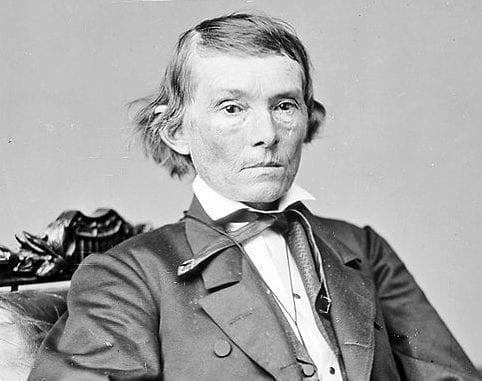
Rabid secessionists or “Fire Eaters” in the South, as they were called, who had long argued that the South should secede from the Union, now found their casus beli with the election of Lincoln. Lincoln was no abolitionist. Even though he personally opposed slavery, especially its extension into the territories, Lincoln was prepared to sustain the institution where it was already established in order to preserve the Union. Nonetheless southern Fire Eaters argued Lincoln was or would come under the thrall of Northern abolitionists and called urgently for secession. On December 20, 1860 by a vote of 169-0, the South Carolina state legislature enacted an “ordinance” that stated “the union now subsisting between South Carolina and other States, under the name of ‘The United States of America,’ is hereby dissolved.” South Carolina was soon followed by Mississippi which seceded on January 9, 1861, Florida (January 10), Alabama (January 11), Georgia (January 19), Louisiana (January 26) and Texas (February 1). Representatives from these seven states gathered in Montgomery Alabama and proclaimed a new Confederate States of America with Jefferson Davis of Mississippi as President and Alexander Stephens of Georgia as Vice President.
Left: CSA President Jefferson Davis; Right: CSA Vice President Alexander Stephens
The Crisis Unfolds
Following their secession, the seven former states of the Confederacy almost immediately set about asserting their sovereignty and independence. In practical terms, that meant seizing all federal property on their territory, most importantly forts, shipyards and other military installations. In South Carolina, the birthplace of secession, all attention was focused on several forts and batteries protecting Charleston Harbor. Most important among these was Fort Sumter which controlled all access to and from Charleston Harbor.
Almost immediately after South Carolina’s secession Governor Francis W. Pickens demanded that all federal forces evacuate these facilities and turn them over to the South Carolina militia. Unwilling to give in to rebel demands but cognizant of their vulnerability and isolation, Federal military forces began to consolidate at Fort Sumter. For the secessionist, this brazen act of defiance was an outrage and indication that the situation would not be resolved easily.
President James Buchanan was reluctant to provoke a crisis with South Carolina out of concern the other slave states might secede but he also understood the small garrison at Fort Sumter was now effectively under siege and could not be expected to hold out long without reinforcements or resupply. On January 5, 1861, Buchanan sent a merchant ship from New York, the Star of the West, with some 200 reinforcements and provisions for the fort. As the ship approached Charleston Harbor on January 9, cadets from the Citadel opened fire on the ship with artillery, forcing the crew to abandon its mission. No further resupply efforts were made in the waning days of the Buchanan administration.
On March 1, the Confederate States government assumed control of the military operations in and around Charleston Harbor. President Jefferson Davis, sent Brigadier General Pierre Gustave Toutant Beauregard to take command and supervise the siege. Beauregard was a well-trained military engineer and strategically placed artillery at various points around Charleston Harbor, effectively ringing the fort. He also took steps to ensure that no supplies from the city were available to the defenders, whose food was running low.
With conditions in Fort Sumter deteriorating rapidly, the newly inaugurated Lincoln Administration now faced its first crisis. Determined to show strength and resolve in the face of rebel belligerence, President Lincoln notified Governor Pickens on April 6 that he was sending On April 6, Lincoln notified Governor Pickens that he was sending two ships to resupply the fort with provisions and as long as these operations were not interfered with no further efforts strengthen the fort with additional men, weapons and ammunition would be made without further notice. Lincoln’s gambit only provoked another ultimatum from the Confederates, demanding that Federal troops immediately evacuate Fort Sumter or risk annihilation.
Brigadier General P.G.T Beauregard
Davis ordered Beauregard to continue to press for the fort’s surrender and if it did not, to shell the fort into submission before the relief expedition arrived. Early on the morning of April 11, Beauregard again urged the fort to surrender but its commander Major Robert Anderson refused commenting, “I shall await the first shot, and if you do not batter us to pieces, we shall be starved out in a few days.” The next day Beauregard sent a follow up message to Anderson seeking further clarification and to see if there was a way to avoid any unnecessary bloodshed. In the message Beauregard wrote, “If you will state the time which you will evacuate Fort Sumter, and agree in the meantime that you will not use your guns against us unless ours shall be employed against Fort Sumter, we will abstain from opening fire upon you.” Anderson replied that he would evacuate Sumter by noon, April 15, unless he received new orders from his government or additional supplies. Judging Anderson’s reply unacceptable the Confederates prepared to bombard the fort.
The Attack Begins
At 4:30 am, on April 12, 1861, a single mortar shell from Confederate artillery deployed at Fort Johnson exploded over Fort Sumter signaling the beginning of the attack. Within minutes 43 Confederate artillery pieces of varying accuracy and power began to methodically shell the beleaguered fort going in a clockwise direction around the harbor, two minutes between each shot. Two hours had passed and the Confederates fired over 200 shots before the fort’s defenders returned fire. Anderson was well aware of the garrison’s shortages of powder and shot and didn’t want waste any firing aimlessly in the dark.
As the battle raged, all of Charleston turned out to watch. Business was suspended and people surged out into the streets and down to the Battery in the south end of the city to get a better view. Wealthy residents climbed to the roofs of their stately manors with picnic baskets and every steeple and every cupola in the city were crowded with spectators. It was a festive atmosphere as excitement drowned out any sense of worry or fear about what would come next.
Confederate solid shot continued to pound away at the stone walls of the fort while exploding shells and heated shot set fire to the wooden structures inside the fort. Because of limited man power, Fort Sumter’s defenders could only fire 21 of its 60 cannon at a time. Moreover, shortages of cartridge bags, projectiles and other necessary equipment forced Anderson and his men to be more conservative in their return fire. Because of these shortages, Anderson reduced his firing down to only six guns.
Night fell and by 7pm the Confederates had scaled back their fire to four shots per hour. Anderson and his men stopped their fire for the evening to conserve their rapidly diminishing resources and a timely rain shower managed to extinguish some of the fires that were raging inside the fort. Outmanned, outgunned, undersupplied, and nearly surrounded by enemy batteries, the garrison was was holding on but just barely. They would live to see another day.
Major Robert Anderson
The following morning, the Confederate bombardment resumed with the same intensity as the day before. The Confederates were firing hot shot almost exclusively with devastating effect and by noon most of the wooden buildings in the fort and the main gate were on fire. Around 1:00 the fort’s flagpole was shot down and the flag re-raised from the ramparts on a make-shift staff. With prospects for surviving another day diminishing, Anderson ordered his men to double their rate of fire. He would go down fighting. By 2:30, it was clear that Federal troops could hold on no longer and Anderson surrendered.
Aftermath
Remarkably, neither side suffered any casualties during the bombardment but the consequences of the attack were enormous. In South Carolina and the rest of the states in rebellion, Anderson’s surrender was celebrated as a great victory and provided a patriotic jolt for the new Confederacy with only little concern for what would come next. In Washington, the brazen attack would prompt Lincoln to issue the call for 75,000 volunteers for 90 day enlistments to suppress the rebellion. Lincoln’s plea would lead Virginia, North Carolina, Arkansas and Tennessee to join their Southern brethren in the new confederacy but the remaining states where slavery was permitted would stay true to the Union, Missouri, Kentucky, Maryland, and Delaware. Nonetheless, even though these states would remain in the Union many were anti-war there were strong southern sympathies in some of these states. A week after Lincoln’s call for volunteers, rioters in Baltimore attacked the train cars carrying Massachusetts militia heading to Washington to help protect the capital. The Civil War had begun.
On April 4, 1968, Dr. Martin Luther King, Jr. was shot dead by James Earl Ray while standing on the balcony of his room at the Lorraine Motel in Memphis Tennessee.
By 1968, Dr. King had expanded his focus to addressing issues of economic inequality in America and the suffering that came with it. He had organized what he called the Poor People’s Campaign to speak out for the disadvantaged regardless of race. He also began to speak out more against the Vietnam War, increasingly viewing it as a “rich man’s war and a poor man’s fight.”
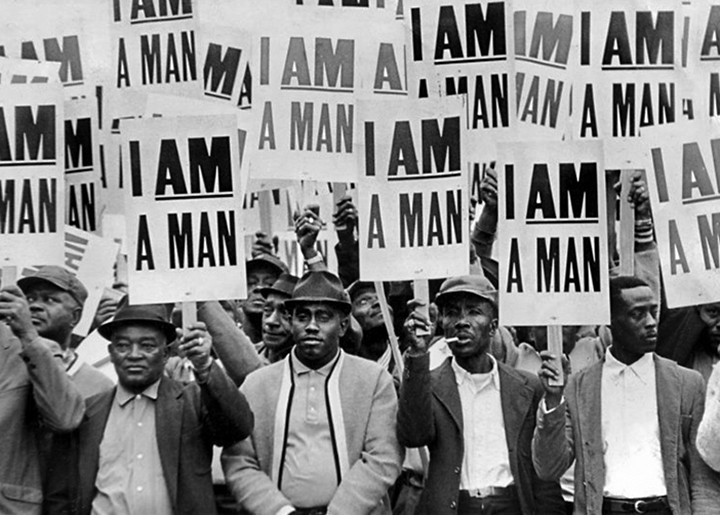
King had been invited to Memphis by pastor James Lawson, a veteran of the Montgomery Bus boycott to take up the cause of 1,300 predominantly black sanitation workers who had staged a walkout on February 11, 1968, to protest unequal wages and terrible working conditions imposed by Memphis mayor Henry Loeb. At the time, Memphis paid black workers significantly lower wages than it did white workers. There were no city-issued uniforms, no restrooms, no recognized union, and no grievance procedure for the numerous occasions on which they were underpaid. The strike was prompted by the death of two of their colleagues, Echol Cole and Robert Walker who were crushed to death in the compactor of a garbage truck — the only place where they could wait out a rainstorm in a white neighborhood where residents were uneasy about African Americans hanging around where they lived. Two other men had died this way in 1964, but the city refused to replace the defective equipment.
Many of King’s closest advisors discouraged him from getting involved in what they viewed as a low level labor dispute. However King saw a deep connection between his larger campaign for economic equality and what was going on in Memphis. In a March 18 speech to the Memphis sanitation workers he famously declared, “What does it profit a man to be able to eat at an integrated lunch counter if he doesn’t have enough money to buy a hamburger?
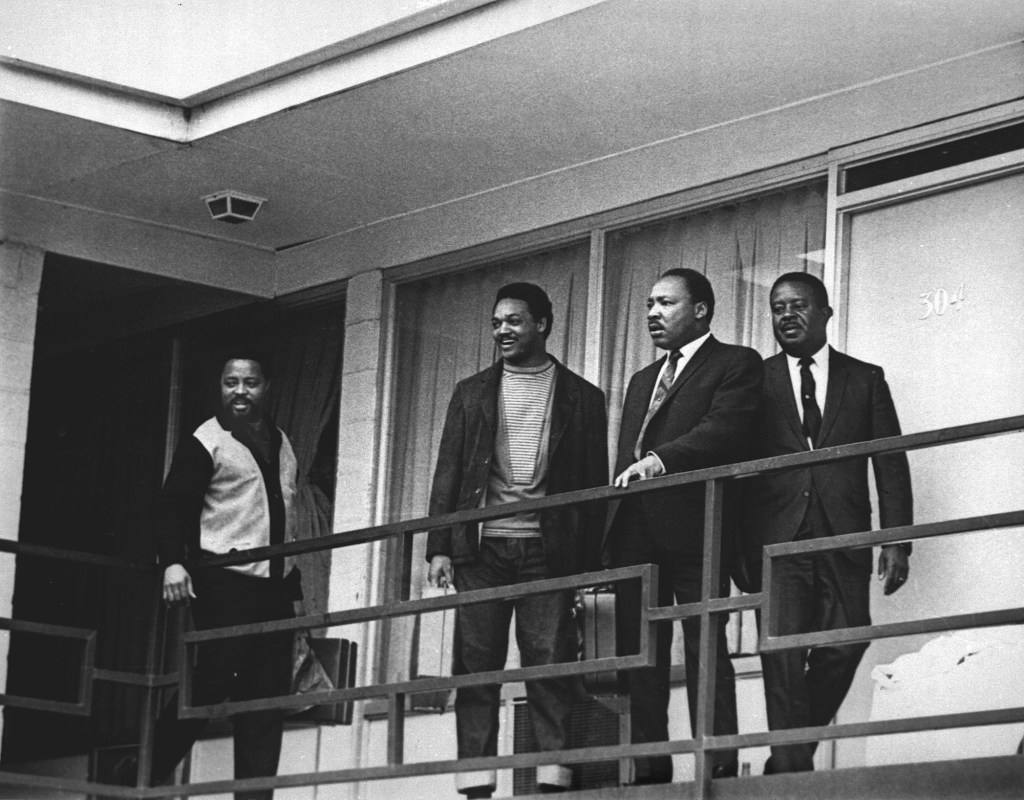
Martin Luther King Jr. stands with fellow civil rights leaders on the balcony of the Lorraine Motel in Memphis, Tenn., on April 3, 1968 — one day before he was assassinated while standing in approximately the same place. From left are Hosea Williams, Jesse Jackson, King and Ralph Abernathy.
King returned to Memphis ten days later to lead another protest. The march began peacefully but it soon became violent. Police immediately reacted to the riot, moving into the crowd with nightsticks, mace, teargas, and gunfire. In the midst of the chaos, a police shot and killed sixteen-year-old Larry Payne. Witnesses said Payne had his hands raised as the officer pressed a shotgun to Payne’s stomach and fired it. That same night Mayor Loeb declared martial law and authorized a 7 pm curfew, bringing in about 4000 additional National Guardsmen.
On April 3, King returned to Memphis to attempt a new march later that week. After arriving, King and his cohorts were slapped with an injunction that prevented them from leading a demonstration in the city. King huddled with his legal team at the Lorraine Motel to discuss strategy and to head off a potential repeat of the riot-instigating actions that had torpedoed his last effort. That day, King gave his last sermon, saying, “We’ve got some difficult days ahead. But it really doesn’t matter with me now, because I’ve been to the mountaintop … And He’s allowed me to go up to the mountain. And I’ve looked over, and I’ve seen the Promised Land. I may not get there with you. But I want you to know tonight that we, as a people, will get to the promised land.”
The next day brought good news. The judge agreed to lift the injunction, allowing for a tightly controlled march on April 8. That evening around 6 p.m., as he prepared for dinner with a local minister, King stepped out to the balcony of room 306 at the Lorraine to chat with colleagues waiting in the courtyard below. A gunshot suddenly pierced the air. King fell prone on the balcony, bleeding profusely from the right side of his face. Although he was rushed off to St. Joseph’s Hospital relatively quickly, the bullet had punctured several vital arteries, fractured his spine, and 39-year-old King was declared dead at 7:05 p.m.
Shortly after the assassination, a policeman discovered a bundle containing a 30.06 Remington rifle next door to the boarding house. The largest investigation in Federal Bureau of Investigation (FBI) history led its agents to an apartment in Atlanta. Fingerprints uncovered in the apartment matched those of James Earl Ray, a fugitive who had escaped from a Missouri prison in April 1967. FBI agents and police in Memphis produced further evidence that Ray had registered on 4 April at the South Main Street roominghouse and that he had taken a second-floor room near a common bathroom with a view of the Lorraine Motel.
The identification of Ray as a suspect led to an international manhunt. On 19 July 1968 Ray was extradited to the United States from Britain to stand trial. In a plea bargain, Tennessee prosecutors agreed in March 1969 to forgo seeking the death penalty when Ray pled guilty to murder charges. The circumstances leading to the plea later became a source of controversy, when Ray recanted his confession soon after being sentenced to a 99-year term in prison.












 Tragedy and Farce