
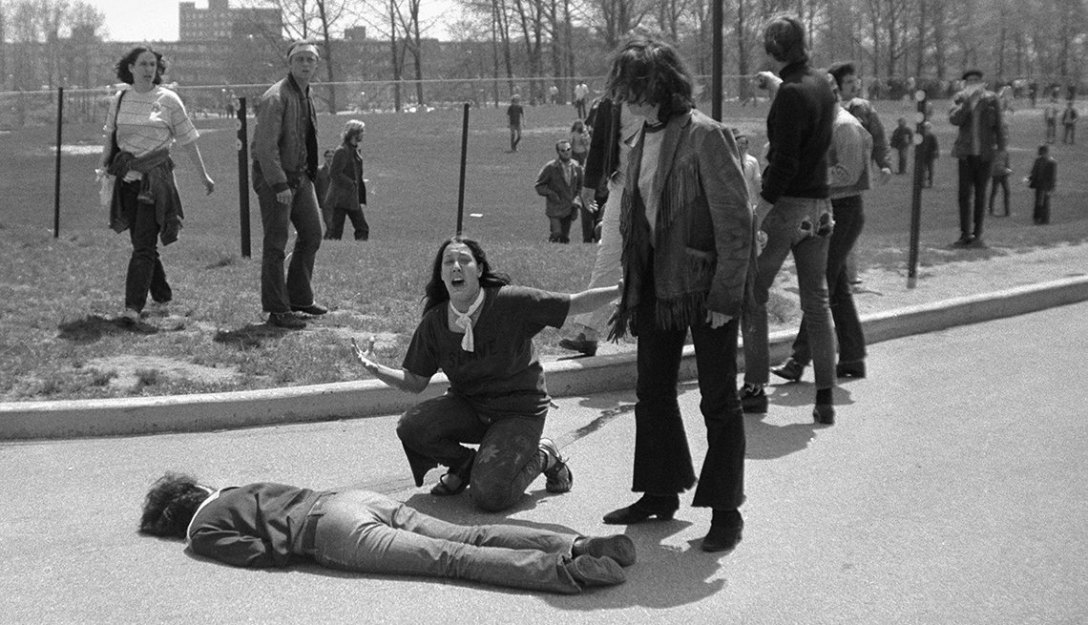
On May 4, 1970, Ohio National Guardsman opened fire on students protesting the Nixon Administration’s controversial decision to expand the Vietnam War into neighboring Cambodia killing four and injuring nine in what would become known as the Kent State Massacre. This tragedy would prove to be a watershed for the anti-war movement further souring an already increasingly skeptical American public against the war, and forever etching the name Kent State in the collective American consciousness.
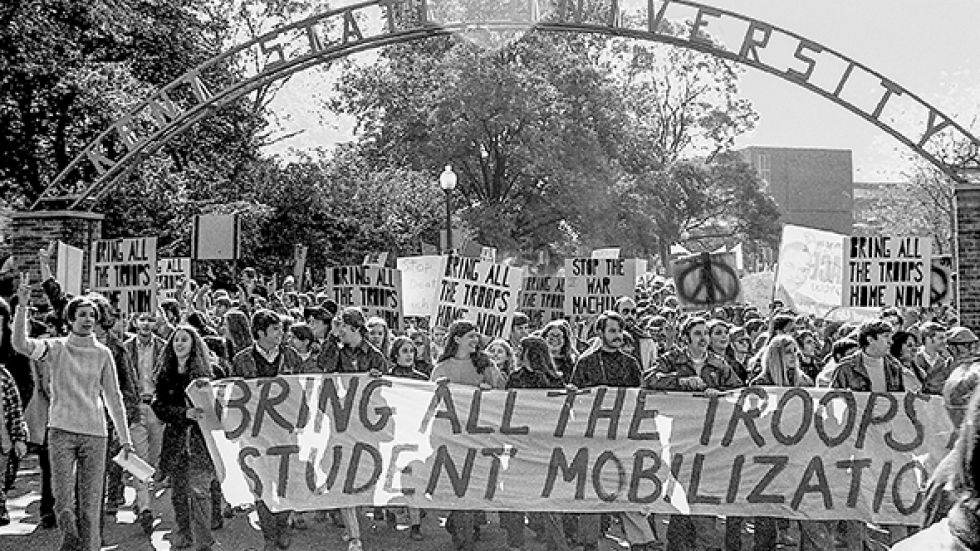
By 1970, the American public, not just college students, had begun to steadily turn against the war. The Vietcong Tet offensive in January 1968, would prove to be a key turning point. Images of Vietcong attacks on the U.S. embassy and heavy fighting all over Saigon were broadcast into the living rooms of ordinary American families contradicting the claims of U.S. political and military leaders that the United States was winning the war. Moreover, in February 1968 when CBS anchorman Walter Cronkite, “the most trusted man in America,” famously declared that he no longer believed that the war was winnable, he confirmed what was becoming increasingly clear to many. In fact, President Richard Nixon was elected in November 1968 due in large part to his promise to end the war. And until April 1970, it appeared he was on the way to fulfilling that campaign promise, as “Vietnamization” increasingly took hold and U.S. military operations were seemingly winding down.
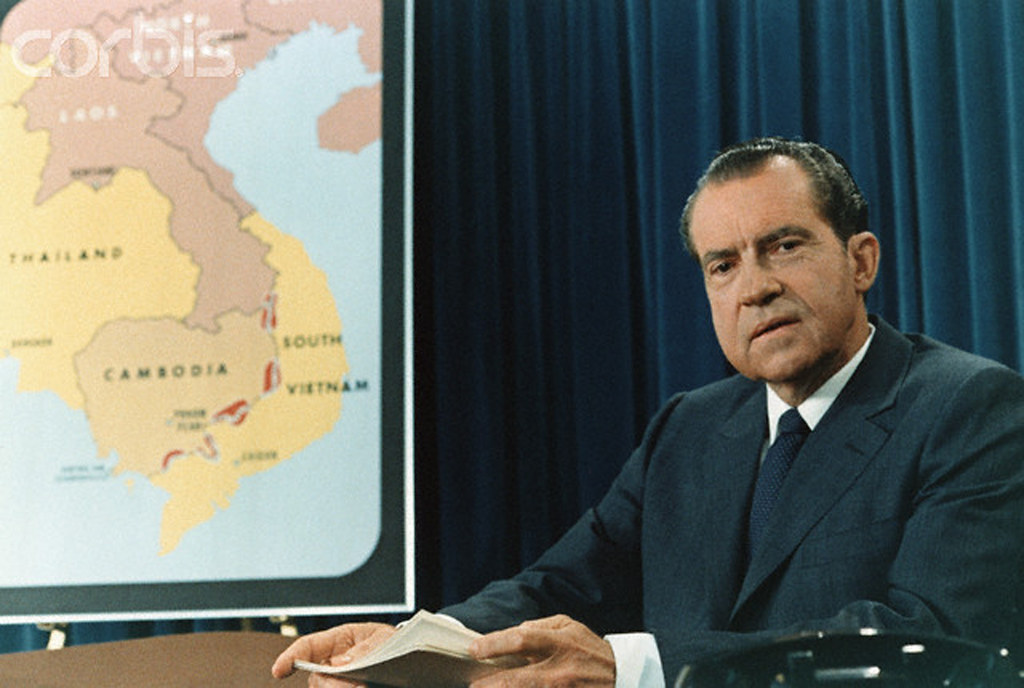
However, on April 30, 1970, President Nixon authorized U.S. troops to invade neighboring Cambodia. As the Vietcong gradually declined as an effective fighting force after Tet, North Vietnamese troops brazenly began using safe havens in Cambodia to launch attacks on the U.S.-backed South Vietnamese forces. Additionally, parts of the Ho Chi Minh trail— a supply route used by the North Vietnamese—passed through Cambodia. Nixon, who was well known for his secrecy, made the decision to expand the war into Cambodia without notifying his Secretary of State William Rogers or Defense Secretary Melvin Laird. He also failed to notify congress drawing the opprobrium of the Senate for illegally widening the war without congressional approval. After symbolically chastising Nixon by repealing the 1964 Gulf of Tonkin Resolution, the Senate voted to cut off funds all U.S. military operations in Cambodia and to force the withdrawal of all U.S. military forces in Southeast Asia. However, these efforts were defeated in the more conservative House of Representatives.
The announcement that U.S. and South Vietnamese troops had invaded Cambodia prompted a firestorm of protests all across college campuses. A war that was supposed to be winding down now seemed to be expanding. At Kent State University protests began immediately on May 1, the day after the invasion. Reports of violent clashes between students and the local police prompted KentMayor Leroy Satrom to declare a state of emergency and to ask the governor for National Guard assistance.
On the night of May 2nd, however, the situation deteriorated as protesters set fire to the school’s ROTC building and clashed with firefighters attempting to put out the blaze. Guardsmen were asked to intervene to stabilize the situation and clashes with protesters continued well into the night, as dozens of arrests were made. The next day passed peacefully but a major demonstration was planned for the fourth.

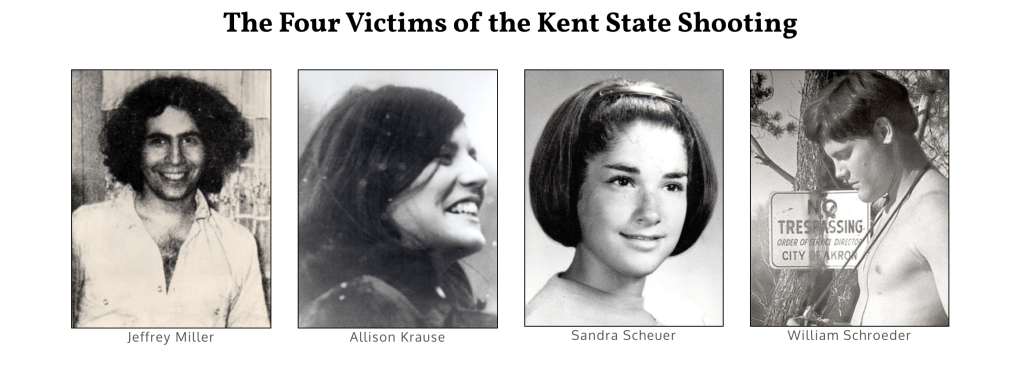
By noon on May 4, approximately 2,000 anti-war protesters had peacefully gathered on the university’s commons to listen to a collection of speakers. The National Guardsman ordered the protestors to disperse but the crowd refused and began shouting and throwing rocks at the Guardsmen. General Robert Canterbury ordered his men to lock and load their weapons, and to fire tear gas into the crowd. The Guardsmen then marched across the Commons, with bayonets fixed to their M-1 rifles forcing protesters to retreat. In the melee that ensued, panicked Guardsman, 28 in all, fired into the crowd of students. In just 13 seconds, nearly 70 shots were fired in total. In all, four Kent State students—Jeffrey Miller, Allison Krause, William Schroeder and Sandra Scheuer—were killed, and nine others were injured.
As news of the shootings leaked out protests on college campuses and throughout the country spread and five days later 100,000 demonstrators gathered in Washington to protest the war and these indiscriminate murders. On June 13, 1970, as a consequence of the shootings, President Nixon established the Presidential Commission on Campus unrest, better known as the Scranton Commission, which he charged to study the dissent, disorder, and violence breaking out on college and university campuses across the nation. The Commission issued its findings in a September 1970 report that concluded that the Ohio National Guard shootings on May 4, 1970, were unjustified. The report said:
“Even if the guardsmen faced danger, it was not a danger that called for lethal force. The 61 shots by 28 guardsmen certainly cannot be justified. Apparently, no order to fire was given, and there was inadequate fire control discipline on Blanket Hill. The Kent State tragedy must mark the last time that, as a matter of course, loaded rifles are issued to guardsmen confronting student demonstrators.”

 Tragedy and Farce