

On May 7, 1954, almost 10,000 French soldiers surrendered to Vietnamese Communist revolutionaries—the Viet Minh— at the battle of Dien Bien Phu after a fifty-five day long siege. The United States at one point would consider using nuclear weapons to assist France and relieve the siege but would ultimately judge such ideas impractical. This disastrous defeat marked France’s exit from Southeast Asia and a gradual unwinding of its colonial empire. For the Vietnamese people, their hard fought victory would not lead to independence but the division of their country and the emergence of a new enemy, the United States. The United States mistakenly would approach Vietnam problem through the Cold War lens of Communist containment rather than the independence struggle against colonial rule that it was, and suffer a similar defeat twenty years later.

World War II and the Japanese Occupation
The story of the battle of Dien Bien Phu, its significance and America’s slow descent into the quagmire of what would become the Vietnam War begins with the end of of World War II. The war had seriously threatened British and French control over their far-flung colonial empires, especially in Southeast Asia. France lost control over much of its overseas empire after it was knocked out of the war in June 1940. In September 1940, Japan extracted humiliating military and economic concessions from the French colonial government in Indo-China–Vietnam, Laos, and Cambodia– which would become an important staging area for all Japanese military operations in Southeast Asia. By the end of 1941, Japan occupied all of Indo-China with its military forces. Although the Japanese occupation shattered the illusions of European supremacy and Asian backwardness, many Vietnamese worried they were trading one colonial occupier for another. The Vietnamese Communist Party, under the leadership of Ho Chi Minh and Vo Nguyen Giap would form a larger umbrella organization with other independence minded groups called the Viet Minh to resist the Japanese. The Viet Minh would work closely with operatives from the United States’ Office of Strategic Services– the forerunner of the CIA– to undermine the Japanese occupation. When Japan finally surrendered in September 1945, the Vietnamese people across the country rallied behind calls for insurrection and the establishment of an independent Vietnamese state. By late August, the Viet Minh controlled most of the major cities and on September 2, Ho Chi Minh and his followers declared a new and independent state called the Democratic Republic of Vietnam (DRV).
The First Indo-China War
The Vietnamese people, however, would have to wait to enjoy the independence they longed for. In the ten years that followed the end of World War II, France and the Viet Minh would fight a bloody struggle as the French sought to reimpose their authority over their former colonial possession. During World War II, U.S. President Franklin Delano Roosevelt made clear that he believed there was no place for colonialism in the post-war world. In fact, he argued that France had forfeited its right to maintain its colonies in Southeast Asia by its poor performance in the war and that Indo-China should be given its independence. However, President Truman did not share Roosevelt’s disdain for colonialism and the onset of the Cold War would significantly alter the U.S. decision-making calculus. The Communist Revolution in China in 1949 and the Korean War in 1950 would give birth to the “Domino Theory,” the idea if one country in a region succumbed to Communism the others would be endangered, all but guaranteeing that the United States would support French efforts to defeat the Vietnamese Communists. By the time the French military forces surrendered at Dien Bien Phu, the United States had invested almost $3 billion in saving Indochina from the specter of communism.
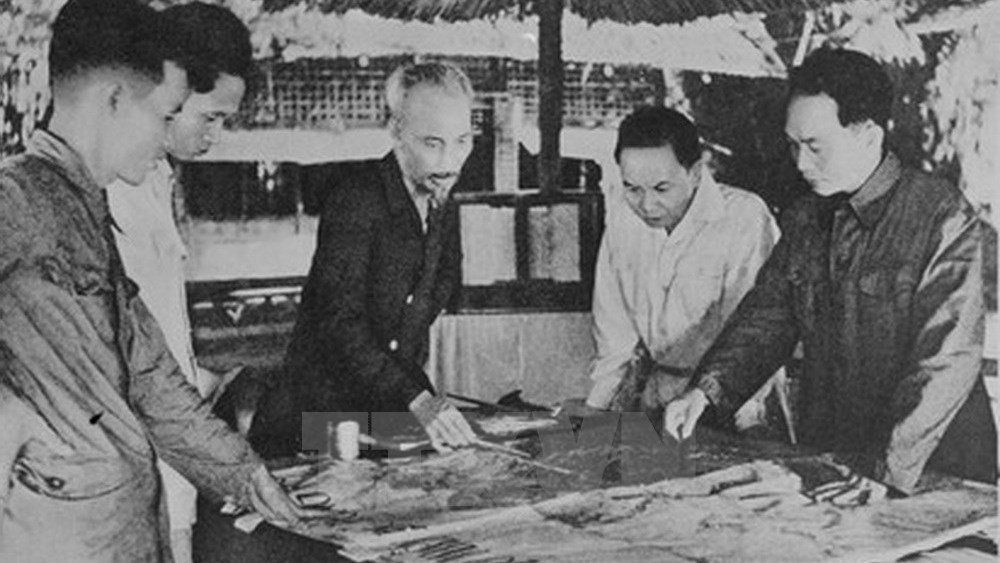
For years the two sides battled to a stalemate but by 1953 the Viet Minh began to expand is hold over larger swathes of the country, strengthened by military and economic assistance from Communist China. Conversely, the French position was becoming more tenuous. The French war effort was hobbled a series of ineffective commanders, war weariness within the military, and a public clamoring for a negotiated end to the conflict. The war had become increasingly known in France as the la sale guerre (‘the dirty war’).
French goals soon shifted away from total victory to creating military conditions to enable an “honorable political solution.” Weary of jungle warfare, the French hoped to draw the Viet Minh into a major confrontation where superior French artillery, armor and air support could be used to decimate their enemy and force them to sue for peace. In November 1953, the French parachuted almost 10,000 troops into the remote village of Dien Bien Phu in mountainous Northwestern Vietnam. Here the French intended to build a heavily fortified base to hamper Viet Minh supply lines extending from Laos and to lure their adversary into a direct confrontation where they believed they held the advantage.
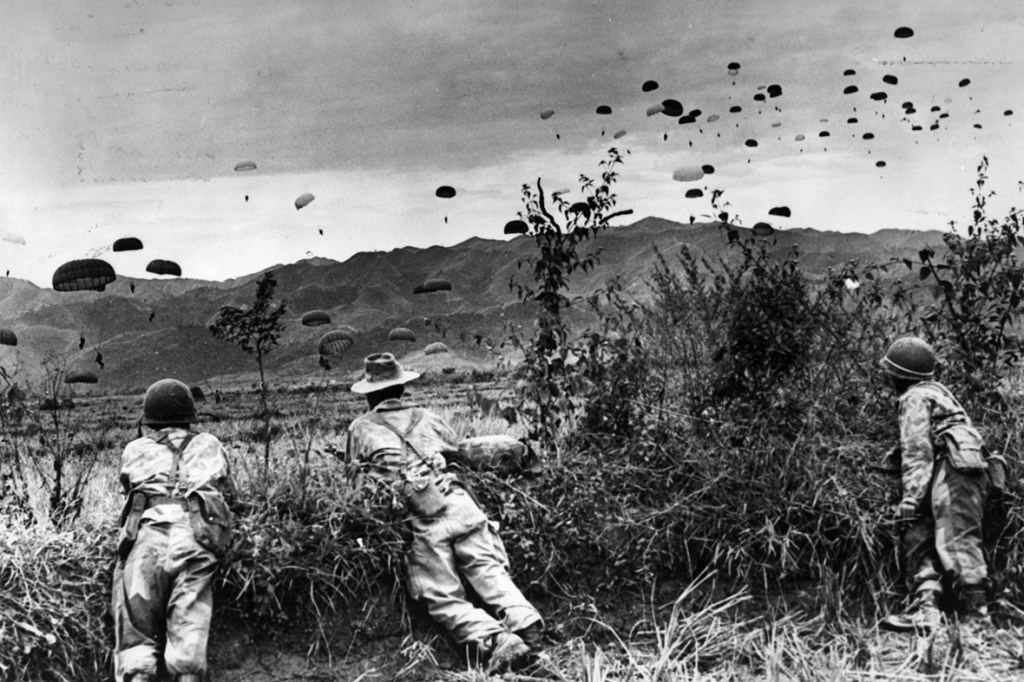
Additional French reinforcements arrived in early December bringing their total to roughly 15,000 and within a month they had transformed their position into a heavily fortified base camp. Under the command of Colonel Christian de Castries the French quickly overcame local Viet Minh opposition and began building a series of eight fortified strong points with artillery while an air strip built by the Japanese during World War II would serve as their main supply line. Dien Bien Phu’s location offered tactical advantages and disadvantages. The base sat on the floor of a large valley, surrounded by steep mountains and cliffs, some up to a mile high. French officers thought the location and surrounding terrain made Dien Bien Phu unassailable. Any enemy offensive against Dien Bien Phu would require a long and arduous trek through the mountainous jungle. The high mountains and inaccessible forest around the base seemed to negate any chance of an artillery assault because the Viet Minh would never be able to get their guns up the mountains that overlooked the base. The French military planners would be proven catastrophically wrong.
Hell in a Small Place…
In January 1954, the Viet Minh army commander, the legendary General Vo Nguyen Giap, believed that the French military build up at Dien Bien Phu presented an opportunity. Much like the French, Giap hoped to inflict such a devastating defeat on the French that they would be forced to negotiate an end the conflict. Giap concentrated nearly 50,000 combat troops in the area, seizing the high ground around the French garrison. What followed next was a logistics miracle as dozens of artillery pieces anti-aircraft guns and thousands of shells were transported piecemeal by bicycle up narrow mountain paths and maneuvered into position. The first Viet Minh shells fell on French forces on January 31, 1954. The heaviness of the barrage came as a surprise to the French who did not believe that Giap possessed such large amounts of artillery.
The Viet Minh finally started their attack on March 13, 1954 with an assault on one of the eight fortified strong points code named “Beatrice,” which fell in a matter of hours. Strong points Gabrielle and Anne-Marie were overrun during the next two days, which denied the French use of the airfield, the key to the French defense. After a two week lull, Giap began a series of assaults on the remaining outposts. However, following a series of costly human wave attacks, he shifted to trench warfare and siege tactics. Throughout April, Giap slowly tightened the noose around the French camp. Now isolated and badly in need of supply, the French garrison struggled to hold on.
Operation Vulture
Desperate, the French turned to the United States for assistance and pressed Washington to launch an overwhelming air strike to save the garrison at Dien Bien Phu. French Foreign Minister Bidault told U.S. officials, “If the fortress fell, France would want to pull out completely from Southeast Asia and assume no continuing commitments, “and the rest of us would have to get along without France in this area.” Anxious to prevent the fall of another Asian nation to Communism after the loss of China and a bloody three year stalemate on the Korean Peninsula, Adm. Arthur W. Radford, Chairman of the Joint Chiefs of Staff and his French counterpart General Paul Ely developed a plan to relieve the beleaguered garrison called Operation Vulture. The plan envisioned sending 60 B-29s from US bases in the region to bomb the Viet Minh’s position. Supporting the bombers would be as many as 150 fighters launched from US Seventh Fleet carriers. Keeping with the Eisenhower administration’s newly promulgated doctrine of “massive retaliation” the the plan also included an option to use up to three atomic weapons. Redford, the top American military officer, gave this nuclear option his backing. US B-29s, B-36s, and B-47s could have executed a nuclear strike, as could carrier aircraft from the Seventh Fleet.
Nevertheless, there was vociferous debate within the U.S. military and the Eisenhower administration about whether the US should intervene to save the French and the risks and dangers that came with intervention, especially the possible use of nuclear weapons. Radford, who played a major role in developing Operation Vulture, clearly was on board with the plan and was joined by Air Force Chief of Staff, General Nathan Twining. On the political side Vice President Richard Nixon and Secretary of State John Foster Dulles favored intervening in support of the French believing that the US and the forces of democracy could ill-afford another setback in Asia. However, proponents of intervention encountered determined bureaucratic opposition. Army Chief of Staff, General Mathew Ridgway, who so brilliantly led US forces in Korea after General Douglass MacArthur was relieved of his command, lobbied against intervention. Ridgway was the leader of a faction within the U.S. Army known as the “Never Again Club” that regarded the Korean War which ended in a draw as an unsatisfactory outcome from the American perspective, and were strongly opposed to fighting another land war in Asia, especially against the Chinese. Ridgway warned that air power alone could not save the French and argued that only the commitment of seven U.S. Army divisions could turn the tide. Ridgway further contended if the United States intervened in Vietnam it was almost a given that China would likewise intervene.


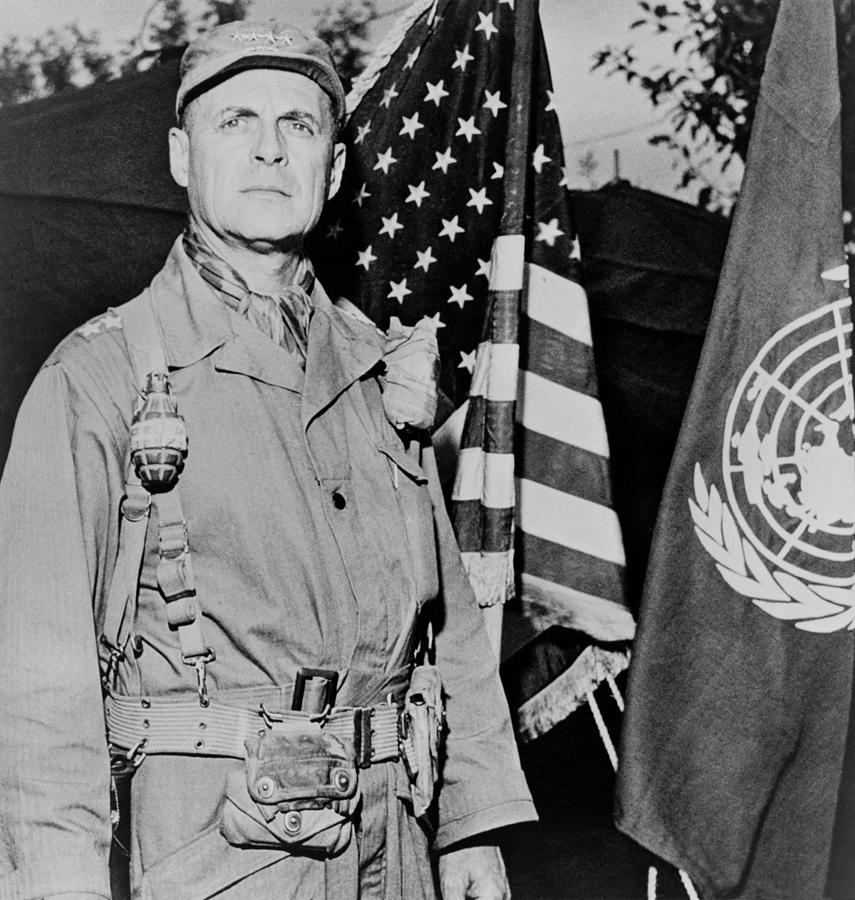
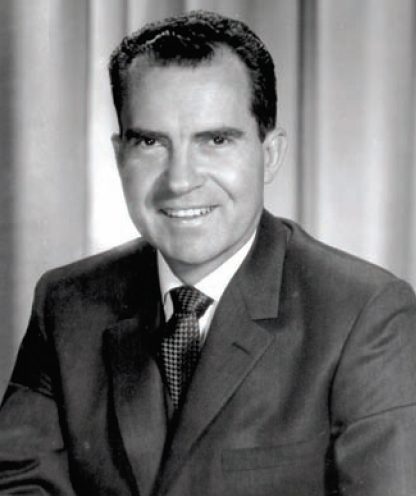
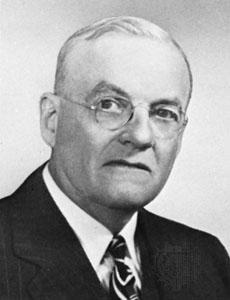
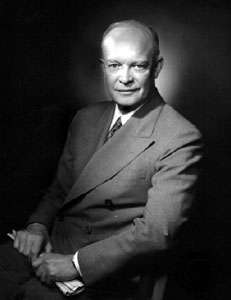
Left: Chairman of the Joint Chiefs of Staff, Admiral Arthur Radford, Air Force Chief of Staff General Nathan Twining, Army Chief of Staff Mathew Ridgway, Vice President Richard Nixon, Secretary of State John Foster Dulles, and President Dwight D. Eisenhower
Besides Ridgway, President Eisenhower also harbored doubts about intervening in support of France. Elected on a platform, that he would go to Korea and end what was an unpopular war, he was sympathetic to Ridgway’s warnings. Eisenhower also was dissatisfied with French policies in Vietnam and he worried about acting without other allies, especially after Great Britain informed him that it did not support the idea of a military intervention against the Viet Minh and would not be “hustled into injudicious military decisions. The time for a decision came in late April but in the end Eisenower, convinced that the political risks outweighed the possible benefits, decided against the intervention. Radioing French headquarters in Hanoi, the French Commander
The End is Near
Left to their own devices, it was only a matter of time before the French surrendered. In early May, Giap renewed his assault and succeeded in overrunning the French defenders. On 7 May, Giáp ordered an all-out attack against the remaining French units with over 25,000 Viet Minh against fewer than 3,000 French troops. As the battle raged, the French commander de Castries radioed headquarters in Hanoi, “The Viets are everywhere. The situation is very grave. The combat is confused and goes on all about. I feel the end is approaching, but we will fight to the finish.” The radio operator in his last words stated: “The enemy has overrun us. We are blowing up everything. Vive la France!” On the evening of May 7 the red flag of the Viet Minh flew over the French command bunker. The battle was over.
The French defeat at Dien Bien Phu was a disaster and a major blow to French prestige. French loses numbered 2,293 killed, 5,195 wounded, and 10,998 captured. Viet Minh casualties are estimated at around 23,000. The defeat at Dien Bien Phu marked the end of the First Indochina War as well as France’s role in Southeast Asia. It also marked the beginning of what would become the United States two decade long involvement in Vietnam.
Aftermath: The United States Steps In
With the French defeat on the battlefield, the United States quickly pivoted to the negotiating table to stop the spread of Communism in Southeast Asia. In July 1954, the Geneva Accords were reached between the Soviet Union, the People’s Republic of China, Great Britain, France and the United States. As part of the agreement, the French agreed to withdraw their troops from northern Vietnam. Vietnam would be temporarily divided at the 17th parallel, pending elections within two years to choose a president and reunite the country. During that two-year period, no foreign troops could enter Vietnam. Ho Chi Minh reluctantly signed off on the agreement though he believed that it cheated him out of the spoils of his victory. The non-communist puppet government set up by the French in southern Vietnam refused to sign, but without French support this was of little concern at the time. The United States also refused to sign, but did commit itself to abide by the agreement.
Conservative critics in the United States bashed the Geneva Accords as a give away to the communists and many resigned themselves to a communist takeover of all Indo-China. However, Secretary of State John Foster Dulles seized on the idea of partition of Vietnam as the only viable way to prevent the spread of Communism throughout Southeast Asia. Despite its pledge to abide by the Geneva Accords the United States reneged on its promise to support nationwide elections to chose a new president and unify the country because it clearly understood that the Communists would win. Instead the United States set about building a steady and durable non-communist South Vietnam, a task that would prove futile over the following two decades.

 Tragedy and Farce