
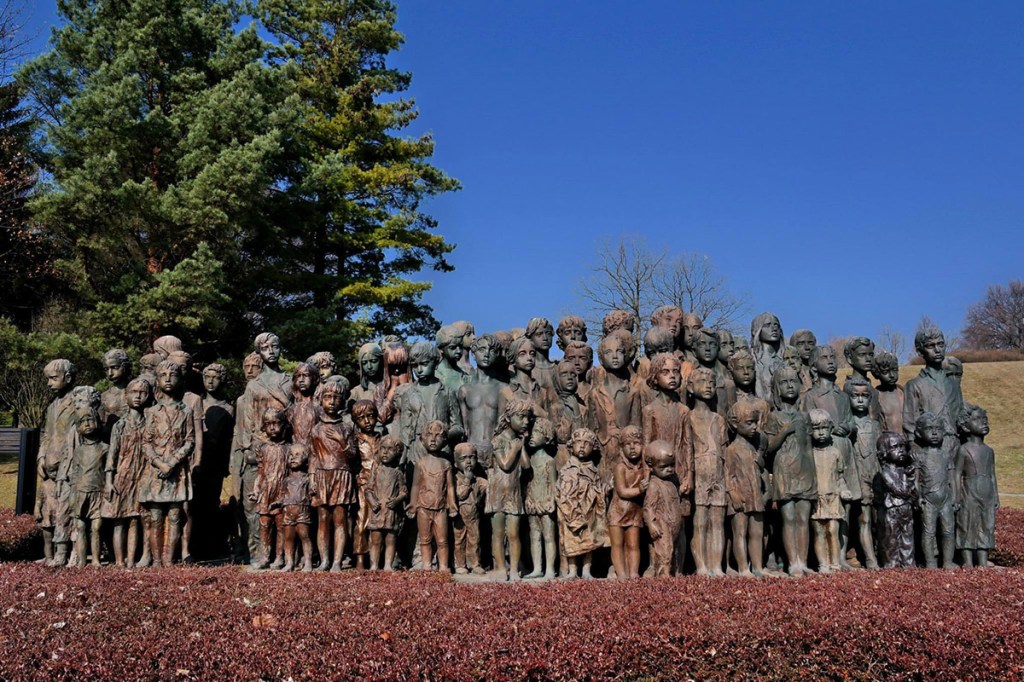
On June 10, 1942, the entire Czechoslovakian village of Lidice was wiped from from the face of the earth in retaliation for the assassination of SS leader Reinhard Heydrich by the Czech underground three weeks earlier. All 172 men and boys over the age of 16 were shot and killed. The women of the village were all sent to the Ravensbruck concentration camp where most died. Ninety young children were sent to the concentration camp at Gneisenau, with some later taken to Nazi orphanages if they were German looking. The Nazis then proceeded to raze the village until not a trace of it remained. All homes were destroyed, trees were chopped down, animals were killed, and even the cemetery was demolished. Soon, all that remained of Lidice was an empty field. It was as if it never existed.
Adolf Hitler personally ordered the destruction of Lidice. One account claims that Hitler randomly pointed to a village on a map as the target of his vengeance and Lidice was the unfortunate victim. Other more likely accounts, claim that Lidice was selected because the village had harbored and aided Heydrich’s assassins.
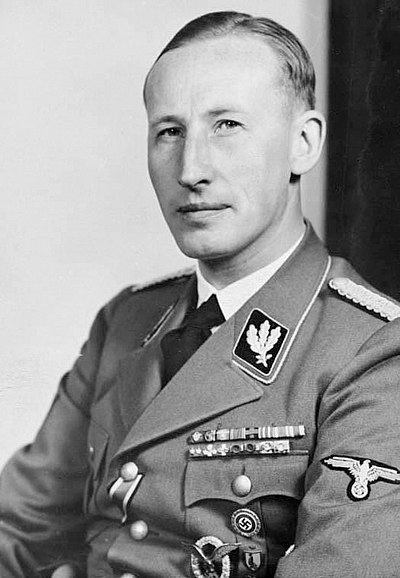
Heydrich, who organized the Kristalnacht attacks against German Jews in pre-war Germany and was the primary architects of the Final Solution, was probably one of the most barbarous and heinous of all the Nazis, demonstrating clear sociopathic tendencies, even by Nazi standards. In addition, to serving as the head of the SS, Heydrich was also acting as “Reichsprotektor,” or Governor, of what the Nazis called the protectorate of Bohemia and Moravia. The Nazis had occupied Czechoslovakia since April 1939. In 1940, they carved out the independent puppet state of Slovakia and absorbed the remaining Czech lands into the Greater German Reich.
Heydrich was one of Hitler’s favorite lieutenants and was sent to Prague near the end of September 1941 and tasked with suppressing rising anti-German sentiment and keeping up production quotas of Czech motors and arms that were “extremely important to the German war effort. Heydrich’s methods were brutal. Within two months of arriving, Heydrich established Protectorate special courts, which sentenced 342 people to be executed. Another 1,200 citizens were handed over to the Gestapo for imprisonment. A large number of Czechs were used as forced labor to support the German war effort while Heydrich set out to erase all signs of Czech national identity. Heydrich told his staff, “We will Germanize the Czech vermin.” To this end, he set in motion a multi-faceted plan. Heydrich ordered teams of doctors and technicians to conduct racial blood tests to determine which Czechoslovakians were “capable of becoming Germans.” At the same time, he sought to systematically dismantle Czechoslovakian culture and history and replace it with a Germanized version. Heydrich was very clear about his eventual goal: “This entire area will one day be definitely German, and the Czechs have nothing to expect here.” Eventually up to two-thirds of the populace were to be either deported to Russia or exterminated after Nazi Germany won the war.
Operation Anthropoid
In 1942, the Nazi occupation of Czechoslovakia was beginning to seem like it would last forever. The Czech government in exile in London was determined to kill Heydrich and end his brutal assault upon the Czech nation. Together with the British Special Operations Executive (SOE) they devised Operation Anthropoid.
In December 1941, two soldiers from the Czechoslovak army in exile, one Czech, Jan Kubis, and one Slovak, Jozef Gabcik, secretly parachuted into the former Czechoslovakia intending to kill Heydrich. Several plans had been under consideration but were deemed impractical. Eventually they decided on a plan to assassinate him as he was being driven to work.

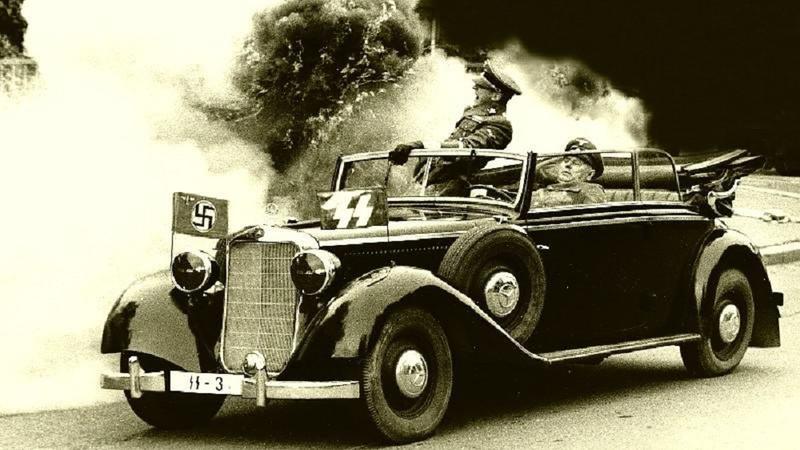
At 10:30 on 27 May 1942, Heydrich and his driver set off on their daily commute to Prague Castle in the center of the city. It was a nine mile journey that included a very sharp turn that required vehicles to slow down in order to safely navigate it. Here Kubis and Gabcik planned to ambush Heydrich. As Heydrich’s vehicle approached the turn and slowed down as expected, Gabčík, dropped his raincoat and raised his Sten submachine gun and, at close range attempted to shoot Heydrich, but the gun jammed. As the car passed, Heydrich made an ultimately fatal error; instead of ordering his driver to accelerate, he stood up and drew his Luger pistol yelling at the driver to halt.
As the Mercedes braked in front of him, Kubiš, who was not spotted by Heydrich or Klein, threw a modified explosive at the car; he misjudged his throw. Instead of landing inside the car, it landed against the rear wheel. Nonetheless, the bomb severely wounded Heydrich. Both the wounded Heydrich and his driver leaped from their vehicle a chasing after their would-be assassins. The driver ran towards Kubiš, who was also staggered by the explosion, but he recovered in time to jump on his bicycle and pedal away. Heydrich was now engaged in a shootout with Gabcik but he suddenly collapsed from the pain of his wounds allowing Gabcik to escape. Heydrich would succumb to his wounds on June 4.
Kubiš, Gabcik, and several other Czech partisans were eventually tracked down to the Saints Cyril and Methodius Cathedral in Prague. 750 SS soldiers descended on the Cathedral where a massive firefight ensued as the men hunkered down in the crypt and the prayer loft of the Cathedral. The Nazis were unable to take the men alive, and the standoff resulted in the deaths of them all, by both suicide and injuries sustained from the firefight.
It

 Tragedy and Farce