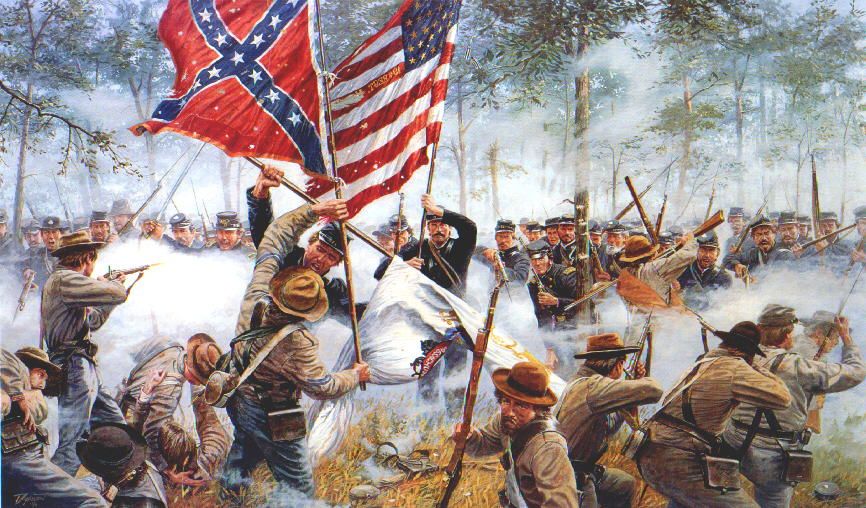
The Battle of the Crater, July 30, 1864

It’s the summer of 1864 and the fortunes of the Confederacy are on the wane. The Army of Northern Virginia is suffering from shortages across the board but one shortage is especially problematic, manpower. The Army of Northern Virginia is steadily being attritted. A series of bloody battles beginning in early May have sapped the Army and put it on the defensive. In early May, at the battle of the Wilderness, Confederate losses number over 11,000. A week later at Spotsylvania Courthouse, the South suffers another 10,000 casualties. In early June, the Confederates return the favor at Cold Harbor inflicting over 10,000 Union losses but they also suffer another 4,500 losses. In little over a month, General Lee has lost a quarter of his army. Lee knows he cannot continue losing men at this pace but he has few options. Lee writes to his son, “Where do we get sufficient troops to oppose Grant? He is bringing to him now the Nineteenth Corps, and will bring every man he can get.” Unlike his predecessors, General Grant is a fighter. He knows that he has Lee on the ropes and he won’t let up. Grant continues to push towards Richmond forcing Lee to move his army to stay between Grant and the rebel capital. Grant deprives Lee of the initiative and Lee is now forced to fight a defensive campaign against Grant’s numerically superior army, one that is not Lee’s strong suit.
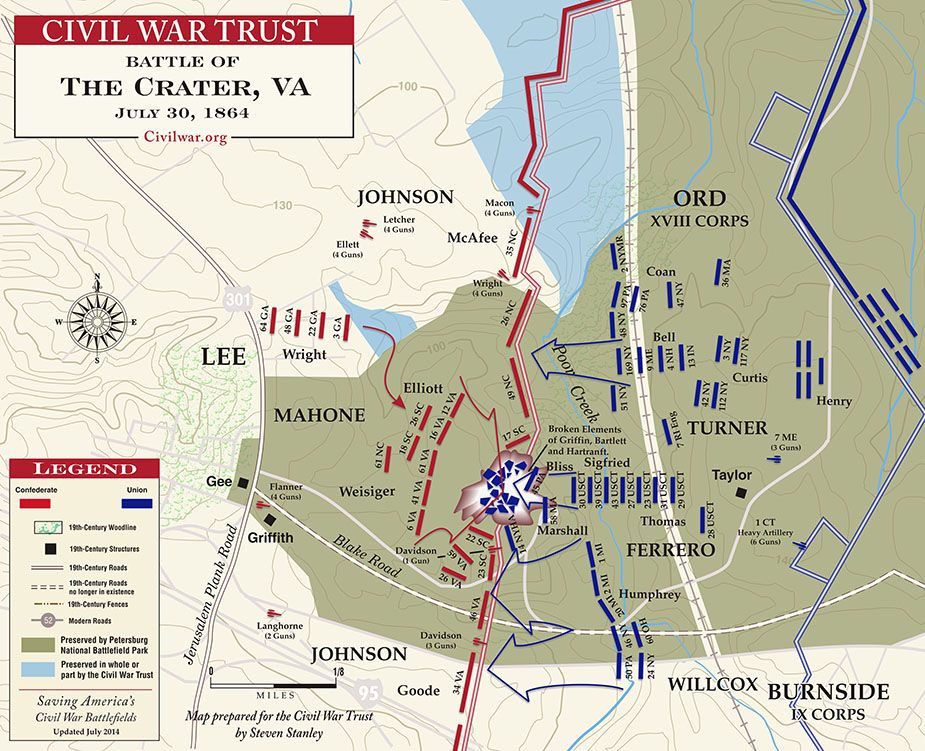
Unable to get between Lee and Richmond, Grant turns his eye toward the critical rail junction of Petersburg, thirty miles south of the capital. Petersburg is vital to the supply of Richmond and its loss would make Richmond’s capture almost inevitable. Shortly after Cold Harbor, Grant marches his forces towards Petersburg and Lee races southward toward Petersburg knowing what its loss would mean. By June 18, Grant had nearly 100,000 men under him at Petersburg compared to the roughly 20,000-30,000 Confederate defenders. Grant realized the fortifications erected around the city would be difficult to attack and pivoted to starving out the entrenched Confederates. Grant had learned a hard lesson at Cold Harbor about attacking Lee in a fortified position but is chafing at the inactivity to which Lee’s trenches and forts had confined him. A regiment of Pennsylvania miners offered a proposal to break the impasse. They would dig a long mine shaft under the Confederate lines and detonate explosives directly underneath fortifications in the middle of the Confederate First Corps line. If successful, not only would all the defenders in the area be killed, but also a hole in the Confederate defenses would be opened. If enough Union troops filled the breach quickly enough and drove into the Confederate rear area, the Confederates would not be able to muster enough force to drive them out, and Petersburg might fall.

The plan was met with great skepticism but Grant did not reject it out of hand. Digging commenced in late June. On July 17, the main shaft reached under the Confederate position. Rumors of a mine construction soon reached the Confederates, but Lee refused to believe or act upon them. For two weeks he debated before directing countermining attempts, which were sluggish and uncoordinated, and failed to discover the mine.

A division of new African-American soldiers was specially trained to carry out the assault once the explosives were detonated. For weeks the division prepared itself for all the chaos potential challenges they might encounter in leading the assault. Despite this intensive training, a decision was made a day before the impending attack to replace the African-American soldiers with another division that was less prepared. Elements within the Union high command lacked confidence in the black soldiers’ combat abilities.

The explosive charges were detonated ‪at 4:44 a.m. on the 30th.‬ They exploded in a massive shower of earth, men, and guns creating a crater that was over 100 feet wide and 30 feet deep. The initial explosive charges immediately killed 278 Confederate soldiers. The remaining troops were stunned by the explosions and did not direct any significant rifle or artillery fire at the enemy for at least 15 minutes. However, the Union troops selected to lead the assault were unprepared for what they encountered. Instead of moving around the crater, they advanced down into it and soon became trapped. The Confederates, under Brig. Gen. William Mahone, regrouped and counterattacked. They began firing rifles and artillery down into the crater in what was later described as a “turkey shoot.” The plan had failed and the battle was lost. However, the strategic situation remained unchanged. Both sides remained in their trenches, and the siege would continue into March of the next year.

Hoover, Mac Arthur and the Bonus Army: July 28, 1932

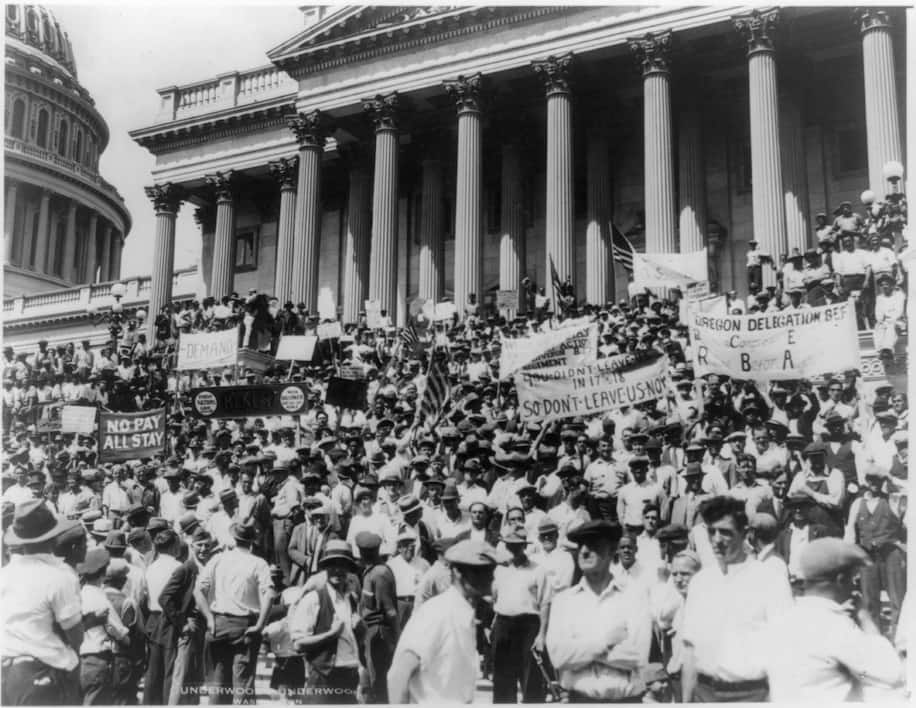
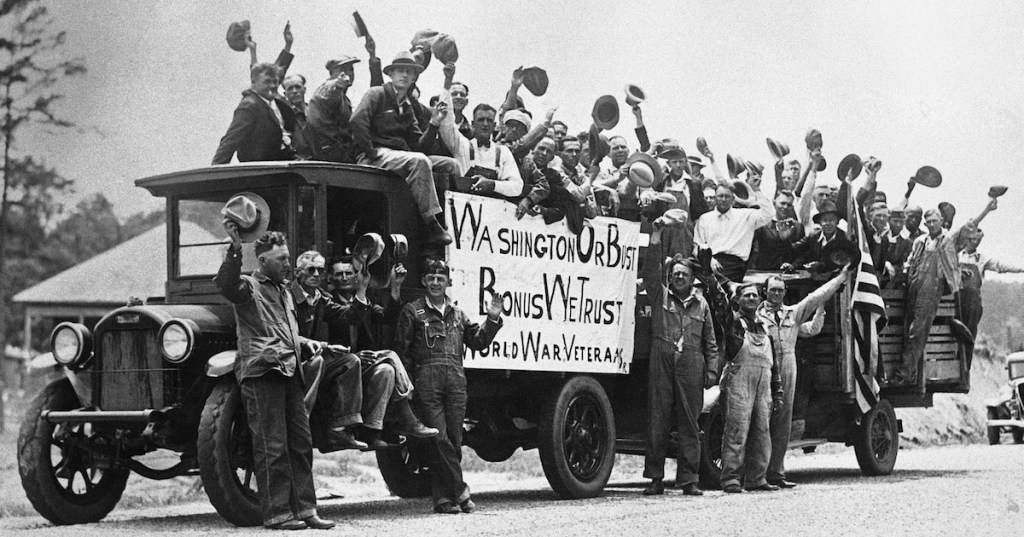
On July 28, 1932,  U.S. Army troops, under the command of General Douglass Mac Arthur violently dispersed the “Bonus Army”—roughly 30,000 World War I veterans and their families—who had gathered in Washington DC to demand early payment of a bonus they had been promised by Congress for their service. Amidst the worsening economic conditions of the Great Depression, these increasingly desperate veterans and their families travelled from all across the country to Washington DC to press their demand. They came in trucks, old buses, and railroad freight cars. The spectacle of heavily armed troops moving against the unarmed veterans, who had fought for their country years earlier, shocked and disgusted many Americans. It also reinforced the perception, right or wrong, that President Herbert Hoover was indifferent to the suffering of the American people during the depression and it played a significant role in Hoover’s decisive defeat in the 1932 presidential election. This episode would also prove to be a turning point in how our nation treated its veterans, serving as a catalyst for the G.I. Bill and other programs set up for returning veterans in the aftermath of World War II.

In 1926, Congress passed the World War Adjusted Compensation Act, otherwise known as the Bonus Act, over a veto from President Calvin Coolidge. The act promised WWI veterans a bonus based on length of service between April 5, 1917 and July 1, 1919; $1 per day stateside and $1.25 per day overseas, with the payout capped at $500 for stateside veterans and $625 for overseas veterans. The catch was this bonus would not pay out until each veteran’s birthday in 1945, paying out to his estate if he should die before then. Although veterans were allowed to borrow against the bonus certificate beginning in 1927, by 1932, banks were short on credit to give.

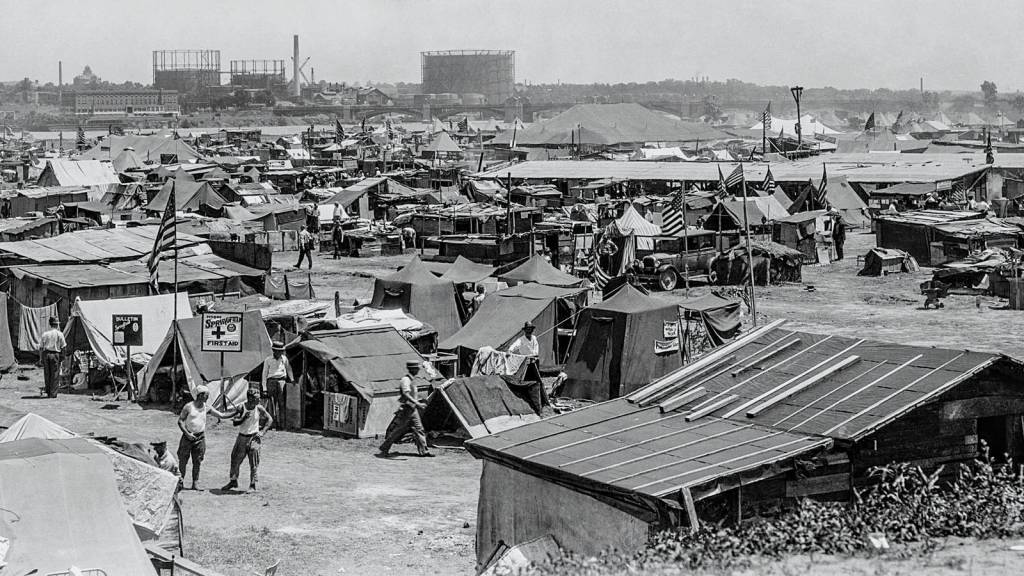
Many of these veterans were now unemployed, broke, and hopeless and began to demand immediate payment to help offset the pernicious impact of the depression. Led by a former Army Sergeant from Oregon, Walter M. Waters, the veterans called themselves the Bonus Expeditionary Force or “the Bonus Army.” They set up camps throughout the city and began to lobby Congress in the spring and summer of 1932 for their bonus. Two camps, in particular, stood out — a group squatting around buildings slated for demolition east of the Capitol on Pennsylvania Avenue, and a larger shanty town in the Anacostia Flats, south of the 11th Street Bridge in what is now Anacostia Park.

The veterans found themselves a sympathetic supporter in Congressman Wright Patman (D-TX), a WWI veteran himself, who introduced a bill on June 15, to pay the veterans. The bill passed the House of Representatives but was subsequently voted down in the Senate, 62-18, with many Senators claiming the country lacked adequate funds to make the immediate payments that were demanded. With the defeat of the Patman bill, some of the veterans returned home believing their cause to be lost but 20,000 remained. Undeterred, Walter Waters vowed, “We’ll stay here until the bonus bill is passed.” He staged daily demonstrations before the Capitol and led peaceful marches past the White House but Hoover refused to give him an audience.

The Bonus Army stages a huge demonstration at the empty Capitol in July 1932.


Unwilling to meet their demands, the Hoover administration disparaged and denounced the veterans as criminals and communist agitators. President Hoover reportedly believed that veterans made up no more than 50 percent of Bonus Army members. In reality, members of the American Communist Party did seek to exploit the situation but they probably represented less than 10 percent of the marchers. A subsequent  study conducted by the Veterans Administration revealed that 94 percent of the marchers had Army or Navy service records.

The Bonus Marchers’ Camp at Anacostia Flats


On July 28, the situation turned violent as the city police tried to remove a number of veterans who were encamped along Pennsylvania Avenue. Amidst the ensuing melee, two of the bonus marchers were killed. Fearing that this was the beginning of a larger riot, President Hoover ordered Mac Arthur and the Army to disperse the veterans. That evening, Mac Arthur and about 1,000 troops advanced with tanks, fixed bayonets, and tear gas seeking to drive the demonstrators back across the 11th Street Bridge to Anacostia Flats. Hoover reportedly warned Mac Arthur twice not to cross the bridge in pursuit of the retreating veterans but the General ignored these warnings believing he was suppressing a violent insurrection seeking to overthrow capitalism and the constitution. Mac Arthur continued to advance on the veterans’ camp. The troops drove off the remaining 10,000 inhabitants and set fire to the shanties. The Bonus Army had been dispersed permanently.

Although the operation was a success, the political consequences were disastrous . Hoover defended his use of force against the veterans, declaring, “A challenge to the authority of the United States Government has been met, swiftly and firmly.” However, many Americans were shocked and dismayed by the news and the images of tanks, soldiers with fixed bayonets, and saber wielding cavalry threatening the veterans. Alabama Senator and future Supreme Court Justice Hugo Black denounced the military crack down as an overreaction. “As one citizen, I want to make my public protest against this militaristic way of handling a condition which has been brought about by wide-spread unemployment and hunger,” Black remarked. Senator Hiram Johnson of California, dubbed the incident “one of the blackest pages in our history.” Even the Washington Daily News, which was normally GOP friendly called it “A pitiful spectacle,” to see “the mightiest government in the world chasing unarmed men, women, and children with Army tanks. If the Army must be called out to make war on unarmed citizens, this is no longer America.”

This episode would torpedo Hoover’s re-election bid in 1932, confirming for many Americans that Hoover lacked the leadership skills and bold new ideas to lead the country through the economic crisis. Hoover would go on to lose in a landslide to Franklin Delano Roosevelt. Remnants of the Bonus Army again began to trickle back into Washington DC shortly after Roosevelt’s inauguration in 1933. Roosevelt also opposed meeting the demands of the veterans on the grounds that it would favor a special class of citizen over others at a time when all were suffering. However, unlike Hoover, Roosevelt would take other positive steps to try and ameliorate the economic hardship of the veterans. He would offer them jobs in his new Civilian Conservation Corps and set up Veteran Rehabilitation Camps to help address the unemployment problem. In 1936, Congress finally passed a bill over President Roosevelt’s veto. The Bonus Army had achieved its objective.

Battle of Fort Wagner, July 18, 1863

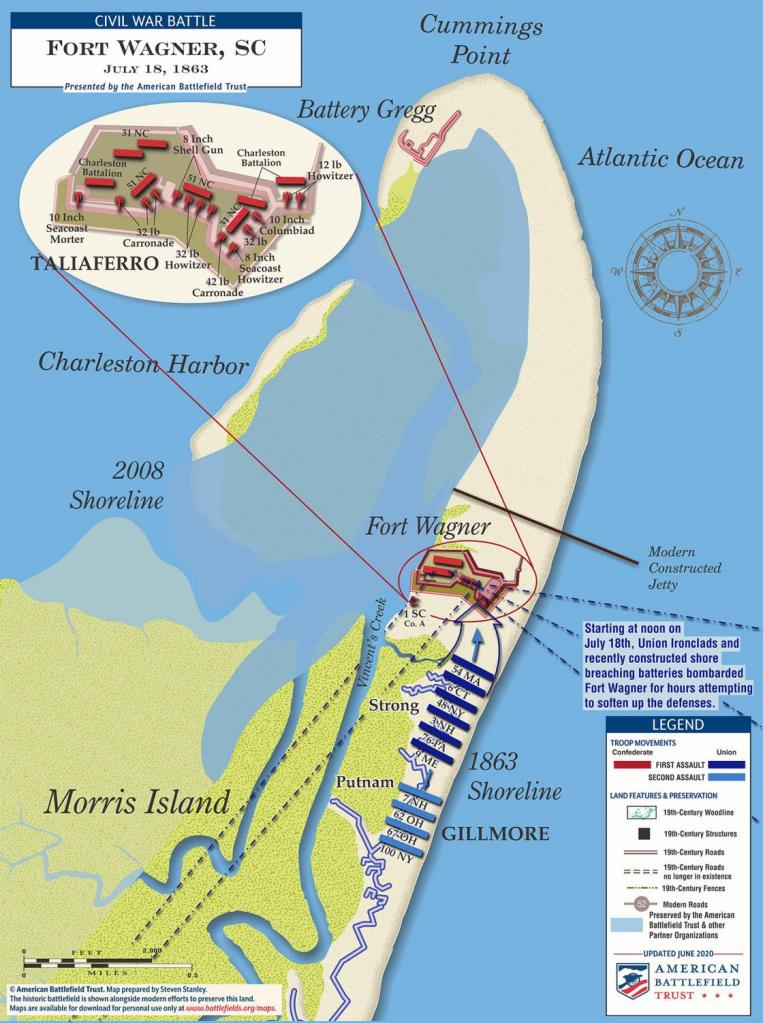
July 18, 1863- The battle of Fort Wagner- For three years Charleston South Carolina was an open wound for Union forces. It was here on April 14, 1861 that the Federal garrison at Fort Sumter, in the middle of Charleston harbor, was forced to surrender after being bombarded by Confederate forces in Charleston, initiating the Civil War. For, two and a half years the Union Navy had blockaded all of the major Southern ports in an effort to strangle the Confederacy. Repeated efforts to capture Charleston failed as the city was protected by a series of strategically placed forts and batteries.

In the spring of 1863, the Federals planned operations to neutralize the fortifications surrounding Charleston and capture the city. Crucial to their plan was the capture of Fort Wagner on Morris Island. On the evening of July 18, after a grueling day long bombardment, the 54th Massachusetts, a regiment of black soldiers spearheaded a direct assault on the fort. Commanded by Colonel Robert Gould Shaw, the scion of a wealthy Massachusetts abolitionist family, the unit was made up of freedmen and escaped slaves and intended to show that African-Americans were more than willing and capable to fight for their freedom. Prior to he assault, the regiment had bee tasked mostly with manual labor and had seen only limited action, as the army command continued to view the 54th as a political project rather than a military unit. The attack started off slowly but proceeded to the double quick as Confederate artillery tore apart the ranks of the 54th with devastating effect. Scaling the top of the earthworks, the 54th was met with a murderous volley of musket fire from the forts defenders killing Colonel Shaw and many others. The attack would ultimately fail with the regiment suffering over 40 percent casualties. Nevertheless, the men of the 54th fought bravely and with great valor. Sergeant William H. Carney, was wounded three times in the hip, chest and head as he retrieved the regimental standard after the flag-bearer was shot. He would receive the nation’s highest combat decoration, the Medal of Honor. Because of the valor shown by the men of the 54th, the US Army increased the number of black enlistments so that by 1865 almost two hundred thousand African Americans had served from 1863-1865. African-American soldiers would fight bravely in other places such as Petersburg and suffer atrocities at the hands or rebel soldiers at Fort Pillow.

African-American soldiers would continue to lay down their lives for their country in World War I and World War II but would still face discrimination and be forced to serve in segregated units until July 26, 1948 when President Truman desegregated the military.

Storming of the Bastille: July 14, 1789

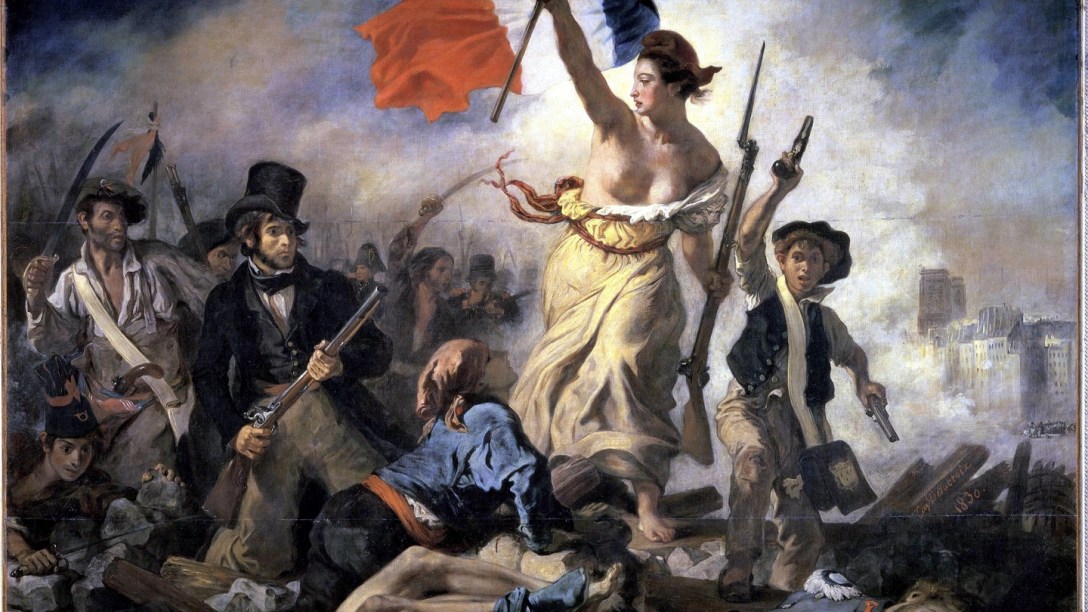
On July 14, 1789, Parisian mobs stormed the Bastille—a notorious prison and symbol of royal tyranny—in what is generally regarded as arguably the  beginning of the French Revolution. Inspired by the American Revolution, the French Revolution would prove to be a watershed event in the history of Western civilization helping spread many of the ideas that now form the foundation of modern liberal democracy.  It would also inspire Karl Marx and other future socialists, with its emphasis on egalitarianism. However, the Revolution, which was originally a popular uprising against the absolute power of the king and the vast inequality between the rich and the poor, would eventually consume itself giving way to the dictatorship of Napoleon Bonaparte and eventually a restoration of the monarchy.

By the mid-1780s, France found itself in deep economic crisis. Decades of war against Great Britain, especially support for the American colonies in their war for independence, had emptied the state coffers. Moreover, an inefficient and regressive taxation system in which the urban poor and middle class paid most of the taxes and the nobility lived lives of luxury combined with two decades of poor harvests left the country on the brink of financial ruin and a social implosion. 

King Louis XVI of France

King Louis XVI sought to replenish the state treasury by raising taxes, including a universal land tax from which the nobility would no longer be exempt. However, he lacked the authority on his own to levy any new taxes. The only institution in France with that power was the Estates General an assembly representing France’s clergy, nobility and middle class. The King agreed to convene the Estates General in May 1789, which had not met since 1614, to garner support for his proposed reforms. The assembly consisted of equal numbers of representatives of each estate, and voting had been by order, with the First Estate (the clergy), the Second Estate (the nobility), and the Third Estate (middle class and peasants) each receiving one vote. Under this framework, the Third Estate routinely was outvoted by the combined vote of the nobility and clergy. Now representing roughly 95 percent of the population, the Third Estate demanded political power commensurate with the amount of the population it represented. Members argued that the Third Estate should be doubled in size and that voting should be by headcount and not order. However, a majority of the clergy and nobility balked at this idea.

Unsatisfied, the Third Estate now decided on a more radical course of action. They declared themselves the National Assembly, that was representative of all the people. This new National Assembly expressed its desire to include the other two Estates in its deliberations but also made it clear that it was determined to conduct the nation’s affairs without them. Faced with a growing insurrection and a threat to his absolute power, King Louis XVI tried to prevent the National Assembly from meeting by locking them out of the Salle des États, claiming it needed to be prepared for a royal speech. On 20 June, the Assembly met in a tennis court outside Versailles and swore not to disperse until a new constitution had been agreed. Messages of support poured in from Paris and other cities; by 27 June, they had been joined by 100 clergy and 47 members of the nobility. On July 9 the Assembly reconstituted itself as the National Constituent Assembly.

A showdown between the crown and the general public was looming. The only questions remained how and when and what would be the catalyst. On 11 July, Louis XVI, acting under the influence of the conservative nobles, dismissed his finance minister, who had been sympathetic to the Third Estate, and rumors soon spread that he was preparing to use the military to shut down the Assembly. The news brought crowds of protestors into the streets who thought this was the beginning of a conservative coup and soldiers of the elite French Guards refused to disperse them. Paris was soon consumed with riots, anarchy, and widespread looting. The mobs now had the support of the French Guard, including arms and trained soldiers who were sympathetic to the people.

Storming of the Bastille


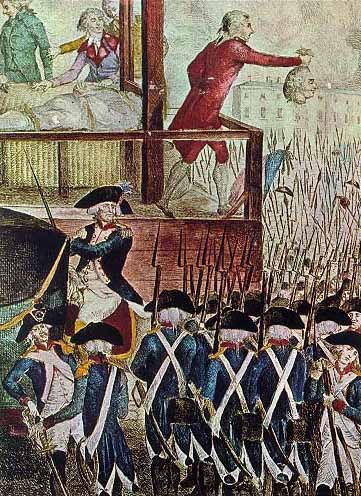
Events came to a head on July 14, when a mob, with the support of the disgruntled French Guard, stormed the Bastille in search of arms and ammunition and to release the large number of political prisoners rumored to be held behind its walls. After several hours of fighting the Governor of the prison surrendered. Shortly thereafter he was executed and his headed paraded around the city on a pike. Although the revolutionaries found stores of arms and ammunition, there were only seven prisoners at the Bastille: four forgers, two noblemen held for “immoral behavior”, and a murder suspect. Nonetheless, a blow had been struck against Royal authority and noble privilege.

The storming of the Bastille had fundamentally changed the balance of power and revealed the monarchy for the sclerotic and delegitimized institution it had become. It also put in motion a series of events over the next decade that would set not only France but the entire European continent aflame. By 1791, the moderates who held power following the attack on the Bastille gave way to more impatient and revolutionary Jacobin elements of the Sans Culottes—the working class—amidst growing food shortages and a worsening economic crisis. The following August, these revolutionaries would arrest Louis XVI, his wife Marie Antoinette, and the rest of the Royal family. The King was executed by guillotine the subsequent January for allegedly conspiring with Austria and Prussia to overthrow the revolution and his wife suffered the same fate nine months later.

The execution of Louis XVI

The execution of the royals ushered in the most violent and bloody phase of the revolution, known as the “Reign of Terror.” Over a 10 month period, 17,000 suspected enemies of the revolution were guillotined without a public trial or any legal assistance. Many of the killings were carried out under orders from Maximilian Robespierre, one of the Jacobin leaders who dominated the draconian Committee of Public Safety that had been set up to root out enemies of the revolution. Intoxicated by his power, Robespierre called for increasingly more executions and purges, even though the threat to the revolution, at home and abroad, had receded. By the summer of 1794 many had begun to turn against Robespierre and his excesses. An uneasy coalition of moderates and revolutionaries formed to oppose Robespierre and his followers. On July 27, 1794 Robespierre was arrested and the next day he and 21 of his supporters were guillotined without a trial.

The death of Robespierre would bring the Reign of Terror to an end and lead to a less radical and less violent phase of the revolution. Executive power was now invested in the hands of a five-member Directory (Directoire) appointed by parliament. The Directory, however, would fail to distinguish itself as an effective governing body. The Directory’s four years in power were riddled with financial crises, popular discontent, inefficiency and, above all, political corruption. On November 9, 1799, as frustration with the Directory reached a fever pitch, a young and brash General named Napoleon Bonaparte staged a coup d’état, abolishing the Directory and appointing himself France’s “First Consul.” The event marked the end of the French Revolution and the beginning of the Napoleonic era, in which France would come to dominate much of continental Europe.


Gettysburg Day Three: July 3, 1863

On the afternoon of July 3, 1863, 12,000 Confederate troops carried out a vain and desperate assault on the Union front along Cemetery Ridge seeking to break the Federal line and steal a victory from the jaws of defeat. The attack, which would cross over a mile of open field and come under a withering storm of artillery was easily repelled. The following day General Robert E. Lee gathered his forces and casualties and began the long retreat across the Potomac, back into Virginia. The second Confederate invasion of the North had again ended in failure.

The second day of the battle of Gettysburg proved as disastrous for the Confederacy as the first day was fortuitous. Every Confederate attack up and down the Emmitsburg Pike was beaten back. The rebels had their opportunities. They had broken the Union lines in spots but strong interior lines and and a reserve of reinforcements allowed the Federals to quickly plug any holes and push the rebels back.

General George Pickett

Despite the failures of the previous day, General Robert E. Lee was committed to continuing the battle the following day. Longstreet continued to argue against any offensive operations but his objections fell on deaf ears. Having attacked the left and right of the Union line with little success, Lee reasoned that the Union center must now be weakened. He incorrectly assumed that the Union Army commander, General George Meade, must have pulled reinforcements from the center to blunt the Confederate attacks on he flanks. Moreover, the last of his army, General George Pickett’s division of Virginians had finally arrived.

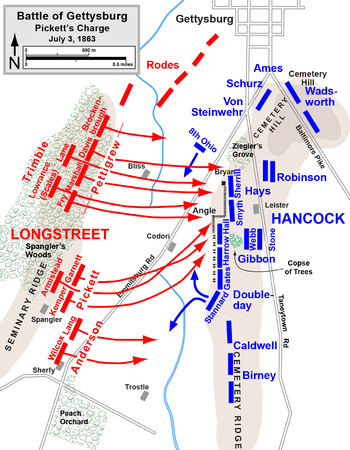
Lee’s plan of attack was simple. He would soften up the Union center with an artillery barrage, then, Pickett’s division, augmented by select regiments from Henry Heth and Isaac Trimble’s divisions that bore the brunt of the fighting on the first day, would advance across a mile of open field and strike the Union center. Although the plan was simple, execution was anything but.

The plan began to go awry from the get go. Around 1pm, 150 Confederate artillery pieces in a 2-mile long line along Seminary Ridge opened fire on the Union Center. Their orders were to silence as many Union batteries as possible on the north end of Cemetery Ridge before the infantry advanced. However, the barrage did not inflict the damage on the Union guns that the Confederate leadership had hoped. The immense amount of smoke generated by the cannonade hindered the aim of the Confederate gunners while inferior shell fuses ensured that some Confederate shells failed to detonate properly rendering them ineffective and leaving many Union batteries relatively unscathed.

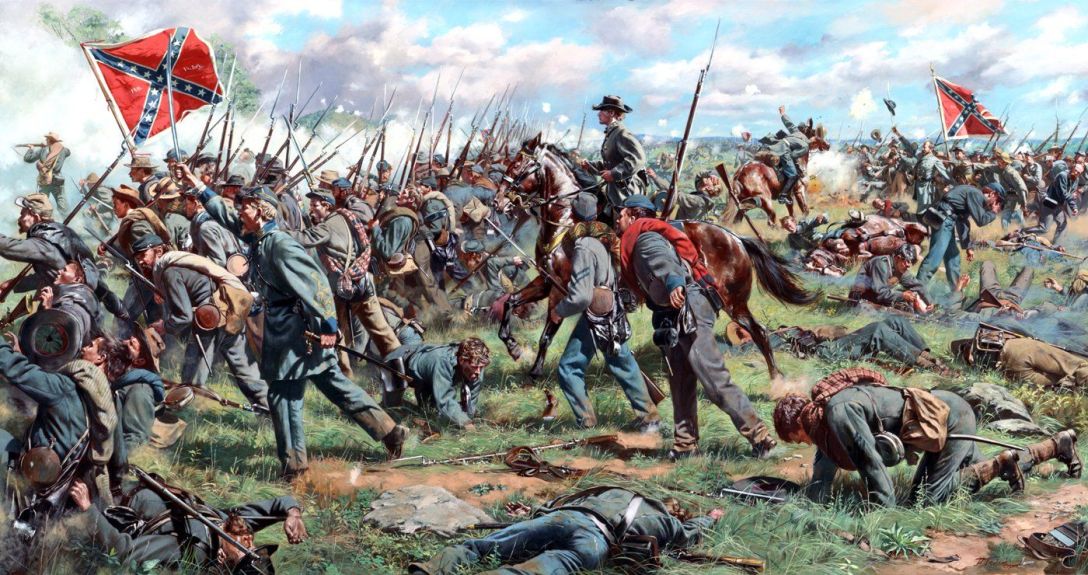
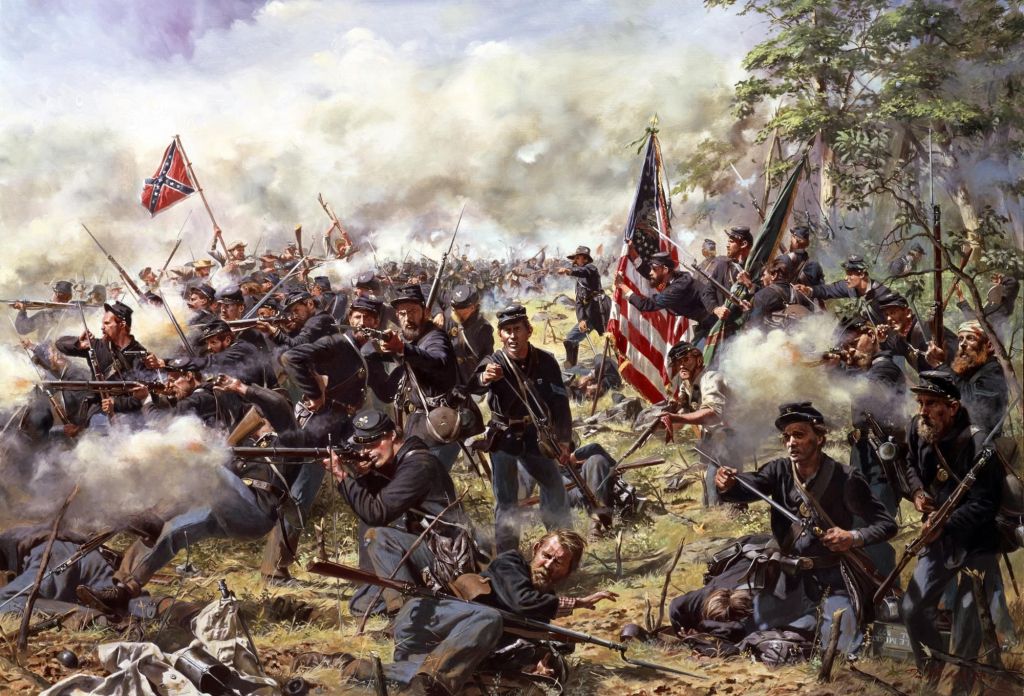
As Confederate artillery began to run low on ammunition the infantry was ordered to form up and prepare for their advance. Around 3pm, Confederate troops stepped out from the tree line along Seminary Ridge and began to move forward in a mile long front proudly and in good order. Crossing over the Emmitsburg Pike, the rebels soon came under a withering fire from Union artillery. Federal guns atop Little Round Top ripped huge gaping holes in the Confederate right flank while those on Cemetery Hill did the same to the rebel left. Once on the other side of the pike, the attack began to falter as Union gunners along Cemetery Ridge switched to canister shot and musket fire became increasingly accurate and effective. Despite mounting losses the Confederates pressed on until they reached a small stone wall which was their destination. The remaining men rushed the stone wall and brutal hand-to-hand combat ensued. The Union quickly reinforced their lines with fresh men and counterattacked. The rebels, expecting reinforcements that never showed, were forced to flee back to their original lines. As the survivors straggled back to Seminary Ridge, many of them passed Robert E. Lee, who told them, “It is my fault.” The attack failed and with it any hope of victory.

Union forces push back the rebels at the stone wall


In the words of William Faulkner, “For every Southern boy fourteen years old, not once but whenever he wants it, there is the instant when it’s still not yet two o’clock on that July afternoon in 1863, the brigades are in position behind the rail fence, the guns are laid and ready in the woods and the furled flags are already loosened to break out and Pickett himself with his long oiled ringlets and his hat in one hand probably and his sword in the other looking up the hill waiting for Longstreet to give the word and it’s all in the balance, it hasn’t happened yet, it hasn’t even begun yet, it not only hasn’t begun yet but there is still time for it not to begin against that position and those circumstances…

The Southern rebellion is now doomed. It is just now a matter of time.


Gettysburg, Day Two: July 2, 1863

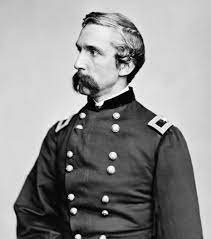
On July 2, 1863, Colonel Joshua Chamberlain and 350 determined volunteers from the 20th Maine Infantry Regiment beat back repeated Confederate assaults on the Union position at Little Round Top at the Battle of Gettysburg thwarting General Robert E. Lee’s plan for a decisive victory on Northern soil that would secure European recognition of the Confederacy and possibly bring Great Britain and France into the war on the side of the South.

Colonel Joshua Chamberlain

The first day was a clear and unequivocal victory for the Confederates. Lee’s army pushed the Union I and XI Corps south of town. However, Ewell’s failure to deliver the coup de grace and drive Union forces from their stronghold atop Cemetery Hill presented Lee with a dilemma. Should he follow the recommendation of his trusted “Old Warhorse” General James Longstreet to retreat, get between the Union Army and Washington, and to initiate a battle at a time and place of its choosing. Lee, the normally bold and aggressive strategist would have nothing to do with a retreat. He wanted to press his first day advantage.

For the better part of the day Lee and his staff vigorously debated the merits of continuing the battle or retreating.  Six out of the seven corps that formed the Union Army of the Potomac were now on the field outnumbering the Confederates. In addition, they occupied a strong defensive position south of town in the shape of a fish hook. Union forces entrenched on Cemetery Hill constituted the barb of the hook while a long line of troops running along Cemetery Ridge formed the shaft. Longstreet argued it was imprudent to attack such a fortified position. However, the left flank of the Union army was exposed, ending at a lightly defended hill with the colorful name of Little Round Top. Here, Lee would focus his attack.

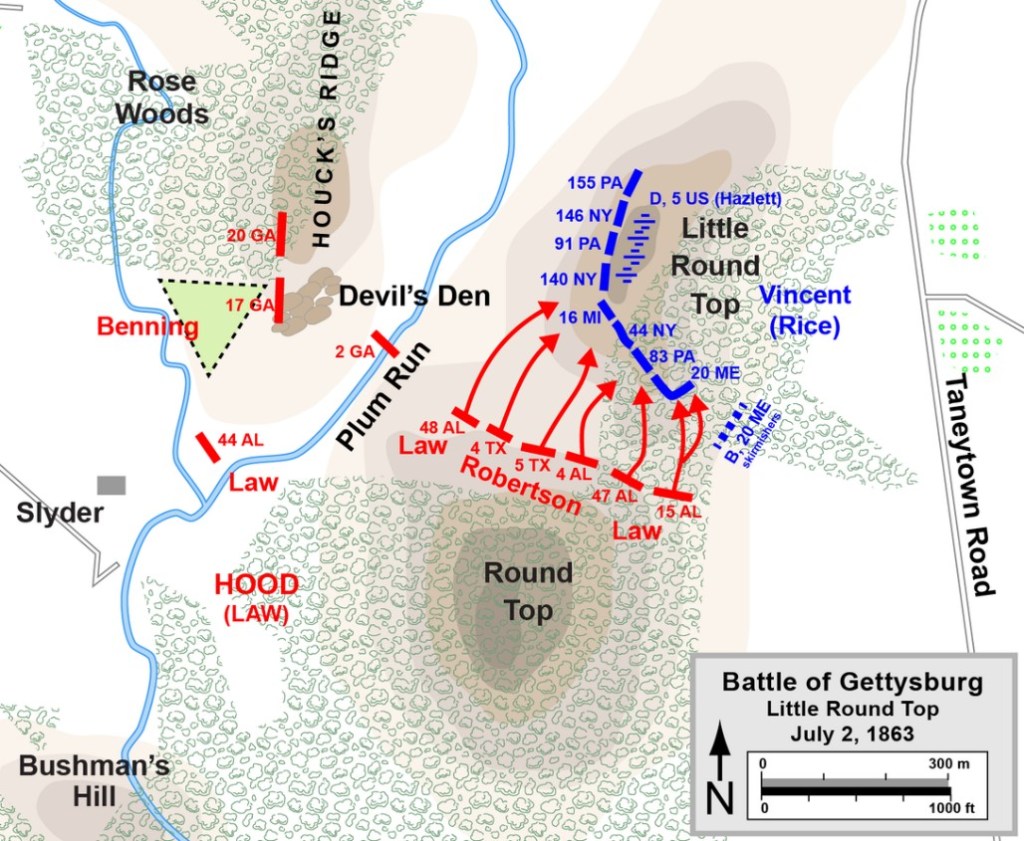
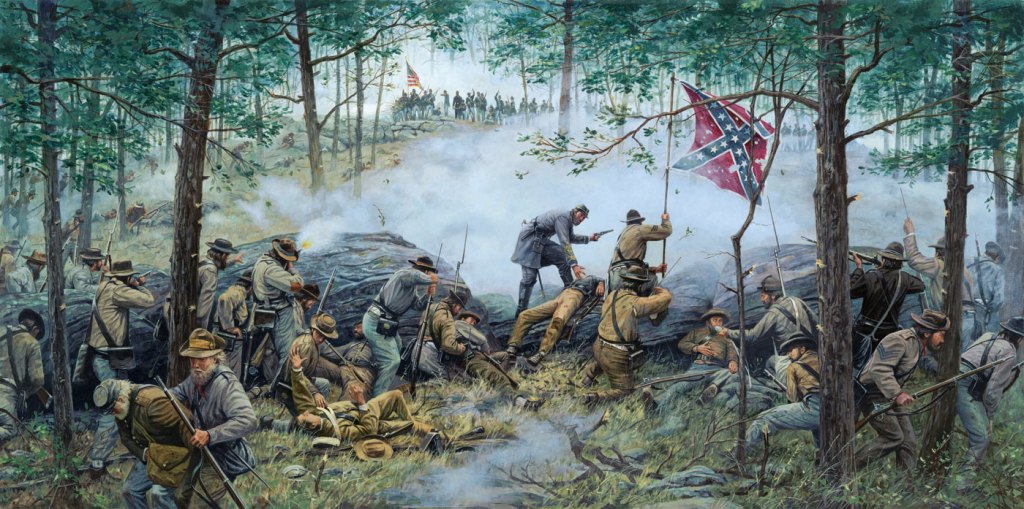
The Confederates began their assault around 4:30 pm led by Major General John Bell Hood’s Division. The right of Hood’s division, General Evander Law’s Alabama brigade spearheaded the attack on Little Round Top. In an effort to obscure their advance, Law’s men scaled the neighboring larger hill, Big Round Top.  By the time they were in position to launch their attack, the men from Alabama were already exhausted and without water on what was a sweltering July day. Moreover, Confederate efforts to conceal their intentions went for naught. Union observers spotted the Confederate advance and reinforcements, including the 20th Maine, were rushed to Little Round Top. Chamberlain and his regiment arrived on the scene, taking up a position at the extreme left of the Union line, roughly 15 minutes before the Confederate attack began.

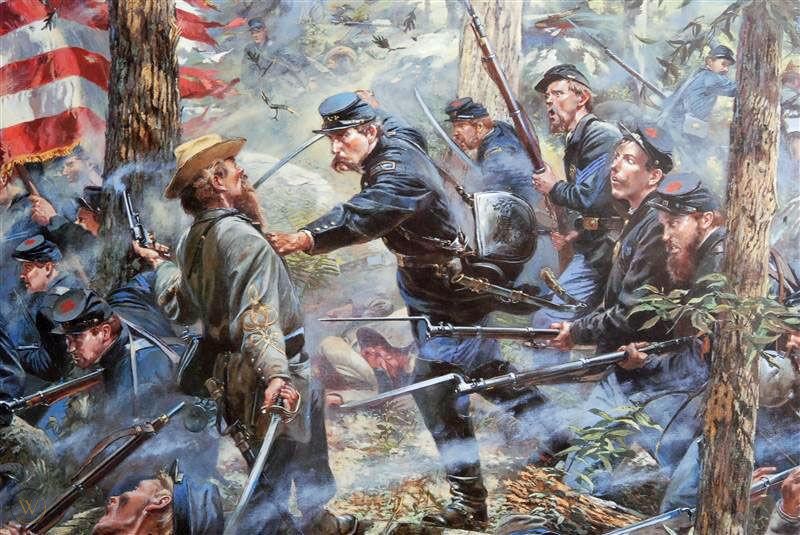
The Confederates stormed up the side of Little Round Top led by the 15th Alabama Regiment. Over the course of an hour, the 20th Maine repulsed two determined Confederate charges seeking to dislodge the Federals, sending the Alabamians tumbling back down the hillside. The Confederates launched a third charge against the 20th Maine as the regiment exhausted its ammunition. Faced with few good options, Lieutenant Colonel Chamberlain quickly ordered his men to fix bayonets and charge downhill to meet the advancing Confederates. Chamberlain’s counterattack would sweep the Alabamians from the field and for all intents and purposes end any further Confederate attacks against Little Round Top.

Despite their setback at Little Round Top, the Confederates would continue their echelon attack up and down the Emmitsburg Pike. The two sides would fight an incredibly bloody battle in the Wheat field in which control of the field passed back and forth between the two sides with the Union ultimately prevailing. Confederate General Ambrose Wright’s brigade of Georgians almost broke the Union line further up the Emmitsburg Pike if it were not for the timely arrival of the 1st Minnesota Regiment that blunted the Georgian advance and sent them retreating back towards Seminary Ridge. A twilight attack against entrenched Union forces on Culp’s Hill by General Edward “Allegheny” Johnson’s division was also turned back. The second day ended as a clear victory for the Union. All of Lee’s assaults had been repulsed. Even though the battle would continue into a third day, it was anti-climatic as the decisive Union victory on day two all but ensured the Confederates defeat.

Gettysburg Day One: July 1, 1863

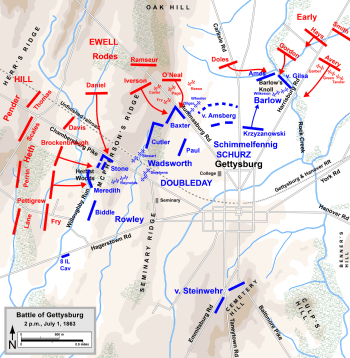
On July 1, 1863 two Confederate brigades, one from Tennessee and one from Mississippi advanced down the Cashtown pike engaging elements of Union General John Buford’s Cavalry division west of the sleepy little Pennsylvania town of Gettysburg. Bufford’s mission is clear, Buy time for the first Corp and the rest of the Union army to arrive. Buffords cavalry is able to halt the Confederate advance for two hours allowing the first infantry brigades of the first Corps to arrive on the scene. However, Confederate General A.P. Hill deploys two more divisions and the Confederate II Corps under General Ewell is advancing from the North. By late afternoon the Rebels have taken Semminary ridge and forced the Union forces to retreat south of town. The rout is on. With the sun setting General Lee gives an ambiguous order to General Richard Ewell to push the scattered Union forces from Cemetery Hill, “if practical.” Ewell decides against such action, which becomes a pivotal point in the battle. Day one goes to the Confederacy but Ewell’s failure to act is a major turning point.