

July 18, 1863- The battle of Fort Wagner- For three years Charleston South Carolina was an open wound for Union forces. It was here on April 14, 1861 that the Federal garrison at Fort Sumter, in the middle of Charleston harbor, was forced to surrender after being bombarded by Confederate forces in Charleston, initiating the Civil War. For, two and a half years the Union Navy had blockaded all of the major Southern ports in an effort to strangle the Confederacy. Repeated efforts to capture Charleston failed as the city was protected by a series of strategically placed forts and batteries.

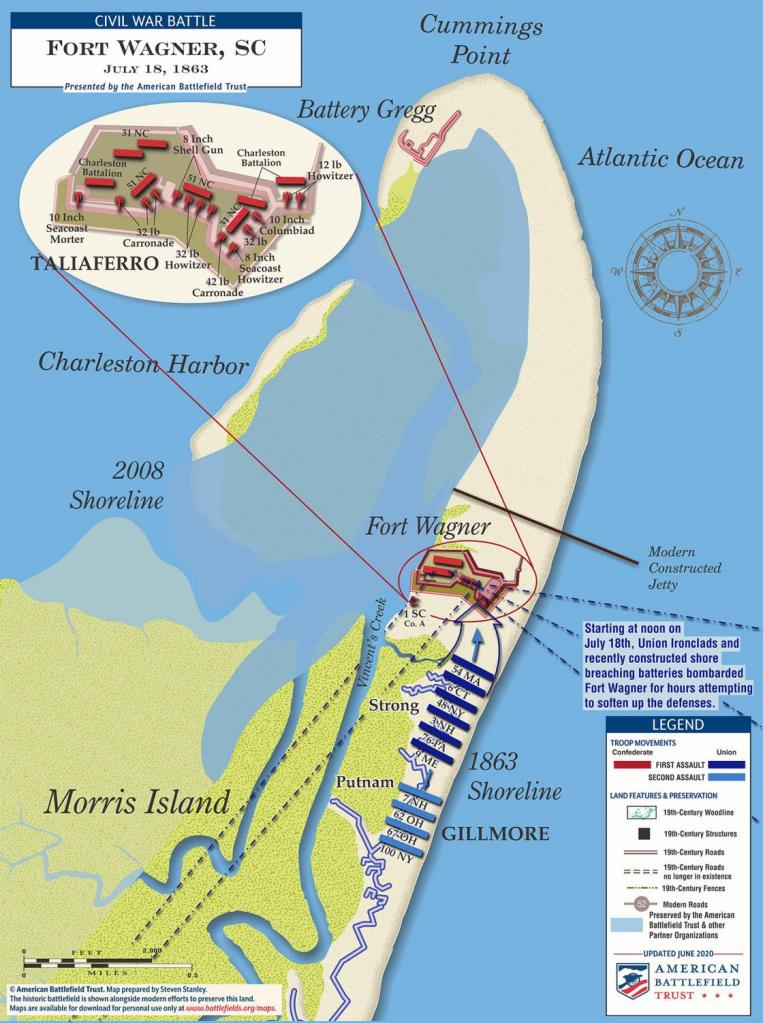
In the spring of 1863, the Federals planned operations to neutralize the fortifications surrounding Charleston and capture the city. Crucial to their plan was the capture of Fort Wagner on Morris Island. On the evening of July 18, after a grueling day long bombardment, the 54th Massachusetts, a regiment of black soldiers spearheaded a direct assault on the fort. Commanded by Colonel Robert Gould Shaw, the scion of a wealthy Massachusetts abolitionist family, the unit was made up of freedmen and escaped slaves and intended to show that African-Americans were more than willing and capable to fight for their freedom. Prior to he assault, the regiment had bee tasked mostly with manual labor and had seen only limited action, as the army command continued to view the 54th as a political project rather than a military unit. The attack started off slowly but proceeded to the double quick as Confederate artillery tore apart the ranks of the 54th with devastating effect. Scaling the top of the earthworks, the 54th was met with a murderous volley of musket fire from the forts defenders killing Colonel Shaw and many others. The attack would ultimately fail with the regiment suffering over 40 percent casualties. Nevertheless, the men of the 54th fought bravely and with great valor. Sergeant William H. Carney, was wounded three times in the hip, chest and head as he retrieved the regimental standard after the flag-bearer was shot. He would receive the nation’s highest combat decoration, the Medal of Honor. Because of the valor shown by the men of the 54th, the US Army increased the number of black enlistments so that by 1865 almost two hundred thousand African Americans had served from 1863-1865. African-American soldiers would fight bravely in other places such as Petersburg and suffer atrocities at the hands or rebel soldiers at Fort Pillow.
African-American soldiers would continue to lay down their lives for their country in World War I and World War II but would still face discrimination and be forced to serve in segregated units until July 26, 1948 when President Truman desegregated the military.

 Tragedy and Farce