

On August 28, 1955, a fourteen year old African-American boy from Chicago, Emmett Till, was kidnapped, brutally murdered and tossed into the Tallahatchie River for allegedly whistling or making inappropriate advances at a white woman while visiting his relatives in Mississippi. Till’s murder would spark a wave of righteous indignation across the nation because of the sheer brutality of the lynching and the young age of the victim. Although Till’s murder would go unpunished, it would prove to be a watershed moment for race relations in the United States serving as a spring board for the Civil Rights movement and the eventual demise of the Jim Crowe South.
The summer of 1955 was a hot one in the United States. Racial tensions were at a pitch in the wake of the Supreme Court’s landmark decision in the case of Brown v. Board of Education which declared race-based segregation unconstitutional. Embittered Southern whites regarded the Court’s decision as a threat to the established racial hierarchy and white supremacist power structure and vowed a campaign of “massive resistance.” In the months before Till’s murder, Rev. George Lee and Lamar Smith were separately shot and killed in Mississippi after organizing black voter-registration drives. In both cases, investigations identified credible white suspects but potential witnesses were afraid to talk and no charges were ever brought. Seeking to escape the boredom of another Chicago summer, Mamie Till Mobley sent her only child to visit her relatives in Money, Mississippi. Before leaving, Mrs. Till Mobley urged her son to be careful and to watch how he behaved in front of white people, warning that Chicago and Mississippi were completely different. “Even though you think you’re perfectly within your right, for goodness sake take low,” she said, according to subsequently published accounts. “If necessary, get on your knees and beg apologies,” she told him. This was the cauldron of hate fourteen year old Emmett Till was about to enter.
Till arrived at the home of his uncle Mose Wright in the Mississippi Delta town of Money on August 21. Three days later he and his two cousins headed to the local grocery store to buy some candy. The store mostly served the local sharecropper population and was owned by a poor white couple, 24-year-old Roy Bryant and his 21-year-old wife Carolyn. Carolyn Bryant was working the front of the store alone that day; her sister-in-law was in the rear of the store watching the Bryant children. What actually happened next is subject to multiple conflicting accounts but most claim that Till had whistled at Bryant or had engaged in some other unacceptable advance that violated the mores of Jim Crowe Mississippi. Bryant stormed out of the store and warned she was going to get a pistol.


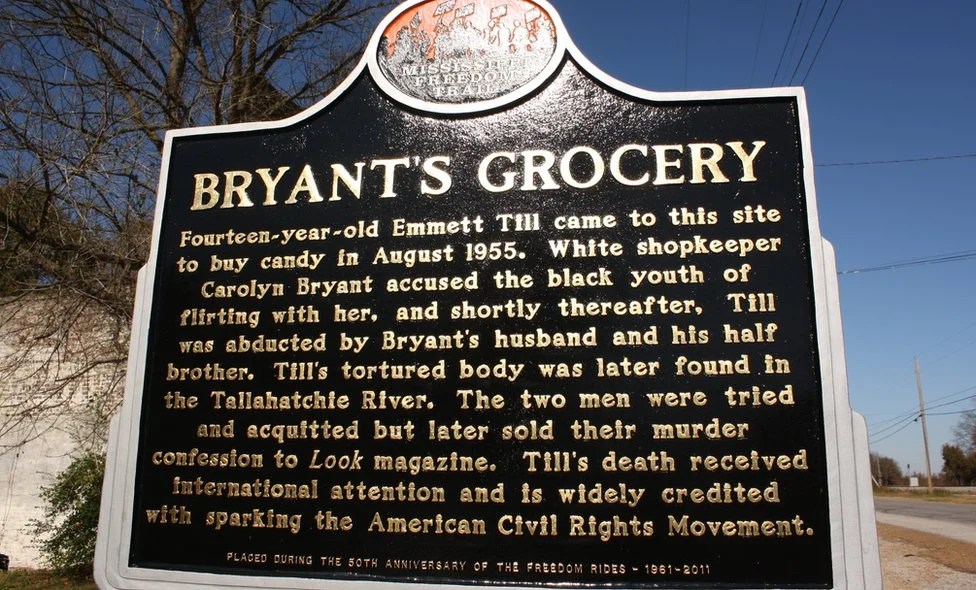
Till and his cousins immediately understood the gravity of the situation. They quickly fled the scene at the urging of some of the older men around town hoping to avoid any unwanted violence. Till refrained from telling his uncle what had happened, fearful of what reprimand might happen and pleaded to return home to Chicago immediately. A few days later, Roy Bryant and his half brother , J.W. Millam went to Mose Wright’s home, in the dead of night, and abducted the terrified 14-year old at gun point. They marched Till to the back of their pick up truck and tied him up before driving off to an isolated barn where they proceeded to teach the young boy a deadly lesson. There they beat Till mercilessly as the boy begged for his mother. They poked out his eye and finally shot him in the head. Once dead, they tied a 75-pound cotton-gin fan around his neck with barbed wire and tossed his body into the Tallahatchie River demonstrating absolutely no remorse for what they had done.

When Till’s body was pulled from the river, his mother could barely identify her son. Mississippi officials pressured Mamie Till Mobley to quickly burry her son in a closed casket ceremony seeking to downplay the murder and move on. Mamie Till Mobley was a strong black woman and she was determined that her only son would not die in vain. Instead, she returned the badly disfigured body to Chicago, where she held an open casket funeral intending to capture the nation’s attention and shine a spotlight on the rampant racism and white supremacist violence directed at African-Americans in the South. The train carrying Till’s body was greeted by large crowds and over 200,000 people paid their respects during the four days of public viewings. Jet Magazine published an expose of photos of Till’s mangled body and his grieving mother at the funeral and the photos reverberated across the nation and around the world. These images would galvanize a movement and inspire African-American Americans to put life and limb at risk in pursuit of the rights, racial equality and justice promised to them as American citizens under the constitution. Less than six months later, an African-American woman in Montgomery Alabama, Rosa Parks, was arrested and fined for refusing to give up her bus seat to a white passenger. When asked why she refused to move Parks explained that she thought about going to the back of the bus but then she thought about Emmett Till and she couldn’t do it.
Roy Bryant and J.W. Millam were arrested for murder within days after Till’s body was discovered but the likelihood of two white men being convicted of murdering an African-American boy in 1950s Mississippi was somewhere between slim and none. The two men were quickly put on trial in September and battle lines were immediately drawn. Northern outrage at the murder prompted many Southerners to resent what they derisively called outside interference and rally in support of the suspects. When Bryant and Millam could not afford an attorney, every lawyer in the county donated their services and $10,000 was collected from local businessmen in support of Bryant and Millam’s defense. Moreover, many whites showed up to watch the trial, bringing their children, picnic baskets and ice cream cones. Meanwhile, African American spectators were relegated to the back and looked on in fear and anger. This was the reality of the Jim Crow South for African Americans. A black man could be killed by a white man without any care or consequence. Neither Bryant nor Millam would be called to the stand to testify and they would eventually be acquitted by an all white male jury after only 67 minutes of deliberations. Jurors later admitted in interviews that although they knew Bryant and Milam were guilty of Till’s murder, they did not think imprisonment or the death penalty were appropriate punishments for white men who had killed a black man. After the verdict was read, Bryant and Millam defiantly walked out of the courtroom lit up cigars and kissed their wives in celebration.

Months later, the two men confessed to killing Till in an interview with Look magazine in exchange for $4,000, however, because of the precedent of double jeopardy in U.S. law, they were never tried again for the murder. In 2017, Carolyn Bryant recanted her testimony, that Till had grabbed her wrist and used sexual obscenities admitting that he had never touched, threatened or harassed her. “Nothing that boy did could ever justify what happened to him,” she said.
Emmett Till’s story would be a historical footnote if it were the exception but it wasn’t. Lynchings were a way of life in the Jim Crow South. They were a tool of extralegal terror intended to intimidate and control African-Americans and maintain a white supremacist power structure by denying them their constitutional rights as American citizens. From 1882 to 1968, 4,743 lynchings occurred in the U.S., according to records maintained by NAACP. The highest number of lynchings during that time period occurred in Mississippi, with 581 recorded. Georgia was second with 531, and Texas was third with 493. Most of these acts of racial terror went unpunished and many occurred with the active participation of law enforcement. Because most African-Americans in the South were denied their right to vote, they could neither elect judges, sheriffs and other officials more representative and protective of their interests or serve on juries. In 2022, President Joe Biden signed the Emmett Till Antilynching Act into law, making lynching a federal hate crime after more than a century of failed efforts in Congress to pass similar legislation.



 Tragedy and Farce