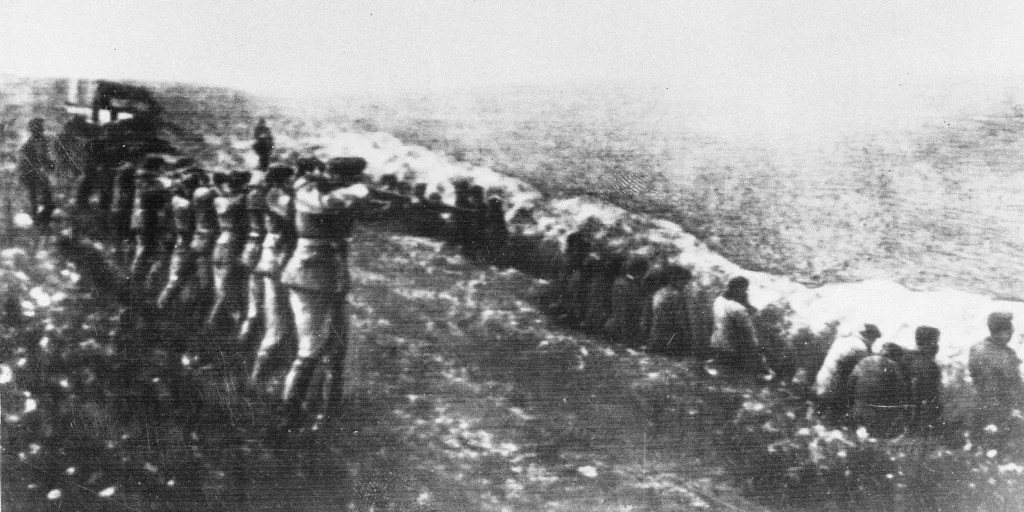
On September 29-30, 1941, the Nazis carried out a mass execution of over 33,000 Soviet Jews at the Babi Yar ravine just outside of Kyiv, Ukraine. The Jews were told they were being relocated and were marched in small groups to the outskirts of the city. There they were stripped naked, their possessions confiscated, and machine-gunned into the ravine by mobile killing squads associated with the Nazi SS called Einsatzgrupen and some Ukrainian auxiliary police. It was one of the largest mass executions of World War II and the apex of the “Bullet Holocaust,” the period before 1942 when the Nazis transitioned to a more systematic approach to exterminating Europe’s Jews using poison gas and “death camps” such as Auschwitz in occupied Poland.
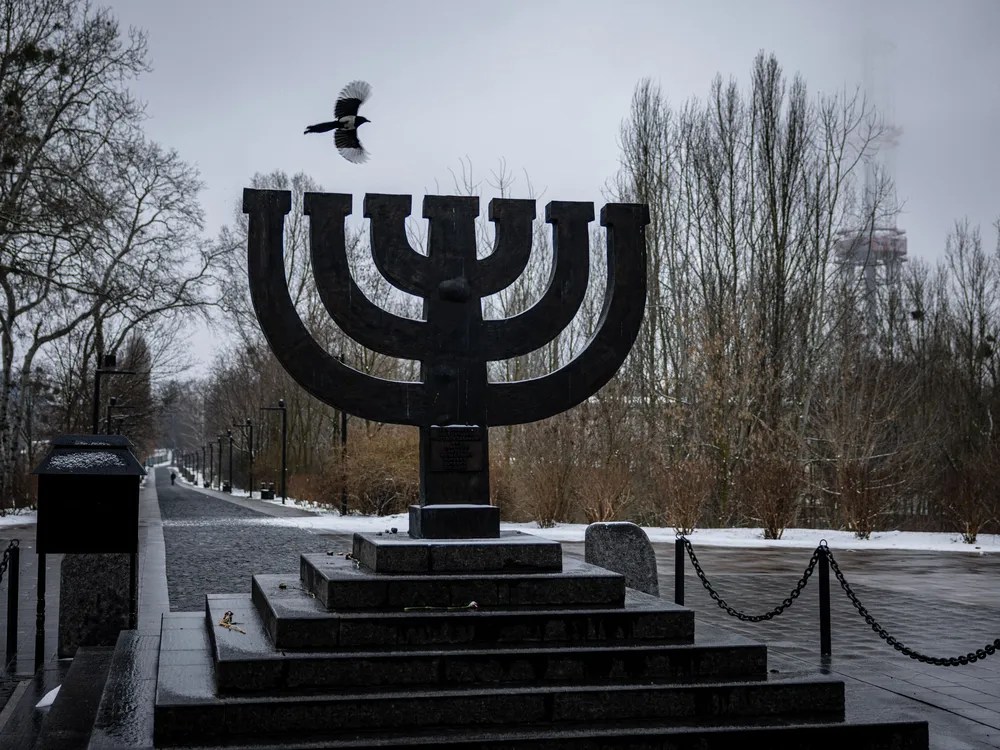
The Babi Yar Memorial Complex outside Kyiv
Nazi Germany invaded the Soviet Union on June 22, 1941 and as the German Wehrmacht advanced deeper into the USSR a wave of executions followed in its wake. In places such as Lithuania, Latvia, Belarus, Moldova and Ukraine, Jews were rounded up and summarily shot by the Einsatzgrupen and local anti-Semites, all in accordance with Adolf Hitler’s racial ideology of creating Lebensraum, or “living space” for the 1000-year German Reich.
The Nazis seized Kyiv, the capital of the Ukrainian Soviet Socialist Republic, on September 19 and the Einsatzgrupen units were ordered to exterminate all Jews and Soviet commissars found there. By the time Germans reached Kyiv in mid-September 1941, about 100,000 of the city’s prewar Jewish population of 160,000 already had fled or joined the Soviet military to fight the invasion. Those that remained were largely women, children, the elderly, and the infirm. During the first week of the German occupation of Kyiv, two major explosions rocked the city, destroying the military headquarters of the German Army Group South and killing a large number of German soldiers. Although the explosions were caused by mines left by retreating Soviet soldiers, the Germans used the sabotage as a pretext to murder those Jews who still remained in Kyiv. On September 26 the German Army and the SS concluded that Kyiv’s Jewish population wouldn’t be confined in a ghetto, but instead annihilated at Babi Yar. Two days later, Nazi authorities in Kyiv ordered all Jewish residents to appear the next morning at an intersection in the city’s Lukianivka district, with all their personal documents, money and valuables and warm clothing. They were then marched through the city to Babi Yar where they were told to undress and lined up and shot. Infants were taken from their parents’ arms and thrown into the ravine.
Einsatzgruppen Executing Ukraine’s Jews at Babi Yar
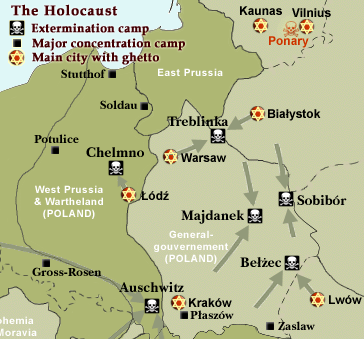
In late 1941, SS head Heinrich Himmler witnessed an Einsatzgruppen mass execution first-hand and concluded that shooting Jews was too costly, inefficient, and exerted too much stress on his men. In November Himmler decided a transition should be made away from mass shootings to the use of poison gas, especially with women and children. Experiments with the use of Zyklon B, a cyanide-based gas, had been in effect since September as well as mobile gas vans to murder mentally ill patients. However, the gas vans were not popular with the Einsatzkommandos, because removing the dead bodies from the van and burying them was a horrible ordeal. On January 20, 1942, Himmler and numerous other Nazi officials involved in implementing the “Final Solution” met in the Berlin suburb of Wannsee to formalize plans for the total eradication of Europe’s 11 million Jews. Here it was decided that the Einsatzgruppen Mobil killing units would be replaced by permanent killing centers at Auschwitz, Belzec, Chelmno, Majdanek, Sobibor, Treblinka, in occupied Poland.
On 17 September 1862, Confederate and Union military forces clashed near Antietam Creek in Western Maryland in what would become the bloodiest day in American history. The two armies together would suffer almost 23,000 killed or wounded and places named “the Cornfield,” “Bloody Lane” or “Burnside’s Bridge” would become forever etched in the collective memory of the nation. The outnumbered Confederates under General Robert E. Lee barely escaped a catastrophic defeat that might have ended the civil war two years sooner if it were not for the indecision of Union General George B. McClellan and his over abundance of caution. Lee’s narrow escape would allow the Confederacy to survive another two and a half years and prove the adage that sometimes it is better to be lucky than good.
The summer of 1862 was ending on a high note for the Confederacy after McClellan’s defeat in the Seven Days Battle and an impressive victory at Second Manassas. In Lee’s mind, momentum was on the side of the Confederacy, and it was time to bring the war to the North. It was time to invade Maryland. Although Maryland was a border state, many Marylanders held pro-Southern sympathies, and Lee calculated that a decisive victory on Maryland soil would not only demoralize the Union but bring Maryland into the war on the side of the Confederacy. It also was harvest time, and Lee wanted to take the war out of Virginia so that its farmers could collect their crops to help feed his army. Many of Lee’s troops were underfed and malnourished subsisting on field corn and green apples, which often gave them indigestion and diarrhea, negatively impacting their availability for combat.
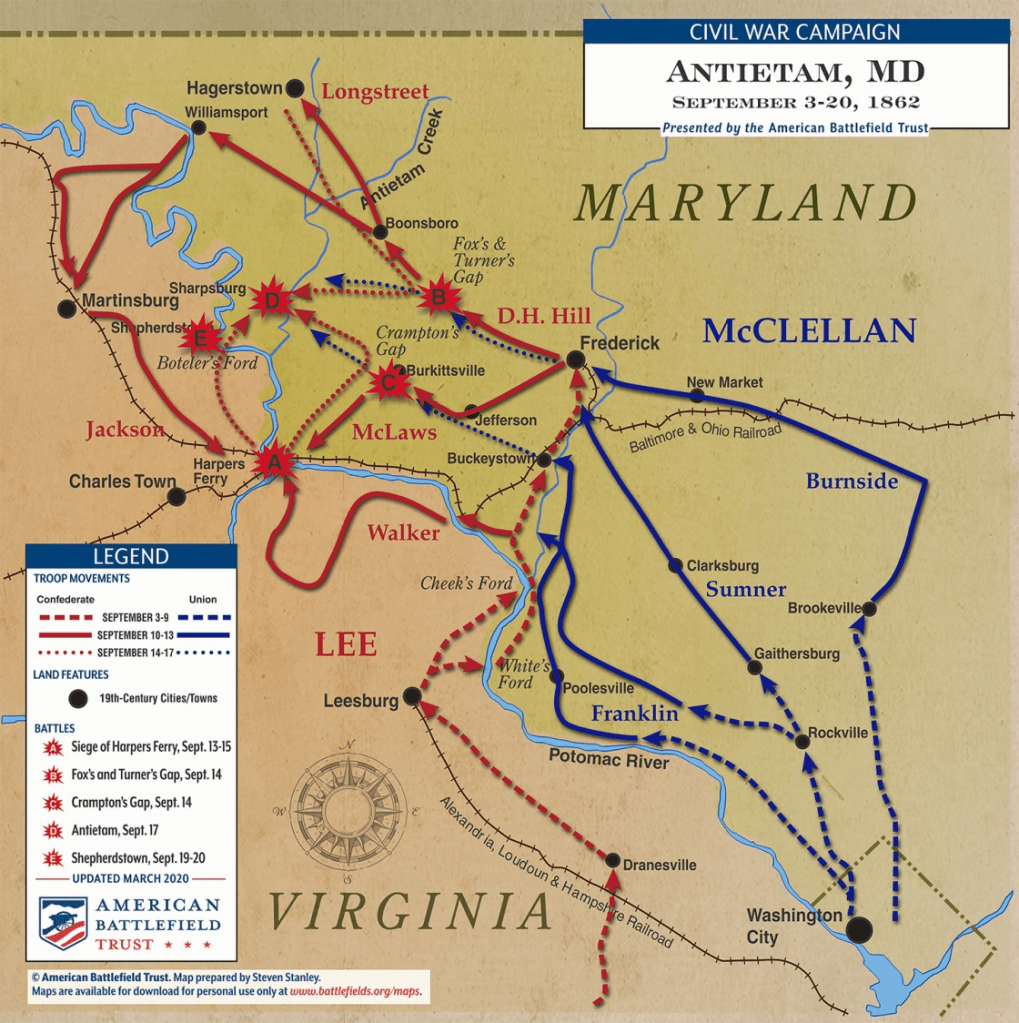
Lee and his 55,000-man army crossed the Potomac River into Maryland on September 4. Three days later his ragged and barefoot army entered the city of Frederick where they encountered an unexpectedly cool reception. Instead of an outpouring of support and affection they found a lack of enthusiasm for their cause if not outright hostility. Several pro-southern citizens of Frederick could not believe that the victorious Confederate army that they heard about was so poorly clad while other stunned citizens just turned their backs. One unnamed citizen noted: “I have never seen a mass of such filthy strong-smelling men.” Lee expected that once he entered Frederick the Union garrisons at Harper’s Ferry and Martinsburg would be withdrawn, clearing the way for him to establish communications through the Shenandoah Valley. Lee could not continue his invasion with these troops sitting on his supply line. He audaciously divided his army and prepared to move deeper into the North while simultaneously seizing Harpers Ferry.
Word that Lee and his army were occupying Frederick prompted McClellan and his 100,000-man army to pursue the rebels. McClellan by nature, was overly cautious. He also consistently overexaggerated the strength of Lee’s army. As a result, his pursuit of Lee lacked the urgency the situation demanded. When McClellan finally reached Frederick on September 12, Lee already divided his army and began to move West. However, McClellan received a stroke of good luck near Frederick when soldiers from the 27th Indiana Regiment discovered a copy of Lee’s orders for the Harper’s Ferry operation, Special Orders no. 191, lying on the ground wrapped around three cigars in a recently abandoned Confederate camp. The discovery of the orders clarified the operational picture for McClellan and revealed that Lee’s army was divided and ripe for defeat in detail.
Now fully aware of Lee’s intentions, McClellan had a simple plan; attack and destroy each element of the Confederate army before it had a chance to reunite. McClellan boasted to Brigadier General John Gibbon of the famed Iron Brigade, “Now I know what to do! Here is a paper with which, if I cannot whip Bobby Lee, I will be willing to go home.” McClellan was determined to seize the initiative and the slowness that characterized his earlier movements disappeared as he raced his army toward the South Mountain range to attack Lee’s army Lee was aware that McClellan was closing in, so after crossing the mountain he sent word to Stonewall Jackson besieging Harper’s Ferry to quickly finish up the task. He also left a rear guard to defend the passes at Turner’s, Fox’s and Crampton’s Gaps to delay McClellan’s and allow time for his army to regroup.
On September 14, advance elements of McClellan’s army engaged Confederate forces guarding the three passes in fierce fighting. The fight would last all day into nightfall and when it was over the Confederates still precariously held two of the three passes. The following day, the Federal garrison at Harpers Ferry surrendered and Lee ordered the forces at South Mountain to withdraw and rejoin the rest of his army near the small town of Sharpsburg. Stonewall Jackson and his men also hurried from Harpers Ferry to rejoin Lee’s army at Sharpsburg, with the exception of General A.P. Hill’s division which remained at Harpers Ferry to prevent Union forces from retaking the town.
Lee had strongly considered breaking off his Maryland Campaign and returning to Virginia but when he received the news of Harpers Ferry’s surrender he decided to remain. He used much of September 16 to reorganize and reposition his army for a battle he knew was coming. In characteristic fashion, McClellan’s innate caution prevented him from taking advantage of an opportunity to crush Lee’s army before it could reunite. McClellan spent much of the two days following the battle at South Mountain drawing up plans instead of vigorously pursuing Lee’s exhausted men. When McClellan did arrive near Sharpsburg, on September 16, he discovered Lee had established a 2.5 mile long battle line behind Antietam Creek. That evening Union and Confederate forces skirmished,McClellan drafted a straightforward battle plan. The next day, his army would strike at each of Lee’s flanks simultaneously, followed by a massive assault on the Confederate center. Even though McClellan’s plan was straight forward, the execution of it was wanting.
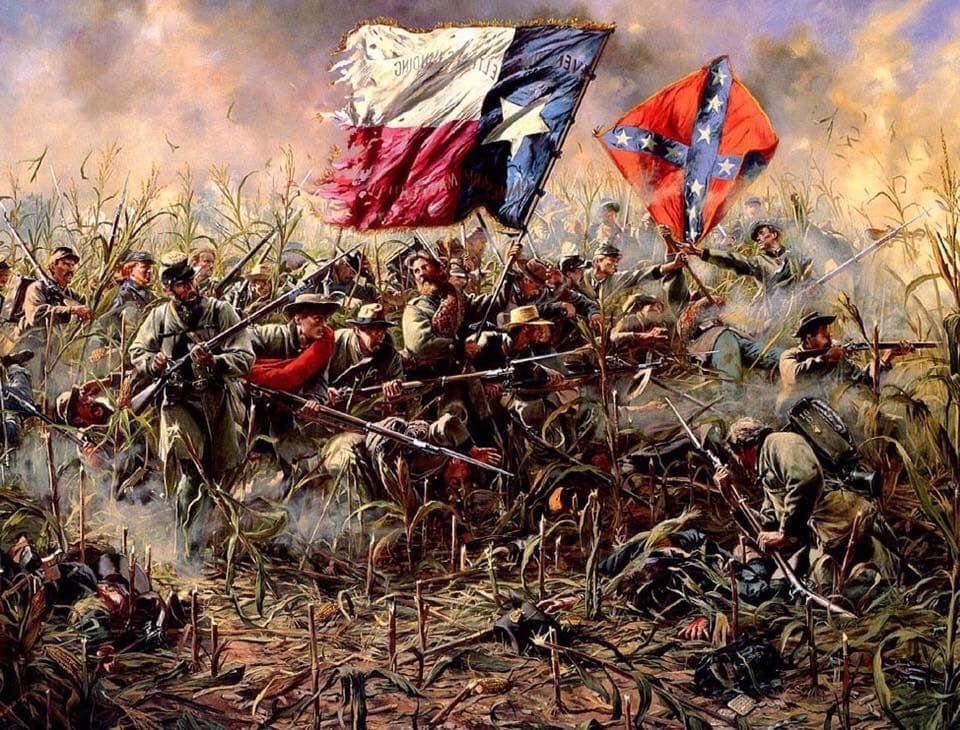
The battle began the following morning at daybreak when the first brigades of General Joe Hooker’s I Corps entered the cornfield of farmer David Miller which would become ground zero for the initial phase of the battle. Hooker’s objective was simple, strike Lee’s left flank and drive it back past a small white stone structure known as the Dunker Church. There was no element of surprise to Hooker’s attack. Lee’s men were prepared and when the first Union troops exited the cornfield a brigade of Georgians rose from the ground, from about 200 yards away, and unleashed a withering volley, knocking dozens from the ranks. Thousands of additional Federals were cut down in the tall corn rows and over the next four hours the field would change hands at least six times. Even when reinforcements from General Joe Mansfield’s XII Corps and General Edwin Summer’s II Corps managed to drive the rebels back to the Dunker Church and the West Woods, a vicious Confederate counterattack forced the Federals to withdraw. By mid-morning, both sides together would suffer around 10,000 killed and wounded by the time fighting in the cornfield and West Woods ended.
The 1st Texas Infantry Drives the Federals from the Cornfield
The focus of the battle soon shifted from the left to the center of the Confederate line. Here two brigades from Alabama and North Carolina occupied a strong defensive position in a fence-lined sunken farm road that would later become known as “Bloody Lane.” The road was worn down from years of wagon use and formed a natural trench for the defenders. Here, over the next three hours, hundreds of Union soldiers, including the famed Irish Brigade, with their colorful green banners, were cut down as they crested a ridge in front of the Rebel defenders. Two Union regiments eventually managed to flank the Confederate line and seized a slightly elevated position that allowed them to pour down a murderous fire upon the rebels. Several brigade and regimental commanders went down and the entire Confederate line began to break under the weight of the attack and a broken command structure. Soon the Confederates were fleeing back towards Sharpsburg with Federals in hot pursuit. With no reserves to commit, First Corps Commander, James Longstreet, masses an artillery barrage that sends the Federals reeling. The situation was so dire that Longstreet and his staff manned one of the rebel artillery pieces. By 1:00 pm, 2500 Confederate dead and wounded lined the sunken road. Union casualties totaled just under 3,000. The fight at the sunken road is a pivotal point in the battle that is the difference between a decisive Union victory and a tactical draw. There are no Confederate reserves left but McClellan grievously overestimated the strength of Lee’s army. Fearing a Confederate counterattack, he declines to deploy his two Corps he has in reserve which probably would have allowed him to cut Lee off from his escape route across the Potomac at Boetler’s Ford.
The final phase of the battle shifts to the Confederate right in the afternoon where a determined Union assault crushes the rebel flank and disaster is only averted by the timely arrival of General A.P. Hill’s division from nearby Harpers Ferry. The key players in this drama were General Ambrose Burnside and his 12,000 strong IX Corps, tasked with rolling up the Confederate flank and cutting off Lee’s retreat, and four undermanned Confederate brigades totaling about 3,000 men standing in his way. The stage is a 12-foot-wide stone bridge crossing Antietam Creek and the rocky high ground on the other side overlooking the bridge that is occupied by 500 Georgians.
Confederate dead in the Sunken Road
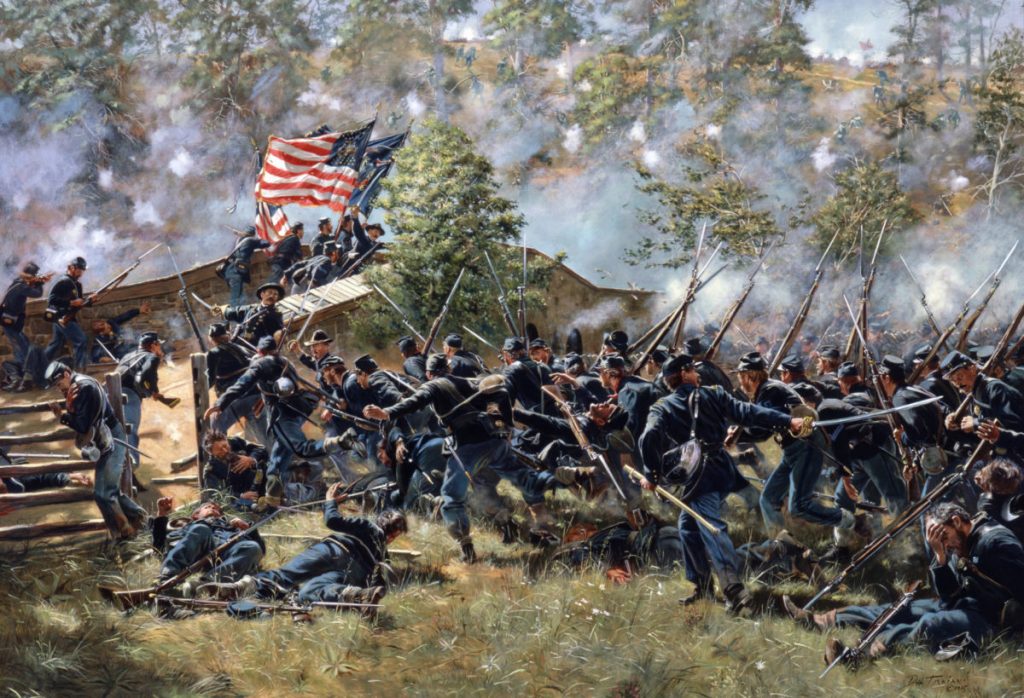
Burnside’s battle plan was to storm the bridge while enacting a crossing, miles downstream where the creek was shallow and could be forded more easily. Around 10 am he launched the first out of what would be three attempts, to seize the bridge. At the same time, he ordered one of his divisions South in search of a crossing point at Snavely’s Ford. The first direct attempt to take the bridge was a complete fiasco. The Connecticut regiment leading the attack came under a withering fire from the Georgians occupying the bluff overhead and within 15 minutes the regiment lost a third of its combat strength. The second assault led by a Maryland and New Hampshire regiment was equally ineffective and costly. By this point in time McClellan was growing impatient and pressing Burnside to take the bridge at all costs. Around 12:30 Confederate volleys began to slack off as the Georgians occupying the bluff overhead began to run low on ammunition. Sensing an opportunity, one New York and one Pennsylvania regiment stormed the bridge under a heavy cover of canister and musket fire. With their ammunition depleted and word spreading that Union troops were crossing near Snavely’s Ford the Confederates fell back, allowing the Federals to cross unopposed.
The 51st Pennsylvania Regiment Seizes the Stone Bridge
Burnside had finally taken the bridge but failed to advance with the urgency the situation warranted. He spent two hours moving three of his divisions, his artillery, and supply wagons across the creek before resuming the offensive. This delay proved crucial and was one of the key differences between a decisive Union victory and a tactical draw. It provided Lee with time to regroup and reorganize his beleaguered defenses following the collapse of his center and for General A.P. Hill’s division, which was marching from Harpers Ferry to arrive.
Around 4:00 pm Burnside’s IX Corps swept forward in a mile-wide battle line, driving back every thing in its way, as it pushed to cut off Lee’s retreat across the Potomac at Boteler’s Ford. The advance was led by the colorful Zouaves of the 9th New York infantry. Many of Burnside’s men were inexperienced but their umbers dwarfed the limited Confederate troops in this immediate sector. Lee and his staff were trying desperately to rally their broken forces and stave off a rout but just then, in a most dramatic fashion, General Maxcy Gregg’s brigade of South Carolinians, the vanguard of A.P. Hill’s division, slammed into the exposed left flank of Burnside’s army sending it reeling back down the hills and across Antietam Creek. One Union soldier from the 4th Rhode Island Regiment later described Hill’s counterattack, “They were pouring in a sweeping fire as they advanced, and our men fell like sheep at the slaughter.” By 5:30 the battle was over.
In many ways the battle of Antietam is a tale of failed opportunities, primarily on the Union side, and a contrast in leadership. The battle was a tactical draw, but it could have and should have been a decisive Union victory. It is easy to challenge some of the rationale underpinning Lee’s Maryland campaign. One can also question his decision to split his army in the face of a numerically superior enemy. However, in reviewing the course of the battle, one would be hard pressed to find fault with how Lee and the rest of the Confederate high command conducted the battle or could have better employed all the means at their disposal.
Left: Robert E. Lee, Right: Gerorge B. McClellan
The same cannot be said for McClellan who proved woefully inadequate. in his typical self-important fashion, cabled a situation report back to Washington the day after the battle writing, “Those in whose judgment I rely on tell me I fought the battle splendidly and that it was a masterpiece of art.” In reality, he fought the battle not to lose rather than trying win. As a result, he squandered opportunity after opportunity to inflict a decisive and catastrophic defeat on the rebel army. Throughout, the battle McClellan had kept two army corps, between 20,000-30,000 troops, in reserve. He mistakenly feared he was badly outnumbered by Lee and that should he be defeated he would need a reserve force to prevent Lee from moving further North. Had McClellan deployed those reserves in support of the attack on the Sunken Road, Burnside’s efforts to roll up the Confederate right flank, or even to launch a series of new attacks the following day most likely would have resulted in a decisive Union victory and possibly shortening the war by two years. McClellan would pay a steep price for his timidity. Two months later he would be relieved of his command by President Lincoln.
On September 12, 1683, a combined Polish-German army under the leadership of the King of Poland, Jan Sobieski, routed the Ottoman Turks at the Battle of Vienna. For two months, the capital of the Habsburg Monarchy, was besieged by the Ottomans and brought to the point of near surrender before Sobieski’s relief force shattered the Turkish lines, breaking the siege. The battle would prove to be one of the most pivotal in history, a climactic struggle between Christianity and Islam, that would thwart any further Turkish expansion into Europe and put in motion what would become the slow steady decline of the Ottoman Empire over the next 200 years.
The Ottoman Empire was an aggressively expansionist power that sought to expand beyond its strongholds in Anatolia, the Near East, and the Levant and into the heart of Europe. The Ottomans first crossed the Bosporus and into Europe in 1346, sweeping through the Balkans, subjugating the Serbs, Greeks, Bulgarians, Albanians and other peoples. In May 1453, the Turks seized Constantinople, after an epic siege, closing the curtain on the once powerful Byzantine Empire and putting all of Europe on notice. Over the next century, the Ottomans, under Sultan Suleiman the Magnificent continued their steady advance northward, conquering the Kingdom of Hungary at the Battle of Mohacs in 1526 before finally being halted at the gates of Vienna in 1529. This was the first defeat inflicted on Suleiman, sowing the seeds of a bitter Ottoman–Habsburg rivalry that lasted until the 20th century. In 1566, the Habsburgs once again defeated Suleyman’s army at the battle of Szigetvár again forcing the Ottomans to retreat. However, Ottoman power was beginning to wane and a series of weak Sultans, palace intrigues, and unrest in other far corners of the empire precluded any further advances into Europe for 150 years.
Europe in the mid-17th century was weak, divided, and vulnerable to the Ottoman threat. The Thirty Years war between Catholics and Protestants that ended with the 1648 peace of Westphalia decimated the continent. By the second half of the century, much of Central Europe was still in rebuild mode; relations between Catholics and Protestants remained bitter and France and the Hapsburgs continued to vie for supremacy on the continent. Under these conditions, the Ottoman Sultan Mehemet IV accepted the recommendation of his overly ambitious Grand Vizier (Prime Minister) Kara Mustafa Pasha, that the time had come again to launch a major military campaign against the House of Habsburg. The Sultan sent notice to Habspurg Emperor Leopold I of his intentions, as was practice before declaring Jihad, and personally threated to take the emperor’s head. He also warned Leopold that he would kill the population of Vienna in its entirety unless they accepted Islam.
Grand Vizier Kara Mustafa Pasha
In late March of 1683, Kara Mustafa, now Serasker or Supreme Commander, and his 170,000 strong army departed Adrianople on the Tonsus river and began their long march north to Vienna. The march was onerous and slow going hampered by early Spring rains, poor roads, disease and illness and an extensive supply train. The Ottoman army reached Belgrade on May 3 where it was reinforced by the arrival of additional Tatar, Arab, Bosnian, Romanian vassals and Hungarian protestants in rebellion against the Habsburgs. After a month of incorporating these new reinforcements, the army resumed its march North, advancing quickly across the Hungarian plain. When word reached Emperor Leopold that the Ottoman Army was approaching Vienna more swiftly than expected he quickly fled the capital for the safety of Linz 135 miles away. Another 60,000 residents allegedly followed suit soon after. In his stead, Leopold left behind a garrison of 15,000 troops under the command of Count Ernst Rüdiger von Starhemberg. Starhemberg was an experienced if not ordinary commander, but he exhibited a steely resolve and swore to “fight to the last drop of blood.”
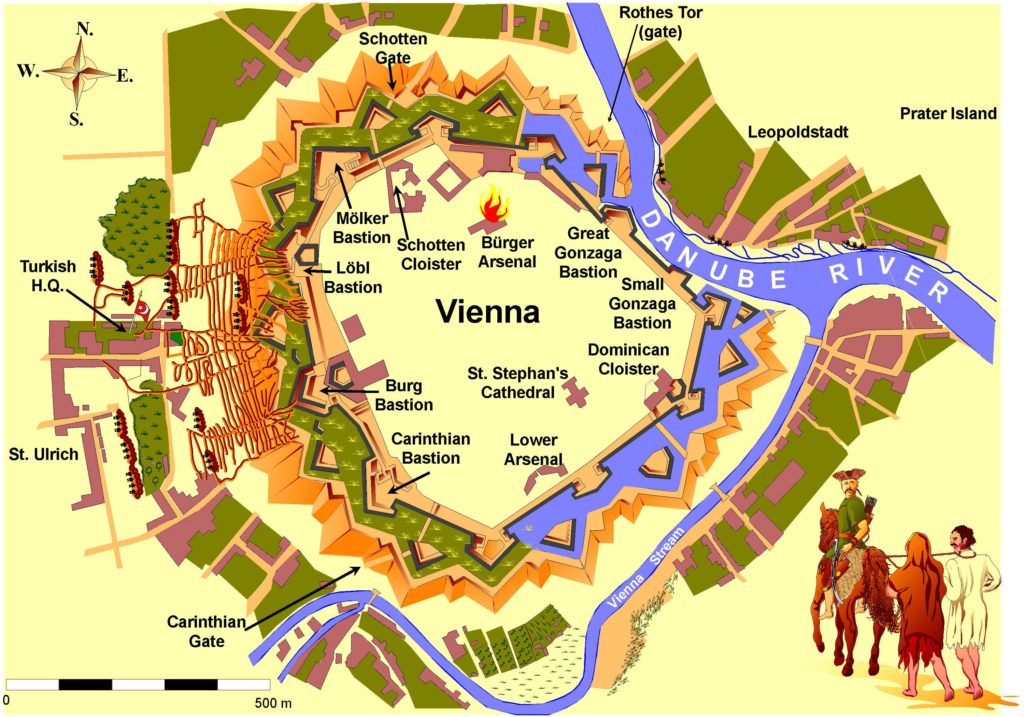
Kara Mustafa and his army reached the outskirts of Vienna on July 14, one week after Leopold fled the city. He immediately demanded the city surrender, urging the defenders to “accept Islam and live in peace under the Sultan!” Starhemberg and his men vigorously rejected his appeal and over the next two days the Ottoman army encircled the city and prepared for an epic siege. Mustafa focused the Ottoman attack on what he considered to be the most vulnerable section of Vienna’s wall, the southwest. He ordered his artillery forward and once in position his guns began to bombard the city wall but with only marginal effect. The Turks were excellent artillerists, but the caliber of their artillery was too small to bring down Vienna’s reinforced stone wall. Instead, Mustafa altered his strategy and directed his engineers to dig a network of trenches and tunnels, directly toward the city so that they could detonate explosives under Vienna’s wall and exploit any potential breeches. At the same time, Turkish archers fired their arrows indiscriminately over the wall and into the city while the Janissaries fired their arquebuses at the defenders along the wall.
For several weeks, Vienna’s defenders successfully beat back repeated enemy attacks but by early September their situation had become increasingly more desperate. Food, water, and ammunition were in short supply. Disease was rampant throughout the city and only a third of Starhemberg’s men remained fit for duty. All the while the Ottoman siege lines inched steadily closer.
On September 2, Ottoman engineers finally managed to blast several gaps in a large section of the wall and two days later elite Turkish Janissaries almost penetrated into the city through a 30-foot breech before being driven back by a countercharge led by Starhemberg himself. The situation reached a critical point on September 8, when the Ottomans seized key defensive positions near the city walls. Anticipating a breach in the city walls, the remaining defenders prepared to fight inside the city hand to hand. For the next three days Ottoman forces pressed hard to break into the city but were repelled by the yeoman efforts of Starhemberg’s exhausted troops. The city was on the verge of surrender and the Ottomans on the threshold of a great victory. Vienna’s only hope was the timely arrival of the anxiously awaited relief army.
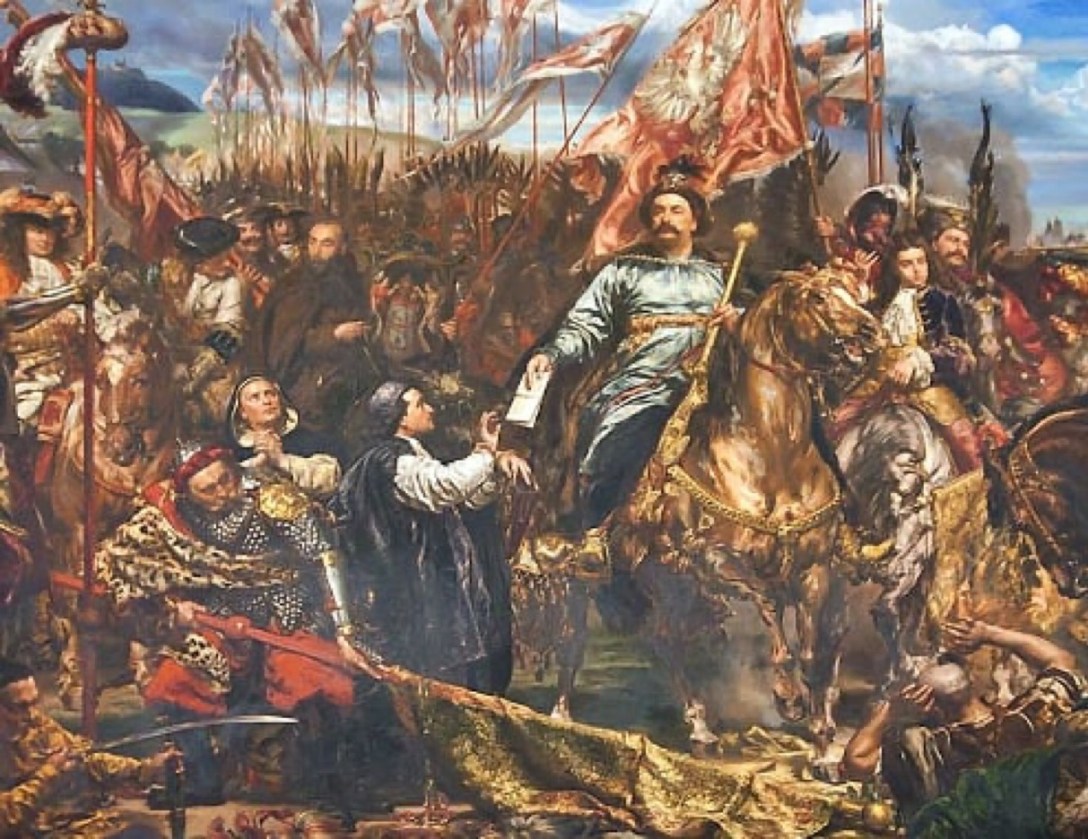
King of Poland, Jan Sobieski
As all these events were transpiring, the diplomatic efforts of Leopold and Pope Innocent XI were paying dividends as a relief army was gathered northwest of Vienna on September 11, under the guise of the Papal sponsored Holy League. Here, roughly 40,000-50,000 troops from the German states of Bavaria, Saxony, Franconia and Swabia and 18,000 Hapsburg troops under the very capable command of Charles V, Duke of Lorraine joined with 18,000 Polish soldiers, including Poland’s famous Winged Hussars (Heavy Cavalry) under King Jan Sobieski. Sobieski assumed command over the entire relief force given his lofty status and prepared to relieve the beleaguered city the next day.
Kara Mustafa did not take the threat of the relief army seriously enough and refused to give up his dream of taking Vienna once and for all. He rejected the advice of his commanders to give up the siege and focus on the threat posed by Sobieski’s Army. Instead, he kept up the pressure on Vienna, diverting only six thousand infantry, twenty-two thousand Tatar cavalry, and six cannons, to confront the relief force. Moreover, no field fortifications were created, and no defensive lines established. The Ottoman camp was completely open to attack.
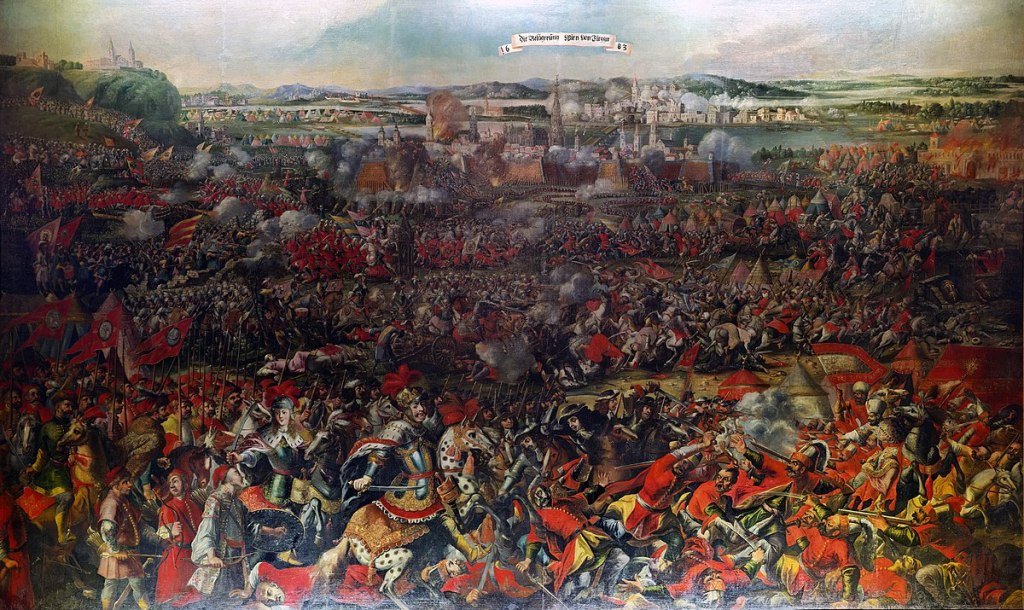
Early on Sunday, September 12, the Holy League army began their assault on the largely unprepared and poorly defended Turkish encampment. The left wing of the army under the command of Charles, the Duke of Loraine, struck first. A mix of Imperial Habsburg and Saxon infantry moved downhill bearing a huge white banner with a scarlet cross, the Army of Christ Crucified. The center, composed of Bavarian and Franconia troops followed and one Ottoman military official watching the advance from afar remarked, “It looked as if a flood of black pitch was pouring downhill crushing and burning everything that opposed it.” After sweeping away Ottoman skirmishers, the Holy League force engaged their Ottoman foes demonstrating a tenacity the Turks had not seen before. After heavy fighting and repelling multiple Ottoman counter attacks, the Christians inflicted significant losses on the Ottomans and were poised for a breakthrough by mid-Afternoon.
On the right, the rugged and ravine filled terrain of the battlefield delayed the arrival of the Poles and their cavalry. By 4:00pm the Poles finally reached flat and easy ground suitable for their horses and formed up ready to enter the fight. After praying the rosary, Sobieski sent forward a detachment of 120 hussars—heavy cavalry—to probe for weaknesses in the Ottoman line. The hussars inflicted and received many casualties but demonstrated that the Ottoman lines were weak and vulnerable.
The climactic scene of the battle occurred around 6:00 when Sobieski launched one of the largest cavalry charges in history. Approximately 18,000 horsemen, including 3,000 heavy Polish Lancers or Winged Hussars, led by Sobieski himself, thundered across the battlefield towards the beleaguered Ottoman camps. The charge was massive but meticulously timed, coinciding with a coordinated push by the German and Habsburg forces from the north, who by this time had recuperated from their heavy fighting earlier in the day. The charge quickly broke the battle lines of the Ottomans, who were already exhausted and demoralized and were now fleeing the battlefield in the face of the combined onslaught. Sobieski’s horsemen headed directly towards the Ottoman camps and Kara Mustafa’s headquarters, while the remaining Viennese garrison sallied out of its defenses to join in the assault. Mustafa knew the battle was lost but his will to fight remained undiminished. He tried to rally his forces to no avail. Only the argument that his own death would cause the destruction of the remaining Ottoman troops persuaded Mustafa to break off the melee. Seizing the Holy Banner of the Prophet and his private treasure, the Grand Vizier fled the battlefield in disgrace. When the battle was over and the Holy League was victorious, Sobieski paraphrased Julius Caesar declaring “Venimus, vidimus, Deus vicit.” We came, we saw, God conquered!
The battle for Vienna was a tremendous loss for the Ottoman Empire, which would never again seriously threaten the city. All told, the Ottomans suffered upwards of 70,000 killed, wounded, or missing between the siege and battle. The magnitude of the defeat was not lost to Kara Mustafa who sought to escape the Sultan’s vengeance by blaming his defeat on subordinate commanders, executing those that might inform the Sultan of the Grand Vizier’s mishandling of the Ottoman army. Mehmed IV remained unconvinced. Mustafa would pay for his failure. On December 25, 1683, in Belgrade, the sultan’s emissaries executed the Grand Vizier by strangulation and sent his head to Constantinople.
The Ottoman defeat at Vienna reversed four centuries of expansion and set the stage for the reconquest of Hungary and other lands in the Balkans by the Habsburg’s and their allies. The Ottomans would fight on for another 16 years, before being forced to sign the Treaty of Karlowitz in 1699, which would cede much of Hungary to the Habsburgs.









 Tragedy and Farce