
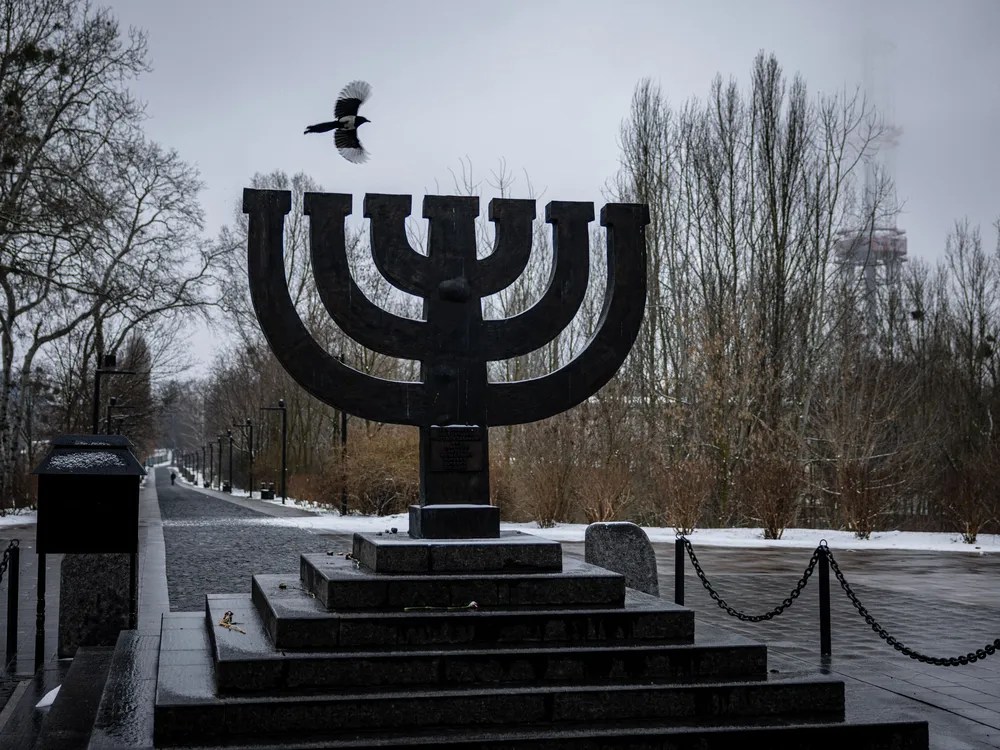
On September 29-30, 1941, the Nazis carried out a mass execution of over 33,000 Soviet Jews at the Babi Yar ravine just outside of Kyiv, Ukraine. The Jews were told they were being relocated and were marched in small groups to the outskirts of the city. There they were stripped naked, their possessions confiscated, and machine-gunned into the ravine by mobile killing squads associated with the Nazi SS called Einsatzgrupen and some Ukrainian auxiliary police. It was one of the largest mass executions of World War II and the apex of the “Bullet Holocaust,” the period before 1942 when the Nazis transitioned to a more systematic approach to exterminating Europe’s Jews using poison gas and “death camps” such as Auschwitz in occupied Poland.
The Babi Yar Memorial Complex outside Kyiv
Nazi Germany invaded the Soviet Union on June 22, 1941 and as the German Wehrmacht advanced deeper into the USSR a wave of executions followed in its wake. In places such as Lithuania, Latvia, Belarus, Moldova and Ukraine, Jews were rounded up and summarily shot by the Einsatzgrupen and local anti-Semites, all in accordance with Adolf Hitler’s racial ideology of creating Lebensraum, or “living space” for the 1000-year German Reich.
The Nazis seized Kyiv, the capital of the Ukrainian Soviet Socialist Republic, on September 19 and the Einsatzgrupen units were ordered to exterminate all Jews and Soviet commissars found there. By the time Germans reached Kyiv in mid-September 1941, about 100,000 of the city’s prewar Jewish population of 160,000 already had fled or joined the Soviet military to fight the invasion. Those that remained were largely women, children, the elderly, and the infirm. During the first week of the German occupation of Kyiv, two major explosions rocked the city, destroying the military headquarters of the German Army Group South and killing a large number of German soldiers. Although the explosions were caused by mines left by retreating Soviet soldiers, the Germans used the sabotage as a pretext to murder those Jews who still remained in Kyiv. On September 26 the German Army and the SS concluded that Kyiv’s Jewish population wouldn’t be confined in a ghetto, but instead annihilated at Babi Yar. Two days later, Nazi authorities in Kyiv ordered all Jewish residents to appear the next morning at an intersection in the city’s Lukianivka district, with all their personal documents, money and valuables and warm clothing. They were then marched through the city to Babi Yar where they were told to undress and lined up and shot. Infants were taken from their parents’ arms and thrown into the ravine.

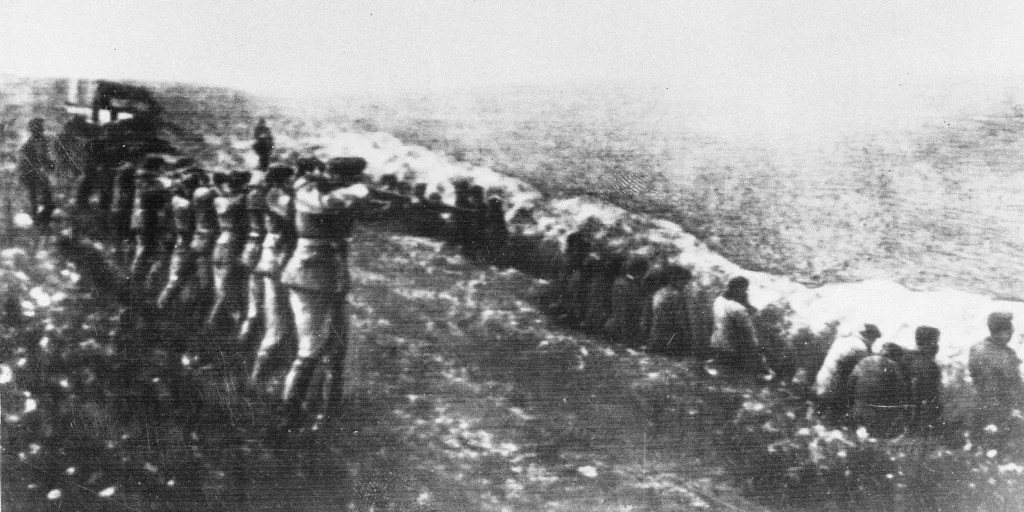
Einsatzgruppen Executing Ukraine’s Jews at Babi Yar
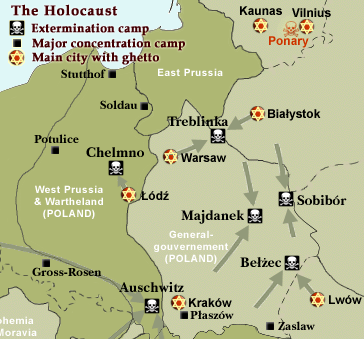
In late 1941, SS head Heinrich Himmler witnessed an Einsatzgruppen mass execution first-hand and concluded that shooting Jews was too costly, inefficient, and exerted too much stress on his men. In November Himmler decided a transition should be made away from mass shootings to the use of poison gas, especially with women and children. Experiments with the use of Zyklon B, a cyanide-based gas, had been in effect since September as well as mobile gas vans to murder mentally ill patients. However, the gas vans were not popular with the Einsatzkommandos, because removing the dead bodies from the van and burying them was a horrible ordeal. On January 20, 1942, Himmler and numerous other Nazi officials involved in implementing the “Final Solution” met in the Berlin suburb of Wannsee to formalize plans for the total eradication of Europe’s 11 million Jews. Here it was decided that the Einsatzgruppen Mobil killing units would be replaced by permanent killing centers at Auschwitz, Belzec, Chelmno, Majdanek, Sobibor, Treblinka, in occupied Poland.
 Tragedy and Farce