

On April 4, 1968, Dr. Martin Luther King, Jr. was shot dead by James Earl Ray while standing on the balcony of his room at the Lorraine Motel in Memphis Tennessee.
By 1968, Dr. King had expanded his focus to addressing issues of economic inequality in America and the suffering that came with it. He had organized what he called the Poor People’s Campaign to speak out for the disadvantaged regardless of race. He also began to speak out more against the Vietnam War, increasingly viewing it as a “rich man’s war and a poor man’s fight.”
King had been invited to Memphis by pastor James Lawson, a veteran of the Montgomery Bus boycott to take up the cause of 1,300 predominantly black sanitation workers who had staged a walkout on February 11, 1968, to protest unequal wages and terrible working conditions imposed by Memphis mayor Henry Loeb. At the time, Memphis paid black workers significantly lower wages than it did white workers. There were no city-issued uniforms, no restrooms, no recognized union, and no grievance procedure for the numerous occasions on which they were underpaid. The strike was prompted by the death of two of their colleagues, Echol Cole and Robert Walker who were crushed to death in the compactor of a garbage truck — the only place where they could wait out a rainstorm in a white neighborhood where residents were uneasy about African Americans hanging around where they lived. Two other men had died this way in 1964, but the city refused to replace the defective equipment.
Many of King’s closest advisors discouraged him from getting involved in what they viewed as a low level labor dispute. However King saw a deep connection between his larger campaign for economic equality and what was going on in Memphis. In a March 18 speech to the Memphis sanitation workers he famously declared, “What does it profit a man to be able to eat at an integrated lunch counter if he doesn’t have enough money to buy a hamburger?
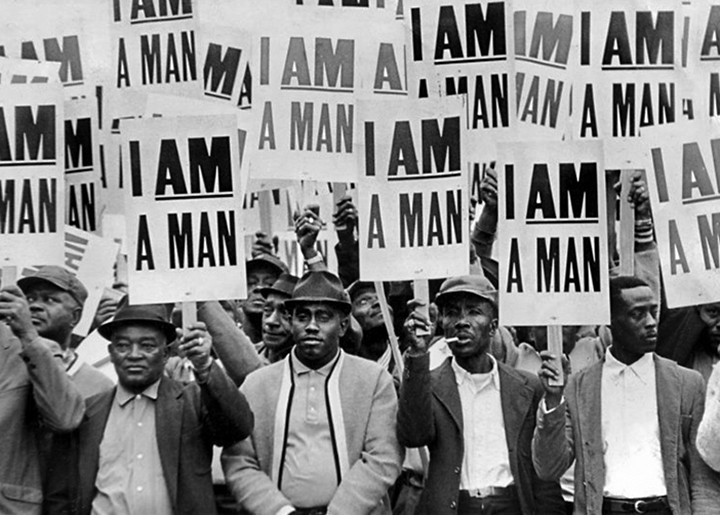
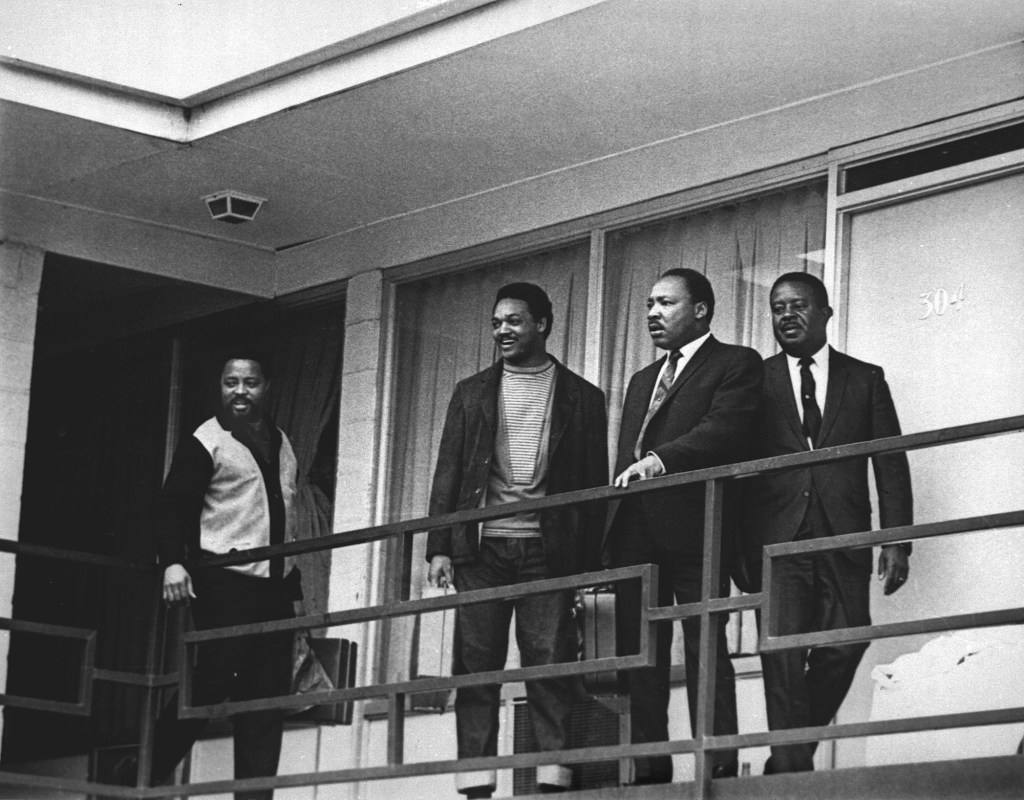
Martin Luther King Jr. stands with fellow civil rights leaders on the balcony of the Lorraine Motel in Memphis, Tenn., on April 3, 1968 — one day before he was assassinated while standing in approximately the same place. From left are Hosea Williams, Jesse Jackson, King and Ralph Abernathy.
King returned to Memphis ten days later to lead another protest. The march began peacefully but it soon became violent. Police immediately reacted to the riot, moving into the crowd with nightsticks, mace, teargas, and gunfire. In the midst of the chaos, a police shot and killed sixteen-year-old Larry Payne. Witnesses said Payne had his hands raised as the officer pressed a shotgun to Payne’s stomach and fired it. That same night Mayor Loeb declared martial law and authorized a 7 pm curfew, bringing in about 4000 additional National Guardsmen.
On April 3, King returned to Memphis to attempt a new march later that week. After arriving, King and his cohorts were slapped with an injunction that prevented them from leading a demonstration in the city. King huddled with his legal team at the Lorraine Motel to discuss strategy and to head off a potential repeat of the riot-instigating actions that had torpedoed his last effort. That day, King gave his last sermon, saying, “We’ve got some difficult days ahead. But it really doesn’t matter with me now, because I’ve been to the mountaintop … And He’s allowed me to go up to the mountain. And I’ve looked over, and I’ve seen the Promised Land. I may not get there with you. But I want you to know tonight that we, as a people, will get to the promised land.”
The next day brought good news. The judge agreed to lift the injunction, allowing for a tightly controlled march on April 8. That evening around 6 p.m., as he prepared for dinner with a local minister, King stepped out to the balcony of room 306 at the Lorraine to chat with colleagues waiting in the courtyard below. A gunshot suddenly pierced the air. King fell prone on the balcony, bleeding profusely from the right side of his face. Although he was rushed off to St. Joseph’s Hospital relatively quickly, the bullet had punctured several vital arteries, fractured his spine, and 39-year-old King was declared dead at 7:05 p.m.

Shortly after the assassination, a policeman discovered a bundle containing a 30.06 Remington rifle next door to the boarding house. The largest investigation in Federal Bureau of Investigation (FBI) history led its agents to an apartment in Atlanta. Fingerprints uncovered in the apartment matched those of James Earl Ray, a fugitive who had escaped from a Missouri prison in April 1967. FBI agents and police in Memphis produced further evidence that Ray had registered on 4 April at the South Main Street roominghouse and that he had taken a second-floor room near a common bathroom with a view of the Lorraine Motel.
The identification of Ray as a suspect led to an international manhunt. On 19 July 1968 Ray was extradited to the United States from Britain to stand trial. In a plea bargain, Tennessee prosecutors agreed in March 1969 to forgo seeking the death penalty when Ray pled guilty to murder charges. The circumstances leading to the plea later became a source of controversy, when Ray recanted his confession soon after being sentenced to a 99-year term in prison.
 Tragedy and Farce