
On August 20-21, 1968, the combined armies of the Soviet Union, Poland, Hungary, and Bulgaria invaded Czechoslovakia to topple the reformist government of Alexander Dubcek and to ensure that Prague remained firmly entrenched in the Soviet orbit and under communist rule. This Soviet-led intervention was the third time since 1953 in which Moscow was forced to use military power to ensure its control over its East European satellites. It also further underscored the fundamental tenet of Soviet policy toward the region, the idea of limited sovereignty. Diversity within the Eastern Bloc was permissible only within the context of strict Soviet control and universal conformance on two key points: loyalty to the Soviet Union in foreign affairs and the primacy of the communist party in the domestic sphere.
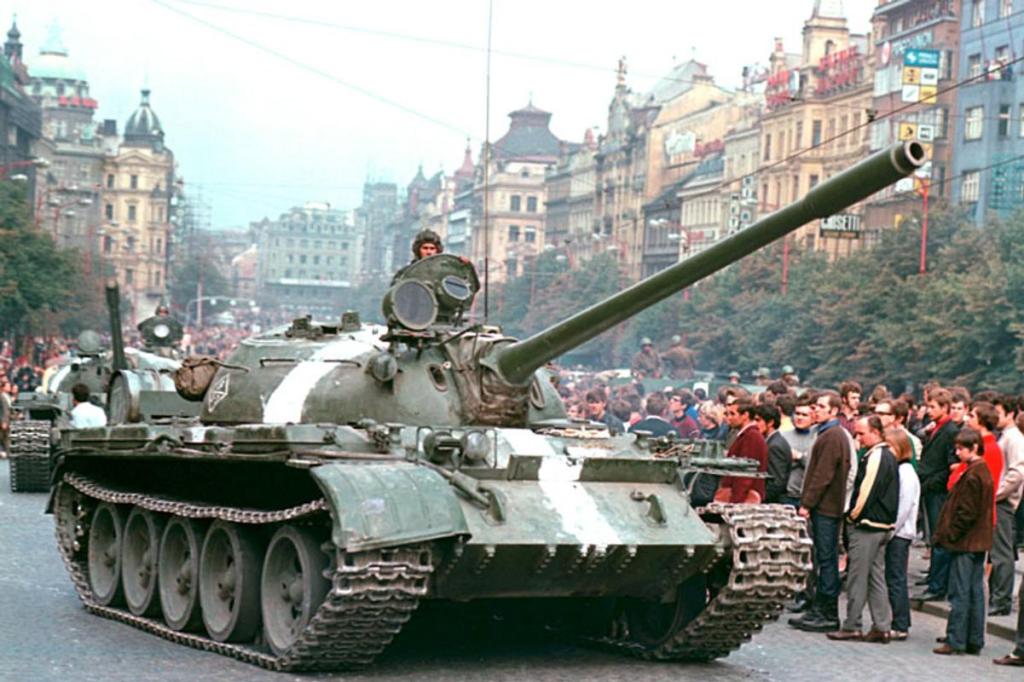
Of all of Moscow’s East European satellites, Czechoslovakia was the last to succumb to full Soviet control and therefore was late to experience de-Stalinization. Since 1948, Czechoslovakia had been ruled by Communist hardliners Klement Gottwald and Antonin Novotny who ensured that unlike Poland or Hungary, Czechoslovakia remained a hardcore Stalinist state firmly within the Soviet sphere of influence. However, by the 1960s the Czech economy began to falter, and cracks within the ruling Communist Party emerged as popular dissatisfaction with communist rule was on the rise.
In early 1968, Novotny was ousted as the head of the Czechoslovakian Communist Party and replaced by Alexander Dubcek in what would become known as the “Prague Spring.” In many ways, Dubcek was a forerunner to future Soviet leader Mikhail Gorbachev. Dubcek, like Gorbachev, sought to breathe new life into the Communist system and insisted that all reforms would take place within the framework of the Marxist-Leninist state. Nonethless, as he implemented reforms he began to lose control of the process. Dubcek relaxed censorship while encouraging greater policy debate and limiting the powers of the secret police. He also pledged to put more emphasis on the production of consumer goods, while suggesting the possibility of a multiparty government and democratic elections ten years in the future. From Moscow’s perspective, it appeared that Dubcek was dismantling Communist rule not reforming it.

Soviet leaders were increasingly alarmed by what was happening in Czechoslovakia and the model it might provide for the Soviet people and the other Communist states of Eastern Europe. However, Soviet leadership was divided between those who wanted to avoid a replay of the 1956 Hungarian crisis and counseled patience and those who argued for a swift military solution to the problem. In Eastern Europe there was surprisingly strong support for the latter. The hardline Communist leaders of East Germany and Poland—Walter Ulbricht and Władysław Gomułka—were especially apprehensive and argued for a decisive military intervention. Gomułka’s support for the use of force was a particularly ironic twist because his rise to the top of the Polish communist party in October 1956 against Moscow’s wishes, almost triggered a Soviet military intervention in Poland. In July, the Kremlin insisted on consultations with their Czechoslovak counterparts to better understand the situation. Dubcek defended his reform agenda and resisted demands he reverse course but reaffirmed Czechoslovakia’s alliance with the Soviet Union and the Warsaw Pact.
As Dubcek struggled to convince the Soviets and his fellow East Europeans of his continued allegiance, momentum for a military intervention was growing in Moscow and the other East European capitals. On 3 August, representatives from the Soviet Union, the German Democratic Republic, the People’s Republic of Poland, the Hungarian People’s Republic, the People’s Republic of Bulgaria and Czechoslovakia met in Bratislava in a last-ditch effort to reach a compromise and avoid military force. The meeting did little to resolve the standoff and only resulted in a vaguely worded declaration subject to contradictory interpretations. The declaration addressed the principles of equality, sovereignty, and territorial integrity while reaffirming the participants unshakable fidelity to Marxism–Leninism, proletarian internationalism, and the implacable struggle against bourgeois ideology and all “antisocialist” forces. More disturbing were the repeated references to fraternal assistance, code word in Soviet parlance for military intervention, and the idea that it was right and duty of all communist states to intervene in another if communist rule were ever endangered or replaced by a non-communist system. This idea would form the basis for what became known as the Brezhnev Doctrine.
At an August 16-17 meeting, the Soviet Politburo unanimously passed a resolution to “provide help to the Communist Party and people of Czechoslovakia through military force”. At an August 18 Warsaw Pact meeting, Brezhnev announced that the intervention would go ahead on the night of 20 August, and asked for “fraternal support”, which the national leaders of Bulgaria, East Germany, Hungary, and Poland duly offered. East German military forces were left out of the invasion at the last minute for fear of reawakening memories of the 1939 German invasion and provoking strong resistance. Romania refused to participate in the intervention and its leader Nicolai Ceausescu condemned the invasion in a August 21 public address calling it a “grave error” that “constituted a serious danger to peace in Europe and for the prospects of world socialism.” His address was perceived as a gesture of disobedience towards the Soviet Union. However, Ceausescu escaped the Kremlin’s ire largely because he continued to run Romania as a hard-core communist state and did not threaten to leave the Warsaw Pact.

Around 11 pm on August 20, more than 200,000 troops and 2,000 tanks from the Soviet Union, Poland, Hungary, and Bulgaria rolled across the border into Czechoslovakia. Armed resistance to the invasion was negligible, but protesters immediately took to the streets. The invaders quickly occupied the capital of Prague and spread out to take control of other major cities, key points of communication, and airports. Soviet leader Leonid Brezhnev insisted on the participation of at least some of Moscow’s Warsaw Pact allies in the intervention to give it a veneer of legitimacy. Nevertheless, Soviet military forces did most of the heavy lifting.
The invasion caught most of Czechoslovakia and the world by surprise. Although resistance to the invasion was negligible, unlike the 1956 Hungarian Uprising, protesters immediately took to the streets. Within hours, Dubcek, along with other government leaders, was arrested and flown to Moscow in hand cuffs for interrogation. He was surprisingly allowed to return to Prague on August 27, where in an emotional address he acknowledged the error of his ways and agreed to curtail his reforms. He was forced to gradually dismiss reformist aides and government officials who were quickly replaced by hard-line Communists. After anti-Soviet rioting broke out in April 1969, he was removed as first secretary of the Czechoslovak Communist Party and replaced by Gustav Husak, a hardliner who was willing to work with the Soviets. Dubcek was later expelled from the Communist Party and briefly served as ambassador to Turkey, before being made a minor forestry official in Slovakia.
In the years that followed, Husák consolidated his power, further purging the government and communist party of Dubcek loyalists, reimposing centralized control over the economy and reinstating the power of the security service. He also ensured that Czechoslovakia once again became a cooperative member of the Warsaw Pact. Husak’s rule would come to be known as the “Reluctant Terror.” It was characterized as one of strict adherence to Soviet policy objectives and the minimum amount of repression necessary to achieve these objectives and prevent a return to Dubcek- style reformism. As a result, the regime was neither a complete return to Stalinism nor al liberal one either. Husak would continue to rule Czechoslovakia until November 1989 when he and the rest of the communists were overthrown in what became known as the Velvet Revolution

 Tragedy and Farce