
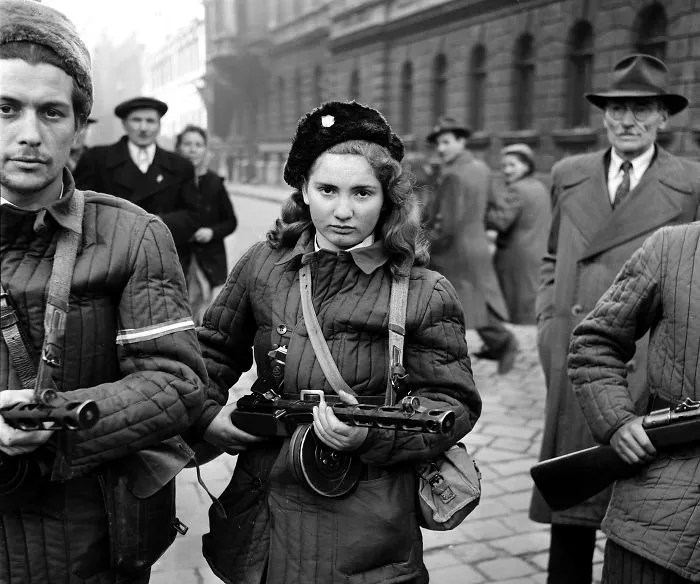
On 23 October 1956, the people of Hungary rose up in a brave yet futile effort to overthrow their Soviet imposed communist government and set up a more democratic and pluralistic political system free of Soviet oppression. The uprising lasted 12 days before Soviet tanks rolled into Budapest deposing the government of Imre Nagy and thwarting the Hungarian revolutionaries efforts to escape the Soviet camp. The uprising presented the Soviet Union with the most serious challenge to its authority in Eastern Europe since the end of World War II. It also revealed the persistent, paradoxical, challenge the Kremlin would face in managing its East European satellites over the next 30 years; the contradiction between its determination to maintain absolute control over these states and building legitimate, viable Communist regimes that could exist without constant Soviet support or intervention.
At the end of World War II, Red Army troops occupied nearly all of the states of Eastern Europe, making their subordination to the Soviet Union almost inevitable. Soviet leader Josef Stalin acknowledged this fact in April 1945 commenting to Milovan Djilas, a high-ranking official in the Yugoslav Communist party, “This war is not as in the past; whoever occupies a territory also imposes on it, it’s own social system. Everyone imposes their own system as far as their army can reach.” The establishment of communist rule in Hungary roughly followed a similar pattern to that of the other East European states. Employing what head of the Hungarian Communist Party Matyas Rakosi termed “salami tactics” the communist proceeded to divide the non-communist opposition while gradually seizing power with the support of the occupying Red Army lurking in the background. By 1948, Hungary’s communists had gained total power over the country, and in 1949 the country was proclaimed a “peoples’ republic” with Rákosi as its absolute ruler.

Rakosi set about rapidly transforming Hungary into a Soviet style communist state. He instituted Stalinist political and economic programs, resulting in Hungary experiencing one of the harshest dictatorships in Europe. Rakosi set up the dreaded AVH, the state political police, to identify and root out regime opponents who were subject to show trials. On the economic front, the government collectivized agriculture and it extracted profits from the country’s farms to finance rapid expansion of heavy industry. Industrial production rose steeply, but the standard of living did not; the production of consumer goods was limited and that of agriculture stagnated. Hungary’s free market economy was replaced by a Soviet command style economy in 1949 and trade was reoriented away from Western Europe towards the Soviet Union. In addition, Hungary, having sided with the Nazis, was obligated to pay reparations to the Soviet Union, Czechoslovakia, and Yugoslavia to the tune of 20 percent of its annual income. By the early 1950s, the imposition of Soviet-style economic policies and the payment of war reparations were impoverishing the Hungarian people fueling anti-Soviet political discontent as the payment of foreign debt and the heavy industrialization of the country took precedence over the material needs of the Hungarian people.
The year 1956 was a tumultuous one in the Soviet Union and its East European satellites. It had been three years since Soviet leader Josef Stalin’s death and Nikita Khrushchev finally prevailed in a three-way power struggle to succeed him. In February, at the Twentieth Party Congress of the Communist Party of the USSR, Khrushchev gave a “secret speech” condemning Stalin. In a tirade that lasted hours, he denounced Stalin’s “cult of personality,” the party purges of the 1930s, the gulags, and his blunders in World War II. He accused Stalin of negligence, deceit, and incompetence which cost millions of Soviet lives.
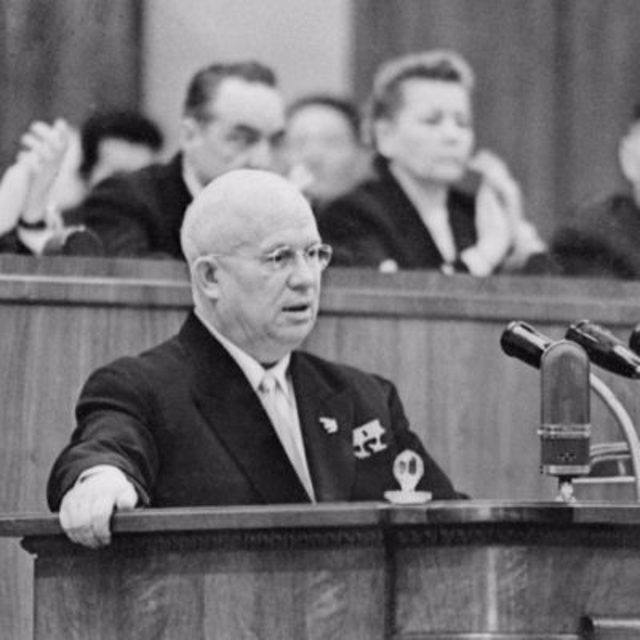
Although Khrushchev’s address was intended to help consolidate his power and mobilize domestic support for a reform agenda in the Soviet Union, it had far reaching implications for the entire Communist Bloc. No where was its impact felt more profoundly than in the six countries of Eastern Europe where their leaders, who were installed by Stalin and were building mini-Stalinist regimes, now found their legitimacy compromised. Khrushchev argued that the Stalinist model was not the only acceptable model of communist development and that there were different roads to socialism. In Poland and Hungary, the people were beginning to chafe under Communist rule, Khrushchev’s speech led to increased protests and demands for political and economic reforms.
In Hungary, popular anger at Communist rule continued to grow rapidly and the government proved unwilling or unable to stop it. In July, Khrushchev facilitated the replacement of hard-line communist ruler Matyas Rakosi with another Stalinist hardliner, Erno Gero. Gero tried to defuse public anger and demonstrate to Moscow he was adhering to the party line of de-Stalinization by allowing the body of Lazlo Rajk, a communist reformer who had been executed in the 1949 Stalinist purges, to be buried in Budapest. His burial on October 6, 1956, brought to the surface anger over past Stalinist injustices against Hungary over the years, and the funeral march quickly transformed into a mass political demonstration. Anti-regime opponents, mostly urban intellectuals and students, began to make bolder and bolder demands of the government while calls for political and economic change soon spread to the working class and peasants as well.

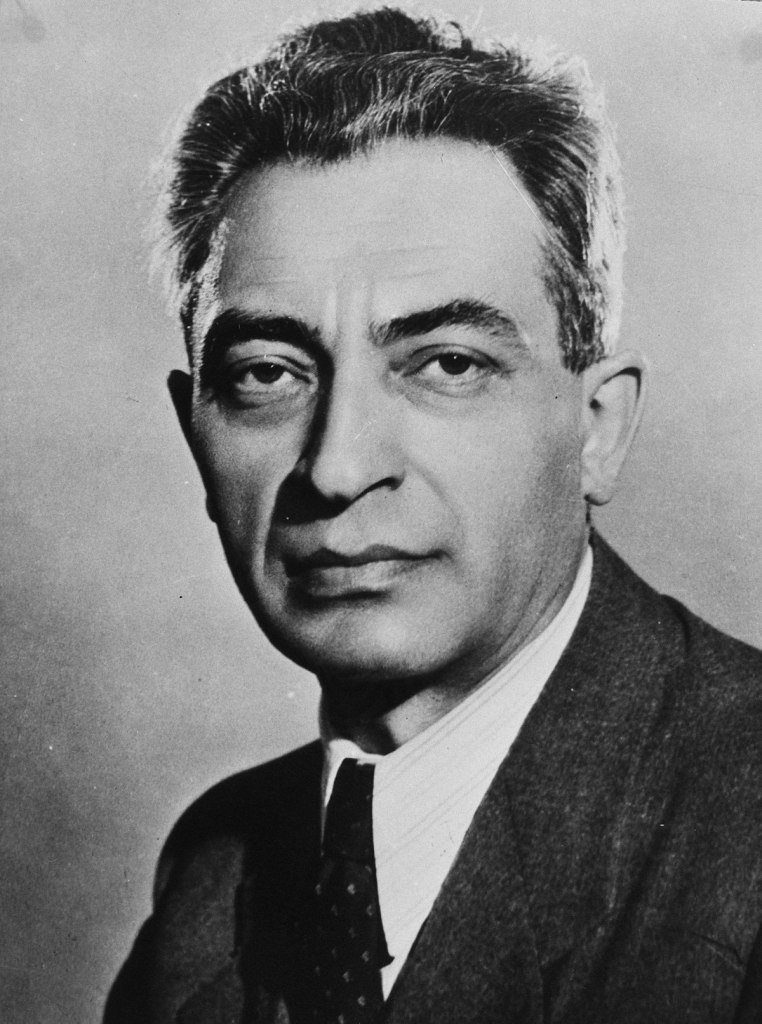

Left: Matyas Rakosi; Center: Erno Gero; Right: Imre Nagy
On the afternoon of 23 October, a restless crowd of 20,000 marched through Budapest and gathered at the statue of Józef Bem, a Hungarian-Polish hero of the 1848 Hungarian Revolution. Here they issued a list of demands known as the “Sixteen Points,” which included political reforms, democratization, the removal of Erno Gero and other Hungarian Stalinists, and the withdrawal of all Soviet military forces. What began as a series of peaceful student demonstrations now began to evolve into something much larger and by the evening there were more than 200,000 people on the streets calling for change.
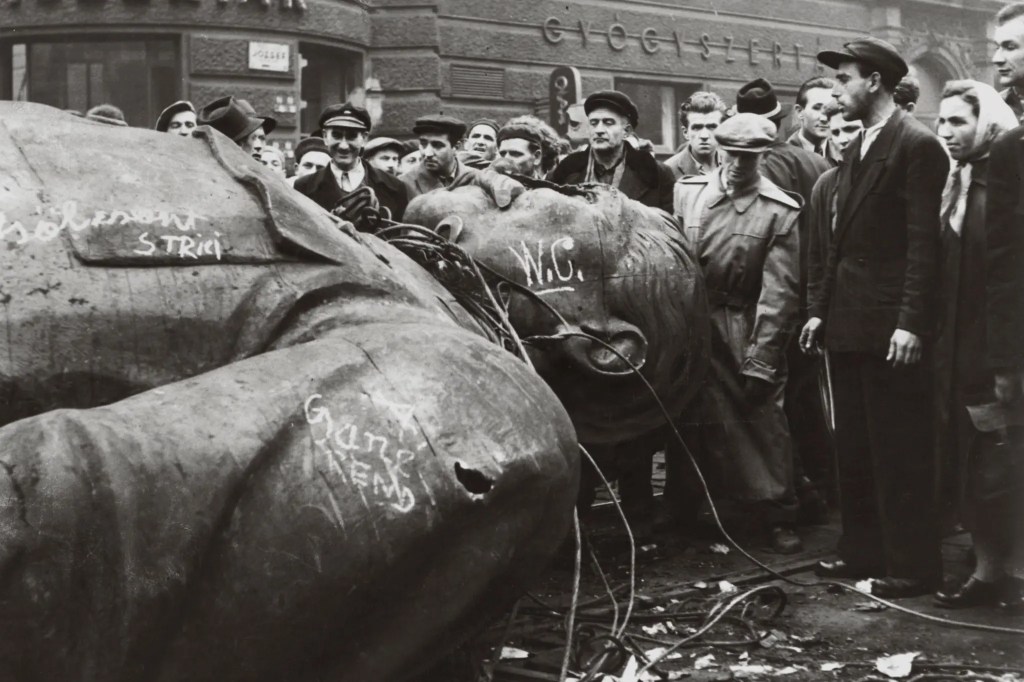
In response, Gero went on the radio that evening and denounced the protesters as fascists and agents of imperialism and vowed that there would be no concessions. Gero’s defiant statements only further outraged the protesters and inflamed an already combustible situation. An angry crowd marched to the center of Budapest and defiantly tore down a ten-meter-high bronze statue of Stalin. They looped steel cables around its neck, pulled it to the ground with trucks and defaced the fallen icon. Elsewhere in Budapest, another group battled police outside a local radio station while units of the Hungarian military were besieged and attacked. Revolutionaries took over public buildings, destroyed Soviet symbols and freed political prisoners who had been locked away for years. The protest now became an armed uprising. The Hungarian Revolution had begun.
Fighting escalated quickly and the Hungarian government was quickly losing control of the situation as well as its security apparatus. Gero ordered the Hungarian military to quash the demonstrations and reestablish order, but many soldiers resisted cracking down on their fellow citizens and some even joined the protests. Acknowledging that his grip on power was slipping, Gero quickly appealed to his Soviet overlords for assistance. Khrushchev lacked confidence in Gero and was initially hesitant to dispatch Soviet military forces to quell the protests but incoming reports from the Soviet Ambassador in Budapest, Yuri Andropov, assured the Kremlin that military intervention was necessary. The next day, Soviet Defense Minister Georgiy Zhukov ordered 6,000 Soviet troops and 700 tanks into downtown Budapest. In return for Soviet military backing, however, Khrushchev insisted that Gero bring back Imre Nagy back into a high-level government position to appease the disgruntled populace. On the morning of October 24, Nagy was again named Prime Minister.
Neither the Soviet army nor the return of Imre Nagy did much to daunt the citizens of Budapest or defuse the crisis. Over the next several days, barricades went up throughout the city while fierce fighting raged between these revolutionaries and the Soviet Army , the Hungarian military, and the State Security Police. Shortly after being appointed Prime Minister, Nagy addressed the nation on radio calling for a ceasefire and promising to institute political reforms. His appeal did nothing to quell the revolutionary fervor. Not a single revolutionary stood down or handed over a weapon.

Nagy was a tragic figure about to be swept up in a wave of revolutionary tumult that he failed to fully grasp and was powerless to stop. Nagy appealed to the pre-revolutionary Hungarian public because he was a reformer and a moderate and not a hardline Stalinist like Rakosi and Gero but he was still a dedicated communist. Like Khrushchev, he believed that there were different pathways to socialism not just the single, rigid, Soviet model, insisted upon by Stalin. He wanted to build a distinctly unique communist system that reflected the national characteristics of the Hungarian people. The problem for Nagy was that Hungary’s young revolutionaries no longer wanted reform. They wanted to overthrow the system. Back in the government, Nagy quickly saw his dream of a new Hungary firmly on a peaceful path to reform communism under his leadership slipping away. He tried to steer a middle course acting as a bridge between the revolutionaries and the various Communist Party factions but for the people of Hungary the time for restraint, halfway measures and middle courses had passed.

With no signs that order was close to being restored, two high-level Soviet Politburo members— Anastas Mikoyan and Mikhail Suslov— traveled to Budapest on October 25 to troubleshoot the situation which was clearly deteriorating. Mikoyan and Suslov arrived to find a government that was no longer functioning and a Hungarian Communist Party that was in shambles. The two Soviet emissaries undressed Gero mercilessly for his handling of the crisis and suggested he resign at once and flee the country. He was quickly replaced by János Kádár as head of the communist party. The Soviets hoped that the new team of Nagy and Kadar would be able to right the ship but the situation was about to get worse. That morning, Hungarian and Soviet military forces opened fire on a group of unarmed protesters in Kossuth Square demanding Gero’s resignation, killing hundreds and wounding many more. As word of the massacre spread throughout Budapest, the revolution quickly devolved into an all-out existential war between ragtag groups of young, poorly armed, and undisciplined rebels and the Soviet army, supported by the few Hungarian military forces that remained loyal to the government.
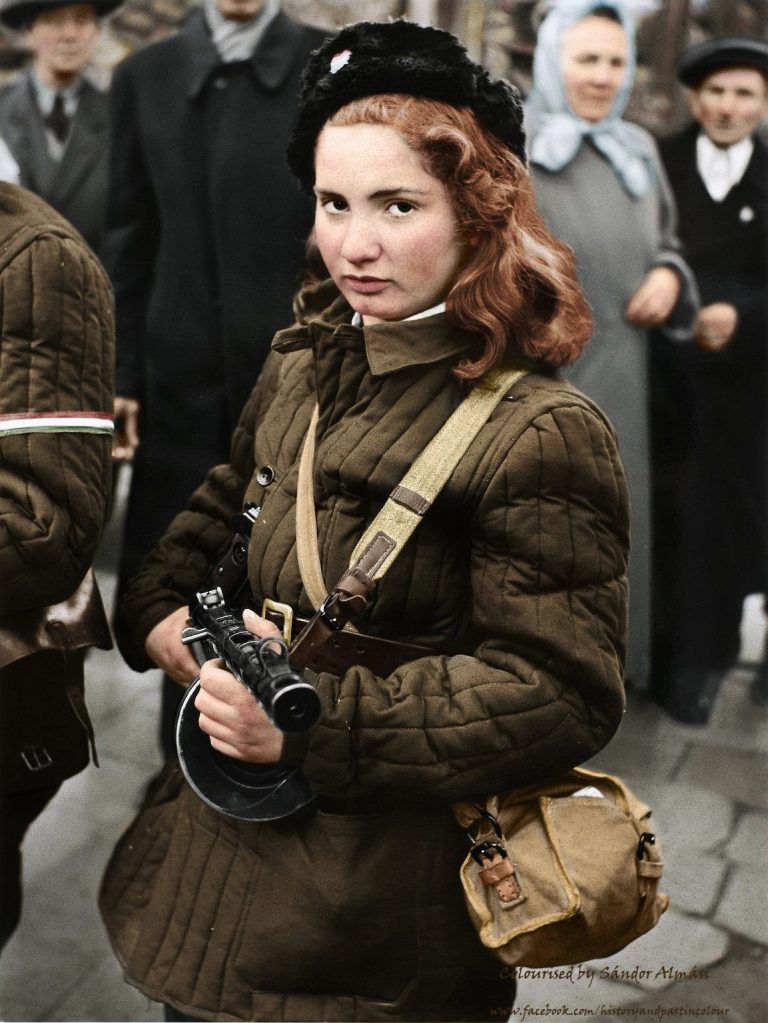
Amidst the growing violence, Nagy continued to try and stake out ground as a bridge between the revolutionaries and hardliners inside the Hungarian Communist Party but his efforts found little traction. On October 27, He announced the formation of a new cabinet that included moderate communists as well as four non-communist ministers in the naive hope the revolutionaries would lay down their arms and embrace the new government. Instead, his announcement met with jeers and the resistance from the revolutionaries. Throughout Hungary, revolutionary councils already assumed the responsibilities of local governments from the defunct Communist party and had mobilized strikes to halt the economy and the functioning of civil society. Moreover, too much blood had been spilled by Hungary’s revolutionaries to settle for anything less than their full demands.
The crisis in Hungary was reaching an inflection point. Almost a week had passed since violence first erupted on the streets of Budapest and Soviet military forces still continued to struggle to suppress the revolution. The young Hungarian freedom fighters refused to be intimidated by Soviet military force and their confidence was growing daily. Conversely, Soviet troops were increasingly exhausted and demoralized with many growing more sympathetic to the Hungarian cause. The Kremlin was not prepared to allow Hungary to leave the Soviet bloc but it needed to find a way to extricate itself from the situation. What to do in Hungary prompted heated debate inside the Soviet Politburo. Hardline Stalinist holdovers like Vyacheslav Molotov, Kliment Voroshilov, and Lazar Kaganovich, who saw the situation in Hungary as an opportunity to discredit Khrushchev, argued strenuously for doubling down on a military solution. However, more moderate voices like Khrushchev and Defense Minister Georgiy Zhukov, who days earlier favored deploying troops, were more conciliatory and cautious urging flexibility. Zhukov argued that the option of military escalation should be kept in reserve but they also needed to consider pulling Soviet forces from the streets of Budapest to create an opening for a negotiated resolution to the crisis.
Khrushchev wanted to reach a deal with the Hungarians that would keep the essence of Soviet rule but allow for a little more independence from Moscow. For that, the Kremlin needed some semblance of a functioning Hungarian government which made Nagy still very relevant to Moscow. The Soviets also needed an opportunity to pull back without losing face. That opportunity presented itself late in the evening of October 27 when Nagy and Kadar approached Mikoyan and Suslov about the possibility of a cease fire and the withdrawal of Soviet troops from Budapest. With Kadar taking the lead, the four men hammered out the broad framework of a agreement and around noon the following day a ceasefire was announced.
The Hungarian people initially greeted the cease fire with considerable skepticism but as the Soviets withdrew their military forces from Budapest over the next several days it came to be seen as a great victory. In the absence of Soviet troops, the Hungarian people set about dismantling the Communist system. Nagy dispensed with his customary moderation and embraced the idea of revolution. On October 30, he announced that the one-party system was being abolished and replaced with a multiparty democratic system. Thousands of political prisoners that had been incarcerated by the regime were released including, Cardinal József Mindszenty, the head of the Hungarian Catholic Church, who received a lifetime sentence in 1949 for opposing Communist rule. Angry mobs of anti-Communist revolutionaries also began to hunt down and execute members of the hated AVH, the Hungarian secret police, and other Communist party functionaries. By November 4, over 200 Communist party officials had been summarily executed.
Within days, Khrushchev regretted his decision to pull out Soviet military forces from Budapest. Increasingly pessimistic reports from Mikoyan and Suslov only served to confirm Moscow’s worst fear; Hungary was trying to break away from the socialist bloc. On the morning of October 31, Khrushchev convened an emergency session of the Politburo to decide what to do in Hungary once and for all. Where as days earlier the prevailing opinion in the Politburo was to give peace a chance, it was now clear from the deteriorating situation in Budapest that the Soviet Union had no other recourse than military force. Citing concerns about Soviet prestige, the unity of the socialist camp, and domestic political concerns, Khrushchev argued that the challenge in Hungary could not go unanswered, “We must take the initiative in restoring order in Hungary,” he declared. On 1 November, Nagy formally announced Hungary’s withdrawal from the Warsaw Pact and Hungary’s international status as a politically non-aligned country. This step ensured that there was no turning back for the Soviets.
The Soviets quickly began preparations to oust Imre Nagy’s revolutionary government and restore Communist rule. Khrushchev informed Moscow’s Warsaw Pact allies of their plan for Hungary which met with little objection except from Poland’s leader, Wladyslaw Gomulka, who assumed power almost two weeks earlier against Soviet wishes. Soviet military forces also surreptitiously began returning. On November 1, Soviet tanks poured across the border into Hungary and when preparations were complete 150,000 Soviet troops from ten divisions and armed with the most modern equipment ringed Budapest. The Hungarians were not oblivious to the Soviet troop movements. Intelligence reporting had trickled in from Hungarian military forces loyal to the new revolutionary government and other observers but Nagy refused to believe the reports and convinced himself he still remained in favor with Moscow. Moreover, there was little Hungary could do at this juncture other than fight back.
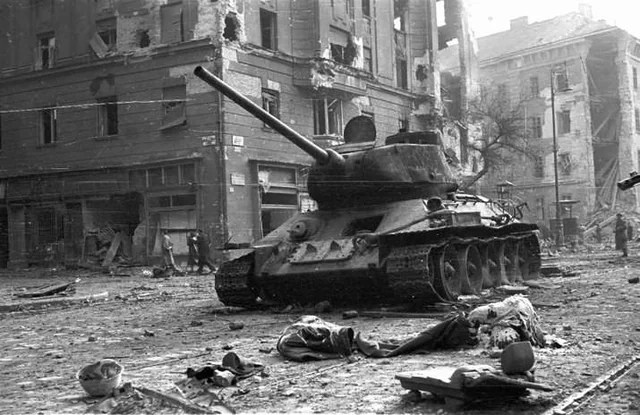
Shortly before dawn on November 4, “Operation Whirlwind”, the Soviet invasion of Hungary, commenced as Soviet tanks rolled into Budapest to depose the government of Imre Nagy. Around 5:30am Imre Nagy broadcast his final plea to the nation and the world, announcing that Soviet forces were attacking Budapest before taking refuge in Yugoslavia’s embassy. Later that day, Janos Kadar, Nagy’s deputy prime minister and titular head of the Hungarian Communist Party, operating under direction from Moscow, declared the formation of a counter-revolutionary government. Fighting would spread through out the city, but the brave Hungarian revolutionaries who previously stalemated the Soviets were no match for the overwhelming firepower Moscow brought to bear this time around. Although sporadic fighting would continue over the next week Hungary’s fate was sealed. When all the guns were finally silenced, roughly 3000 Hungarians and 700 Soviet army troops were killed in the uprising since October 23.
With most of Budapest under Soviet control by 8 November, Janos Kádár became Prime Minister of the Hungarian “Revolutionary Worker-Peasant Government” and General Secretary of the Hungarian Communist Party, a position he would hold until 1988. Imre Nagy would suffer a far more terrible fate. After holding up in the Yugoslav embassy for two weeks, he was lured out of the embassy under false promises, arrested, and deported to Romania. On June 16, 1958, Nagy was tried and executed for treason alongside his closest allies, and his body was buried in an unmarked grave.
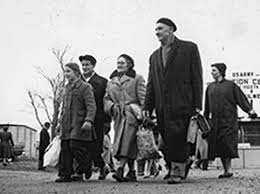
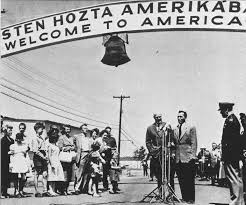
In the immediate aftermath of the Soviet invasion, many thousands of Hungarians were arrested. Eventually, 26,000 of these were brought before the Hungarian courts, 22,000 were sentenced and imprisoned, 13,000 were interned, and 229 were executed. Approximately 200,000 Hungarians fled Hungary to Austria as refugees as a result of the uprising. More than 30,000 of these refugees would be airlifted by the US military and resettled in the United States as part of Operation Safe Haven. Upon arrival, the Hungarians were temporarily housed at Camp Kilmer, in Piscataway New Jersey where multiple federal agencies assisted them through a resettlement process to become the newest members of American society. Many settled in nearby New Brunswick, which had an already thriving Hungarian-American community.



 Tragedy and Farce