November 9-10, 1938: Kristallnacht, the Beginning of the Holocaust

On November 9–10, 1938, Nazi leaders unleashed a series of pogroms against the Jewish population in Germany, annexed Austria, and in the Sudetenland which was seized from Czechoslovakia a month earlier. This event came to be called Kristallnacht (The Night of Broken Glass) because of the shattered glass that littered the streets after the vandalism and destruction of Jewish-owned businesses, synagogues, and homes. Kristallnacht was an unmistakable harbinger of the horrors yet to come and is widely regarded as the beginning of the Holocaust.

German officials claimed that Kristallnacht had erupted as a spontaneous outburst of public sentiment in response to the assassination of Ernst vom Rath. Vom Rath was a German embassy official stationed in Paris. Herschel Grynszpan, a 17-year-old Polish Jew, had shot the diplomat on November 7, 1938. A few days earlier, German authorities had expelled thousands of Jews of Polish citizenship living in Germany from the Reich; Grynszpan had received news that his parents, residents in Germany since 1911, were among them. Grynszpan’s parents and the other expelled Polish Jews were initially denied entry into their native Poland. They found themselves stranded in a refugee camp near the town of Zbaszyn in the southern border region between Poland and Germany. 

 In reality it was a purposeful, well orchestrated, act of state terror.  Vom Rath died on November 9, 1938, two days after the shooting. The day happened to coincide with the anniversary of the failed 1923 Beer Hall Putsch, an important date in the Nazi calendar. The Nazi Party leadership, assembled in Munich for its commemoration and chose to use the occasion as a pretext to launch a night of antisemitic excesses. Propaganda minister Joseph Goebbels, a chief instigator of the Kristallnacht pogroms, suggested to the convened Nazi ‘Old Guard’ that ‘World Jewry’ had conspired to commit the assassination. He announced that “the Führer has decided that … demonstrations should not be prepared or organized by the Party, but insofar as they erupt spontaneously, they are not to be hampered.”

The violence was largely prompted or provoked by Hitler’s Sturmabteilung (SA) but also included many ordinary German who held anti-Semitic prejudices and joined in the pogrom. The SA was the paramilitary wing of the Nazi Party and often referred to as “Storm Troopers” and the “Brown Shirts.” The SA were mostly violent street thugs and embittered veterans of the First World War who fought Jews, communists, and other perceived enemies of the Reich who they judged to be responsible for Germany’s defeat in the war and her subsequent hardships. Many members wore civilian clothes to support the fiction that the disturbances were expressions of ‘outraged public reaction.’ The “spontaneous” rioters also were to take no measures endangering non-Jewish German life or property; they were not to subject foreigners (even Jewish foreigners) to violence; and they were to remove all synagogue archives prior to vandalizing synagogues and other properties of the Jewish communities.

The SA led mobs shattered the shop windows of an estimated 7,500 Jewish-owned commercial establishments and looted their wares. Jewish cemeteries became a particular object of desecration in many regions. Many synagogues burned throughout the night in full view of the public and of local firefighters, who had received orders to intervene only to prevent flames from spreading to nearby buildings. The mobs also attacked Jews in their homes while forcing Jews they encountered to perform acts of public humiliation. Up to 30,000 Jewish males were arrested, with most of them transferred from local prisons to Dachau, Buchenwald, Sachenhausen, and other concentration camps. The Nazis also determined that the Jews should be liable for the damages caused during “Kristallnacht.” “The Decree on the Penalty Payment by Jews Who Are German Subjects” also imposed a one-billion mark fine on the Jewish community, supposedly an indemnity for the death of vom Rath. 

“Kristallnacht” provided the Nazi government with an opportunity at last to totally remove Jews from German public life. It was the culminating event in a series of anti-Semitic policies set in place since Hitler took power in 1933. In the weeks that followed, the German government promulgated dozens of laws and decrees to deprive Jews of their property and of their means of livelihood. Many of these laws enforced “Aryanization” policy—the transfer of Jewish-owned enterprises and property to “Aryan” ownership, usually for a fraction of their true value. Ensuing legislation barred Jews, already ineligible for employment in the public sector, from practicing most professions in the private sector. The legislation made further strides in removing Jews from public life. German education officials expelled Jewish children still attending German schools. German Jews lost their right to hold a driver’s license or own an automobile. Legislation restricted access to public transport. Jews could no longer gain admittance to “German” theaters, movie cinemas, or concert halls.

On November 15, 1938, one week after Kristallnacht, President Franklin D. Roosevelt denounced Nazi Germany’s terror attack on Jews, saying, “I myself could scarcely believe that such things could occur in a twentieth-century civilization.” FDR made an exception to his practice of off-the-record press conferences by allowing newspapers to quote this statement from his meeting with reporters that day. The president also announced that he had recalled the US ambassador to Germany, Hugh Wilson. The United States was the only nation to recall its ambassador and would not replace him until after the end of the war in 1945. 
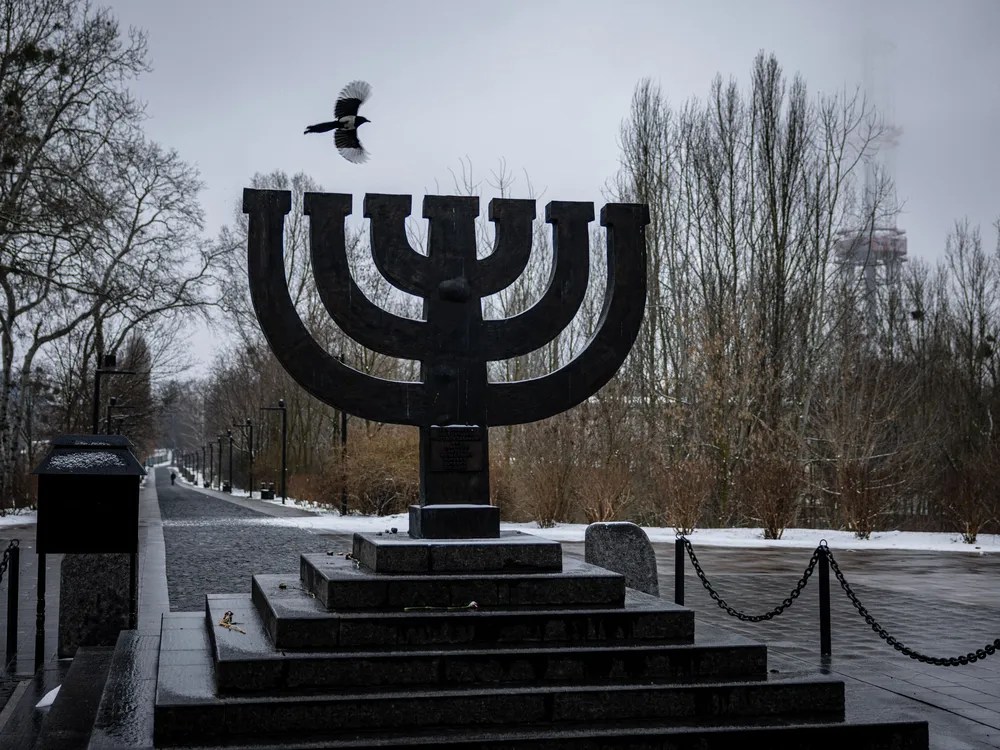
Tragedy at Babi Yar, Ukraine, September 29-30, 1941

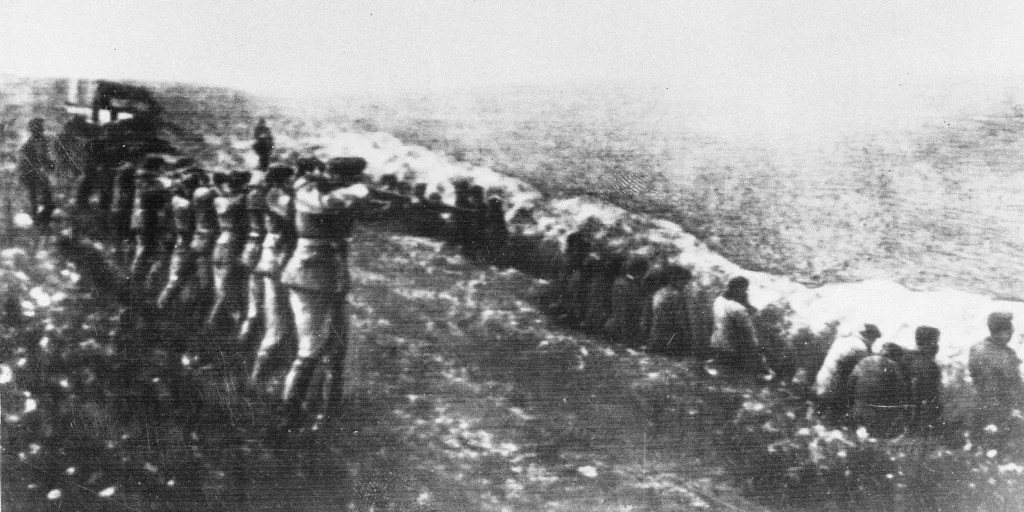
On September 29-30, 1941, the Nazis carried out a mass execution of over 33,000 Soviet Jews at the Babi Yar ravine just outside of Kyiv, Ukraine. The Jews were told they were being relocated and were marched in small groups to the outskirts of the city. There they were stripped naked, their possessions confiscated, and machine-gunned into the ravine by mobile killing squads associated with the Nazi SS called Einsatzgrupen and some Ukrainian auxiliary police. It was one of the largest mass executions of World War II and the apex of the “Bullet Holocaust,” the period before 1942 when the Nazis transitioned to a more systematic approach to exterminating Europe’s Jews using poison gas and “death camps” such as Auschwitz in occupied Poland. 

The Babi Yar Memorial Complex outside Kyiv

Nazi Germany invaded the Soviet Union on June 22, 1941 and as the German Wehrmacht advanced deeper into the USSR a wave of executions followed in its wake. In places such as Lithuania, Latvia, Belarus, Moldova and Ukraine, Jews were rounded up and summarily shot by the Einsatzgrupen and local anti-Semites, all in accordance with Adolf Hitler’s racial ideology of creating Lebensraum, or “living space” for the 1000-year German Reich. 

The Nazis seized Kyiv, the capital of the Ukrainian Soviet Socialist Republic, on September 19 and the Einsatzgrupen units were ordered  to exterminate all Jews and Soviet commissars found there.  By the time Germans reached Kyiv in mid-September 1941, about 100,000 of the city’s prewar Jewish population of 160,000 already had fled or joined the Soviet military to fight the invasion. Those that remained were largely women, children, the elderly, and the infirm. During the first week of the German occupation of Kyiv, two major explosions rocked the city, destroying the military headquarters of the German Army Group South and killing a large number of German soldiers. Although the explosions were caused by mines left by retreating Soviet soldiers, the Germans used the sabotage as a pretext to murder those Jews who still remained in Kyiv. On September 26 the German Army and the SS concluded that Kyiv’s Jewish population wouldn’t be confined in a ghetto, but instead annihilated at Babi Yar.  Two days later, Nazi authorities in Kyiv ordered all Jewish residents to appear the next morning at an intersection in the city’s Lukianivka district, with all their personal documents, money and valuables and warm clothing. They were then marched through the city to Babi Yar where they were told to undress and lined up and shot. Infants were taken from their parents’ arms and thrown into the ravine.

Einsatzgruppen Executing Ukraine’s Jews at Babi Yar

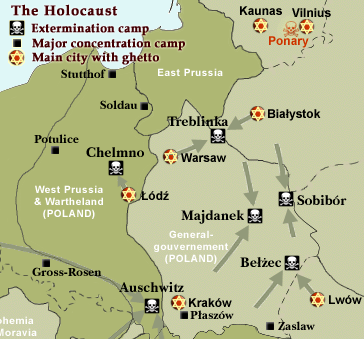
In late 1941, SS head Heinrich Himmler witnessed an Einsatzgruppen mass execution first-hand and concluded that shooting Jews was too costly, inefficient, and exerted too much stress on his men. In November Himmler decided a transition should be made away from mass shootings to the use of poison gas, especially with women and children. Experiments with the use of Zyklon B, a cyanide-based gas, had been in effect since September as well as mobile gas vans to murder mentally ill patients.  However, the gas vans were not popular with the Einsatzkommandos, because removing the dead bodies from the van and burying them was a horrible ordeal. On January 20, 1942, Himmler and numerous other Nazi officials involved in implementing the “Final Solution” met in the Berlin suburb of Wannsee to formalize plans for the total eradication of Europe’s 11 million Jews. Here it was decided that the Einsatzgruppen Mobil killing units would be replaced by permanent killing centers at   Auschwitz, Belzec, Chelmno, Majdanek, Sobibor, Treblinka, in occupied Poland.

The Lidice Massacre, June 10, 1942

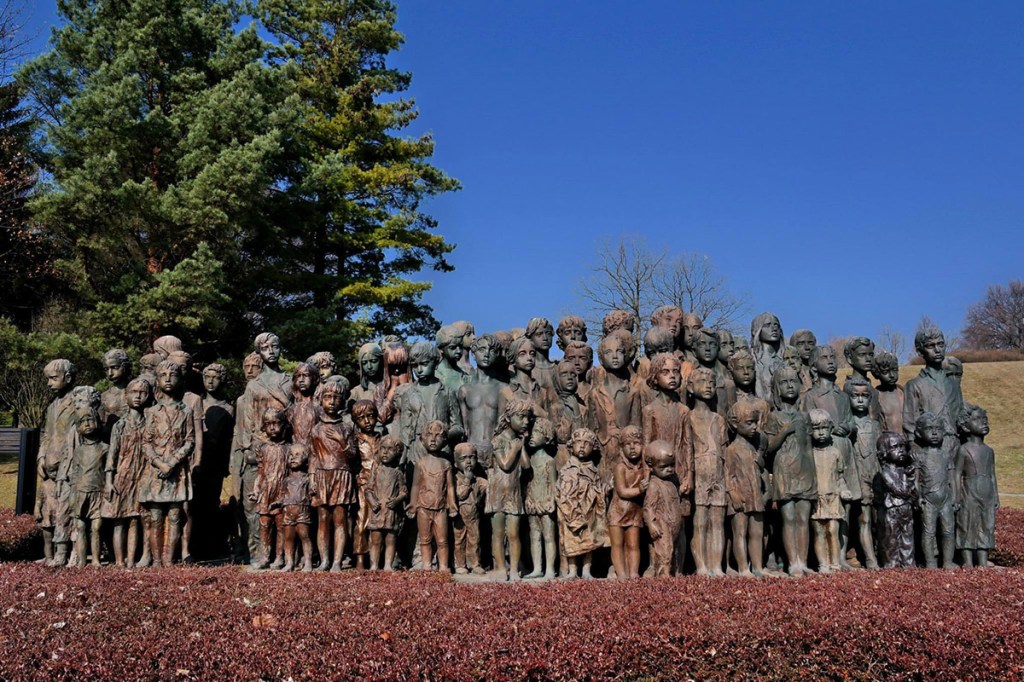
On June 10, 1942, the entire Czechoslovakian village of Lidice was wiped from from the face of the earth in retaliation for the assassination of SS leader Reinhard Heydrich by the Czech underground three weeks earlier. All 172 men and boys over the age of 16 were shot and killed. The women of the village were all sent to the Ravensbruck concentration camp where most died. Ninety young children were sent to the concentration camp at Gneisenau, with some later taken to Nazi orphanages if they were German looking. The Nazis then proceeded to raze the village until not a trace of it remained. All homes were destroyed, trees were chopped down, animals were killed, and even the cemetery was demolished. Soon, all that remained of Lidice was an empty field. It was as if it never existed.

A memorial to the murdered children of Lidice

Adolf Hitler personally ordered the destruction of Lidice. One account claims that Hitler randomly pointed to a village on a map  as the target of his vengeance and Lidice was the unfortunate victim. Other more likely accounts, claim that Lidice was selected because the village  had harbored and aided Heydrich’s assassins. 

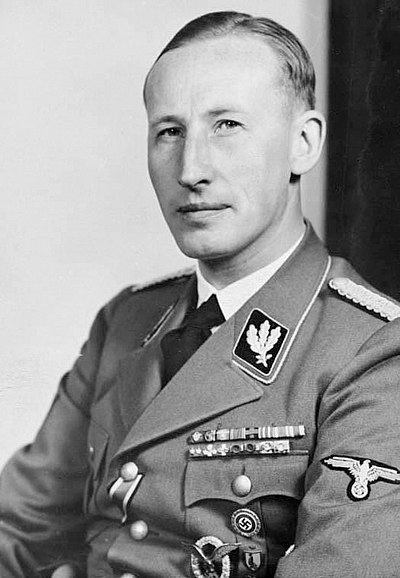
Heydrich, who organized the Kristalnacht attacks against German Jews in pre-war Germany and was the primary architects of the Final Solution, was probably one of the most barbarous and heinous of all the Nazis, demonstrating clear sociopathic tendencies, even by Nazi standards. In addition, to serving as the head of the SS, Heydrich was also acting as “Reichsprotektor,” or Governor, of what the Nazis called the protectorate of Bohemia and Moravia. The Nazis had occupied Czechoslovakia since April 1939. In 1940, they carved out the independent puppet state of Slovakia and absorbed the remaining Czech lands into the Greater German Reich.

Heydrich was one of Hitler’s favorite lieutenants and was sent to Prague near the end of September 1941 and tasked with suppressing rising anti-German sentiment and keeping up production quotas of Czech motors and arms that were “extremely important to the German war effort.  Heydrich’s methods were brutal. Within two months of arriving, Heydrich established Protectorate special courts, which sentenced 342 people to be executed. Another 1,200 citizens were handed over to the Gestapo for imprisonment. A large number of Czechs were used as forced labor to support the German war effort while Heydrich set out to erase all signs of Czech  national  identity. Heydrich told his staff, “We will Germanize the Czech vermin.” To this end, he set in motion a multi-faceted plan. Heydrich ordered teams of doctors and technicians to conduct racial blood tests to determine which Czechoslovakians were “capable of becoming Germans.” At the same time, he sought to systematically dismantle Czechoslovakian culture and history and replace it with a Germanized version. Heydrich was very clear about his eventual goal: “This entire area will one day be definitely German, and the Czechs have nothing to expect here.” Eventually up to two-thirds of the populace were to be either deported to Russia or exterminated after Nazi Germany won the war.

Operation Anthropoid

In 1942, the Nazi occupation of Czechoslovakia was beginning to seem like it would last forever. The Czech government in exile in London was determined to kill Heydrich and end his brutal assault upon the Czech nation. Together with the British Special Operations Executive (SOE) they devised Operation Anthropoid.

In December 1941, two soldiers from the Czechoslovak army in exile, one Czech, Jan Kubis, and one Slovak, Jozef Gabcik, secretly parachuted into the former Czechoslovakia intending to kill Heydrich. Several plans had been under consideration but were deemed impractical. Eventually they decided on a plan to assassinate him as he was being driven to work.

Left: Jan Kubis, Right Jozef Gabcik

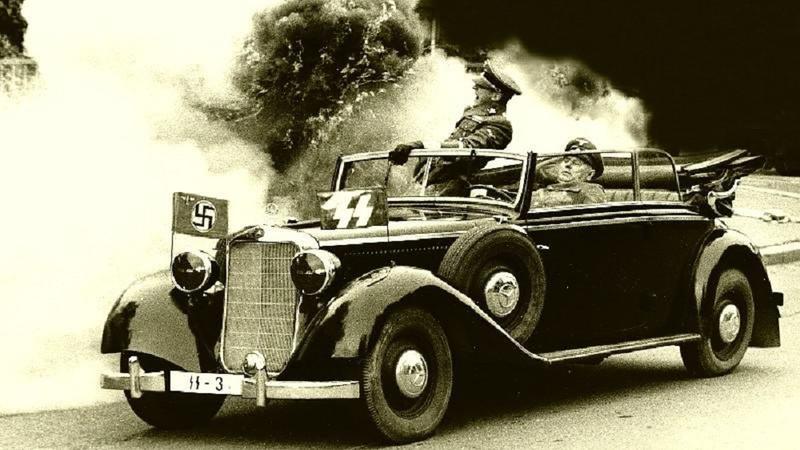
At 10:30 on 27 May 1942, Heydrich and his driver set off on their daily commute to Prague Castle in the center of the city. It was a nine mile journey that included a very sharp turn that required vehicles to slow down in order to safely navigate it. Here Kubis and Gabcik planned to ambush Heydrich. As Heydrich’s vehicle approached the turn and slowed down as expected, Gabčík, dropped his raincoat and raised his Sten submachine gun and, at close range attempted to shoot Heydrich, but the gun jammed. As the car passed, Heydrich made an ultimately fatal error; instead of ordering his driver to accelerate, he stood up and drew his Luger pistol yelling at the driver to halt.

As the Mercedes braked in front of him, Kubiš, who was not spotted by Heydrich or Klein, threw a modified explosive at the car; he misjudged his throw. Instead of landing inside the car, it landed against the rear wheel. Nonetheless, the bomb severely wounded Heydrich. Both the wounded Heydrich and his driver leaped from their vehicle a chasing after their would-be assassins. The driver ran towards Kubiš, who was also staggered by the explosion, but he recovered in time to jump on his bicycle and pedal away. Heydrich was now engaged in a shootout with Gabcik but he suddenly collapsed from the pain of his wounds allowing Gabcik to escape. Heydrich would succumb to his wounds on June 4.

Kubiš, Gabcik, and several other Czech partisans were eventually tracked down to the Saints Cyril and Methodius Cathedral in Prague. 750 SS soldiers descended on the Cathedral where a massive firefight ensued as the men hunkered down in the crypt and the prayer loft of the Cathedral. The Nazis were unable to take the men alive, and the standoff resulted in the deaths of them all, by both suicide and injuries sustained from the firefight.


It