On 17 September 1862, Confederate and Union military forces clashed near Antietam Creek in Western Maryland in what would become the bloodiest day in American history. The two armies together would suffer almost 23,000 killed or wounded and places named “the Cornfield,” “Bloody Lane” or “Burnside’s Bridge” would become forever etched in the collective memory of the nation. The outnumbered Confederates under General Robert E. Lee barely escaped a catastrophic defeat that might have ended the civil war two years sooner if it were not for the indecision of Union General George B. McClellan and his over abundance of caution. Lee’s narrow escape would allow the Confederacy to survive another two and a half years and prove the adage that sometimes it is better to be lucky than good.
The summer of 1862 was ending on a high note for the Confederacy after McClellan’s defeat in the Seven Days Battle and an impressive victory at Second Manassas. In Lee’s mind, momentum was on the side of the Confederacy, and it was time to bring the war to the North. It was time to invade Maryland. Although Maryland was a border state, many Marylanders held pro-Southern sympathies, and Lee calculated that a decisive victory on Maryland soil would not only demoralize the Union but bring Maryland into the war on the side of the Confederacy. It also was harvest time, and Lee wanted to take the war out of Virginia so that its farmers could collect their crops to help feed his army. Many of Lee’s troops were underfed and malnourished subsisting on field corn and green apples, which often gave them indigestion and diarrhea, negatively impacting their availability for combat.
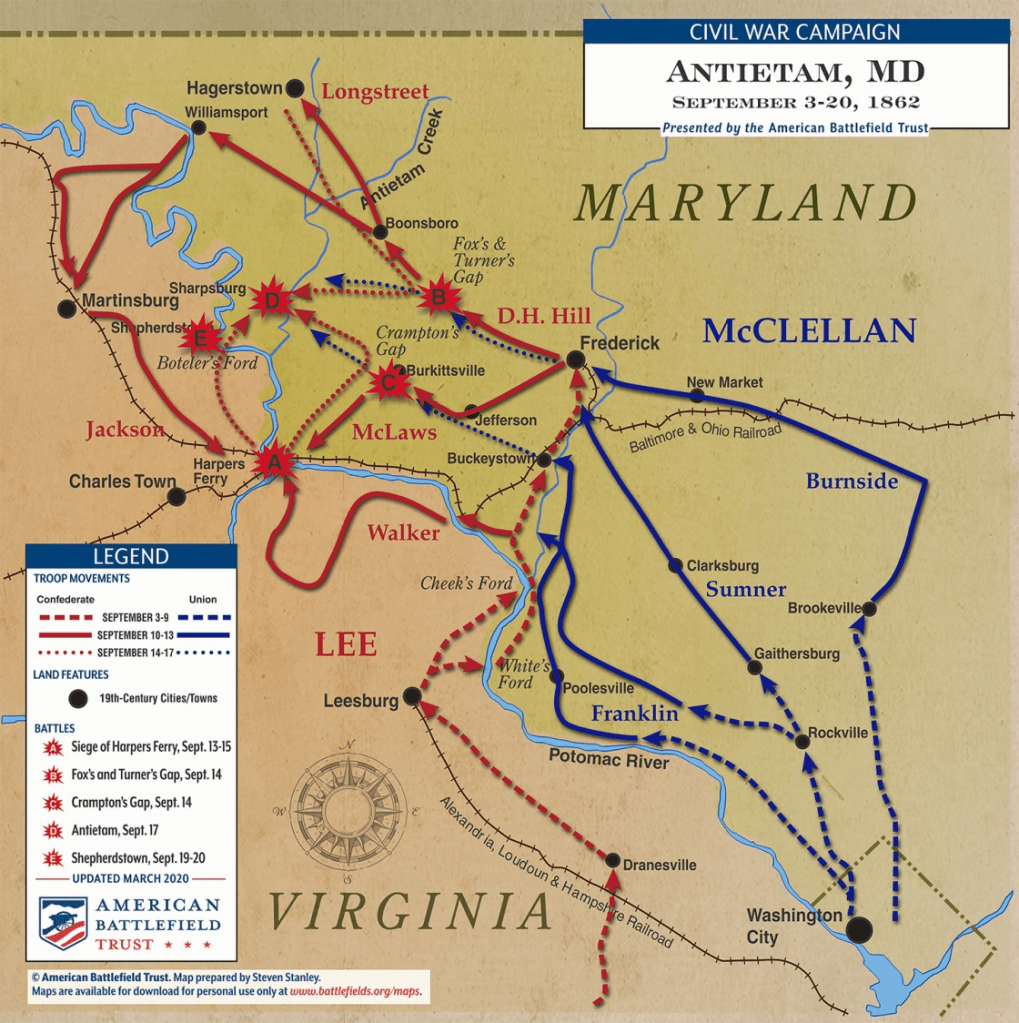
Lee and his 55,000-man army crossed the Potomac River into Maryland on September 4. Three days later his ragged and barefoot army entered the city of Frederick where they encountered an unexpectedly cool reception. Instead of an outpouring of support and affection they found a lack of enthusiasm for their cause if not outright hostility. Several pro-southern citizens of Frederick could not believe that the victorious Confederate army that they heard about was so poorly clad while other stunned citizens just turned their backs. One unnamed citizen noted: “I have never seen a mass of such filthy strong-smelling men.” Lee expected that once he entered Frederick the Union garrisons at Harper’s Ferry and Martinsburg would be withdrawn, clearing the way for him to establish communications through the Shenandoah Valley. Lee could not continue his invasion with these troops sitting on his supply line. He audaciously divided his army and prepared to move deeper into the North while simultaneously seizing Harpers Ferry.
Word that Lee and his army were occupying Frederick prompted McClellan and his 100,000-man army to pursue the rebels. McClellan by nature, was overly cautious. He also consistently overexaggerated the strength of Lee’s army. As a result, his pursuit of Lee lacked the urgency the situation demanded. When McClellan finally reached Frederick on September 12, Lee already divided his army and began to move West. However, McClellan received a stroke of good luck near Frederick when soldiers from the 27th Indiana Regiment discovered a copy of Lee’s orders for the Harper’s Ferry operation, Special Orders no. 191, lying on the ground wrapped around three cigars in a recently abandoned Confederate camp. The discovery of the orders clarified the operational picture for McClellan and revealed that Lee’s army was divided and ripe for defeat in detail.
Now fully aware of Lee’s intentions, McClellan had a simple plan; attack and destroy each element of the Confederate army before it had a chance to reunite. McClellan boasted to Brigadier General John Gibbon of the famed Iron Brigade, “Now I know what to do! Here is a paper with which, if I cannot whip Bobby Lee, I will be willing to go home.” McClellan was determined to seize the initiative and the slowness that characterized his earlier movements disappeared as he raced his army toward the South Mountain range to attack Lee’s army Lee was aware that McClellan was closing in, so after crossing the mountain he sent word to Stonewall Jackson besieging Harper’s Ferry to quickly finish up the task. He also left a rear guard to defend the passes at Turner’s, Fox’s and Crampton’s Gaps to delay McClellan’s and allow time for his army to regroup.
On September 14, advance elements of McClellan’s army engaged Confederate forces guarding the three passes in fierce fighting. The fight would last all day into nightfall and when it was over the Confederates still precariously held two of the three passes. The following day, the Federal garrison at Harpers Ferry surrendered and Lee ordered the forces at South Mountain to withdraw and rejoin the rest of his army near the small town of Sharpsburg. Stonewall Jackson and his men also hurried from Harpers Ferry to rejoin Lee’s army at Sharpsburg, with the exception of General A.P. Hill’s division which remained at Harpers Ferry to prevent Union forces from retaking the town.
Lee had strongly considered breaking off his Maryland Campaign and returning to Virginia but when he received the news of Harpers Ferry’s surrender he decided to remain. He used much of September 16 to reorganize and reposition his army for a battle he knew was coming. In characteristic fashion, McClellan’s innate caution prevented him from taking advantage of an opportunity to crush Lee’s army before it could reunite. McClellan spent much of the two days following the battle at South Mountain drawing up plans instead of vigorously pursuing Lee’s exhausted men. When McClellan did arrive near Sharpsburg, on September 16, he discovered Lee had established a 2.5 mile long battle line behind Antietam Creek. That evening Union and Confederate forces skirmished,McClellan drafted a straightforward battle plan. The next day, his army would strike at each of Lee’s flanks simultaneously, followed by a massive assault on the Confederate center. Even though McClellan’s plan was straight forward, the execution of it was wanting.
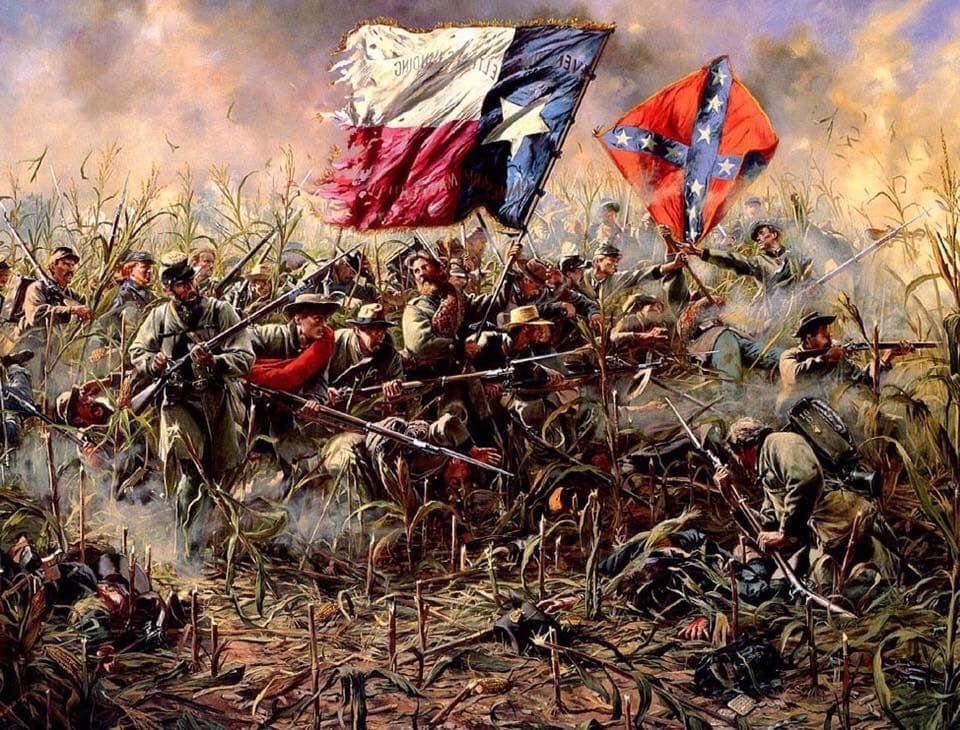
The battle began the following morning at daybreak when the first brigades of General Joe Hooker’s I Corps entered the cornfield of farmer David Miller which would become ground zero for the initial phase of the battle. Hooker’s objective was simple, strike Lee’s left flank and drive it back past a small white stone structure known as the Dunker Church. There was no element of surprise to Hooker’s attack. Lee’s men were prepared and when the first Union troops exited the cornfield a brigade of Georgians rose from the ground, from about 200 yards away, and unleashed a withering volley, knocking dozens from the ranks. Thousands of additional Federals were cut down in the tall corn rows and over the next four hours the field would change hands at least six times. Even when reinforcements from General Joe Mansfield’s XII Corps and General Edwin Summer’s II Corps managed to drive the rebels back to the Dunker Church and the West Woods, a vicious Confederate counterattack forced the Federals to withdraw. By mid-morning, both sides together would suffer around 10,000 killed and wounded by the time fighting in the cornfield and West Woods ended.
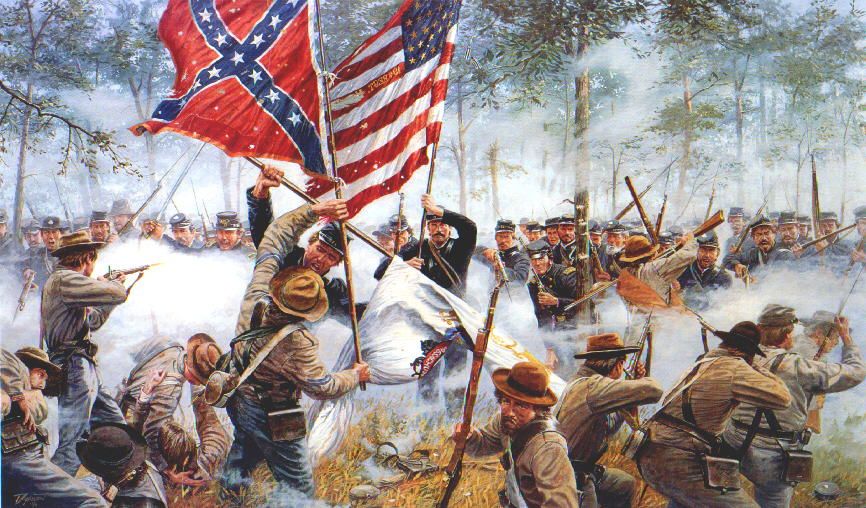
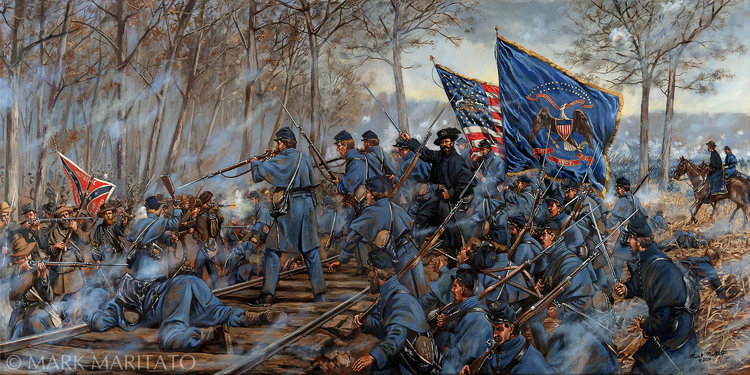
The 1st Texas Infantry Drives the Federals from the Cornfield
The focus of the battle soon shifted from the left to the center of the Confederate line. Here two brigades from Alabama and North Carolina occupied a strong defensive position in a fence-lined sunken farm road that would later become known as “Bloody Lane.” The road was worn down from years of wagon use and formed a natural trench for the defenders. Here, over the next three hours, hundreds of Union soldiers, including the famed Irish Brigade, with their colorful green banners, were cut down as they crested a ridge in front of the Rebel defenders. Two Union regiments eventually managed to flank the Confederate line and seized a slightly elevated position that allowed them to pour down a murderous fire upon the rebels. Several brigade and regimental commanders went down and the entire Confederate line began to break under the weight of the attack and a broken command structure. Soon the Confederates were fleeing back towards Sharpsburg with Federals in hot pursuit. With no reserves to commit, First Corps Commander, James Longstreet, masses an artillery barrage that sends the Federals reeling. The situation was so dire that Longstreet and his staff manned one of the rebel artillery pieces. By 1:00 pm, 2500 Confederate dead and wounded lined the sunken road. Union casualties totaled just under 3,000. The fight at the sunken road is a pivotal point in the battle that is the difference between a decisive Union victory and a tactical draw. There are no Confederate reserves left but McClellan grievously overestimated the strength of Lee’s army. Fearing a Confederate counterattack, he declines to deploy his two Corps he has in reserve which probably would have allowed him to cut Lee off from his escape route across the Potomac at Boetler’s Ford.
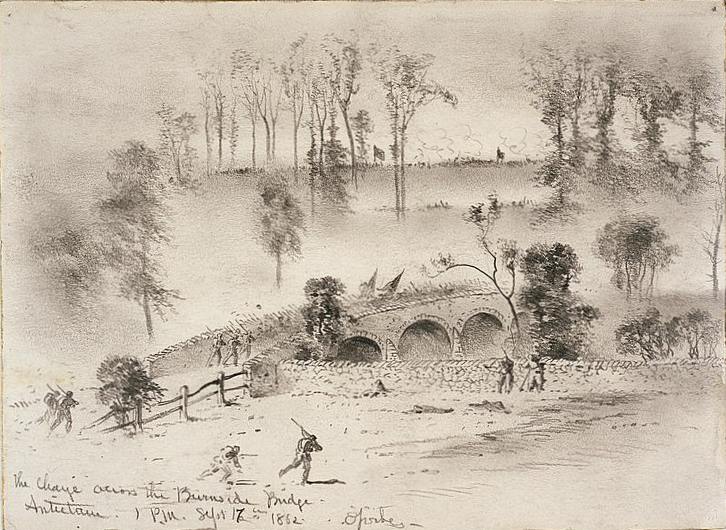
The final phase of the battle shifts to the Confederate right in the afternoon where a determined Union assault crushes the rebel flank and disaster is only averted by the timely arrival of General A.P. Hill’s division from nearby Harpers Ferry. The key players in this drama were General Ambrose Burnside and his 12,000 strong IX Corps, tasked with rolling up the Confederate flank and cutting off Lee’s retreat, and four undermanned Confederate brigades totaling about 3,000 men standing in his way. The stage is a 12-foot-wide stone bridge crossing Antietam Creek and the rocky high ground on the other side overlooking the bridge that is occupied by 500 Georgians.
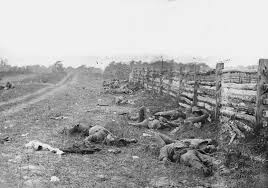
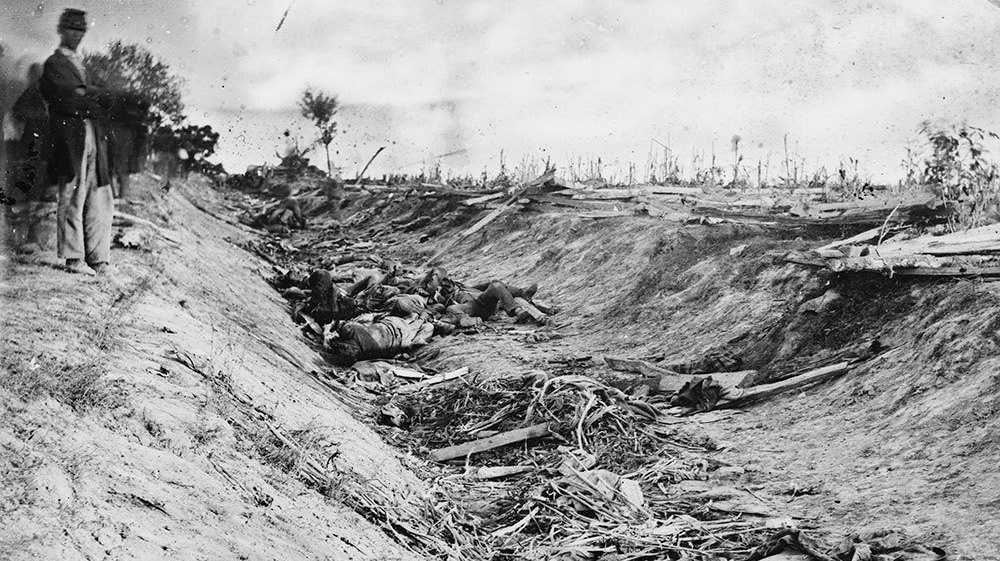
Confederate dead in the Sunken Road
Burnside’s battle plan was to storm the bridge while enacting a crossing, miles downstream where the creek was shallow and could be forded more easily. Around 10 am he launched the first out of what would be three attempts, to seize the bridge. At the same time, he ordered one of his divisions South in search of a crossing point at Snavely’s Ford. The first direct attempt to take the bridge was a complete fiasco. The Connecticut regiment leading the attack came under a withering fire from the Georgians occupying the bluff overhead and within 15 minutes the regiment lost a third of its combat strength. The second assault led by a Maryland and New Hampshire regiment was equally ineffective and costly. By this point in time McClellan was growing impatient and pressing Burnside to take the bridge at all costs. Around 12:30 Confederate volleys began to slack off as the Georgians occupying the bluff overhead began to run low on ammunition. Sensing an opportunity, one New York and one Pennsylvania regiment stormed the bridge under a heavy cover of canister and musket fire. With their ammunition depleted and word spreading that Union troops were crossing near Snavely’s Ford the Confederates fell back, allowing the Federals to cross unopposed.
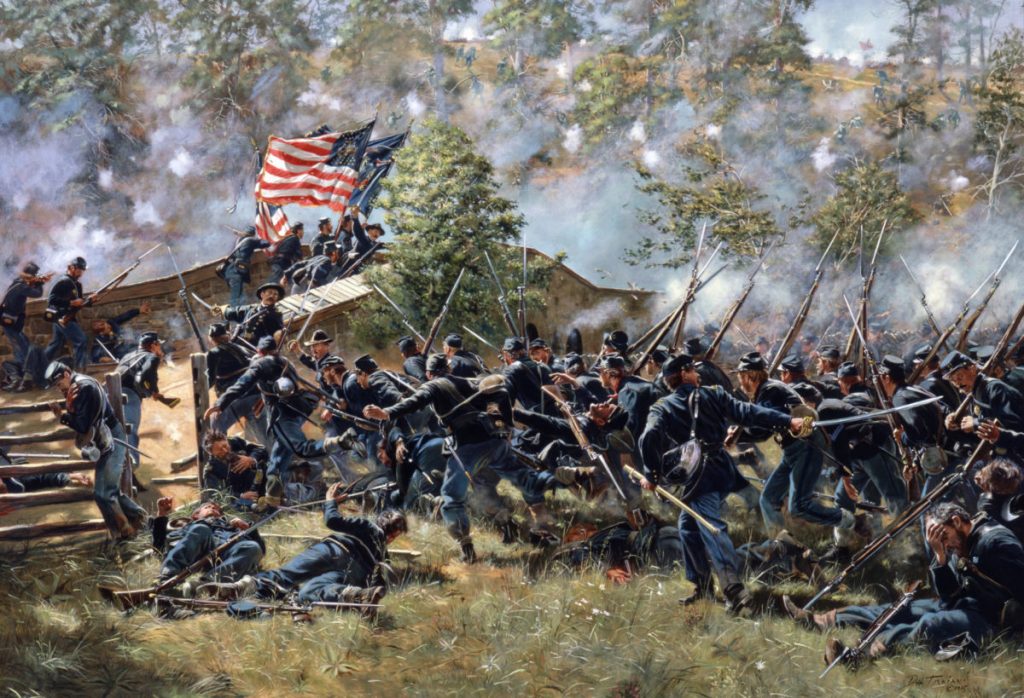
The 51st Pennsylvania Regiment Seizes the Stone Bridge
Burnside had finally taken the bridge but failed to advance with the urgency the situation warranted. He spent two hours moving three of his divisions, his artillery, and supply wagons across the creek before resuming the offensive. This delay proved crucial and was one of the key differences between a decisive Union victory and a tactical draw. It provided Lee with time to regroup and reorganize his beleaguered defenses following the collapse of his center and for General A.P. Hill’s division, which was marching from Harpers Ferry to arrive.
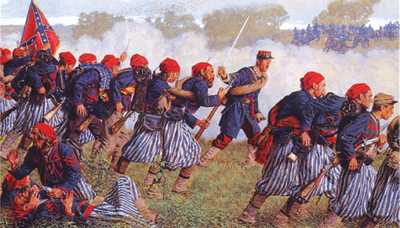
Around 4:00 pm Burnside’s IX Corps swept forward in a mile-wide battle line, driving back every thing in its way, as it pushed to cut off Lee’s retreat across the Potomac at Boteler’s Ford. The advance was led by the colorful Zouaves of the 9th New York infantry. Many of Burnside’s men were inexperienced but their umbers dwarfed the limited Confederate troops in this immediate sector. Lee and his staff were trying desperately to rally their broken forces and stave off a rout but just then, in a most dramatic fashion, General Maxcy Gregg’s brigade of South Carolinians, the vanguard of A.P. Hill’s division, slammed into the exposed left flank of Burnside’s army sending it reeling back down the hills and across Antietam Creek. One Union soldier from the 4th Rhode Island Regiment later described Hill’s counterattack, “They were pouring in a sweeping fire as they advanced, and our men fell like sheep at the slaughter.” By 5:30 the battle was over.
In many ways the battle of Antietam is a tale of failed opportunities, primarily on the Union side, and a contrast in leadership. The battle was a tactical draw, but it could have and should have been a decisive Union victory. It is easy to challenge some of the rationale underpinning Lee’s Maryland campaign. One can also question his decision to split his army in the face of a numerically superior enemy. However, in reviewing the course of the battle, one would be hard pressed to find fault with how Lee and the rest of the Confederate high command conducted the battle or could have better employed all the means at their disposal.
Left: Robert E. Lee, Right: Gerorge B. McClellan
The same cannot be said for McClellan who proved woefully inadequate. in his typical self-important fashion, cabled a situation report back to Washington the day after the battle writing, “Those in whose judgment I rely on tell me I fought the battle splendidly and that it was a masterpiece of art.” In reality, he fought the battle not to lose rather than trying win. As a result, he squandered opportunity after opportunity to inflict a decisive and catastrophic defeat on the rebel army. Throughout, the battle McClellan had kept two army corps, between 20,000-30,000 troops, in reserve. He mistakenly feared he was badly outnumbered by Lee and that should he be defeated he would need a reserve force to prevent Lee from moving further North. Had McClellan deployed those reserves in support of the attack on the Sunken Road, Burnside’s efforts to roll up the Confederate right flank, or even to launch a series of new attacks the following day most likely would have resulted in a decisive Union victory and possibly shortening the war by two years. McClellan would pay a steep price for his timidity. Two months later he would be relieved of his command by President Lincoln.
It’s the summer of 1864 and the fortunes of the Confederacy are on the wane. The Army of Northern Virginia is suffering from shortages across the board but one shortage is especially problematic, manpower. The Army of Northern Virginia is steadily being attritted. A series of bloody battles beginning in early May have sapped the Army and put it on the defensive. In early May, at the battle of the Wilderness, Confederate losses number over 11,000. A week later at Spotsylvania Courthouse, the South suffers another 10,000 casualties. In early June, the Confederates return the favor at Cold Harbor inflicting over 10,000 Union losses but they also suffer another 4,500 losses. In little over a month, General Lee has lost a quarter of his army. Lee knows he cannot continue losing men at this pace but he has few options. Lee writes to his son, “Where do we get sufficient troops to oppose Grant? He is bringing to him now the Nineteenth Corps, and will bring every man he can get.” Unlike his predecessors, General Grant is a fighter. He knows that he has Lee on the ropes and he won’t let up. Grant continues to push towards Richmond forcing Lee to move his army to stay between Grant and the rebel capital. Grant deprives Lee of the initiative and Lee is now forced to fight a defensive campaign against Grant’s numerically superior army, one that is not Lee’s strong suit.
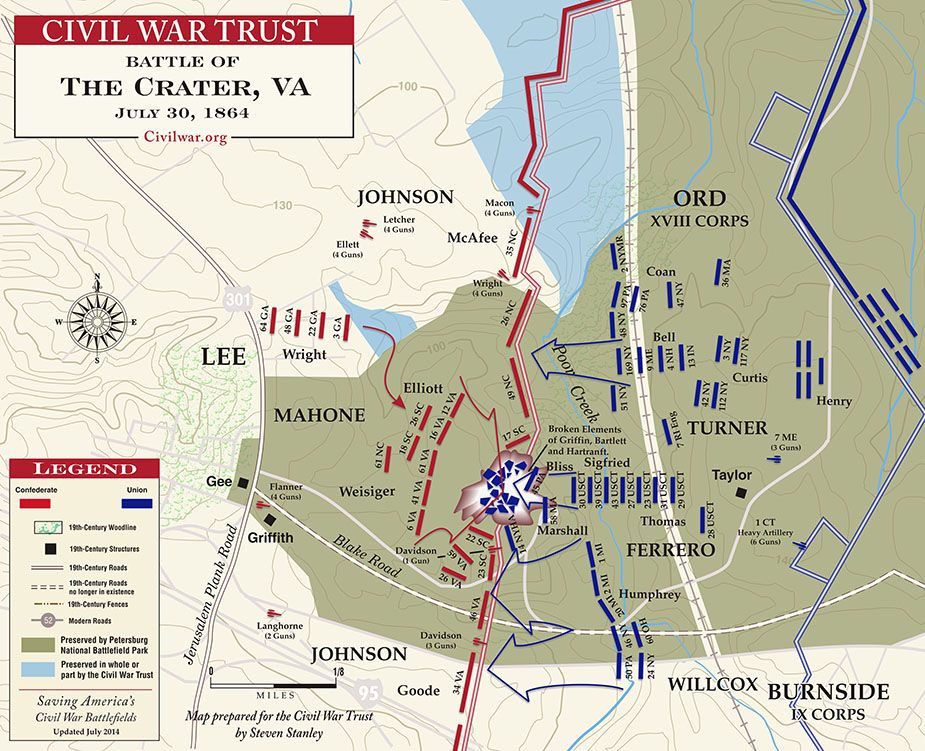
Unable to get between Lee and Richmond, Grant turns his eye toward the critical rail junction of Petersburg, thirty miles south of the capital. Petersburg is vital to the supply of Richmond and its loss would make Richmond’s capture almost inevitable. Shortly after Cold Harbor, Grant marches his forces towards Petersburg and Lee races southward toward Petersburg knowing what its loss would mean. By June 18, Grant had nearly 100,000 men under him at Petersburg compared to the roughly 20,000-30,000 Confederate defenders. Grant realized the fortifications erected around the city would be difficult to attack and pivoted to starving out the entrenched Confederates. Grant had learned a hard lesson at Cold Harbor about attacking Lee in a fortified position but is chafing at the inactivity to which Lee’s trenches and forts had confined him. A regiment of Pennsylvania miners offered a proposal to break the impasse. They would dig a long mine shaft under the Confederate lines and detonate explosives directly underneath fortifications in the middle of the Confederate First Corps line. If successful, not only would all the defenders in the area be killed, but also a hole in the Confederate defenses would be opened. If enough Union troops filled the breach quickly enough and drove into the Confederate rear area, the Confederates would not be able to muster enough force to drive them out, and Petersburg might fall.
The plan was met with great skepticism but Grant did not reject it out of hand. Digging commenced in late June. On July 17, the main shaft reached under the Confederate position. Rumors of a mine construction soon reached the Confederates, but Lee refused to believe or act upon them. For two weeks he debated before directing countermining attempts, which were sluggish and uncoordinated, and failed to discover the mine.
A division of new African-American soldiers was specially trained to carry out the assault once the explosives were detonated. For weeks the division prepared itself for all the chaos potential challenges they might encounter in leading the assault. Despite this intensive training, a decision was made a day before the impending attack to replace the African-American soldiers with another division that was less prepared. Elements within the Union high command lacked confidence in the black soldiers’ combat abilities.
The explosive charges were detonated at 4:44 a.m. on the 30th. They exploded in a massive shower of earth, men, and guns creating a crater that was over 100 feet wide and 30 feet deep. The initial explosive charges immediately killed 278 Confederate soldiers. The remaining troops were stunned by the explosions and did not direct any significant rifle or artillery fire at the enemy for at least 15 minutes. However, the Union troops selected to lead the assault were unprepared for what they encountered. Instead of moving around the crater, they advanced down into it and soon became trapped. The Confederates, under Brig. Gen. William Mahone, regrouped and counterattacked. They began firing rifles and artillery down into the crater in what was later described as a “turkey shoot.” The plan had failed and the battle was lost. However, the strategic situation remained unchanged. Both sides remained in their trenches, and the siege would continue into March of the next year.
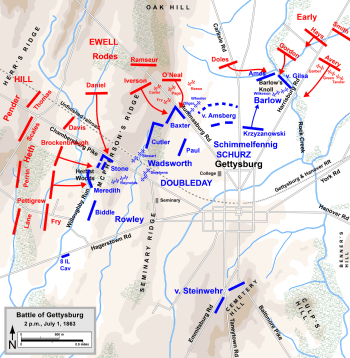
On July 1, 1863 two Confederate brigades, one from Tennessee and one from Mississippi advanced down the Cashtown pike engaging elements of Union General John Buford’s Cavalry division west of the sleepy little Pennsylvania town of Gettysburg. Bufford’s mission is clear, Buy time for the first Corp and the rest of the Union army to arrive. Buffords cavalry is able to halt the Confederate advance for two hours allowing the first infantry brigades of the first Corps to arrive on the scene. However, Confederate General A.P. Hill deploys two more divisions and the Confederate II Corps under General Ewell is advancing from the North. By late afternoon the Rebels have taken Semminary ridge and forced the Union forces to retreat south of town. The rout is on. With the sun setting General Lee gives an ambiguous order to General Richard Ewell to push the scattered Union forces from Cemetery Hill, “if practical.” Ewell decides against such action, which becomes a pivotal point in the battle. Day one goes to the Confederacy but Ewell’s failure to act is a major turning point.
Left: The battle at 12:30pm; Center: The battle at 2:30pm; Right: The end of the first day
On December 13, 1862, the Army of the Potomac under Major General Ambrose Burnside conducted a direct frontal assault on entrenched Confederate positions in the Virginian town of Fredericksburg in what would become one of the most lopsided defeats in the civil war.
Early November of 1862 was a dark time in Washington. Almost two months since the Army of the Potomac turned back the Confederate invasion of the North at the battle of Antietam, President Lincoln remained haunted by the missed opportunity to destroy the rebel army in one decisive battle. Lincoln put his trust in army commander Major General George B. McClellan twice, only to be disappointed by the general’s excessive caution and annoyed by his repeated insolence. On November 7, Lincoln relieved McClellan of his command once and for all turning to Major General Ambrose Burnside as his successor. Burnside clearly was not McClellan’s equal in terms military skill and even he himself thought he was ill-suited for the job. Nonetheless, his greatest selling point was that he was generally well liked by most of his peers, something that could not be said about the rest of the Union general officer corps. Lincoln now had himself a new army commander, one who was more cooperative and congenial if not less capable.
Lincoln urged Burnside to carry out a late fall offensive against the rebels before winter set in, hoping to prevent the Northern public from losing confidence in his administration and the war effort. Stuck behind the Rappahannock river, Burnside intended to conduct a pontoon crossing of the river and rapidly move towards Richmond before the Confederates could get between him and the rebel capital.
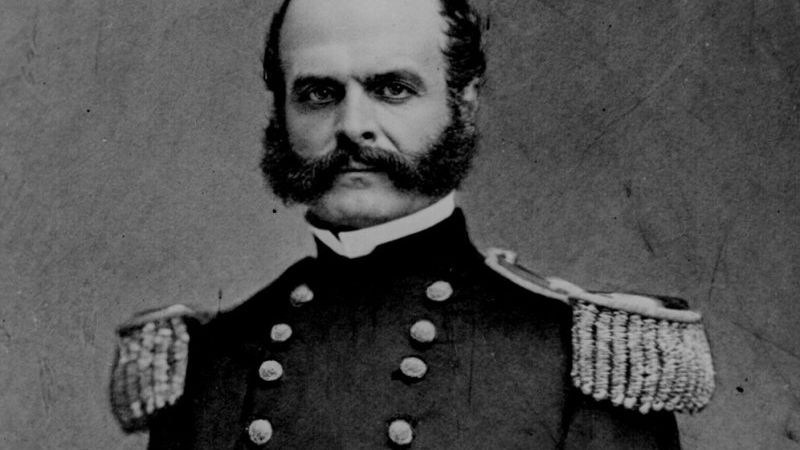
Major General Ambrose Burnside
Burnside began moving his forces toward the river on 15 November but his plans began to go awry almost immediately. The pontoons he hoped to use to affect the crossing were delayed and did not arrive for almost another month. Confederate commander General Robert E. Lee expected that Burnside would beat him across the Raphanock and was prepared to engage the Union army further South. However, when it became clear that Burnside was delayed he directed his army to Fredericksburg. Lee moved Major General James Longstreet’s corps toward Fredericksburg from Culpeper while Major General Thomas J. “Stonewall” Jackson’s men followed from the Shenandoah Valley.
The pontoons that Burnside was expecting had finally arrived and the Union army made preparations to cross the river on 11 December. Burnside originally planned to cross the river at a location south of town but intelligence reporting convinced him that the rebels had anticipate his move and were gathering forces in the area to oppose the crossing. Instead, Burnside decided to cross the river immediately in town where only a Mississippi regiment was thought to be occupying Fredericksburg
Union engineers began to assemble the pontoon bridges shortly before dawn on 11 December. The engineers immediately came under fire from Mississippi and Florida sharpshooters hiding in the town buildings along the river. In response, Union artillery pounded the city. When the bombardment failed to drive the Confederates back, Burnside sent the 7th Michigan and 19th Massachusetts Infantry regiments across the river in pontoon boats to secure a small bridgehead and rout the sharpshooters. Union forces advanced up the narrow streets and alleys of Fredericksburg but continued to take casualties from well hidden Confederate sharpshooters. Darkness and the arrival of fresh Union troops compelled the Confederates to withdraw to the heights West of town, but they had bought the Army of Northern Virginia precious time to prepare for the main Union assault that was soon to come.
Union forces clearing the rebel sharpshooters from Caroline street
Burnside spent the next day moving the remainder of his army across the river. He issued attack orders early on the morning of December 13. His plan was simple. The Union left, under Major General William Franklin would strike Stonewall Jackson’s corps just south of town. On the Union right, the Major General Edwin Sumner’s II Corps would cross almost a thousand yards of open fields and attack General Longstreet’s corps which was deployed on a series of five hills west of town known as Mayre’s Heights. There they hunkered down behind a stonewall and a sunken road posing an even more formidable challenge for Sumner’s men.
The Slaughter Pens
In the morning fog on December 13, Franklin ordered a single corps, Maj. Gen. Joseph Reynolds’ 1st Corps, to move into place south of the city along the railroad. After adjusting his lines, Reynolds had the Confederate line heavily shelled for an hour, though with little effect or response from Jackson, who had ordered his gunners to hold their fire until the Federal infantry advanced. As the Union soldiers approached Jackson’s line for a more direct attack, the Confederates responded, pushing them back. An artillery duel ensued, with Union guns now landing hits on their targets. In the early afternoon, Reynolds ordered his two remaining infantry divisions to approach the Confederate line, where they found a hole in the line left by Jackson, who wrongly assumed the terrain—swampy woodland—was impassable. Finding the advantage in attacking the Confederates, Union major general George Meade began to roll up the Confederate lines. Jackson ordered his reserves to counterattack, while Meade sent word to Brig. Gen. David Birney for reinforcements that would never come; Birney refused to coordinate efforts with Meade. Left unsupported and facing an overwhelming onslaught, Meade retreated, with the Confederates pushing their advantage. The area of intense fighting would become known as the Slaughter Pens. By late afternoon, Jackson had readjusted his lines and tried to goad the Union into attacking, but Meade refused to respond. With darkness approaching, the battle south of Fredericksburg came to an end.
The battle to the north, with Longstreet on Marye’s Heights and Sumner emerging from the city streets, was even less successful for the Union. Sumner’s men had to cross about half a mile of open ground that included a mill race (a trench five feet deep, 15 feet wide, and filled with three feet of water) before approaching a stone wall, behind which Longstreet had his men entrenched, with artillery on the heights behind them. As the fog lifted and artillery booms from the battle downriver were heard, Sumner began ordering wave after wave of divisions to advance toward Marye’s Heights. Throughout the day, the Union divisions advanced and were cut down by Confederate artillery and gunfire. Late in the day, the 9th Corps of Maj. Gen. Joseph “Fighting Joe” Hooker’s Grand Division attempted to flank the sunken road but only succeeded in adding more blue-clad casualties to the heaps that lay in the fields.
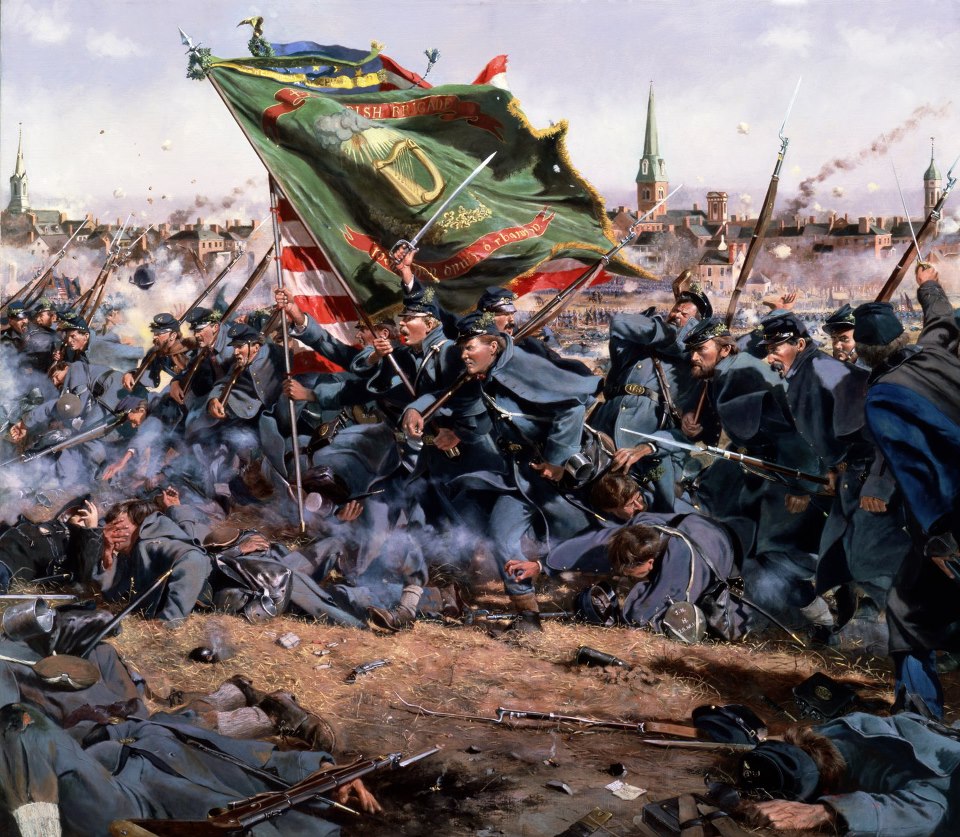
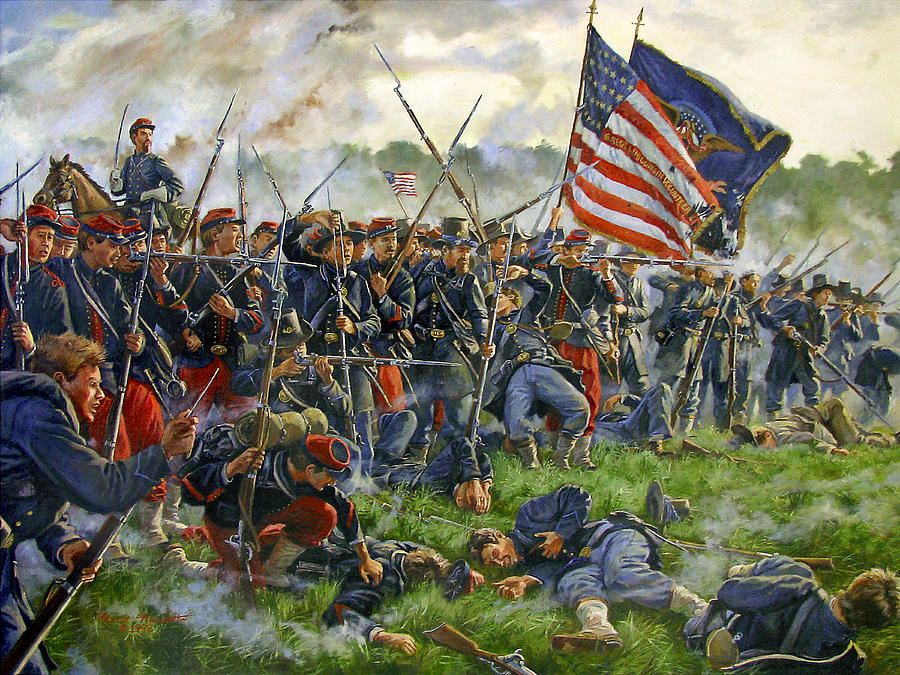
The Irish Brigade coming under heavy fire attacking Mayre’s Heights
That night, a Confederate soldier from South Carolina, Richard Kirkland, risked his life to take water and warm clothing over the stone wall to the wounded and dying of the enemy; the “Angel of Marye’s Heights” is an enduring symbol of humanitarianism. Kirkland would be killed at the Battle of Chickamauga the following autumn.
Burnside intended to renew the frontal assaults the next morning, but the commanders of his three grand divisions convinced him not to. The following two days were filled with the misery and suffering of the wounded between the two lines. The night of December 15, Burnside retreated to winter camp in Stafford County.
The battle was an undeniable disaster for the Union army and only served fo further depress Union morale heading into the winter. Union casualties at Fredericksburg almost reached 13,000 troops. Confederate losses were less than 5500.
It was a mid-September morning in 1862 along the Antietam creek in Western Maryland. The sun was beginning to rise as the nighttime sky slowly gave way to the blue and orange hues of the morning. An overnight rain ended and a morning ground fog was dissipating as the first Union soldiers broke camp and began moving south toward the Miller family’s cornfield. Confederate artillery from the high ground on the Union right opened fire as the the Yankees trampled through the cornfield, warning both sides that a battle had commenced. At the opposite end of the cornfield two brigades of battle-hardened Confederate veterans, patiently waited, poised to stem the advance. As the first blue coats emerged from the cornfield, the Confederates rose from the ground unleashing a thunderous volley, ripping through the Union ranks in what would become the opening engagement in the bloodiest day in American history.
At Antietam, close to 23,000 American soldiers were either killed or wounded in a roughly twelve hour period. The casualties from Gettysburg, Shiloh, Chancellorsville, Chickamauga and Spotsylvania exceed those of Antietam but these battles were multi-day affairs. If Shiloh was a loss of innocence, a demonstration that war was not some kind of lark or noble adventure that one entered into lightly, then Antietam was another wake-up call for both sides.
Antietam is an epic battle in every sense of the word. It is one both in terms of it’s importance and consequences. One that is epic in the sense that key points of the battle— the cornfield, Bloody Lane, and Burnside’s Bridge—are forever etched in U.S. military history. It is a battle where the men of both sides were pushed to their limits and beyond. On the Union side alone, 20 Medals of Honor were awarded for acts of bravery during the battle. It is also the first time where the battlefield carnage is recorded by photograph for the American public to see.
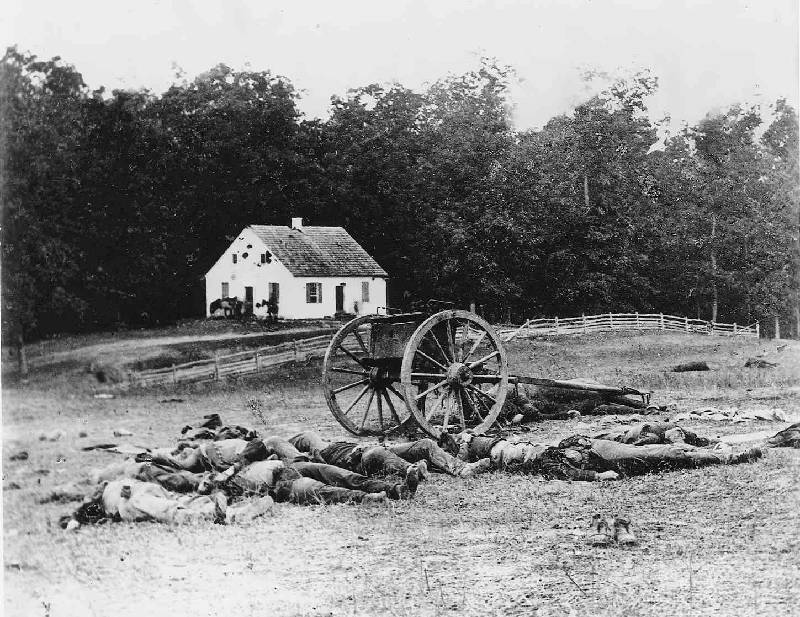
Confederate dead near the Dunker Church and along the Hagerstown Pike.
The drama of that fateful September morning was set in motion less than a month earlier. At the end of August, General Robert E. Lee and the Army of Northern Virginia soundly defeated Union forces at the Second Battle of Manassas while scoring a tactical victory at the Battle of Chantilly, that sent the Yankees scurrying back behind the defenses of Washington. With only 55,000 troops under his command, Lee’s army posed no serious threat to Washington DC. Moreover, his army was badly in need of food and other supplies and the Virginia countryside had been ravaged by the war. Faced with this reality, Lee opted to take the war North. He would invade Maryland and if possible Pennsylvania with goal of securing supplies, undermining Northern morale, and encouraging Maryland to join the Confederacy. Lee also calculated that his advance into Maryland would draw out the Union army from its defenses and supply base in Washington DC where he could deliver a decisive blow.
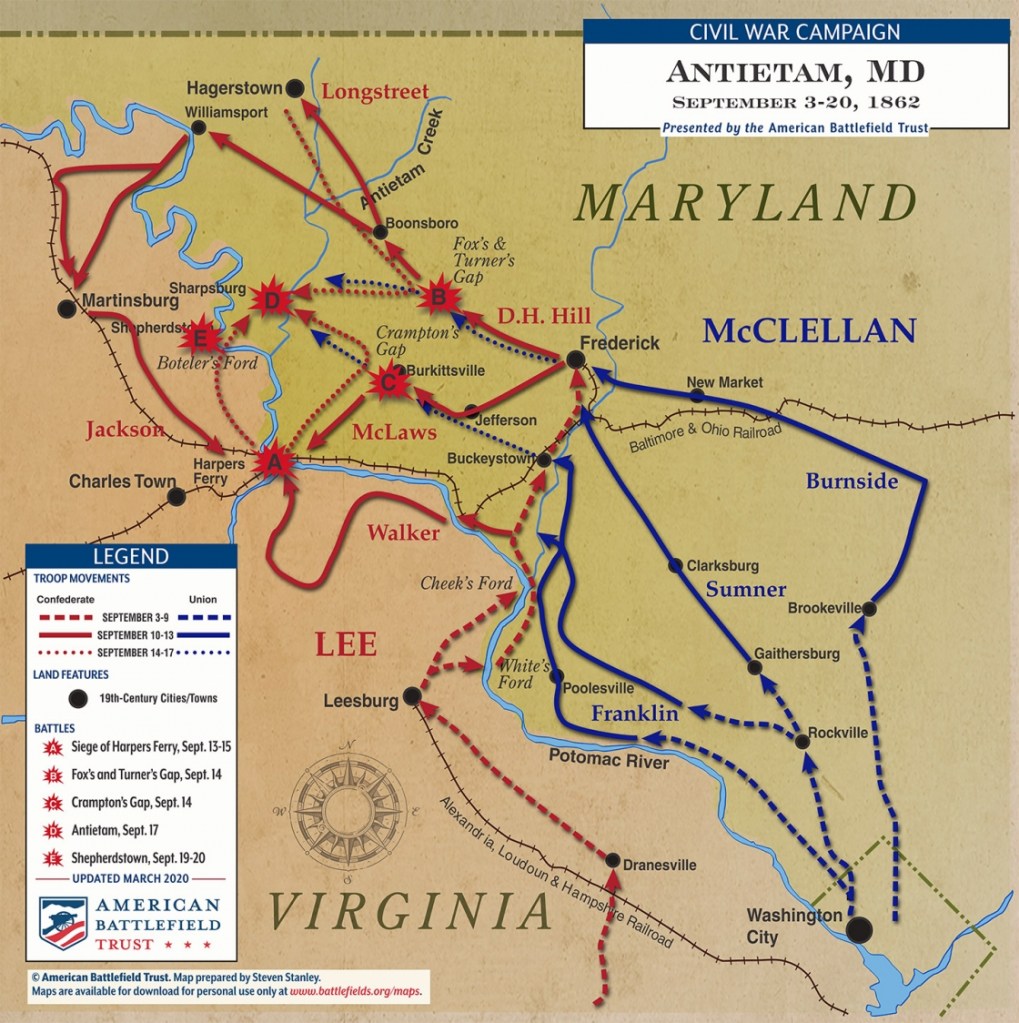
On September 4, his rag-tag Confederate army crossed over the Potomac River into Maryland near Leesburg Virginia and advanced rapidly north toward Frederick, Maryland. However, things began to go wrong immediately for the rebel invaders. A large number of confederate forces refused to crossover into Maryland claiming that they joined the army to defend the South against Northern aggression, not to invade the North. Confederate forces also did not receive the warm welcome they expected. Unlike Baltimore and southern Maryland where there were a considerable number of Southern sympathizers and slaveholders, Western Maryland was a center of pro-Union sentiment. Lee also expected that when he entered Frederick, that the supply line to the Federal garrison at Harpers Ferry would be cut and force the 14,000 troops there to withdrawal. They did not and the garrison posed a continuing threat to Southern supply lines. Consequently, Lee was forced to divide his already depleted army. He ordered General Stonewall Jackson and his Corps to seize Harpers Ferry. He then sent General James Longstreet and 10,000 men ahead to Hagerstown, leaving a smaller contingent of forces behind at South Mountain to guard the army’s rear and protect the mountain passes at Fox, Turner, Crampton gap.
News that the Confederates had crossed the Potomac into Maryland, set off alarm bells in Washington but the Union commander, General George McClellan was slow to respond. On September 7, the 87,000 strong Army of the Potomac began their pursuit of the Confederate Army but did not reach Frederick until six days later. As luck would have it soldiers from the 27th Indiana infantry regiment found a copy of Lee’s plans wrapped around three cigars in a field. Emboldened by his good fortune, McClellan boasted, “Here is a paper with which if I cannot whip Bobbie Lee, I will be willing to go home.” With that critical information, McClellan knew that Lee’s army was divided and their locations. He ordered his army to advance West with all deliberate speed toward the mountain passes, near South Mountain. He would now destroy Lee’s divided army piecemeal.
On 14 September, the advancing Union army clashed with the rear guard of Lee’s army for control of the three mountain passes — Fox, Turner, and Crampton’s Gap, at South Mountain. The fighting was fierce as the Union army moved up the jagged rocks against determined Confederate resistance. The smaller Confederate detachment held firm against repeated Union assaults. The fighting would continue non-stop into the evening with the outnumbered rebels eventually retreating and ceding the passes to the Union army. When the battle ended a combined 4,000 Union and Confederate soldiers were killed including Federal Ninth Corps commander, General Jesse Lee Reno, and Confederate Brigadier General Samuel Garland. The next day Harpers Ferry succumbed to Confederate forces.
Having dislodged Confederate forces from the mountain passes, McClellan and his army passed over South Mountain and were within striking range of Lee’s vulnerable army. However, McClellan continued to operate with his customary lack of urgency. He failed to press the vulnerable Confederates and allowed Lee time to regather his divided army and assume a defensive position behind Antietam creek, just east of Sharpsburg. Stonewall Jackson and his men rejoined Lee on the 16th after securing the surrender of Harpers Ferry. However, Jackson left behind a division under Major General A.P. Hill to complete the turnover. Longstreet and his men had begun their return march from Hagerstown after hearing the sounds of battle echoing from South Mountain. Union forces continued to outnumber the Confederates by a 2:1 margin but McClellan still erroneously believed he was outnumbered.
The Battle Begins
Lee expected that the overly cautious McClellan would not attack before September 17 and McClellan did not disappoint. The Union commander diligently spent all day September 16 carefully developing his battle plan around Antietam Creek’s three crossings: the Upper, Middle, and Lower bridges. McClellan’s opening attack would use the Upper Bridge to strike Lee’s left flank followed up by a coordinated attack on his right across the Lower Bridge. These two attacks were expected to thin out the Confederate Center, where Union forces would cross over the Middle Bridge and strike a final blow. With the flank attacks cutting off his avenues of retreat, Lee would be compelled to surrender. That evening, two Union I and XII corps crossed over the Upper Bridge with orders to strike Lee’s left early the next day. Despite McClellan’s meticulous preparation, few things would go as planned.
Shortly after daybreak on the morning of September 17th, Major General Joseph Hooker and his three divisions of the I Corps emerged from their bivouacs on the Poffenberger farm and moved south toward the North end of the Miller family’s 30-acre cornfield. At the opposite end of the field, in unknown strength and location, waited the Confederate forces of Major General Thomas “Stonewall” Jackson for their expected attack. Over the next four hours, this cornfield would become ground zero for some of the worst carnage in U.S. history. The battle here would be marked by a series of attacks and counter attacks in which neither side was able to gain the upper hand. The field would change hands no fewer than six times but when all was said and done the fighting ended in a stalemate as the focus of the battle shifted south.
1.) Hooker’s brigades begin their attack on the cornfield; 2.) Hood’s division counter attacks; 3.) General D.H. Hill sends reinforcements from the Sunken Road; 4.) Mansfield’s Twelfth Corps drives Hood’s men from the field
Hooker’s battle plan was simple and uncomplicated. There was no deception or complex maneuvering involved. The I Corps would carry out a direct assault on the Confederate left flank and drive it back past a small white stone structure on raised ground known as the Dunker Church. Hooker positioned his forces for battle in the shape of an inverted pyramid. He deployed Brigadier General James Ricketts’ division on the left, Brigadier General Abner Doubleday’s division on the right and placed Brigadier General George Meade’s division behind the two in reserve.
General Ricketts’ division would lead the attack and around 6:00 am Brigadier General Abram Duryee’s brigade deployed into a double line and entered the cornfield. Moving forward, they disappeared amongst the head-high cornstalks, unsupported but undaunted. As Duryee’s men neared the end of the cornfield, a brigade of Georgians, under the command of Colonel Marcellus Douglass, rose from the ground about 200 yards away and unleashed a deafening volley, knocking dozens from the ranks. Duryee’s brigade stood toe to toe with the Georgians firing behind the for cover of an old wooden fence. Men in the ranks of both sides fell rapidly but after 30 minutes of intense fighting and 300 casualties Duryee’s men slowly began to fall back.
Three regiments from Douglass’ brigade pursued the retreating Federals and they were soon joined by Brigadier General Harry Hay’s brigade from Louisiana, whom Jackson sent to bolster the Georgians. As Hays’ brigade advanced, they crashed into one of Ricketts’ other brigades under the command of Colonel Richard Coulter. Coulter’s brigade just emerged from the East Woods and was moving to support Duryee’s men. In some of the fiercest fighting of the battle, Hay’s men drove Coulter’s brigade back into the East Woods, where it rallied, strengthened by reinforcements. Exhausted and running low on ammunition Hays’ brigade was forced to retreat.
On the Union right, Doubleday’s division began its attack about the same time as Duryee’s men were falling back. Brigadier General John Gibbon’s “Iron Brigade” led the attack with the brigades of Colonel Walter Phelps and Brigadier General Marsena Patrick close behind on the left and right. Gibbon’s men were all Midwesterners of hearty stock and earned their sobriquet as reliable and determined fighters the previous month at Manassas. Advancing south along the Hagerstown Pike, Gibbon’s brigade entered the cornfield around 6:30 am led by the 6th Wisconsin regiment with the 2nd Wisconsin regiment following on its left. Behind them were the 7thWisconsin and the 19th Indiana. Pushing its way through the dense corn, the 6th Wisconsin was suddenly hit by an unexpectedly strong volley from its right flank. A battle line of Virginians emerged from the West Woods and delivered a second volley tearing into the 6th Wisconsin, killing and wounding dozens. Both the 2nd and 6th Wisconsin wheeled to meet this new threat, taking cover behind a wooden rail fence. Gibbon also redeployed the 7th Wisconsin and the 19thIndiana west of the turnpike to drive the Virginians from the field, while Doubleday sent Patrick’s brigade in support. The Virginians were soon pushed back.
With the immediate threat to their right eliminated, the 2nd and 6th Wisconsin, along with Phelps’ brigade, continued to move forward toward the Dunker Church. As they approached the end of the cornfield, they were met with the same deadly fire that Duryee’s brigade received 30 minutes earlier. Three regiments of Georgians, from Douglass’ brigade rose up and unleashed a powerful volley. The men of Gibbon and Phelps’ brigades closed ranks behind a wooden fence and returned fire with equally devastating effect. Pressed hard by Doubleday’s division, the Georgians began to fall back opening the door to the Dunker Church. Suddenly, two brigades of Louisianans and Virginians emerged from the depths of the West Woods under Brigadier General William Starke. Starke’s men took up positions along a wooden rail fence on the east side of the Hagerstown Pike and fired into the Union flank, slowing their advance. Gibbon and Phelps’ men pivoted to meet the new threat. At one point the two battle lines were only 30 yards apart blazing away at each other. They fell by the score, including Starke who was shot three times and would die within the hour. The 7th Wisconsin and the 19th Indiana, which had earlier driven the Confederates from the Northern edge of the West Woods now appeared on Starke’s left inflicting heavy damage. Their position no longer tenable, the rebels retreated back behind the West Woods.
As the Confederate line began to crumble, Jackson turned to only remaining reserve, Brigadier General John Bell Hood’s Division. Hood’s division was made up of three brigades of Texans and two from Georgia and South Carolina, who had proven themselves in previous battles to be reliable and tenacious fighters. Shortly after 7:00 am Hood’s men poured out of the West Woods behind the Dunker Church howling their dreaded rebel yell. They drove Hooker’s First Corps back across the Cornfield, to just about where the Union attack began. Hood, however, was unable to consolidate his gains. Around 8:00 am, Mansfield’s twelfth corps, with its 7000 troops entered the battle. They pushed Hood’s men and additional reinforcements from General Daniel Harvey Hill’s command back across the field, south to the Dunker Church. Hood’s Division suffered grievously with 1,380 dead and wounded, about 60 percent of its strength. Mansfield’s command also paid dearly for the ground it reclaimed at the cost of over 1500 casualties, including Mansfield himself who was mortally wounded.
Around 9:30 am, the Union Second Corps under General Edwin Summer, entered the battle, launching one last assault to smash Lee’s left flank. Sumner sent General John Sedgwick’s division forward towards the West Woods. As Sedgwick’s men advanced into the woods, they collided with Confederate Major General Lafayette McClaws division that was rushing to bolster the Confederates reeling left flank. Instead of delivering a crushing blow, Sedgwick’s men found themselves catching fire from three sides and were ripped apart. In less than 20 minutes, Sedgwick’s division suffered over 2,200 casualties and forced to retreat.
With Sedgwick’s retreat, fighting around Miller’s cornfield and the West Woods began to wane with both sides exhausted from the ordeal. Over 8,000 dead and wounded from both sides littered the ground around what remained of the cornfield, West Woods and the Dunker Church. General Hooker would later somberly write, “It was never my fortune to witness a more bloody, dismal battlefield.” That evening, after the battle concluded, General Lee would ask Hood where his division was. He responded, “They are lying on the field where you sent them. My division has been almost wiped out.”
The Sunken Road
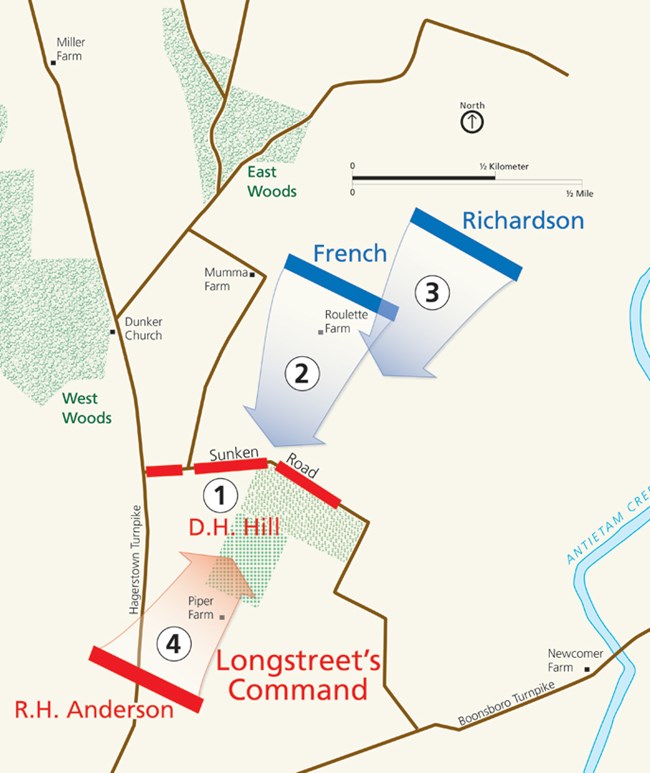
The focus of the battle soon shifted from the left to the center of the Confederate line. Here 2,600 Confederate troops from Alabama and North Carolina hunkered down in a fence-lined sunken road waiting for a Union attack. The road had been worn down from years of wagon use and formed a natural trench. Nevertheless, despite these formidable defenses, the center was the weakest part of the Confederate line. For the next, three hours, Confederate forces here fought back repeated assaults by 10,000 Union troops in what would become known as “Bloody Lane.”
Shortly after Sedgwick’s attack on the West Woods, Summer ordered a second division under General William French forward to support him but upon learning of Sedgwick’s predicament, French was ordered to turn south and attack the Confederate center. French directed a series of brigade level attacks beginning around 9:30am. Two of the attacks were carried out by relatively inexperienced brigades and were beaten back. A third attack was launched by a more veteran brigade but met with similar results. In one hour, French’s division suffered over 1,700 casualties.
1.) 2,600 Alabama and North Carolina troops under the command of General D.H. Hill, 2.) French’s three assaults, 3.) Richardson’s division arrives, 4.) Anderson’s reinforcements arrive.
Both sides began to send in reinforcements demonstrating the gravity of the situation. Around 10:30, Lee sent his last reserves, Major General R.H. Anderson’s division, to extend the Confederate line on the right. About the same time, 4,000 men of General Israel Richardson’s division arrived on French’s left. The fourth attack on the Confederate position would come from Richardson’s Division and led by the Irish Brigade of Brigadier General Thomas Meagher. Armed with obsolete smooth bore muskets that had limited range and their distinctive emerald flags waving in the wind, the Irish Brigade was cut down by heavy volleys losing over 500 men before withdrawing.
Confederate Dead in the Sunken Road
Increasingly desperate, Richardson sent General John Caldwell’s veteran brigade to attack Anderson’s men on the Confederates’ right. Two regiments of Caldwell’s brigade managed to swing around the right of the Confederate line and seized an elevated position that allowed them to pour a murderous fire down upon the entire Confederate line. The effect was devastating. Several Confederate brigade and regimental commanders went down causing havoc in the ranks. The Confederate line began to break under the sheer weight of the Union attack and a broken command structure. Soon the Confederates were fleeing back towards Sharpsburg with Richardson’s forces in hot pursuit. Scrambling to stop the Union advance, Confederate First Corps Commander General James Longstreet hastily massed an artillery barrage sending Richardson’s forces back reeling. The situation was so dire that Longstreet and his staff manned one of the rebel artillery pieces. Longstreet would later remark, “We were already badly whipped and were only holding our ground by sheer force of desperation.” This is a critical moment in the battle. The center of Lee’s army is broken and on the ropes but McClellan fails to recognize the opportunity. Sumner’s corps is spent but McClellan still has two extra corps in reserve. McClellan, still believing he is outnumbered by Lee, refuses to commit his reserves. When the action around this portion of the battle finally ended, over 2500 Confederate dead and wounded lined the sunken road. Union casualties totaled just under 3,000.
The Battle for Burnside’s Bridge
After the fighting around the sunken road subsided, the focus of the battle shifted further south for the final action of the day. Under McClellan’s battle plan, Major General Ambrose Burnside and his 12,000 strong IX corps were tasked with launching a diversionary attack on Confederate forces behind Antietam Creek that comprised the right flank of the Confederate line to prevent Lee from reinforcing his left. However, Burnside didn’t receive his orders to begin his assault until close to 10am, after most of the action against Lee’s left had finished.
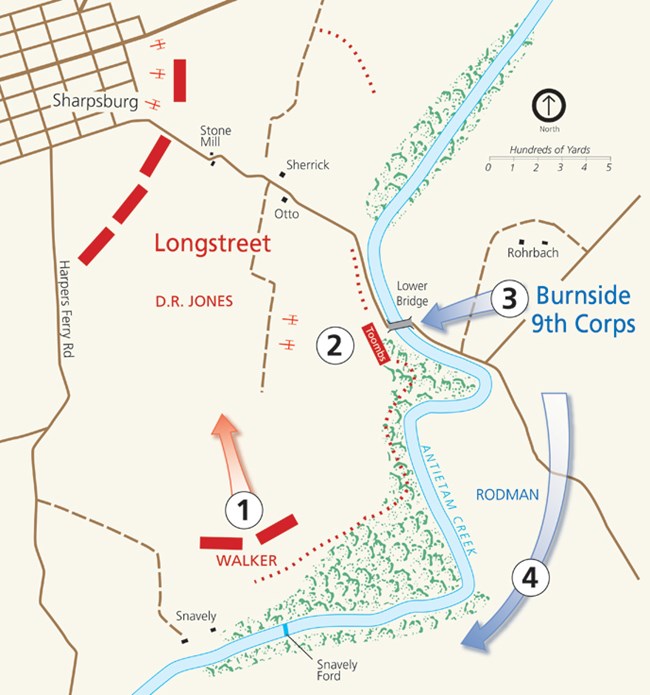
Confederate forces in this sector of the battlefield consisted of four thin brigades totaling only 3,000 and were badly out numbered by Burnside’s Corps. An entire division and a brigade were pulled from here as reinforcements during earlier fighting in the cornfield and the sunken road. Nevertheless, the Confederates occupied a formidable position commanding the heights overlooking a small stone bridge, the southern most crossing point over Antietam Creek. Here were deployed two Georgian regiments, under Brigadier General Robert Toombs with a clear line of fire from above targeting the bridge.
The third Union assault on the Rohrbach Bridge
Burnside’s plan was to storm the bridge while enacting a crossing further downstream to attack the Confederate right flank. Around 10am, he launched the first out of what would be three attempts, to seize the bridge. At the same time he ordered General Isaac Rodman’s division South in search of an identified crossing point at Snavely’s Ford. The first attempt to take the bridge was a fiasco. According to Burnside’s plan, skirmishers from the 11th Connecticut Regiment were supposed to clear out rebel sharpshooters from the heights allowing the 8th Ohio Regiment to storm across the bridge. The Connecticut regiment, marched down an exposed road that paralleled the creek and came under a withering fire from the 500 Confederates occupying the bluff. Within 15 minutes the regiment lost 139 men, a third of its overall combat strength. The Ohio regiment became lost and got caught in a firefight further upstream. The second attack came shortly thereafter with the 2nd Maryland and 6th New Hampshire regiments leading the way. They followed the same exposed path as the first attack with the same results.
1.) In the early hours of the battle, Lee moved soldiers from this part of his line north toward the Cornfield and the West Woods. This shift resulted in one division, numbering about 3,000 men protecting his right; 2.) Fewer than 500 Confederate troops, commanded by Gen. Robert Toombs, lined Antietam Creek from this point southward to Snavely Ford; 3.) Here Burnside carried out three assaults to take the bridge; 4.) Burnside sends Rodman’s division to flank the Confederates.
In two hours, Burnside’s corps made little progress and the Union high command was growing impatient. McClellan sent an aide to Burnside instructing him to take the bridge at all cost. He next turned to Brigadier General Edward Ferrero’s brigade to lead the next assault. Ferrero selected his two best regiments the 51st New York and the 51st Pennsylvania to lead the attack. The Pennsylvania regiment was a raucous unit of hard-drinking men who loved their whiskey. Ferrero had suspended their whiskey ration in an earlier disciplinary action but promised to restore it if they succeeded. The Confederates, who had fended off attack after attack, were starting to run low on ammunition. Around 12:30, Confederate volleys began to slack off as the troops exhausted their ammunition. Sensing an opportunity, the New York and Pennsylvania regiments stormed the bridge under a cover of heavy canister and musket fire. With their ammunition depleted and word that Rodman’s division was crossing at Snavely’s Ford, the Confederates withdrew. Burnside had won his bridge and the 51st Pennsylvania their whiskey.
Up Came Hill: The Final Attack
Burnside had finally taken the bridge but failed to press his advance with the necessary urgency. Burnside spent two hours moving three of his divisions, his artillery and supply wagons across Antietam Creek before resuming his offensive. This delay provided Lee with valuable time to reorganize his beleaguered defenses. It also bought time for Major General A.P. Hill’s division, which had been left behind at Harpers Ferry to complete the Union surrender, to reach the battlefield and save the day. Once the battle began, Lee sent word to Hill and his division to begin the 17 mile march to Sharpsburg as quickly as possible.
1.) The Confederates lone under strength division under General D.R. Jones; 2.) Burnside’s Corps advances; 3.) Hill’s counter attack
Around 3:00 pm, 8,000 Union soldiers, under Burnside’s command swept forward in a mile-wide battle line across the undulating fields south of Sharpsburg. Their objective was to roll up the Confederate flank and cut Lee’s army off from Boteler’s Ford, their only escape route across the Potomac River. The only thing in the way of their advance was Brigadier General D.R. Jones under strength 2,500 men division and 28 pieces of artillery. As Burnside’s three divisions continued to advance forward, led by the colorful Zouaves of the 9th New York Regiment, the rebels’ flank was collapsing. Lee and his staff were trying desperately to rally their broken forces and stave off a rout but just then, in a most dramatic fashion, A.P. Hill’s division arrived from Harpers Ferry, exhausted but ready for a fight. Approximately, 3:30, the lead element of Hill’s division, Brigadier General Maxcy Gregg’s brigade of South Carolinians, slammed into Burnside’s exposed left flank. The relatively inexperienced troops of Burnside’s left flank proved no match for Hill’s grizzled veterans and they were sent reeling back down the hills and across Antietam Creek. One Union soldier from the 4th Rhode Island Regiment later described Hill’s counter attack, “They were pouring in a sweeping fire as they advanced, and our men fell like sheep at the slaughter.” By 5:30pm the Battle was over.
Gathering the Dead
Both sides fell back that evening battered and bruised. The end of the fighting brought the grim reality of that day sharply into focus as both sides tallied their loses. For the next 24 hours, pitiful groans of agony from the wounded still on the battlefield and the fetid smell of death filled the air. Surgeons, stretcher-bearers, and burial details worked feverishly around the clock attending to the dead and wounded. On the Union side, casualties totaled approximately 12,400 including 2,100 killed in action and another 10,300 wounded, missing, or captured. Confederate loses reached 10,300 to include roughly 1,560 dead and 8,770 wounded, missing or captured. These totals represented 25% of the Federal force and 31% of the Confederates.
The next morning, Lee’s army prepared to defend against a Federal assault that never came. After an improvised truce for both sides to recover and exchange their wounded, Lee’s forces began withdrawing across the Potomac that evening to return to Virginia. On September 19 elements of General Fitz John Porter’s V corps, which were held entirely in reserve during the battle, crossed over the Potomac River at Boteler’s Ford and attacked Lee’s rearguard. The following day Porter sent additional forces across the river to establish a bridgehead. General A.P. Hill’s division counterattacked while many of the Federals were crossing the river, inflicting heavy casualties. Porter pulled back to the Maryland side of the river. This rearguard battle near Shepherdstown, Virginia discouraged further Federal pursuit of Robert E. Lee’s defeated army back to Virginia.
The Importance of Leadership
In many ways, Antietam is a tale of failed opportunities, mostly for the Union. The Battle was in effect a draw but is generally considered a Union victory because the South was turned back and denied it’s overall strategic objectives. It’s become fashionable today to re-examine Lee’s record to find fault with his military leadership and decision making to compensate for the myth making of the Lost cause era. However, as Stephen Sears argues in his account of the battle, “Landscape Turned Red,” one would be hard pressed to find fault with how Lee and the rest of the Confederate high command conducted the battle or could have better employed all the means at their disposal.
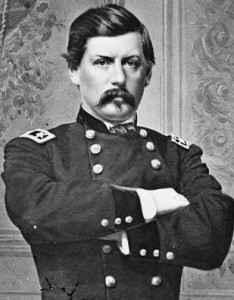
Left: General Robert E. Lee; Right: General George B. McClellan
The same cannot be said for the Union and it’s commander George McClellan who proved woefully inadequate. McClellan, in his typical self-important fashion, cabled a situation report back to Washington the day after the battle writing, “Those in whose judgment I rely tell me I fought the battle splendidly and that it was a masterpiece of art.” In reality, he fought the battle not to lose rather than trying win. As a result, he squandered opportunity after opportunity to inflict a decisive and catastrophic defeat on the rebel army. Throughout, the battle McClellan had kept two army corps, between 20,000-30,000 troops, in reserve. He mistakenly feared he was badly outnumbered by Lee and that should he be defeated he would need a reserve force to prevent Lee from moving further North. Had McClellan deployed those reserves in support of the attack on the Sunken Road, Burnside’s efforts to roll up the Confederate right flank, or even to launch a series of new attacks the following day most likely would have resulted in a decisive Union victory and possibly shortening the war by two years. McClellan would pay a steep price for his timidity. Two months later he would be relieved of his command by President Lincoln.













 Tragedy and Farce