
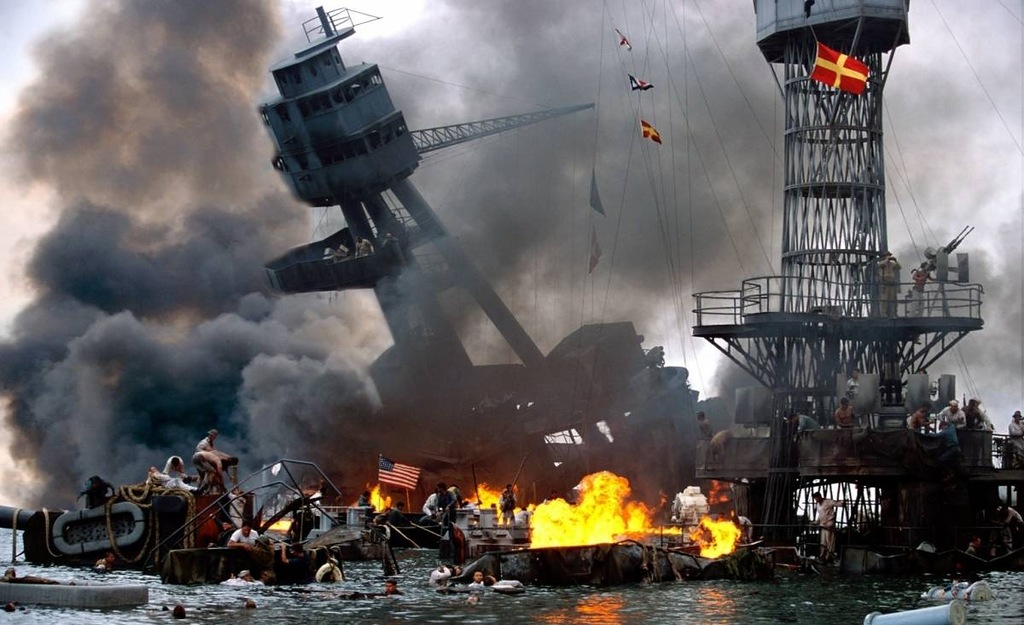
In the early morning hours of Sunday December 7, 1941, over 350 Japanese dive bombers, torpedo bombers and fighter aircraft carried out a devastating surprise attack on the US Pacific Fleet at Pearl Harbor in a day that President Franklin D. Roosevelt declared would “live in infamy.” The attack was the culmination of months of progressively deteriorating bilateral relations, punctuated by a debilitating U.S. oil embargo in response to Japan’s increasing militarism and aggressive territorial expansion across the Asia-Pacific region. By 1941, the Japanese had come to believe that war with the US was inevitable and that its best hope for victory was a short and decisive conflict. The preemptive strike was an audacious gamble designed to neutralize the US Pacific Fleet, prevent the US from interfering in its plans to conquer Southeast Asia and force the United States to sue for peace from a position of weakness. The attack would have the opposite effect initiating a four year war that would include the detonation of two atomic bombs over Hiroshima and Nagasaki and Japan’s ultimate capitulation.
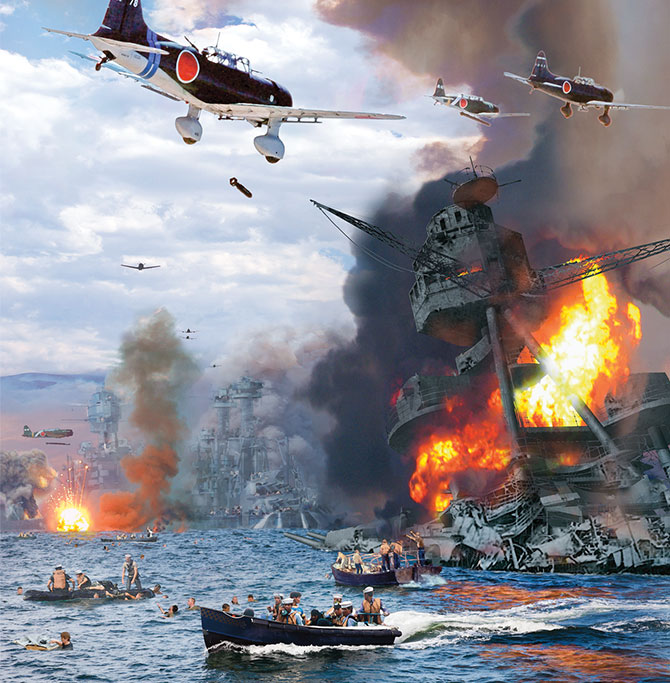
With great secrecy, a Japanese naval task force of 67 ships, including six aircraft carriers, departed its home base in the Kuril Islands on November 26, en route to a rendezvous point 230 miles northwest of the Hawaiian Islands. From there, the six carriers would carry out a two waves of attacks against the unsuspecting US fleet at Pearl Harbor. The first wave was to target the airfields and stationary aircraft as well as the eight battleships the US had docked at Pearl Harbor. Japanese military leaders believed the loss of these ships would be a terrible blow to American morale and naval power and hasten its capitulation. The second wave would target lesser value ships such as cruisers, destroyers, and other stationary targets like dry docks and oil tanks.
The first Japanese aircraft took off from their carriers on December 7, around 6am, heading in a south easterly direction toward Pearl Harbor. Roughly two hours later, Mitsuo Fuchida, the young captain who commanded the first wave, broke radio silence shouting, “Tora, Tora, Tora,” code word to inform the Japanese fleet that they had indeed achieved surprise. Striking hard and fast, Japanese dive bombers destroyed hundreds of US military aircraft neatly arrayed on the ground at the Naval Air Station on Ford Island and the adjoining Wheeler and Hickam fields. At the same time, the eight battleships of the US fleet were perfect targets for the Japanese pilots. Within 30 minutes, four US battleships— the Arizona, Oklahoma, West Virginia, and California—were sunk and the remaining four badly damaged. The Arizona quickly sank after it was struck eight times by Japanese bombs, one of which hit a forward ammunition magazine blasting the ship into two. The Oklahoma was hit by four torpedoes and capsized. Both the West Virginia and the California would also sink upright in the shallow water of the harbor after multiple bomb and torpedo hits.
As the first wave of attackers were completing their run, a second wave hit the US fleet around 8:50 am but it was much less successful than the first. The second wave inflicted more destruction on the already badly damaged battleships and sank several lesser value light cruisers, destroyers and minelayers. However, the second wave failed to destroy critical fleet infrastructure, like the submarine base,oil storage depots, and dry docks that would allow the US to recover more quickly. Moreover, the Japanese failed to destroy the three US aircraft carriers of the Pacific Fleet which had been sent to sea on maneuvers days earlier.
Total US personnel loses that day included just over 2400 killed, almost half of whom were trapped in the USS Arizona and another 1,200 wounded. All eight battleships that were present were either sunk or heavily damaged as well as 13 other smaller ships. However, all but the Arizona and Oklahoma were eventually repaired and returned to service years later in the war. The US also lost almost 400 aircraft. In comparison, Japanese loses were minuscule: 29 aircraft an and 5 midget submarines. Damage to the US Pacific Fleet was severe but not the unequivocal knock out blow Japanese military planners sought.
Japanese Rear Admiral Chuichi Hara best summed up the results by saying, “We won a great tactical victory at Pearl Harbor and thereby lost the war.”
On December 8, at 12:30 p.m., Roosevelt addressed a joint session of Congress and, via radio, the nation in which he spoke his immortal words. The Senate followed with a near unanimous declaration of war against Japan. Three days later Nazi Germany and Fascist Italy declared war on the United States in solidarity with Japan. The United States now found itself in the middle of another world war.
The attack on Pearl Harbor immediately united a divided nation. Public opinion had been moving towards support for entering the war during 1941, but considerable opposition remained until the attack. Overnight, Americans united against the Empire of Japan in response to calls to “Remember Pearl Harbor. Within 30 days of the attack on Pearl Harbor, over 130,000 men would enlist for military service. Many of these men would have their chance at revenge six months later at the Battle of Midway where the US inflicted a crushing defeat on the Japanese Navy, changing the trajectory of the war in the Pacific in its favor.
 Tragedy and Farce