On August 27, 1776, British Redcoats routed General George Washington and his fledgling Continental Army at the Battle of Long Island, paving the way for the seizure of New York City which the British would hold until the end of the Revolutionary War in 1783. The battle was the first major engagement for the Continental Army following its creation on June 14, 1775 and its inexperience and lack of discipline showed. The scale and scope of the defeat raised serious doubts about whether Washington was the right person to command the army and nearly ended the American experiment in independence and self-governance before it began
In the Spring of 1776, optimism and patriotic fervor was on the rise throughout the thirteen colonies. British military forces had been forced to vacate Boston and given the blood spilled at Lexington and Concord and Bunker Hill, it was clear there was no turning back. Political discourse no longer centered around a redress of colonial grievances but increasingly focused on full-fledged independence from Great Britain. The will for independence was certainly there, as evidenced by the promulgation of a Declaration of Independence in Philadelphia on July 4. The question remained, however, whether the colonist could win their freedom, let alone keep it, for Great Britain was not about to let them go without a fight.
After British troops were forced to withdraw from Boston to Nova Scotia, all eyes turned to New York City, where it was expected that British would try to return and occupy the crucially important city, with its strategic location and deep sheltered harbor. In April, Washington raced his 19,000 man Continental Army to New York City ahead of the British. However, he quickly recognized that defending the city was nearly impossible. The city consisted of three islands—Manhattan, Staten Island and Long Island— and all of their shorelines were suitable for an amphibious landing which made it difficult to predict where exactly the British might land. Moreover, the Royal Navy’s ability to control the rivers and water ways that cut through New York City would allow British warships to bring their heavy guns to almost any fight. Writing to his brother John, Washington offered a blunt assessment of the situation: “We expect a very bloody summer at New-York … and I am sorry to say that we are not, either in men or arms, prepared for it.”
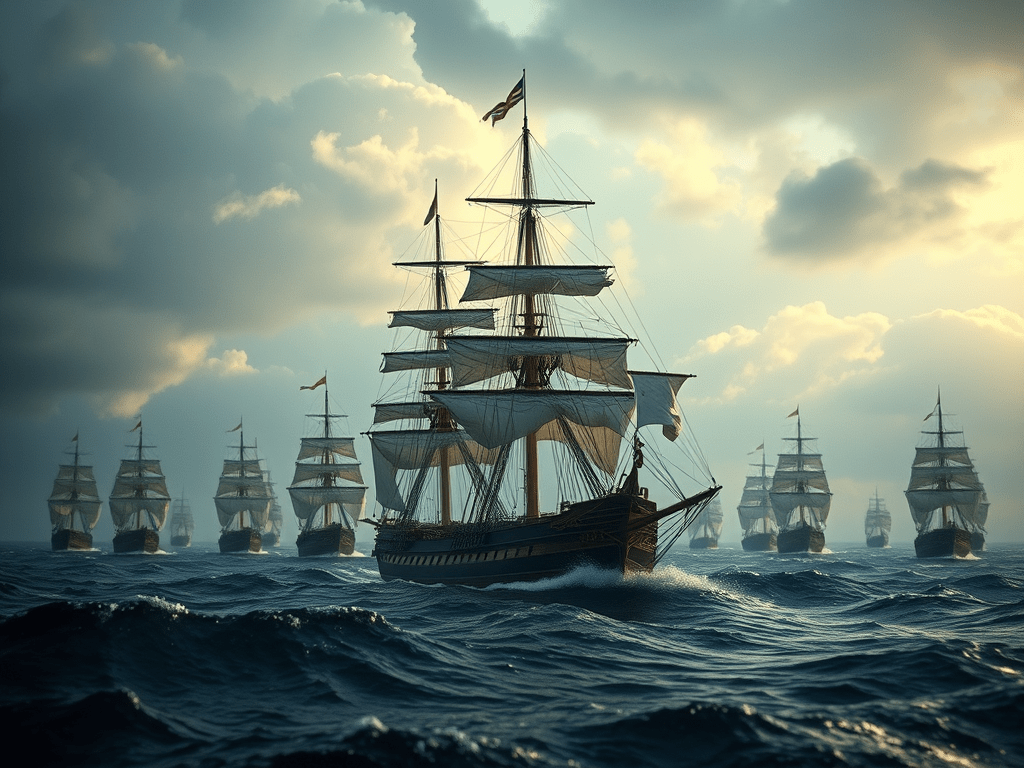
The first British warships were sighted near Sandy Hook, New Jersey, on June 29, 1776, and within hours, 45 ships would drop anchor in Lower New York Bay. One American soldier was so awed by the fleet, he declared that it looked like “all London afloat.” Of these ships were some of the most powerful in the Royal Navy such as the 64-gun Asia and the 50-gun Centurion and Chatham. The guns on these ships alone outnumbered the combined firepower of all American shore batteries. On July 2, British troops began to land on Staten Island. By mid-August, the British fleet numbered over 400 ships large and small, including 73 warships and 8 ships of the line, while the army had grown to 32,000, more than the entire population of New York City.
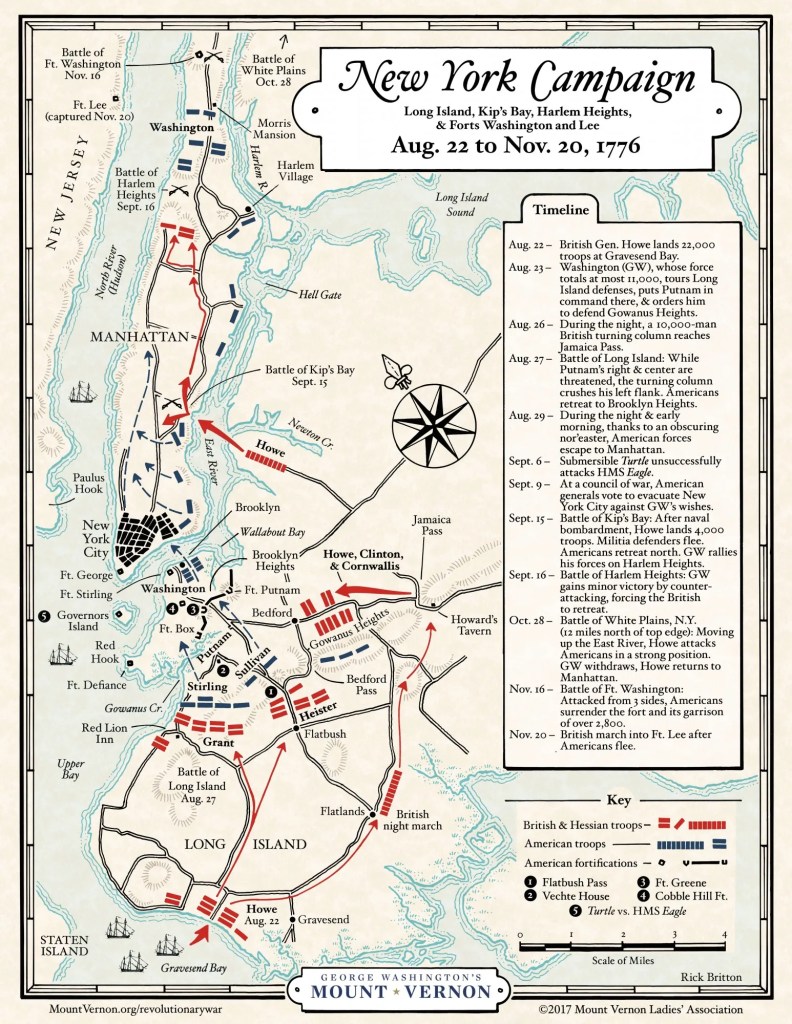
On August 22, 20,000 British and Hessian troops departed Staten Island and made an amphibious landing at Gravesend Bay on the southwestern shore of Long Island. Washington had built fortifications and deployed half his army here in anticipation of a British landing. General William Howe was in overall command of all British troops. However, the battle plan was conceived of by his second in command, General Henry Clinton. Clinton’s plan was to split the army into three divisions. Two divisions would make feints directly against the Americans entrenched on the wooded hills of the Gowanus Heights. The largest division, 10,000 men personally under Clinton’s command, would make an overnight march through an unguarded pass on the left of the American line and turn their flank by surprise.
As the battle commenced in the early morning hours of August 27, the British executed their plan flawlessly and with great success. One division of British regulars under General James Grant and one of Hessian mercenaries under General Leopold Phillip von Heister kept the American defenders fixed and distracted as Clinton maneuvered to turn their flank. Around 9 am, the British sprung their trap as Clinton’s Division reached Bedford village behind the American line and engaged the defenders. At the same time, the two other divisions now turned their feints into full-fledged attacks. With bayonets fixed, the Hessians charged the American left under General John Sullivan and fighting descended into vicious hand to hand combat as the Hessians ruthlessly butchered the Americans. The inexperienced Continentals were now caught between a hammer and an anvil and in danger of being cut off from their route of retreat. Recognizing the danger of their situation, Sullivan’s men panicked and fled pell-mell towards their fortifications at Brooklyn Heights.
With the American left flank disintegrating before their eyes, the American right now began to feel the full weight of Grant’s attack. General William Alexander and his brigade put up stiff resistance for two hours, but the collapse of the American left put his brigade’s position increasingly in peril. Threatened with encirclement, Alexander ordered his brigade to fall back. He personally led 250 Marylanders in a bayonet charge against an overwhelming British force creating a crucial window of time for more of his soldiers to escape to their fortifications in Brooklyn Heights. Alexander was eventually taken prisoner and only nine of the original 250 made it to the safety of Brooklyn Heights. Watching the battle on the right unfold, Washington remarked “Good God, what brave fellows I must lose.”
By noon, the battle had largely ended. But when the dust cleared the total number of Americans killed, captured, and wounded reached nearly 2200. Although Washington managed to survive a catastrophic day, he wasn’t out of danger yet. His army remained divided between Manhattan and Long Island and the portion that remained on Long Island was exhausted and penned up, with Howe’s army in front of it and the East River at its back. On August 29th, Washington made the unavoidable decision to withdraw his troops from Brooklyn Heights. That evening, under a cover of darkness and fog, a Massachusetts regiment composed of mostly sailors and fishermen ferried the endangered troops back across the East River on flat bottom boats to the temporary safety of Manhattan.
Washington’s defeat opened the door to a series of equally disastrous losses that ultimately allowed the British to seize full control of New York City. On September, 15, the Americans were routed again at the Battle of Kipp’s Bay as British troops established a foothold on Manhattan Island. Washington would score a minor victory at the Battle of Harlem Heights the next day but suffer another ignominious and demoralizing defeat at White Plains on October 28. Three weeks later American forces were driven from Forts Washington and Lee giving the British full control of New York City. Washington and his army retreated into New Jersey and were chased across the Delaware River into Pennsylvania. The almost uninterrupted progression of defeats in the summer and fall of 1776 squelched much of the optimism from earlier in the year and cast grave doubt on the viability of the revolution and George Washington’s competency as a military commander. Only Washington’s bold decision to cross the icy Delaware River on Christmas night and wage a surprise attack on the Hessian garrison at Trenton would restore faith and optimism in the cause and tamp down doubts about his suitability uas a military commander.
On October 21, 1805, a British naval fleet under the command of Admiral Horatio Nelson, destroyed a combined Franco-Spanish fleet at the Battle of Trafalgar, permanently ending Napoleon’s plans for invading Great Britain and ensuring that England would remain the world’s dominant naval and commercial power for the next century. Trafalgar is one of the most famous naval battles in history and it is remembered as Nelson’s greatest victory, but it would come at great personal cost, his life. After the French defeat at Trafalgar, Napoleon would forgo any immediate efforts to rebuild the French Navy. Instead, he sought to destroy Great Britain’s capacity to make war by closing off Europe’s markets to British trade through a European wide embargo, known as the Continental System. These actions would put in motion a series of events that eventually would lead to his disastrous invasion of Russia seven years later and his subsequent defeat and exile to the isle of Elba.
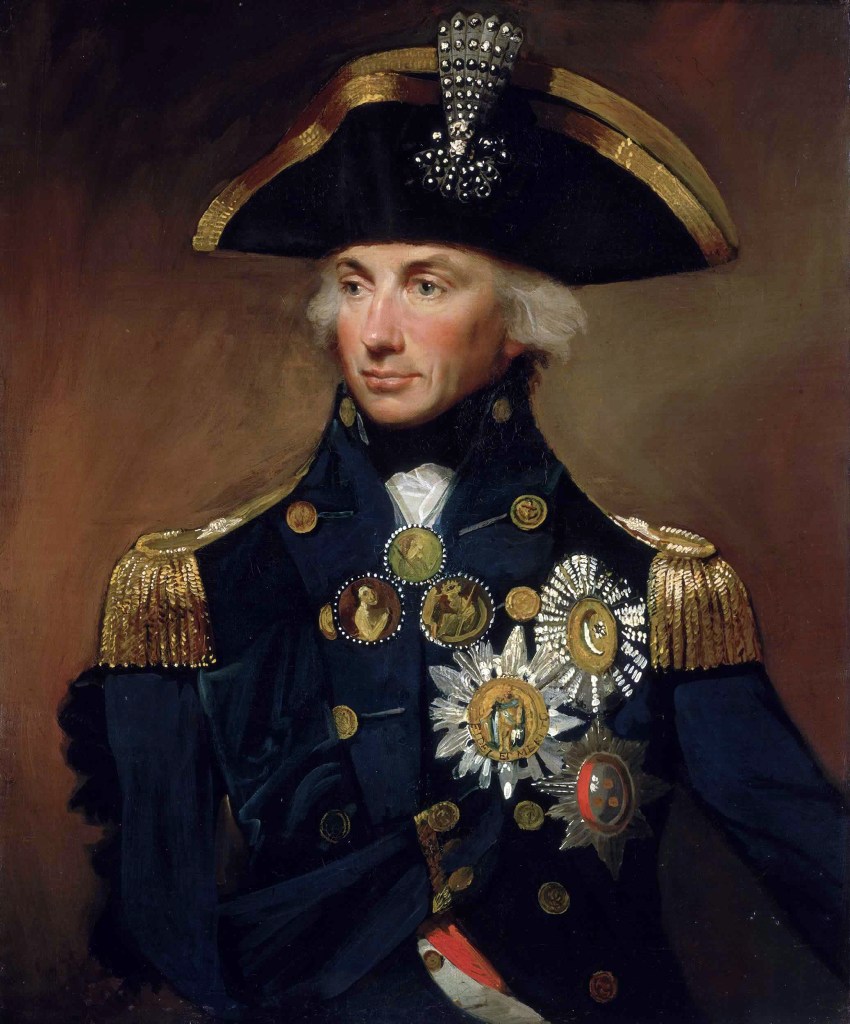
By 1805 Nelson was already a national hero and regarded as one of Great Britain’s bravest and most able military officers. From 1793 until his death at Trafalgar, Nelson was involved in battle after battle, risking life and limb for king and country. In 1794, he lost sight in his right eye at the Battle of Calvi in Corsica. Three years later he lost his right arm, slightly above his elbow, leading a doomed assault on the Spanish island of Tenerife in which his arm was hit by a musket ball. At the battle of the Nile in 1798 his daring and courage completely decimated the French fleet, destroying all but two ships. He scored another impressive victory against the Danes at the Battle of Copenhagen, where he defied orders to break off the engagement. Nelson famously put his telescope to his blind eye, claiming he did not see the signal. A charismatic, born leader, Nelson was beloved by both his men and the British public, and it was said that wherever he went the air was filled with huzzahs.
In the Spring of 1803, Great Britain and Napoleon once again found themselves at war after the collapse of the Treaty of Amiens which provided a brief 14-month respite after almost a decade of constant war. From roughly 1792-1802, Great Britain and its coalition partners, Austria and Russia, wagged a continuous struggle to contain the pernicious Jacobin influences of revolutionary France. By the time the Treaty of Amiens was signed in March 1802, both Britain and France were in desperate need of peace. Each side’s finances were in complete disarray—Napoleon would be compelled to sell the Louisiana territory to the United States during this period—and domestic challenges in both countries had become more pressing. Nonetheless, in an effort to achieve a mutually acceptable peace, certain contentious issues were papered over, and neither side was ever quite able give up the suspicion that the other was simply using the peace as an interregnum to gather strength and resume hostilities.
Napoleon recognized that he could never fully realize his grandiose ambitions without defeating Great Britain or at least crippling its war fighting capacity. With the onset of war, he began to expand the port at Boulogne, assemble a new 200,000-man army and build a fleet of barges all specifically for the invasion of England. Napoleon boasted, “With God’s help I will put an end to the future and very existence of England.” He then proceeded to construct a monument in Boulogne to commemorate his anticipated victory. Any successful invasion, however, required control over the English Channel and both the French fleet and their Spanish allies remained bottled up in their ports by a British blockade.
In March of 1805, Napoleon was ready to move against the British and he devised an elaborately complex plan to lure Nelson and the British fleet away from the Channel by threatening Britain’s valuable sugar plantations in the West Indies. The Franco-Spanish fleet under Vice Admiral Pierre-Charles de Villeneuve would slip the British blockade in Toulon; race across the Atlantic; double back and rendezvous with another smaller French fleet before clearing the Channel for the invasion. At first his plan looked like it might succeed as Nelson took off in pursuit, but it soon unraveled. On his return, Villeneuve missed his rendezvous and in late July he was intercepted by a smaller British fleet and forced into a fierce but inconclusive battle. Instead of linking up with the French fleet at Brest and driving off the British Channel squadrons as Napoleon insisted, he elected to sail his damaged fleet back to the port of Ferrol in Northern Spain before moving south to Cadiz. At the same time. Napoleon’s position on the continent took a turn for the worse. Austria and Russia once again joined Great Britain in a coalition against France and an angry and frustrated Napoleon was now compelled to put his invasion plans on indefinite hold. On August 25, his invasion force broke camp near Boulogne and marched into Germany, ending any immediate threat of invasion.
Although the threat of invasion receded, Nelson was determined to destroy the Franco-Spanish fleet once and for all. With Villeneuve ensconced in Cadiz, Nelson and his flagship the HMS Victory left the Royal Navy dockyard at Portsmouth on September 14 and sailed towards the Spanish coastline. Hoping to lure the combined Franco-Spanish force out from Cadiz harbor and engage it in a decisive battle, Nelson kept his main force out of sight approximately 50 miles (80 km) offshore and sent a squadron of frigates to keep watch on the harbor. Villeneuve previously fought Nelson in 1798 at the disastrous Battle of the Nile and he wanted no part battling him again. He also knew, from first-hand experience, that the British possessed better guns, better gunpowder, and their crews were far quicker and more accurate with those guns than the French. But he also faced competing pressures to leave Cadiz. The port city was in the midst of a Yellow Fever outbreak and its food stocks and other supplies were dwindling. Most importantly, he was quickly losing favor with Napoleon because of his inaction. On 16 September, Napoleon directed Villeneuve to put to sea at the first favorable opportunity, go to Naples and land the soldiers his ships carried to reinforce his troops there, then fight decisively if they met a numerically inferior British fleet. Villeneuve hesitated to deploy once again further infuriating Napoleon.
Two developments served to convince Villeneuve that the time had come to depart Cadiz and bring this prolonged drama to its inevitable climax. In early October, Nelson dispatched six of his ships to Gibraltar to gather supplies for the fleet. When Villeneuve was informed that Nelson’s fleet now numbered only 21 ships, he surmised that his increased quantitative advantage might be enough to compensate for his crews’ inferior training. More importantly though, Villeneuve received word on October 18, that Napoleon intended to replace him with his old service rival, Admiral Francois Etienne Rosily. Rosily was already in Madrid and reportedly was on his way to Cadiz to relieve him. Rather than submit to such indignity and humiliation Villeneuve hastily sped up the work of readying his fleet for sea — he would slip out port before Rosily arrived. Villeneuve’s goal was not Napoleon’s, but a personal quest that might win him glory in France. He would seek out Nelson’s fleet, which he knew to be nearby, and destroy it. On the morning of October 19, the Franco-Spanish fleet departed Cadiz and by the evening of the next day the two fleets cautiously were moving towards each other and an inevitable battle.
At dawn on 21 October the British observed Villeneuve’s Combined Fleet eleven miles away, approaching Cape Trafalgar and Nelson gave the order to ‘prepare for battle’. The French were sailing in line off Cape Trafalgar, while the British came in from the west, gradually forming two columns. The first led by Nelson himself aboard his flagship Victory and the second led by his close friend, Admiral Cuthbert Collingwood aboard the Royal Sovereign. Although the British Fleet was outnumbered, the enemy totaling nearly 30,000 men and 2632 guns to Nelson’s 18,000 men and 2148 guns, Nelson was confident that his strategy and the superior skill of his crews would lead to victory.
Nelson didn’t simply want to defeat the enemy, he wanted to annihilate it so that Great Britain, its colonies, its trade, and its commercial interests would never come under threat from France ever again. Nelson’s battle plan was simple if not unconventional for the day. Naval battles of the time traditionally were fought with the two opposing fleets drawing themselves up to form two parallel lines of battle. Nelson instead intended to sail his ships perpendicular into the enemy line, pierce it in two spots, create massive confusion, and bing about what he called a “pell-mell battle,” of individual ship-to-ship actions where superior British gunnery, seamanship, and morale would destroy the enemy in detail before the unengaged ships could come to their aid. The main drawback of this strategy was that the leading British attackers would be subjected to direct raking broad side fire at their bows, to which they would be unable to reply.
The British fleet was closing on its French and Spanish foes around 11:45 am when Nelson issued his immortal call to arms, “England expects every man to do his duty.” Shortly thereafter Nelson belayed his final signal to engage the enemy and with that he and Collingwood advanced their respective columns toward the enemy fleet. Nelson’s strategy worked almost perfectly but at great cost. Collingwood, in the Royal Sovereign, outpaced Nelson and was the first to come under enemy fire. Multiple blasts from the French and Spanish ships ripped through the Royal Sovereign’s sails and rigging but failed to stem its advance. Aiming for a gap between the French ship Fougueux and the Spanish Santa Anna, the Royal Sovereign pierced the enemy line and poured a devastating broadside side through the stern of the Santa Anna inflicting terrible damage on the ship and her crew. After the Royal Sovereign delivered its first salvo against the Santa Anna, the two ships became intertwined trading shot for shot until both ships were little more than splintered wrecks. Just before 1:30, the Spanish ship surrendered.
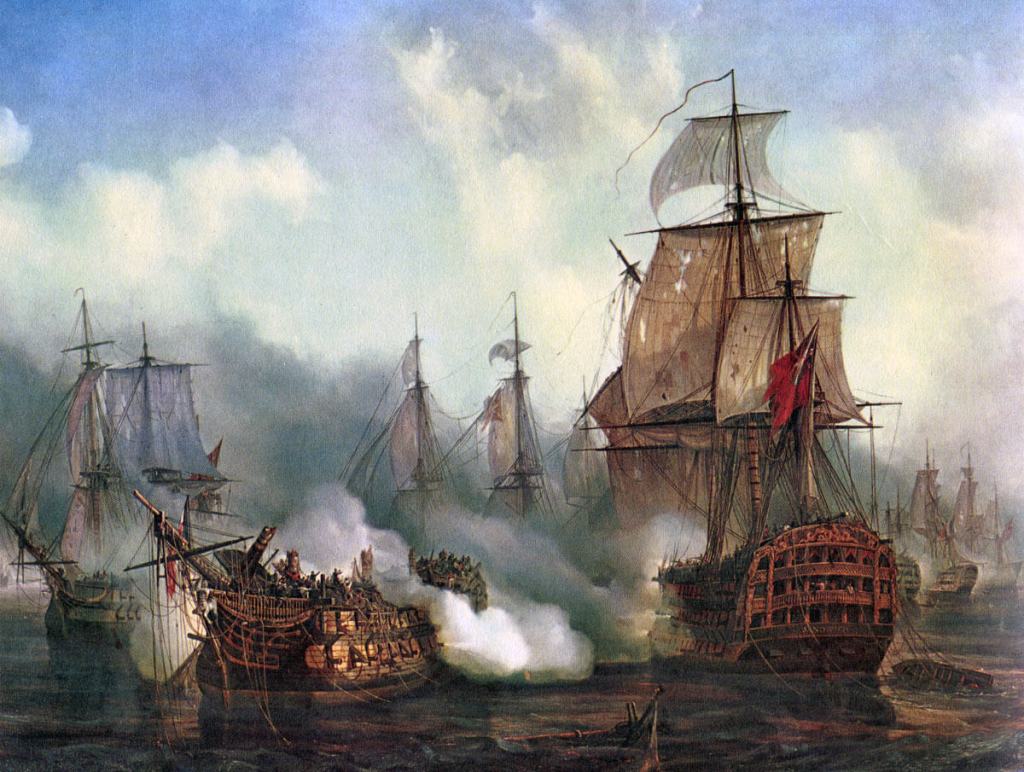
Meanwhile, Nelson’s advance was slowed by diminishing winds, leaving the Victory even more exposed to French fire and unable to respond. Approaching the enemy line, the Victory began to take on serious damage. Her mizenmast was shot away. Her wheel was smashed as well, blown to pieces by a lucky shot. Her foremast was riddled, and her sails were pockmarked with holes. Nevertheless, the Victory pressed on severing the enemy line between Villeneuve’s flagship Bucentaure and the Redoutable Passing behind the Bucentaure, Victory unleashed a devastating double shot broadside through its stern, disabling the ship and killing or wounding almost half the crew. After delivering its attack, the largely unnavigable Victory ran its bowsprit into the rigging of the 74-gun Redoutable ensnaring the two ships.
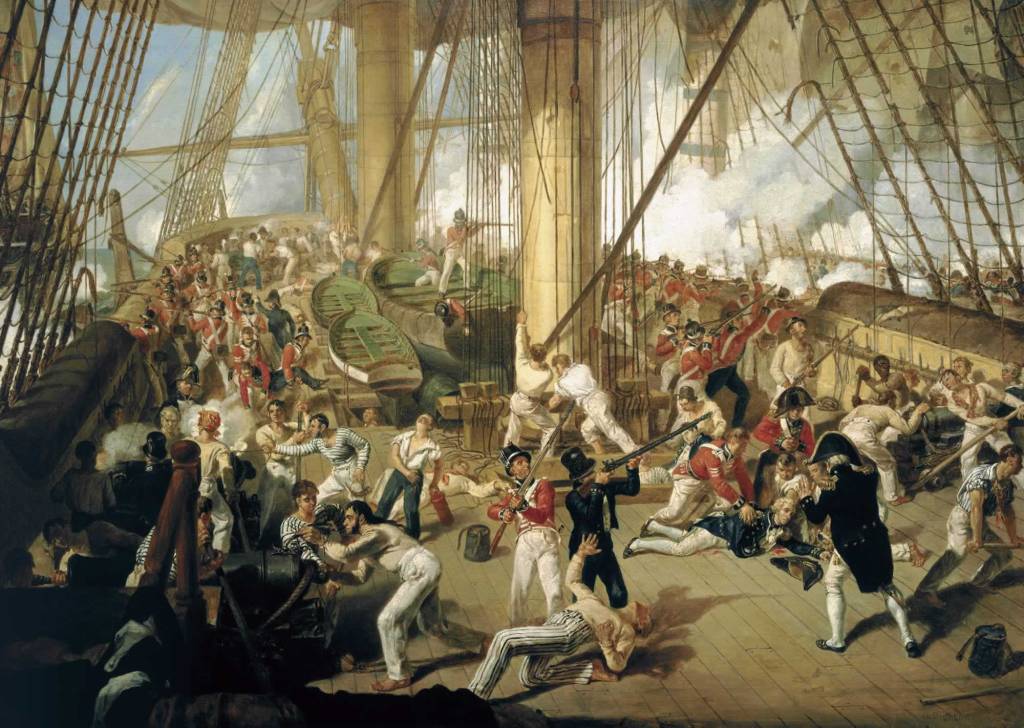
Bound together the two ships pounded away at one another from a few yards away. Superior British firepower — a 26-gun advantage — and a faster rate of fire gave Victory a decided edge as it inflicted significant structural damage on the French warship. At the same time, the tangled ships also formed a single battlefield where a fierce melee broke out between British sailors and marines and their French counterparts, with the French proving far more effective at small arms combat than anticipated. French sharpshooters firing from the rigging of the Redoutable. laid down a murderous fire on the crew of the Victory with muskets and grenades, drenching the deck with blood. Around 1:15 pm, tragedy struck the British fleet when Nelson, who defiantly paced the deck directing the battle, was shot by a French sniper and fell mortally wounded. He was rushed below deck with his face covered to hide his identity and prevent the spread of demoralizing rumors. As Nelson lay dying below deck, the battle with the Redoutable was reaching a climax. Sensing that the battle was moving his favor, the French Captain was preparing a boarding party to overwhelm the Victory, when another British ship – the 98 gun Temeraire—came up on the other side of the Redoutable, close enough to almost touch the French ship, unleashing a thunderous volley from from her 32-pounder carronades massacring the French crew. With his ship taking on water and barely afloat and his crew decimated, the captain of the Redoutable struck his colors and surrendered his ship around 1:40pm. When the Redoutable surrendered it was more a shattered hulk than a warship, with 522 of his 670 men dead or wounded.
As more and more of the British fleet entered the frey, the battle largely proceeded according to Nelson’s plan. French and Spanish ships of the enemy center and rear were isolated and defeated in detail. By the time the battle ended around 4 pm, the British took 22 vessels of the Franco-Spanish fleet and lost none. The combined French and Spanish fleet suffered roughly 4,400 men kiled in action, 2,500 wounded and up to 8,000 captured. Among those taken prisoner, was the French commander,Vice Admiral Villeneuve, who was later paroled, returned to France, and committed suicide the following April after his requests to return to military service were denied. The British lost 458 killed and about 1,200 wounded, with most of these casualties occurring on the Victory and the Royal Sovereign. Nevertheless the death of Nelson eclipsed the entire combined total of French and Spanish casualties in terms of importance. On receiving the news of Nelson’s death, King George III is alleged to have said, in tears, “We do not know whether we should mourn or rejoice. The country has gained the most splendid and decisive victory that has ever graced the naval annals of England; but it has been dearly purchased.””We have lost more than we have gained.”
Great Britain’s victory at Trafalgar ensured British naval supremacy for the next century and beyond. The Royal Navy was never again seriously challenged by the French Navy or any other coalition of naval forces and Napoleon never revived his plans to invade England. Napoleon would remain in power for another 10 years but the French defeat at Trafalgar would put him on the path that would lead to his ultimate downfall.
Unable to defeat Great Britain with military force Napoleon turned to economic warfare in an attempt to impoverish her. By 1806, Napoleon was once again in control of much of continental Europe and in November of that year he issued a series of decrees essentially closing European ports to British trade, an embargo that would become the “Continental System.” Napoleon calculated Britain depended completely upon trade with Europe for its prosperity, so cutting off trade with continental Europe would ruin the British economy and force it to sue for peace. Since Napoleon had no navy with which to blockade Britain’s ports, his embargo would only work if every European nation participated in closing their ports to British commerce. Napoleon’s intent to enforce the embargo led to a series of ruinous military campaigns, most consequentially his 1812 invasion of Russia, after Tsar Alexander I left the blockade and reopened his ports to British trade. The invasion proved disastrous, resulting in the destruction of his Grande Armée, and marking the start of Napoleon’s downfall that would result in his defeat and his first exile to the island of Elba in 1814.




 Tragedy and Farce