
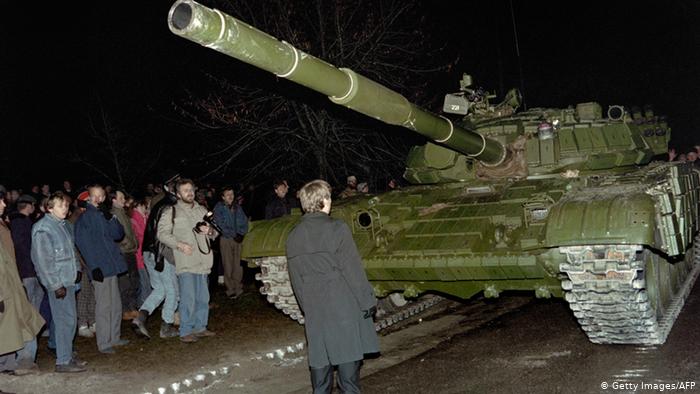
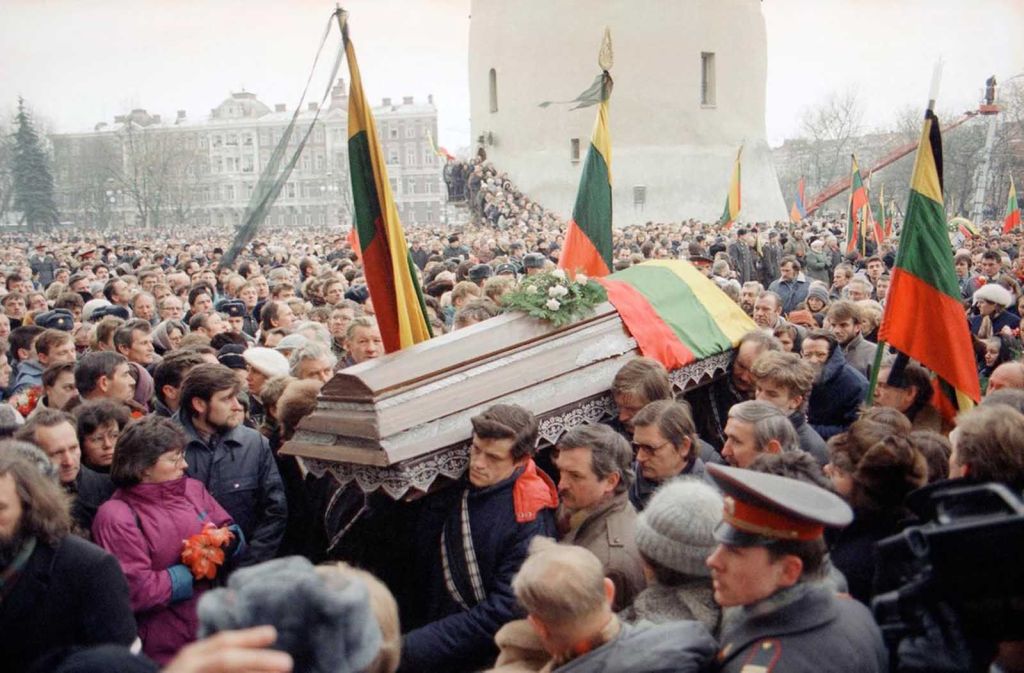
On January 13, 1991, Soviet military forces, brutally killed 13 Lithuanian protestors and injured over 700 others in Vilnius, in an effort to quash Lithuania’s independence movement and to restore full Soviet authority over the rebellious Soviet Socialist Republic. The crackdown in Lithuania would be repeated in neighboring Latvia in the ensuing weeks and herald a counterattack by Soviet hardliners to rein in the nationalist impulses and centrifugal forces unleashed by Soviet President Gorbachev’s Perestroika and Glasnost reforms. This hardline backlash would culminate in the failed August 1991 coup that would eventually lead to the collapse of the USSR.
The collapse of communist regimes in the fall of the previous year, served as an inspiration for many of the non-Russian Soviet Socialist Republics that had long chaffed under Soviet rule, especially the Baltic States who were forcibly annexed by the Soviets in 1940. In March 1990, the Soviet Socialist Republic of Lithuania, under nationalist leader Vytautas Landsbergis, boldly challenged Soviet authority by declaring its sovereignty and independence from Moscow. Neither Moscow nor the West recognized Vilnius’ declaration, and the Kremlin embarked on a subtle campaign of economic coercion and psychological operations to bring Lithuania back into line.


Gorbachev imposed an economic blockade on the Lithuanian Republic, which led to a rise in inflation and a shortage of goods and energy supplies, and undermined faith and confidence in the Lithuanian leadership. In early January, Lithuania was forced to sharply increase prices. Soviet authorities used these actions to foment unrest and opposition to Lithuanian authorities and to create a pretext for military intervention. Internationally, it was favorable timing for a military intervention because the world was distracted by Saddam Hussein’s occupation of Kuwait and the impending U.S. military action to oust him.
In early January, Soviet authorities organized a rally in front of the Supreme Council of Lithuania. Protesters tried to storm the parliament building but were driven away by unarmed security forces using water cannons. Despite a Supreme Council vote the same day to halt price increases, the scale of protests and provocations backed by the pro-Soviet Lithuanian Communist Party increased. During a radio and television address, Landsbergis called upon independence supporters to gather around and protect the main governmental and infrastructural buildings.
On January 8-9, the Kremlin began to dispatch crack military forces to Lithuania, including the 76th Guards Airborne Division and the elite ALPHA counterterrorism unit explaining these deployments were needed to ensure constitutional order and the effectiveness of laws of the Lithuanian SSR and the Soviet Union. On the 10th, Gorbachev addressed the Lithuanian leadership, demanding a restoration of the constitution of the USSR in Lithuania and the revocation of all anti-constitutional laws. He also warned that military intervention could be possible within days. When Lithuanian officials asked for Moscow’s guarantee not to send armed troops, Gorbachev did not reply.
The following day, Soviet military forces sprang into action seizing critical buildings, transportation nodes, and means of communication. That evening, the pro-Soviet Lithuanian Communist Party announced the creation of the “National Salvation Committee of Lithuanian SSR” and claimed to be the only legitimate government in Lithuania. Overnight, Deputy Minister of Defense of the Soviet Union, General Vladislav Achalov, arrived in Lithuania and took control of all military operations. On the other side independence supporters from all over Lithuania started to encircle the main strategic buildings: the Supreme Council, the Radio and Television Committee, the Vilnius TV Tower and the main telephone exchange to prevent the military from seizing these important locations.
What transpired on the next day and what would become known as “Bloody Sunday” would decisively shape not only the outcome of this standoff but the deconstruction of the USSR over the next eight months. Early on the 13th, Soviet tanks and armored personnel carriers departed their bases and headed to the Vilnius TV Tower and the main telephone exchange. Upon arrival in the vicinity of the TV tower, tanks start to fire blank rounds to intimidate and disperse the protestors defending the tower. Failing in that effort, tanks and soldiers encircled the TV tower firing live ammunition overhead and into civilian crowds gathered around the building. Tanks and armored personnel carriers drove straight through the lines of people. Fourteen people were killed in the attack, most of them shot and two crushed by tanks.

Fifty miles west of the Lithuanian capital a small television station in the Lithuanian city of Kaunas was broadcasting news and video of the crackdown to the West. News of the brutal murder of innocent Lithuanians prompted strong condemnation from the Europeans and outrage inside the rest of the USSR. The United States’ reaction was more tempered. The United States was preoccupied with the imminent onset of Operation Desert Storm against Iraq and there were concerns that sharp public criticism of Gorbachev risked complicating these impending military operations. President George H.W. Bush denounced the incident, but was notably careful not to criticize Gorbachev directly, instead directing his remarks at “Soviet leaders.”
Inside the USSR, there was anger and apprehension. More than 100,000 protestors gathered in Moscow to denounce the military’s actions in Lithuania. A spokesman for then Russian President, Boris Yeltsin, prophetically warned, “ I do not exclude the possibility that Russia could be next, although perhaps Georgia would preceede us.” The spokesman, Pavel Voshchanov, was correct that there would be more crackdowns. He was just wrong about the next target. In less than two weeks, similar events would play out in neighboring Latvia.
I remember these events distinctly. I just returned to Georgetown after Christmas break and was getting ready for the start of my second semester of graduate school. The world was on edge because of tensions in the Persian Gulf but for those of us Soviet watchers this crackdown was a wake-up call. Since at least December 1988, when Gorbachev announced at the UN, the Soviets would unilaterally cut its military by 500,000 men, we had seen largely a continuing positive trend in how the Soviets conducted themselves in the world. In February 1989 the Soviets pulled out of Afghanistan and later in the fall Gorbachev essentially renounced the Brezhnev Doctrine and allowed the communist regimes in Eastern Europe to be overthrown. The events in Lithuania were a reminder that there were still hardline forces that would fight tooth and nail to put the nationalist genie back in the bottle and preserve the USSR. Little did we know at the time this was the first step in the dissolution of the USSR.
 Tragedy and Farce