The Little Rock Nine, September 24, 1957

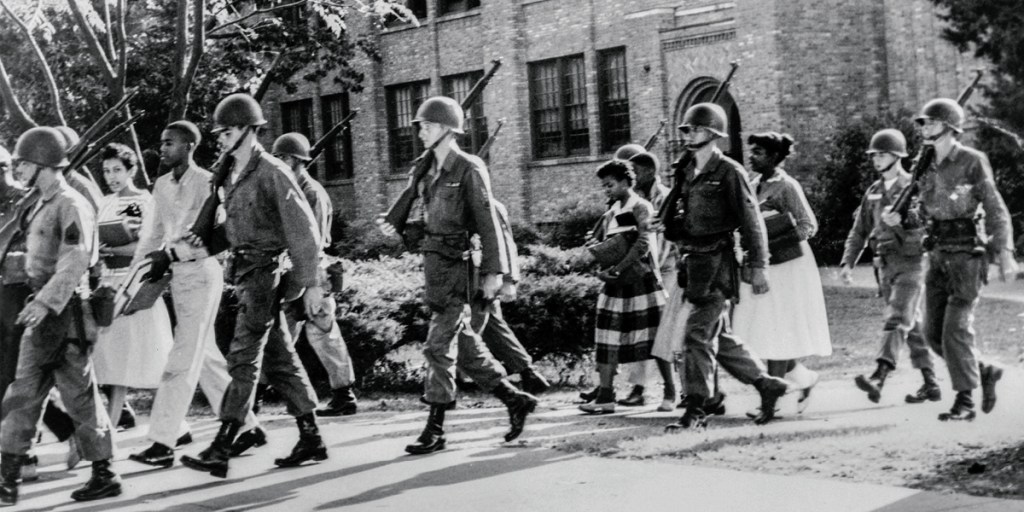
On September 24, 1957, President Dwight D. Eisenhower ordered 1,200 troops from the 101st Airborne Division to forcibly integrate Little Rock Central High School in the face of strong public opposition and determined resistance from Arkansas Governor Orval Faubus. These troops would escort nine African-American teens—Minnijean Brown, Elizabeth Eckford, Ernest Green, Thelma Mothershed, Melba Patillo, Gloria Ray, Terrence Roberts, Jefferson Thomas and Carlotta Walls—into the school, forcing a high profile showdown between state and Federal authorities. Although federal troops would clear the way for their entrance that day, “the Little Rock Nine,” would be subject to constant threat, abuse, and harassment the remainder of the year while the state and the rest of the South developed new strategies to avoid desegregation.
Brown v. Board of Education: The Battle Begins

The landmark 1954 Supreme Court ruling in Brown v. Board of Eduction, which declared segregation unconstitutional, sent shockwaves through out Arkansas and the rest of the South prompting vows of “massive resistance.” Many Southern states initial impulse was to simply ignore the ruling for as long as possible and slow roll the court-ordered desegregation. However, this strategy became increasingly untenable. Foot dragging on the issue had become so prevalent in the South, the court issued a second decision in 1955, known as Brown II, ordering school districts to integrate “with all deliberate speed.” At the same time, the National Association for he Advancement of Colored People (NAACP) also pressed the issue by registering black students in previously all-white schools in cities throughout the South. In Arkansas, the local chapter of the NAACP carefully selected these nine students who it believed had the intelligence, determination, and fortitude to succeed in breaking the color barrier.

In response to these dual pressures, the Little Rock school board voluntarily came up with a plan for gradually integrating the school system. The first schools to be integrated would be the high schools beginning in September 1957. Among these was Little Rock Central High School where this drama would play out. The school board’s plan was deeply divisive prompting a wave of bitterness and resentment amongst a large swathe of the white community in Arkansas. Two pro-segregation groups formed to oppose the plan: The Capital Citizens Council and the Mother’s League of Central High School.

Blockades and Protests

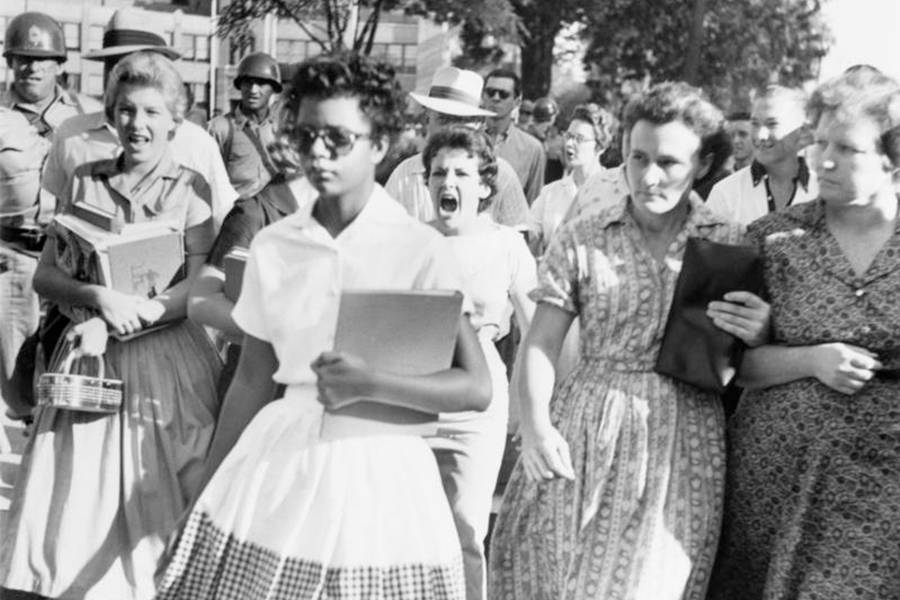
On September 2, 1957 the night prior to what was to be the Nine’s first day in Central High classrooms, Arkansas governor Orval Faubus ordered the state’s National Guard to block their entrance. Faubus said it was for the safety of the nine students warning that violence and bloodshed might break out if black students were allowed to enter the school. On the advice of the school board, the nine African-American students delayed their arrival till the second day, where they encountered a large angry white mob in front of the school, spewing racial epithets, threatening violence and engaging in acts of denigrating behavior. One of the most iconic images of that day was of Elizabeth Eckford, who arrived alone that morning to confront the mob. Eckford, whose family was too poor to afford a telephone, did not get word ahead of time of plans to coordinate their arrival. Eckford was greeted with chants of “two,four, six, eight, we ain’t gonna integrate.” Eckford would recount her experience that day in very stark terms, “They glared at me with a mean look and I was very frightened and didn’t know what to do. I turned around and the crowd came toward me. They moved closer and closer. Somebody started yelling, “Drag her over this tree! Let’s take care of that nigger!”

Elizabeth Eckford approaching Little Rock Central High School on her own


All nine students were prohibited from entering the school that day in what would prove to be the opening salvo in a much larger battle. Sixteen days later a federal judge ordered the National Guard removed and on September 23, the Little Rock Nine attempted to enter the school again. Though escorted by Little Rock police into a side door, another angry crowd gathered and tried to rush into Central High. Fearing for the lives of the nine students, school officials sent the teens home. They did, however, manage to attend classes for about three hours.

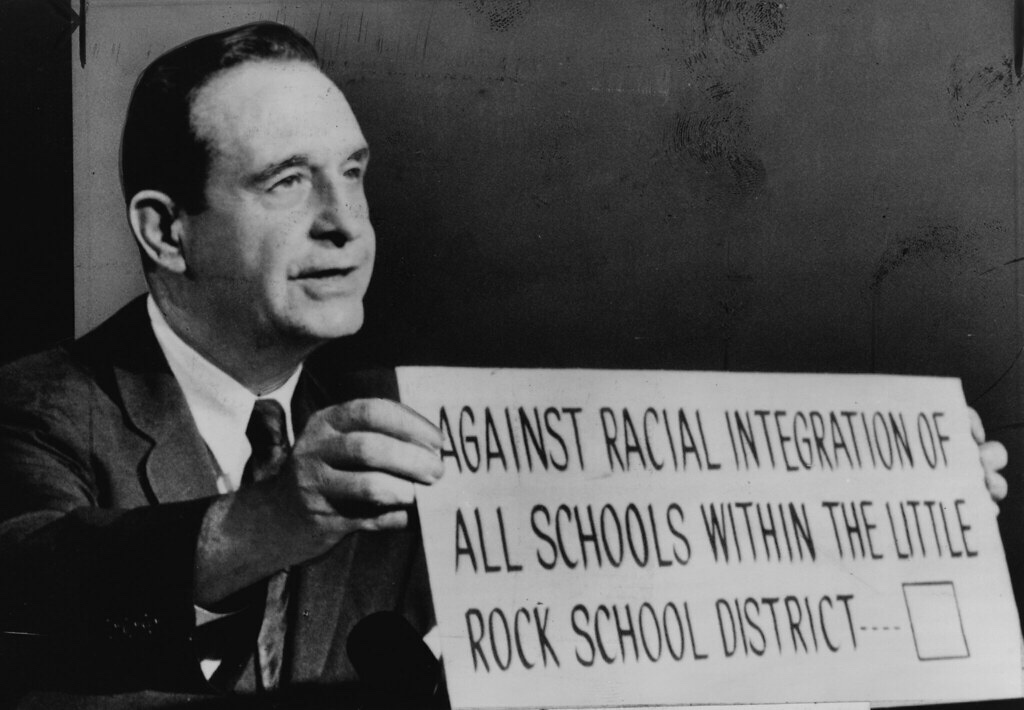
The next day, following a plea from Little Rock’s mayor, Woodrow Mann, President Dwight Eisenhower federalized the National Guard and sent U.S. Army troops to the scene. On September 25, the nine African-American teens entered Little Rock Central High School, personally guarded by soldiers from the Army’s 101st Airborne Division, and began regular class attendance. The Federal government forcibly imposed its authority but the struggle to integrate was far from over. Over the course of the school year, the nine African-American teens were subjected to daily harassment, jeers, and violence at the hands of many white students. For example, Melba Patillo was kicked, beaten and had acid thrown in her face while Gloria Ray was kicked down a flight of steps. At the same time, state authorities regrouped and changed tactics. In September of the following year, Governor Faubus closed all of Little Rock’s high schools for the entire year pending a public vote, to prevent African American attendance. Little Rock citizens voted 19,470 to 7,561 against integration and the schools remained closed for an entire year.
Aftermath

The showdown to integrate Little Rock Central High School was a precursor of things to come through out the entire South over the next decade as white supremacists and segregationists maneuvered to resist integration. Faubus’ use of the national guard and his decision to closed down Little Rock’s public high schools would be replicated by segregationist governors in Mississippi, Alabama, Virginia, and elsewhere. In September 1962, the small university town of Oxford Mississippi was turned into a war zone as Federal Marshals battled with violent white supremacists mobs seeking to prevent African-American James Meredith from attending the University of Mississippi, in what would become known as the “Battle of Oxford.” A year later Alabama Governor George Wallace personally stood in the doorway to the registrar at the University of Alabama to stop African-American Vivian Malone Jones from attending. In Virginia, Prince Edward County would close down its public school system from 1959-1964 rather than comply with court-ordered integration.

The Battle of the Crater, July 30, 1864

It’s the summer of 1864 and the fortunes of the Confederacy are on the wane. The Army of Northern Virginia is suffering from shortages across the board but one shortage is especially problematic, manpower. The Army of Northern Virginia is steadily being attritted. A series of bloody battles beginning in early May have sapped the Army and put it on the defensive. In early May, at the battle of the Wilderness, Confederate losses number over 11,000. A week later at Spotsylvania Courthouse, the South suffers another 10,000 casualties. In early June, the Confederates return the favor at Cold Harbor inflicting over 10,000 Union losses but they also suffer another 4,500 losses. In little over a month, General Lee has lost a quarter of his army. Lee knows he cannot continue losing men at this pace but he has few options. Lee writes to his son, “Where do we get sufficient troops to oppose Grant? He is bringing to him now the Nineteenth Corps, and will bring every man he can get.” Unlike his predecessors, General Grant is a fighter. He knows that he has Lee on the ropes and he won’t let up. Grant continues to push towards Richmond forcing Lee to move his army to stay between Grant and the rebel capital. Grant deprives Lee of the initiative and Lee is now forced to fight a defensive campaign against Grant’s numerically superior army, one that is not Lee’s strong suit.

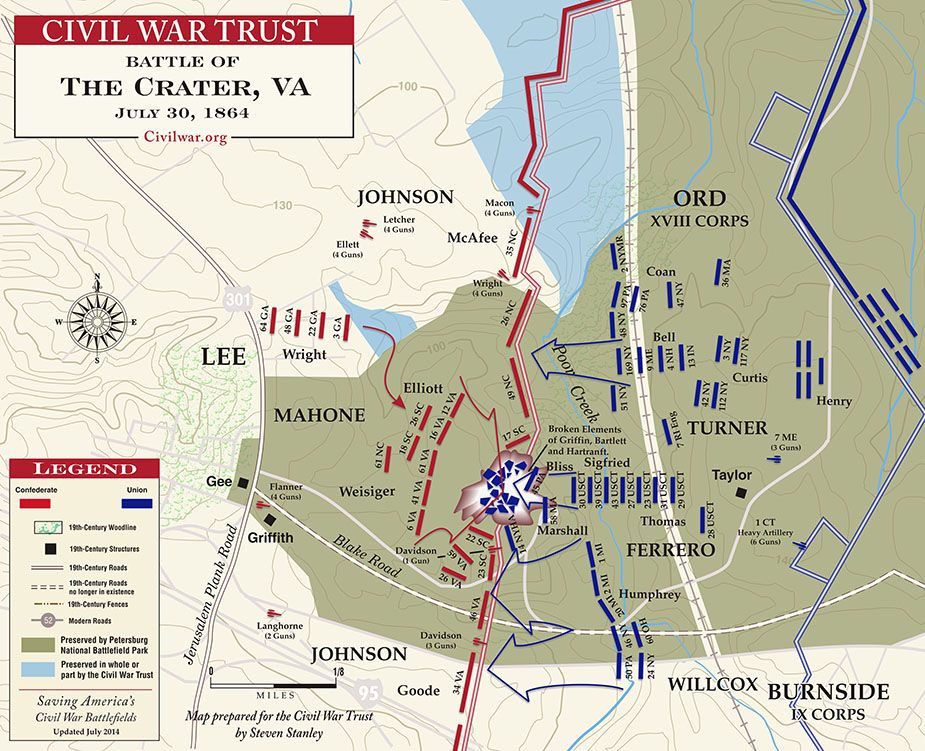
Unable to get between Lee and Richmond, Grant turns his eye toward the critical rail junction of Petersburg, thirty miles south of the capital. Petersburg is vital to the supply of Richmond and its loss would make Richmond’s capture almost inevitable. Shortly after Cold Harbor, Grant marches his forces towards Petersburg and Lee races southward toward Petersburg knowing what its loss would mean. By June 18, Grant had nearly 100,000 men under him at Petersburg compared to the roughly 20,000-30,000 Confederate defenders. Grant realized the fortifications erected around the city would be difficult to attack and pivoted to starving out the entrenched Confederates. Grant had learned a hard lesson at Cold Harbor about attacking Lee in a fortified position but is chafing at the inactivity to which Lee’s trenches and forts had confined him. A regiment of Pennsylvania miners offered a proposal to break the impasse. They would dig a long mine shaft under the Confederate lines and detonate explosives directly underneath fortifications in the middle of the Confederate First Corps line. If successful, not only would all the defenders in the area be killed, but also a hole in the Confederate defenses would be opened. If enough Union troops filled the breach quickly enough and drove into the Confederate rear area, the Confederates would not be able to muster enough force to drive them out, and Petersburg might fall.

The plan was met with great skepticism but Grant did not reject it out of hand. Digging commenced in late June. On July 17, the main shaft reached under the Confederate position. Rumors of a mine construction soon reached the Confederates, but Lee refused to believe or act upon them. For two weeks he debated before directing countermining attempts, which were sluggish and uncoordinated, and failed to discover the mine.

A division of new African-American soldiers was specially trained to carry out the assault once the explosives were detonated. For weeks the division prepared itself for all the chaos potential challenges they might encounter in leading the assault. Despite this intensive training, a decision was made a day before the impending attack to replace the African-American soldiers with another division that was less prepared. Elements within the Union high command lacked confidence in the black soldiers’ combat abilities.

The explosive charges were detonated ‪at 4:44 a.m. on the 30th.‬ They exploded in a massive shower of earth, men, and guns creating a crater that was over 100 feet wide and 30 feet deep. The initial explosive charges immediately killed 278 Confederate soldiers. The remaining troops were stunned by the explosions and did not direct any significant rifle or artillery fire at the enemy for at least 15 minutes. However, the Union troops selected to lead the assault were unprepared for what they encountered. Instead of moving around the crater, they advanced down into it and soon became trapped. The Confederates, under Brig. Gen. William Mahone, regrouped and counterattacked. They began firing rifles and artillery down into the crater in what was later described as a “turkey shoot.” The plan had failed and the battle was lost. However, the strategic situation remained unchanged. Both sides remained in their trenches, and the siege would continue into March of the next year.

Gettysburg Day Three: July 3, 1863

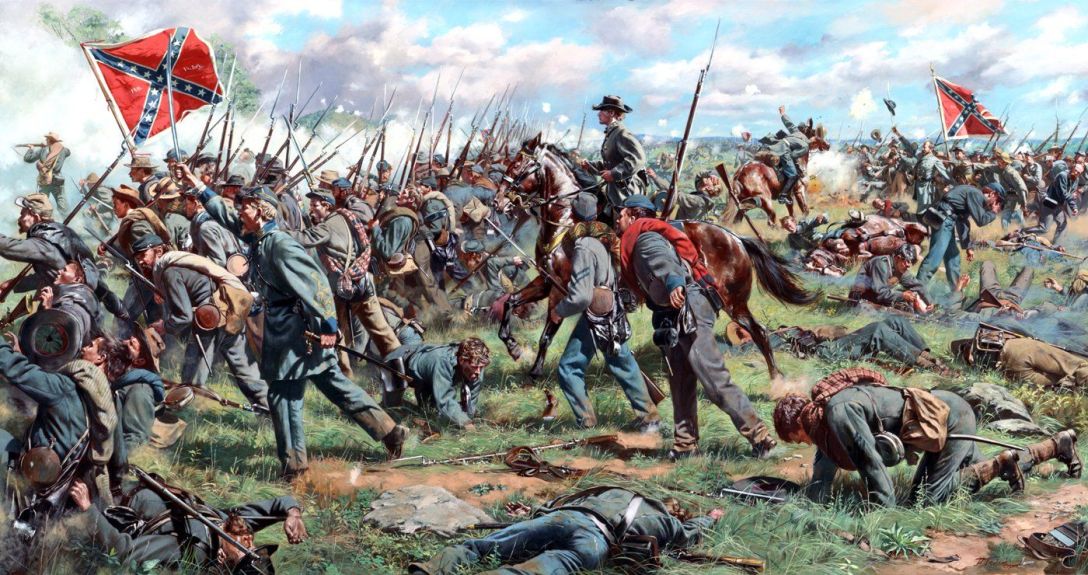
On the afternoon of July 3, 1863, 12,000 Confederate troops carried out a vain and desperate assault on the Union front along Cemetery Ridge seeking to break the Federal line and steal a victory from the jaws of defeat. The attack, which would cross over a mile of open field and come under a withering storm of artillery was easily repelled. The following day General Robert E. Lee gathered his forces and casualties and began the long retreat across the Potomac, back into Virginia. The second Confederate invasion of the North had again ended in failure.

The second day of the battle of Gettysburg proved as disastrous for the Confederacy as the first day was fortuitous. Every Confederate attack up and down the Emmitsburg Pike was beaten back. The rebels had their opportunities. They had broken the Union lines in spots but strong interior lines and and a reserve of reinforcements allowed the Federals to quickly plug any holes and push the rebels back.

General George Pickett

Despite the failures of the previous day, General Robert E. Lee was committed to continuing the battle the following day. Longstreet continued to argue against any offensive operations but his objections fell on deaf ears. Having attacked the left and right of the Union line with little success, Lee reasoned that the Union center must now be weakened. He incorrectly assumed that the Union Army commander, General George Meade, must have pulled reinforcements from the center to blunt the Confederate attacks on he flanks. Moreover, the last of his army, General George Pickett’s division of Virginians had finally arrived.

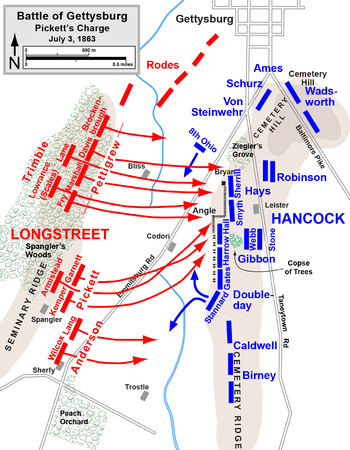
Lee’s plan of attack was simple. He would soften up the Union center with an artillery barrage, then, Pickett’s division, augmented by select regiments from Henry Heth and Isaac Trimble’s divisions that bore the brunt of the fighting on the first day, would advance across a mile of open field and strike the Union center. Although the plan was simple, execution was anything but.

The plan began to go awry from the get go. Around 1pm, 150 Confederate artillery pieces in a 2-mile long line along Seminary Ridge opened fire on the Union Center. Their orders were to silence as many Union batteries as possible on the north end of Cemetery Ridge before the infantry advanced. However, the barrage did not inflict the damage on the Union guns that the Confederate leadership had hoped. The immense amount of smoke generated by the cannonade hindered the aim of the Confederate gunners while inferior shell fuses ensured that some Confederate shells failed to detonate properly rendering them ineffective and leaving many Union batteries relatively unscathed.

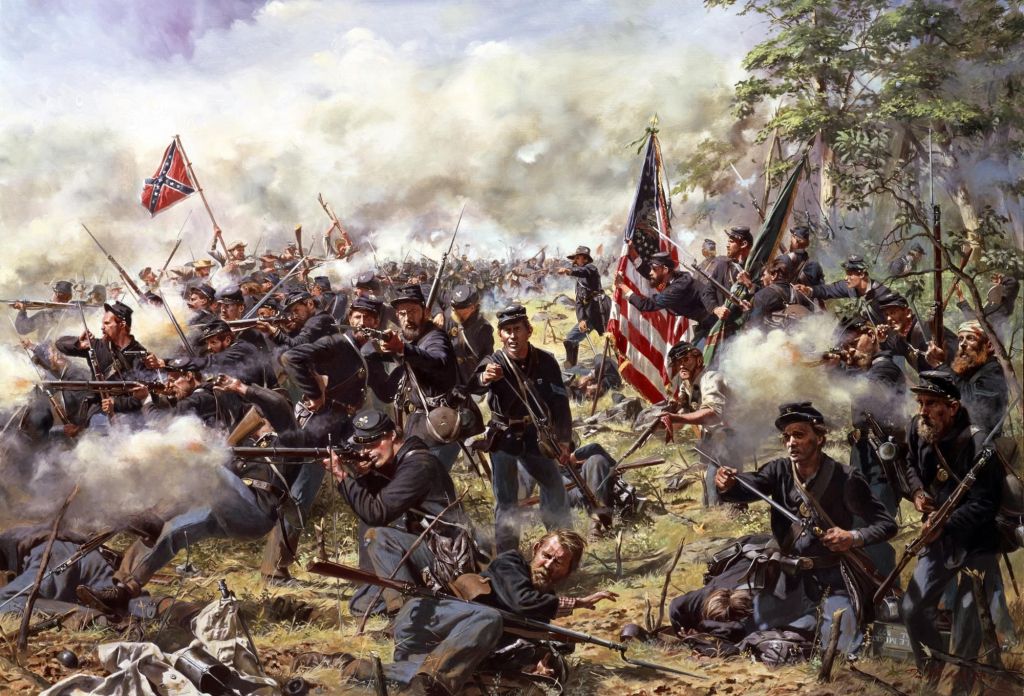
As Confederate artillery began to run low on ammunition the infantry was ordered to form up and prepare for their advance. Around 3pm, Confederate troops stepped out from the tree line along Seminary Ridge and began to move forward in a mile long front proudly and in good order. Crossing over the Emmitsburg Pike, the rebels soon came under a withering fire from Union artillery. Federal guns atop Little Round Top ripped huge gaping holes in the Confederate right flank while those on Cemetery Hill did the same to the rebel left. Once on the other side of the pike, the attack began to falter as Union gunners along Cemetery Ridge switched to canister shot and musket fire became increasingly accurate and effective. Despite mounting losses the Confederates pressed on until they reached a small stone wall which was their destination. The remaining men rushed the stone wall and brutal hand-to-hand combat ensued. The Union quickly reinforced their lines with fresh men and counterattacked. The rebels, expecting reinforcements that never showed, were forced to flee back to their original lines. As the survivors straggled back to Seminary Ridge, many of them passed Robert E. Lee, who told them, “It is my fault.” The attack failed and with it any hope of victory.

Union forces push back the rebels at the stone wall


In the words of William Faulkner, “For every Southern boy fourteen years old, not once but whenever he wants it, there is the instant when it’s still not yet two o’clock on that July afternoon in 1863, the brigades are in position behind the rail fence, the guns are laid and ready in the woods and the furled flags are already loosened to break out and Pickett himself with his long oiled ringlets and his hat in one hand probably and his sword in the other looking up the hill waiting for Longstreet to give the word and it’s all in the balance, it hasn’t happened yet, it hasn’t even begun yet, it not only hasn’t begun yet but there is still time for it not to begin against that position and those circumstances…

The Southern rebellion is now doomed. It is just now a matter of time.