Mississippi Burning, June 21, 1964

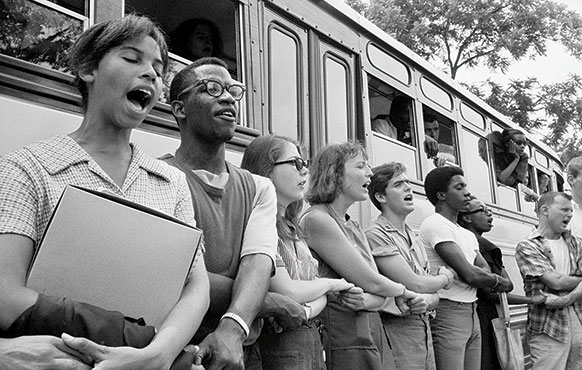
On June 21, 1964 three civil rights activist, Michael Schwerner, Andrew Goodman, and James Chaney were kidnapped and brutally murdered by the Ku Klux Klan in Neshoba County Mississippi. The three were part of what was called Freedom Summer when hundreds of students and young civil rights activists descended upon Mississippi to register and educate the African-American population about their voting rights and to combat the state’s white supremacist power structure that disenfranchised blacks. The murder of Schwerner, Goodman, and Chaney would prove instrumental in the passage of the landmark 1964 Civil Rights Act and the 1965 Voting Rights Act the following year.

The project was organized by the Council of Federated Organizations, a coalition of the four major civil rights organizations — the Student Non-Violent Coordinating Committee, the Congress of Racial Equality, the National Association for the Advancement of Colored People, and the Southern Christian Leadership Conference. The project set up dozens of Freedom Schools, Freedom Houses, and community centers in small towns throughout Mississippi to aid the local Black population. 

Mississippi was chosen as the target of this effort because it had the lowest percentage of registered African-American voters of any state in the Union, only 6.7 percent of eligible black voters. Blacks had been restricted from voting since the turn of the century due to barriers to voter registration and other laws. Many of Mississippi’s white residents deeply resented these “outside agitators” and any attempt to change their ways. The Ku Klux Klan, the White Citizens’ Council, the Sovereignty Commission and even state and local law enforcement were engaged in a campaign of violence and harassment aimed intimidating these students and discouraging local African-Americans from cooperating with these outsiders. Schwerner, in particular, because of his work and “beatnik” appearance, attracted the attention of the Klan, which put him on their special hit list and gave him the code name “Goatee.”
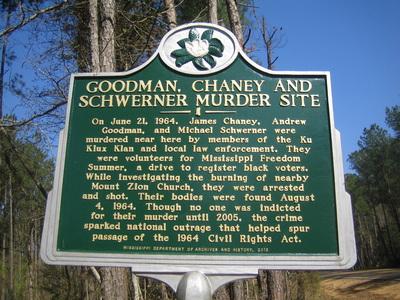
On June 21, 1964, Schwerner, Goodman, and Cheney went to investigate the burning of the Mt. Zion Church in Neshoba county Mississippi by the Klan that served as a Freedom School. They were stopped by Neshoba County Deputy Sheriff Cecil Price just inside the city limits of Philadelphia, the county seat. Price, a member of the KKK who had been looking out for Schwerner or other civil rights workers, threw them in the Neshoba County jail, allegedly under suspicion for church arson. Price kept them in jail for seven hours till late in the evening, denying them a phone call, before he released them on bail. During this time he organized,a plan with his fellow Klan members to murder the activists. Price escorted them out of town on a lonely dirt road and directed never to return. Shortly after exiting the town limits they were chased down by the Klan, pulled over, abducted and murdered. Schwerner and Goodman were shot in the head. Chaney was beaten and castrated before being shot. Their bodies were buried in a newly constructed earthen dam just south of town.
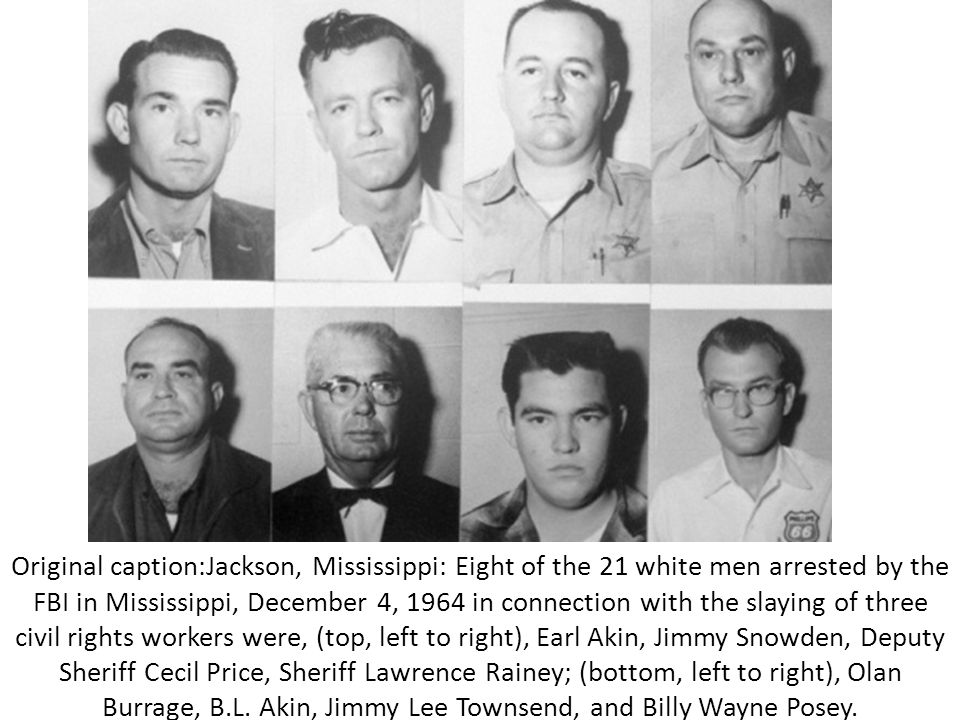
The ensuing FBI search for the three slain civil rights workers grabbed the attention of the nation and finally spotlight on Mississippi’s dreadful record on voting rights and the violent campaign against civil rights that was being waged in that state. On August 4, the remains of the three young men were found. The culprits were identified, but the state of Mississippi made no arrests. With the state unwilling to prosecute the case, nineteen men, including Deputy Price, were indicted on December 4, 1964 by the U.S. Justice Department for violating the civil rights of Schwerner, Goodman, and Chaney (charging the suspects with civil rights violations was the only way to give the federal government jurisdiction in the case). After nearly three years of legal wrangling, in which the U.S. Supreme Court ultimately defended the indictments, the men went on trial in Jackson, Mississippi. Three later an all-white jury found seven men guilty, including Price and KKK Imperial Wizard Sam Bowers. Nine were acquitted, and the jury deadlocked on three others. The mixed verdict was hailed as a major civil rights victory, as no one in Mississippi had ever before been convicted for actions taken against a civil rights worker. None of the convicted men served more than six years behind bars.

On June 21, 2005, the forty-first anniversary of the three murders, Edgar Ray Killen, was found guilty of three counts of manslaughter for his role in the case. At eighty years of age and best known as an outspoken white supremacist and part-time Baptist minister, he was sentenced to 60 years in prison. He died in prison on January 11, 2018, six days before his 93rd birthday.
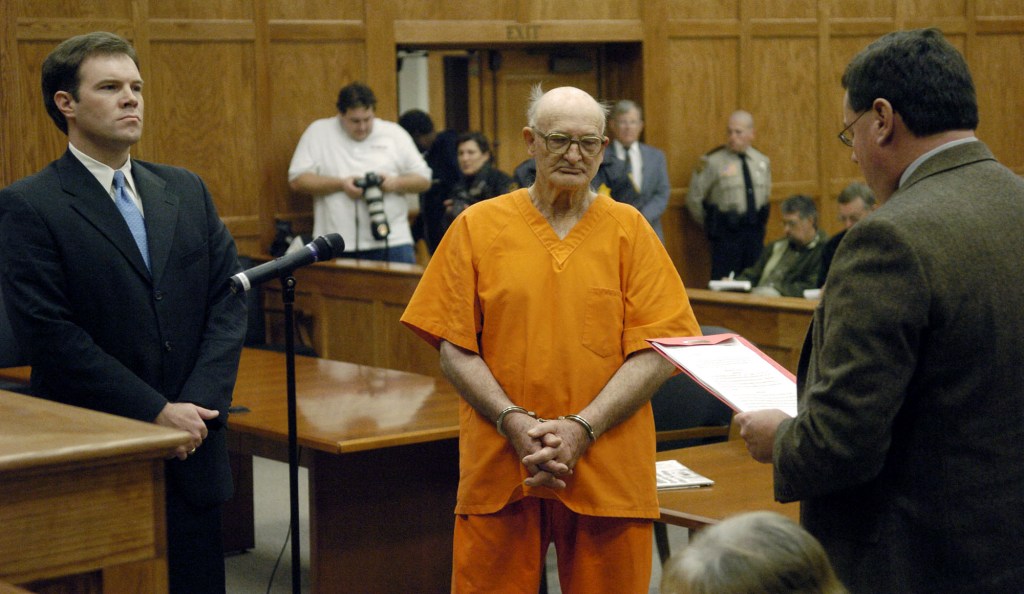
Flanked by public defender Chris Collins, left, reputed Ku Klux Klan member Edgar Ray Killen listens as Neshoba County District Attorney Mark Duncan, right, reads the indictment charging Killen with murder in the slayings of three civil rights workers more than 40 years ago, during his appearance in circuit court, Friday, Jan. 7, 2005, in Philadelphia, Miss. (AP Photo/Rogelio Solis)

Ghosts of Mississippi: The Assassination of Medgar Evers, June 12, 1963

On June 12, 1963, civil rights activist Medgar Evers was gunned down in his driveway outside his home in Jackson Mississippi by white supremacist and segregationist Byron De La Beckwith. Emerging from his automobile after a late night NAACP meeting, Evers was shot in the back by Beckwith who had been positioned across the street waiting to ambush him. The bullet pierced through his heart but he managed to stagger to his door. Evers’ wife, Myrlie, and his three children—who were still awake after watching an important civil rights speech by President John F. Kennedy—heard the gun shot and hurried outside. They were soon joined by neighbors and police. Evers was rushed to the hospital where he was initially denied admission because of his race. He died less than 50 minutes later at the age of 37. Evers was buried on June 19 in Arlington National Cemetery with full military honors. 

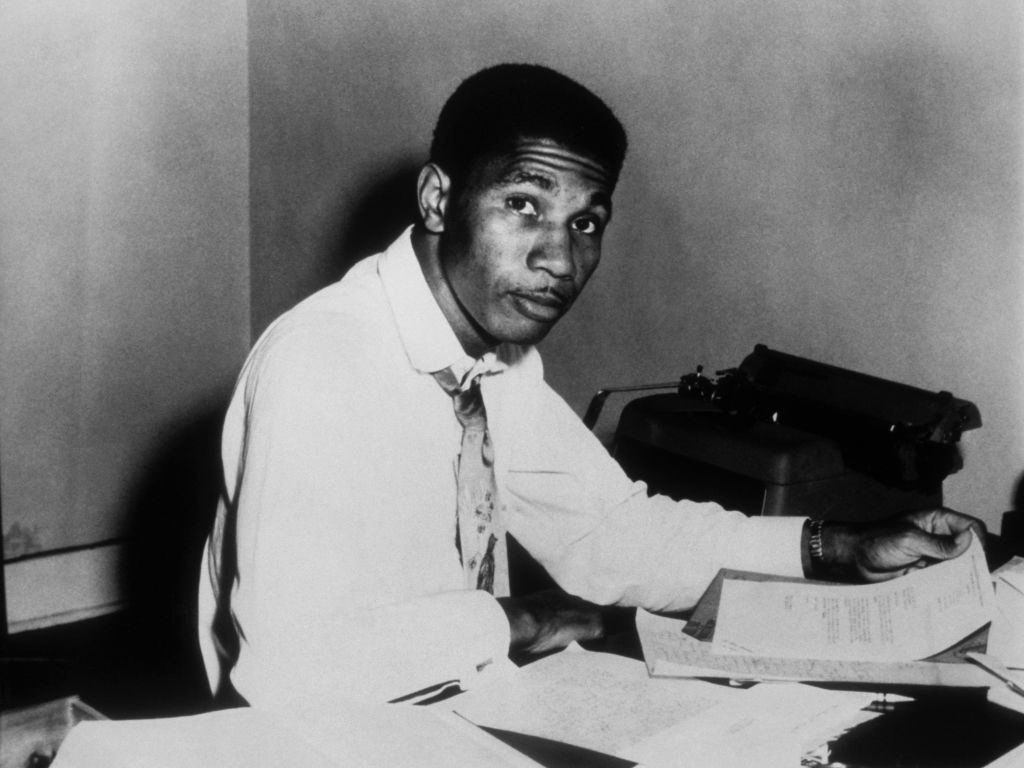
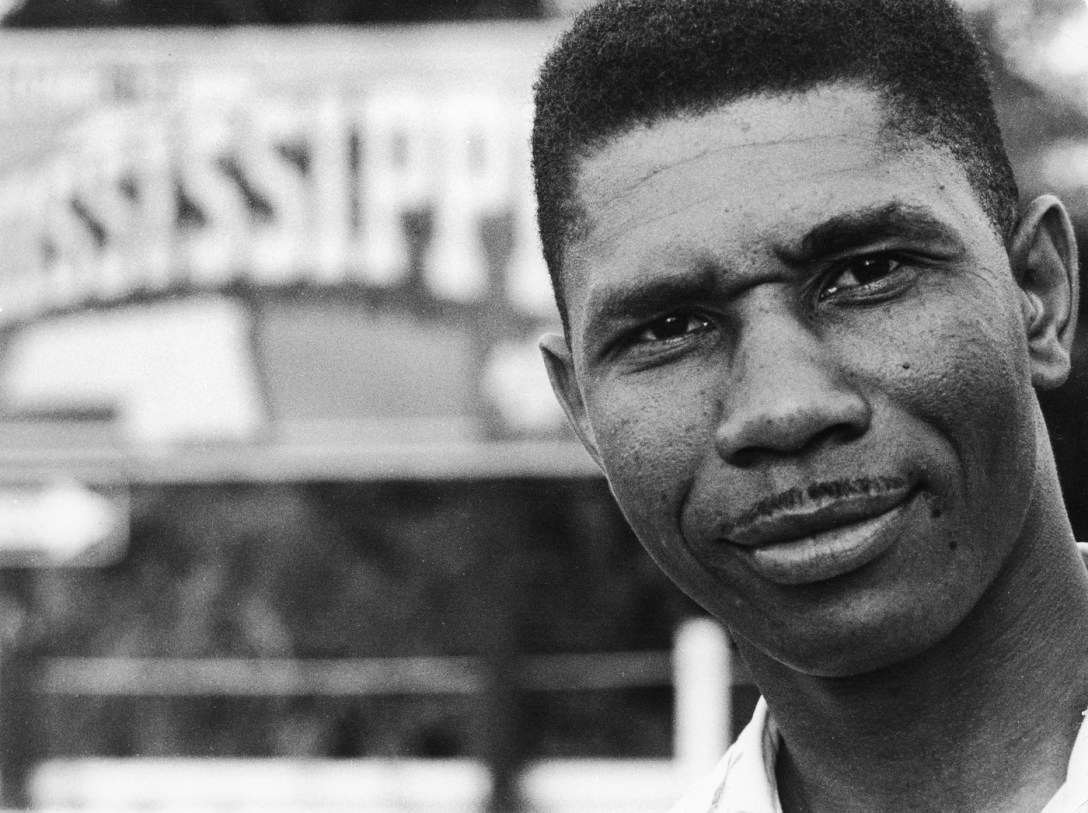
Medgar Evers, the NAACP Field Director for Mississippi

Evers was a decorated World War II veteran who had fought at Normandy in 1944. However, like many other African-American veterans, he returned to a nation that denied him his citizenship rights at the polls. In 1946, Evers attempted to cast a ballot but twenty armed white men, some of whom had been his childhood friends, had learned of his plans to vote and turned up to threaten him. Evers feared for his life. “I made up my mind that it would not be like that again,” he vowed.

Shortly after the landmark Supreme Court ruling in Brown v. Board of Education, Evers volunteered to challenge segregation in higher education and applied to the University of Mississippi School of Law. He was rejected on a technicality, but his willingness to risk harassment and threats for racial justice caught the eye of national NAACP leadership; he was soon hired as the organization’s first field secretary in Mississippi.

Evers was one of Mississippi’s leading civil rights activists. He fought racial injustices in many forms from segregation to how the state and local legal systems handled crimes against African Americans. Evers’ work put him squarely in the crosshairs of the White Citizens Council, a white supremacist group formed in the aftermath of the Brown ruling devoted to preserving segregation. He garnered national attention for organizing demonstrations and boycotts to help integrate Jackson’s privately owned buses, the public parks, Mississippi’s Gulf Coast beaches as well as the Mississippi State Fair. He led voter registration drives, and helped secure legal assistance for James Meredith, a black man whose 1962 attempt to enroll in the University of Mississippi was met with riots and state resistance.

Beckwith was arrested on June 21, 1963 for the murder of Evers but would escape conviction for most of his life, largely due to the racist system of justice that dominated the deep South in the 1960s. He was tried twice in February and April 1964 but in each trial the two all white juries failed to reach a verdict resulting in two mistrials. Beckwith received the support of some of Mississippi’s most prominent citizens, including then-Governor Ross Barnett, who appeared at Beckwith’s first trial to shake hands with the defendant in full view of the jury. After his release Beckwith bragged about his skill with a rifle and hinting to segregationist friends that, indeed, he had killed Evers.

That Beckwith would not be held accountable, while reprehensible, was hardly surprising and consistent with what was increasingly the norm across the South. African-Americans and civil rights activists could expect little legal protection from the courts and law enforcement in the 1960s South which operated largely to preserve segregation and often ignored the facts when white defendants were accused of harming African-Americans. Moreover, most African-Americans were still disenfranchised by Jim Crow laws and therefore ineligible for jury duty. The two white men who murdered fourteen year old Emmet Till eight years earlier for allegedly whistling at a white woman were acquitted . The Ku Klux Klan members that perpetrated the 16th Street Baptist Church bombing in Birmingham, Alabama later that year also escaped justice. The same for the murderers of three civil rights workers in Mississippi the following year.

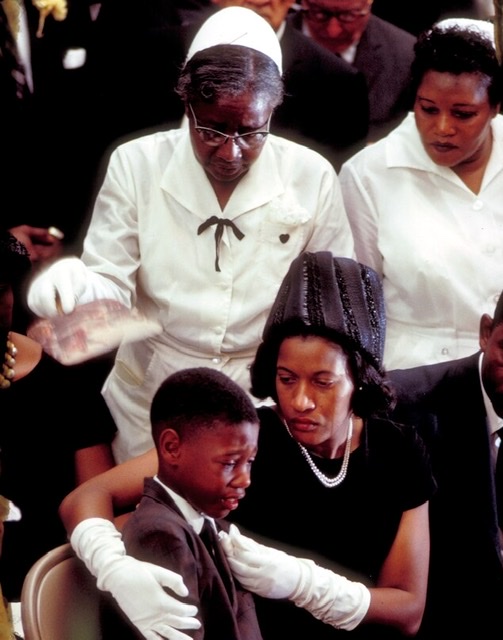
Mylie Evers and son Daniel Kenyatta Evers at Medgar Evers’ funeral

Evers’ assassin, the unrepentant Byron De La Beckwith

Evers was one of Mississippi’s leading civil rights activists. He fought racial injustices in many forms from segregation to how the state and local legal systems handled crimes against African Americans. Evers’ work put him squarely in the crosshairs of the White Citizens Council, a white supremacist group formed in the aftermath of the Brown ruling devoted to preserving segregation. He garnered national attention for organizing demonstrations and boycotts to help integrate Jackson’s privately owned buses, the public parks, Mississippi’s Gulf Coast beaches as well as the Mississippi State Fair. He led voter registration drives, and helped secure legal assistance for James Meredith, a black man whose 1962 attempt to enroll in the University of Mississippi was met with riots and state resistance.

Evers’ home and the driveway where he was shot

Evers’ assassination was a pivotal moment in the Civil Rights movement, a bloody milestone in the fight for racial equality that began with the murder of 14 year-old Emmett Till eight years earlier. It would also prove to be a harbinger of the assassination of Martin Luther King, Jr. by James Earl Ray five years later.