Hoover, Mac Arthur and the Bonus Army: July 28, 1932

On July 28, 1932,  U.S. Army troops, under the command of General Douglass Mac Arthur violently dispersed the “Bonus Army”—roughly 30,000 World War I veterans and their families—who had gathered in Washington DC to demand early payment of a bonus they had been promised by Congress for their service. Amidst the worsening economic conditions of the Great Depression, these increasingly desperate veterans and their families travelled from all across the country to Washington DC to press their demand. They came in trucks, old buses, and railroad freight cars. The spectacle of heavily armed troops moving against the unarmed veterans, who had fought for their country years earlier, shocked and disgusted many Americans. It also reinforced the perception, right or wrong, that President Herbert Hoover was indifferent to the suffering of the American people during the depression and it played a significant role in Hoover’s decisive defeat in the 1932 presidential election. This episode would also prove to be a turning point in how our nation treated its veterans, serving as a catalyst for the G.I. Bill and other programs set up for returning veterans in the aftermath of World War II.
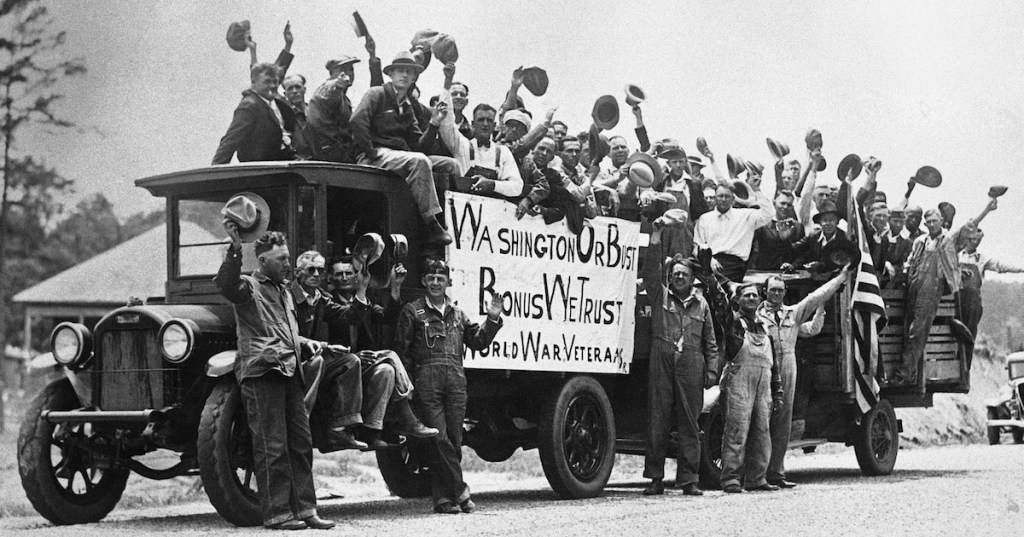
In 1926, Congress passed the World War Adjusted Compensation Act, otherwise known as the Bonus Act, over a veto from President Calvin Coolidge. The act promised WWI veterans a bonus based on length of service between April 5, 1917 and July 1, 1919; $1 per day stateside and $1.25 per day overseas, with the payout capped at $500 for stateside veterans and $625 for overseas veterans. The catch was this bonus would not pay out until each veteran’s birthday in 1945, paying out to his estate if he should die before then. Although veterans were allowed to borrow against the bonus certificate beginning in 1927, by 1932, banks were short on credit to give.

Many of these veterans were now unemployed, broke, and hopeless and began to demand immediate payment to help offset the pernicious impact of the depression. Led by a former Army Sergeant from Oregon, Walter M. Waters, the veterans called themselves the Bonus Expeditionary Force or “the Bonus Army.” They set up camps throughout the city and began to lobby Congress in the spring and summer of 1932 for their bonus. Two camps, in particular, stood out — a group squatting around buildings slated for demolition east of the Capitol on Pennsylvania Avenue, and a larger shanty town in the Anacostia Flats, south of the 11th Street Bridge in what is now Anacostia Park.

The veterans found themselves a sympathetic supporter in Congressman Wright Patman (D-TX), a WWI veteran himself, who introduced a bill on June 15, to pay the veterans. The bill passed the House of Representatives but was subsequently voted down in the Senate, 62-18, with many Senators claiming the country lacked adequate funds to make the immediate payments that were demanded. With the defeat of the Patman bill, some of the veterans returned home believing their cause to be lost but 20,000 remained. Undeterred, Walter Waters vowed, “We’ll stay here until the bonus bill is passed.” He staged daily demonstrations before the Capitol and led peaceful marches past the White House but Hoover refused to give him an audience.
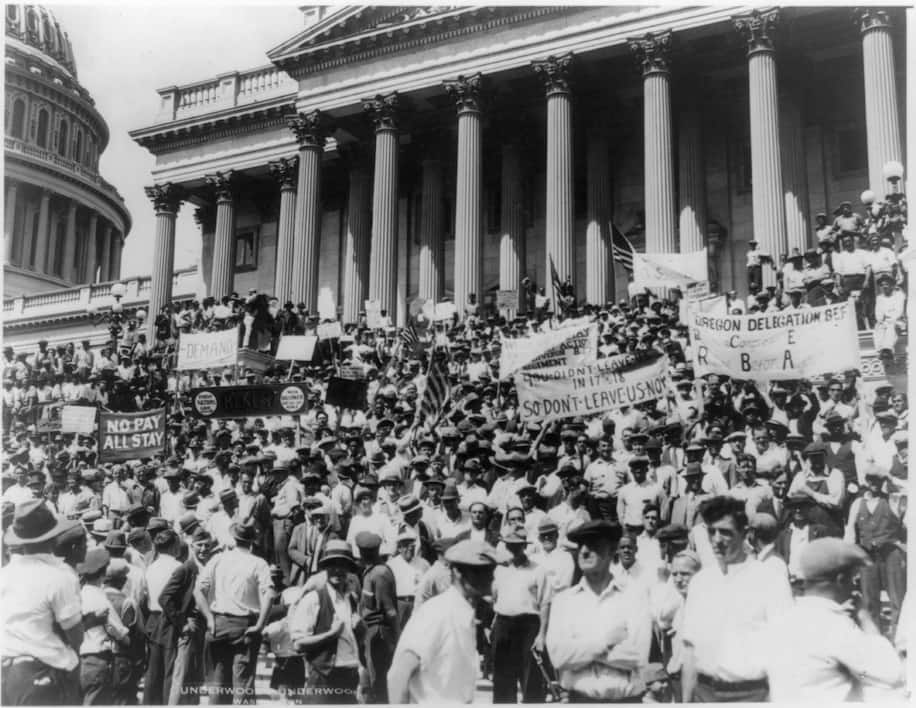
The Bonus Army stages a huge demonstration at the empty Capitol in July 1932.


Unwilling to meet their demands, the Hoover administration disparaged and denounced the veterans as criminals and communist agitators. President Hoover reportedly believed that veterans made up no more than 50 percent of Bonus Army members. In reality, members of the American Communist Party did seek to exploit the situation but they probably represented less than 10 percent of the marchers. A subsequent  study conducted by the Veterans Administration revealed that 94 percent of the marchers had Army or Navy service records.
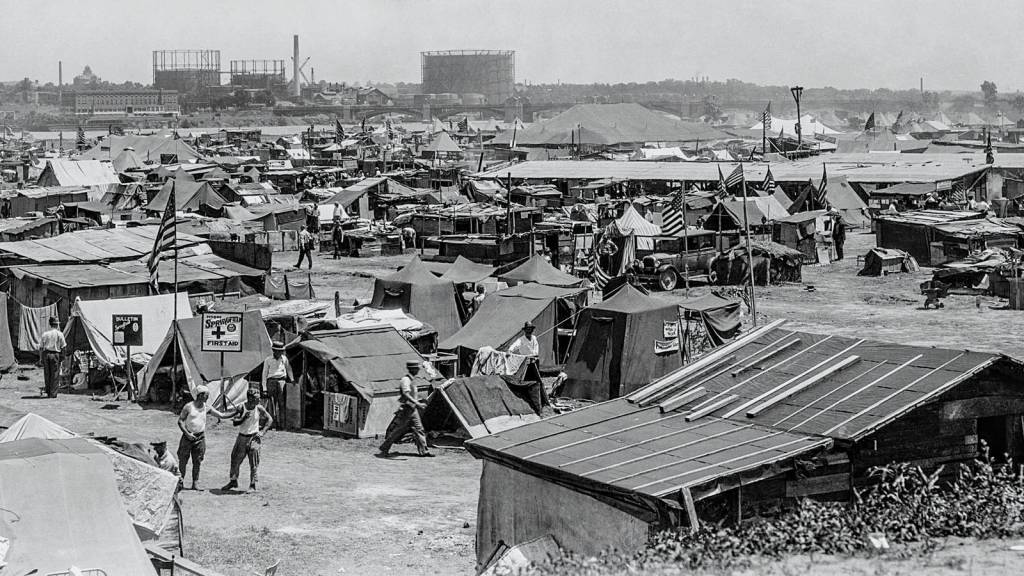
The Bonus Marchers’ Camp at Anacostia Flats


On July 28, the situation turned violent as the city police tried to remove a number of veterans who were encamped along Pennsylvania Avenue. Amidst the ensuing melee, two of the bonus marchers were killed. Fearing that this was the beginning of a larger riot, President Hoover ordered Mac Arthur and the Army to disperse the veterans. That evening, Mac Arthur and about 1,000 troops advanced with tanks, fixed bayonets, and tear gas seeking to drive the demonstrators back across the 11th Street Bridge to Anacostia Flats. Hoover reportedly warned Mac Arthur twice not to cross the bridge in pursuit of the retreating veterans but the General ignored these warnings believing he was suppressing a violent insurrection seeking to overthrow capitalism and the constitution. Mac Arthur continued to advance on the veterans’ camp. The troops drove off the remaining 10,000 inhabitants and set fire to the shanties. The Bonus Army had been dispersed permanently.

Although the operation was a success, the political consequences were disastrous . Hoover defended his use of force against the veterans, declaring, “A challenge to the authority of the United States Government has been met, swiftly and firmly.” However, many Americans were shocked and dismayed by the news and the images of tanks, soldiers with fixed bayonets, and saber wielding cavalry threatening the veterans. Alabama Senator and future Supreme Court Justice Hugo Black denounced the military crack down as an overreaction. “As one citizen, I want to make my public protest against this militaristic way of handling a condition which has been brought about by wide-spread unemployment and hunger,” Black remarked. Senator Hiram Johnson of California, dubbed the incident “one of the blackest pages in our history.” Even the Washington Daily News, which was normally GOP friendly called it “A pitiful spectacle,” to see “the mightiest government in the world chasing unarmed men, women, and children with Army tanks. If the Army must be called out to make war on unarmed citizens, this is no longer America.”

This episode would torpedo Hoover’s re-election bid in 1932, confirming for many Americans that Hoover lacked the leadership skills and bold new ideas to lead the country through the economic crisis. Hoover would go on to lose in a landslide to Franklin Delano Roosevelt. Remnants of the Bonus Army again began to trickle back into Washington DC shortly after Roosevelt’s inauguration in 1933. Roosevelt also opposed meeting the demands of the veterans on the grounds that it would favor a special class of citizen over others at a time when all were suffering. However, unlike Hoover, Roosevelt would take other positive steps to try and ameliorate the economic hardship of the veterans. He would offer them jobs in his new Civilian Conservation Corps and set up Veteran Rehabilitation Camps to help address the unemployment problem. In 1936, Congress finally passed a bill over President Roosevelt’s veto. The Bonus Army had achieved its objective.
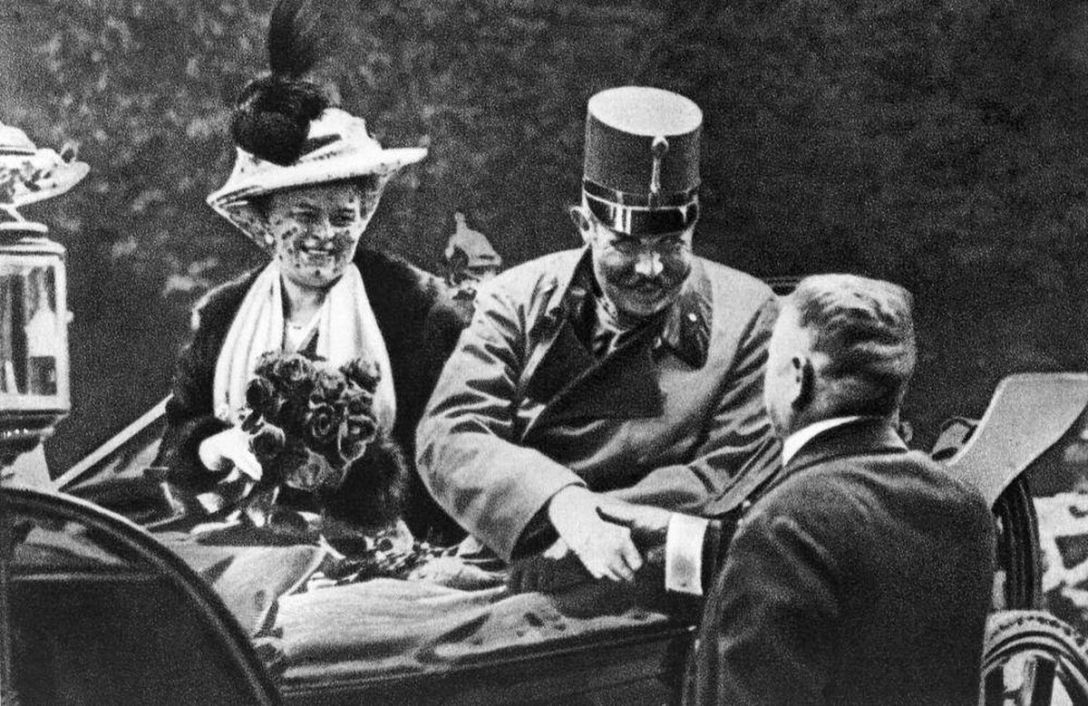
Sarajevo, June 28, 1914

On June 28, 1914, Archduke Franz Ferdinand, presumptive heir to the Hapsburg throne, was assassinated in the Bosnian capital of Sarajevo by a young Serbian nationalist, Gavrilo Princip in what would prove to be a key turning point in the history of the 20th century. The Archduke’s murder put in motion a series of events that would unleash the greatest calamity the world had known up to that point, World War I. The war would destroy an entire generation of European young men, 20 million dead soldiers and another 21 million wounded. It would not be what U.S. President Woodrow Wilson declared, “the war to end all wars.” It only laid the ground work for an even greater catastrophe twenty five years later, World War II.

By the beginning of the 20th century, the Hapsburg empire had become an increasingly unruly multi-ethnic empire with various ethnic groups at odds with each other or agitating for independence. One such problematic group was the ethnic Serbs of Bosnia-Herzegovina, a multi-ethnic territory the Hapsburgs seized from the Ottoman Empire in 1874. Ethnic Serbs comprised about 40 percent of Bosnia’s population, many of who were intent on integrating Bosnia with Serbia to form a “Greater Serbia” state, a goal that Serbia encouraged and actively worked to realize. Serbian military intelligence, with or without the consent of the Serbian government, was actively engaged in covert actions to undermine Vienna’s control over the province. One such operative was Colonlel Dragutin Dimitrijević,  the leader of a secret Serbian military society, called “the Black Hand” whose aim was to unite all of the South Slavs of the Balkans under Serbian rule. Dimitrijevic, or Apis, as he was better known, was cultivating ties with a group of radical Serbian separatists called the “Young Bosnia” movement that would play a pivotal role in the events leading up to World War I.

Archduke Franz Ferdinand

The Archduke was not only Emperor Franz Joseph’s presumptive heir; he was also inspector general of the Austrian-Hungarian army. And in that capacity, he agreed to attend a series of June 1914 military exercises in Bosnia. Franz Ferdinand was dismissive of the Serbs, often referring to them as “pigs,” “thieves,” “murderers” and “scoundrels.” Nevertheless he was also quite sensitive, perhaps more than any other high level official, to the ethnic powder keg that the multi-ethnic Hapsburg Empire had become as it expanded. The Archduke supported reforming the empire from the dual Austro-Hungarian monarchy to a a triple monarchy of Slavs, Germans and Hungarians each having an equal voice in government. This idea was unpopular with the Hapsburg ruling elite but Franz Ferdinand saw it as a more effective way of neutralizing the problem of the Serbs than military force that risked a larger war with Russia, Serbia’s ally.

The date selected for Franz Ferdinand’s visit, June 28, unfortunately coincided with another important event in Serbian history. It was the anniversary of the 1389 Battle of Kosovo Polje in which the Serbs were defeated by the Ottoman Turks and subjugated under Turkish rule for the next 500 years. The battle, in which both Serbian King Lazar and the Ottoman Sultan Murad were killed, plays a crucial role in Serbian national identity and the decision to hold the Archduke’s visit on that day only fanned the flames of dissent among Serbian nationalists even further.

The Archduke and his wife Sophie

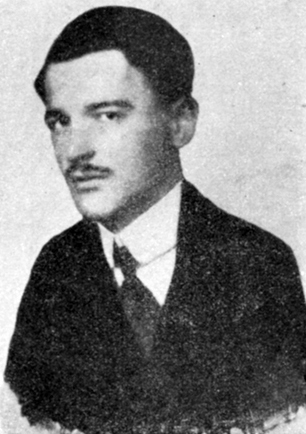
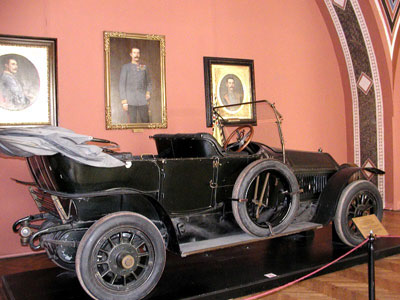
News of Franz Ferdinand’s upcoming visit to Sarajevo prompted Serbian radicals associated with the Young Bosnia movement to begin plotting to assassinate him. On the morning of the Archduke’s visit, seven Bosnian Serbs, armed with pistols, bombs, and cyanide capsules likely provided by Serbian military intelligence, fanned out along the expected motorcade route as he and his entourage drove through the city to City Hall. As the motorcade approached the first two assassins, they lost their nerve and failed to act. A third assassin, Nedeljko Cabrinovic, was not so reticent. Shortly after 10:00am, Cabrinovic tossed a bomb at the open roof sedan carrying the Archduke and his wife. The bomb bounced off their car exploding underneath the one directly behind it injuring the occupants. The Royal couple arrived safely at City Hall for their scheduled reception with no further attempts on their lives.

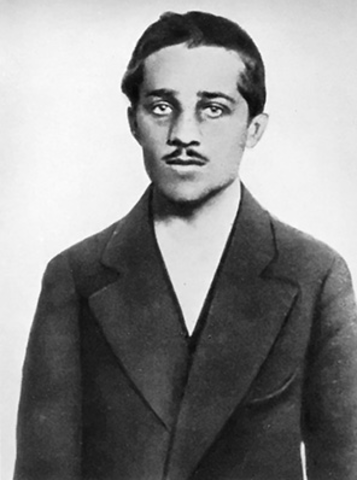
After finishing up their reception at City Hall, Franz Ferdinand made the fateful decision that he wanted to go to the hospital and visit those who had been injured in the failed assassination attempt. This change in plans would end in tragedy. The driver, unfamiliar with the local streets accidentally turned down a wrong side street, just where another assassin, Gavrilo Princip, happened to be standing by chance. As the Archduke’s driver attempted to reverse back onto the main road, Princip pulled out his pistol and fired two shots at the archduke from point-blank range, piercing him in the neck and also striking his wife in the abdomen. Both would die within minutes of their wounds.

Austria-Hungary was convinced that neighboring Serbia was the true mastermind behind the attack and opted to use the crisis to settle its long-standing score with the Serbs. The Austrians hoped to strike a blow against Belgrade and stymie its efforts to unite the South Slavs of the Balkans under Serbian leadership. Their plan, developed in coordination with Germany, was to force a military conflict that would, they hoped, end quickly and decisively with a crushing Austrian victory before the rest of Europe—namely, Serbia’s powerful ally, Russia—had time to react.

On July 23, the Austro-Hungarian government issued Serbia an ultimatum in which it blamed Serbia for the assassination and presented Belgrade with a list of demands that it expected to be fulfilled by Belgrade or it would declare war. The Serbs were given two days to respond. The list consisted of ten demands, many of which the Austrian leadership believed Serbia would never agree to accept. Winston Churchill, at the time in charge of Britain’s Royal Navy, called the Austrian ultimatum “the most insolent document of its kind ever devised”. In short, the ultimatum was intended as a pretext to justify war. Much to the surprise of the Austrians, Serbia agreed to almost all of the demands, only refusing to accept a direct investigation by Austro-Hungarian police officers on its territory. Serbia continued to insist that it gave no moral or material support to Princip and the other assassins.

Austria-Hungary declared war on Serbia on July 28, 1914, exactly a month after the assassination of the Archduke. The declaration set off a chain of events that would plunge the entire continent into crisis. Russia, Serbia’s long-time protector, condemned Austria’s aggression and on July 30 began mobilizing its military forces in support of its ally. Germany followed suit as expected and on August 1, declared war on Russia. At the same time Berlin demanded a declaration of neutrality from France to avoid a two-front war. When Paris refused, Germany felt it had no alternative and declared war on France on August 3. The next day Germany invaded Belgium to attack France. Great Britain, which had pledged to defend Belgium demanded an explanation for German aggression against Belgium. When one was not forthcoming Britain declared war on Germany. The war that all the European powers had long expected finally erupted.


Jean Jaurès: Europe’s Last Great Hope

In 1914, as all of Europe’s statesmen and diplomats girded themselves for the coming calamity that would become known as World War I, others labored below the surface seeking to head off this descent into the abyss. One such figure was Jean Jaures, leader of the French Socialist party. In the weeks before the outbreak of the war, Jaures tried to organize general labor strikes in France and Germany to force their governments to step back from war and negotiate a peace. He urged all socialist to resist their nation’s call to arms and to unite in the interest of the working class and stop the march to war. Jaures was perhaps Europe’s best and last chance to avoid the coming cataclysm, a chance that was snuffed out by an assassin’s bullet on July 31, 1914.

Jaurès was born into a lower middle-class family that had been impoverished by business failures. He was a towering intellect and a professor of philosophy and historian. However, he was more drawn to politics than teaching.  Because of his life experiences, Jaures was always drawn to the plight of the working class. He was a socialist but not in doctrine. His socialism did stem from Marx it was he argued, “the product of history, of endless and timeless sufferings.” He believed that man was good, that society could be made good and the struggle to make it so was to be fought daily. In a sense he was closer to Eduard Bernstein and the evolutionary socialists who argued that the working class was not sinking into impoverishment but making gains and that socialism cold be achieved by working within the system than the more revolutionary Marx who believed it could only be achieved through violent revolution.

As leader of the French socialist party and a brilliant orator, Jaures exercised a powerful voice in the Second International, an organization of 33 socialist parties from around the world working to advance the proletarian revolution. As Europe’s diplomatic crises multiplied in the early part of the 20th century, Jaures tried to move the Second International to focus more on how the socialist parties of Europe might prevent a European wide conflagration that seemed increasingly imminent. In 1907 the Second International adopted a resolution stating, “If a war threatens to break out, it is the duty of the working classes and their parliamentary representatives in the countries involved, supported by the coordinating activity of the International Socialist Bureau, to exert every effort in order to prevent the outbreak of war by the means they consider most effective. The resolution further added, “In case war should break out anyway, it is their duty to intervene in favor of its speedy termination and with all their powers to utilize the economic and political crisis created by the war to rouse the masses and thereby to hasten the downfall of capitalist class rule.” However, the resolution did not answer the question of how.

For Jaures, the answer was clear, the general strike. The concept of the general strike which provoked heated debate amongst the various members of the Second International. The idea was divisive, especially amongst more orthodox Marxists who believed that war was a natural and unavoidable consequence of capitalism and necessary for advancing the proletarian revolution. At the August 1910 Congress of the Second International in Copenhagen, James Keir Hardie a member of the British Labour Party, proposed a new resolution, which called for a general strike in case of war, in order to simultaneously paralyze mobilization in the relevant countries. The delegates agreed that it was necessary to discuss the resolution, but decided to defer that to the next congress, on August 1914. 

As war became increasingly more likely, in the wake of Archduke Frank Ferdinand’s assassination, Jaurès tried to rally the forces of international socialism to prevent a war. Jaurès prophetically warned earlier that a war would unleash the most terrible holocaust since the Thirty Years war An emergency meeting of the executive International Socialist Bureau in Brussels in July 1914 with all the big-wigs of the international socialist movement attending. All the leaders talked about all-out resistance but it soon became clear that the last chance for peace was slipping through Jaurès’ fingers. Jaurès pressed all the attending leader to call a general strike but  there would be no general strike. There was no support. All preconceived notions that class interest would supersede nationalism were shattered. One by one all the great socialist leaders rejected Jaurès’ call. Victor Adler, the great Austrian socialist noted the war was popular in Austria, and the Austrian socialists would no resist it. Adler’s comments were echoed by all the other great socialist leaders.  What every one failed to grasp was that in all the countries of Europe, everyone believed some one else was responsible for the coming conflict.

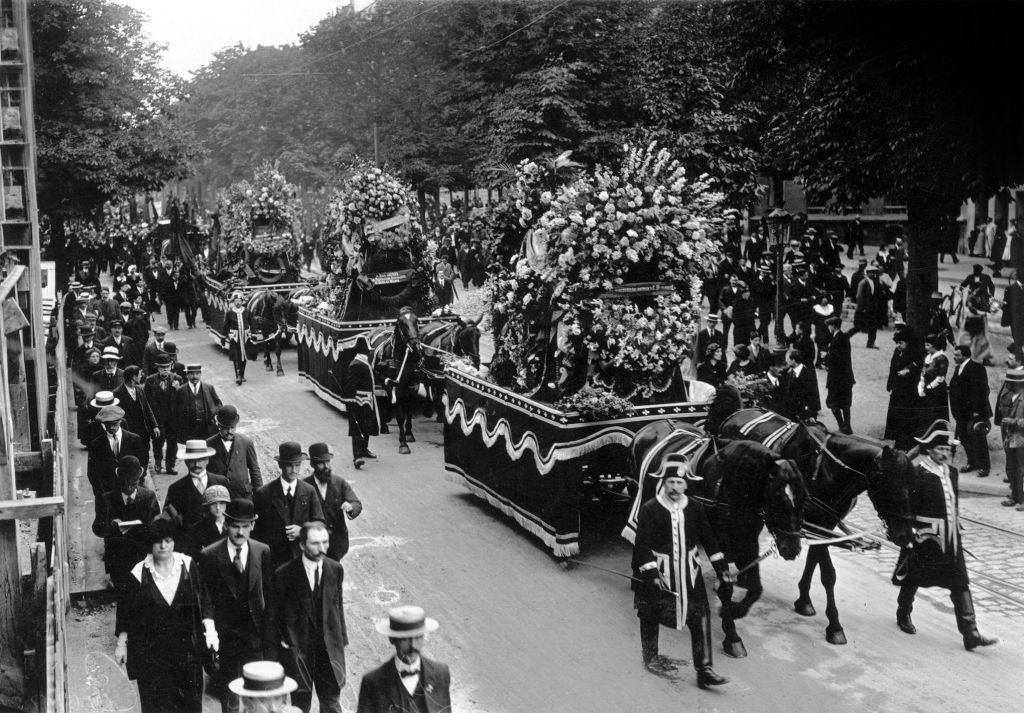
Frustrated and dejected, Jaurès returned to Paris. He spoke passionately at one of the last anti-war rallies. Two days later on July 31st Jaurès was assassinated by a over zealous French nationalist, Raoul Villain, who was fearful of Jaurès’ power to prevent France from going to war.

Funeral of Jean Jaures on August 4, 1914 in Paris