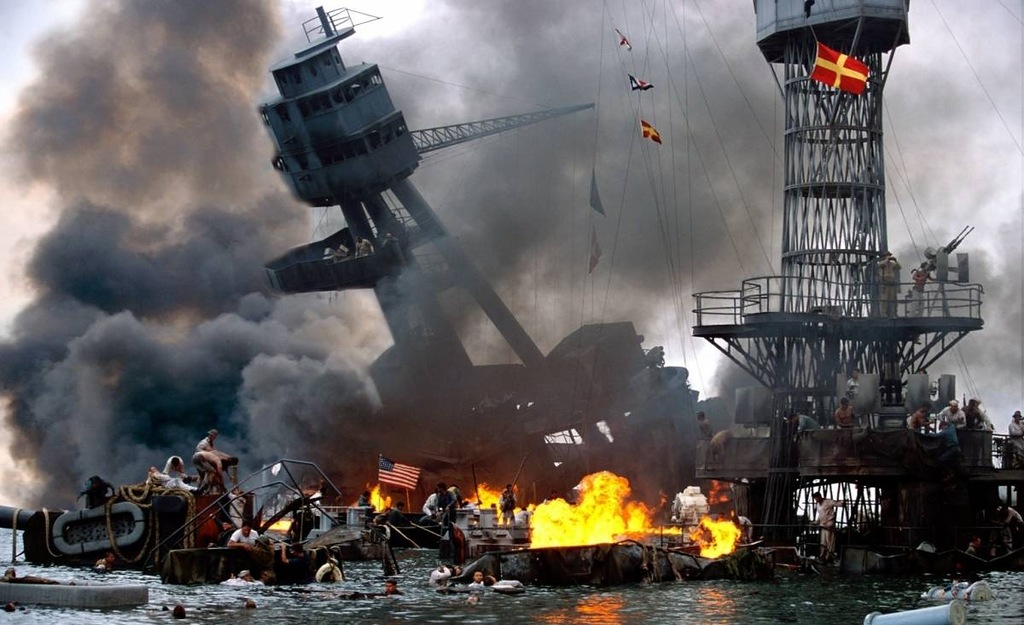
December 7, 1941: A Day of Infamy


In the early morning hours of Sunday December 7, 1941,  over 350 Japanese dive bombers, torpedo bombers and fighter aircraft carried out a devastating surprise attack on the US Pacific Fleet at Pearl Harbor in a day that President Franklin D. Roosevelt declared would “live in infamy.”  The attack was the culmination of months of progressively deteriorating  bilateral relations, punctuated by a debilitating U.S. oil embargo in response to Japan’s increasing militarism and aggressive territorial expansion across the Asia-Pacific region. By 1941, the Japanese had come to believe that war with the US was inevitable and that its best hope for victory was a short and decisive conflict. The preemptive strike was an audacious gamble designed to neutralize the US Pacific Fleet, prevent the US from interfering in its plans to conquer Southeast Asia and force the United States to sue for peace from a position of weakness. The attack would have the opposite effect initiating a four year war that would include the detonation of two atomic bombs over Hiroshima and Nagasaki and Japan’s ultimate capitulation. 
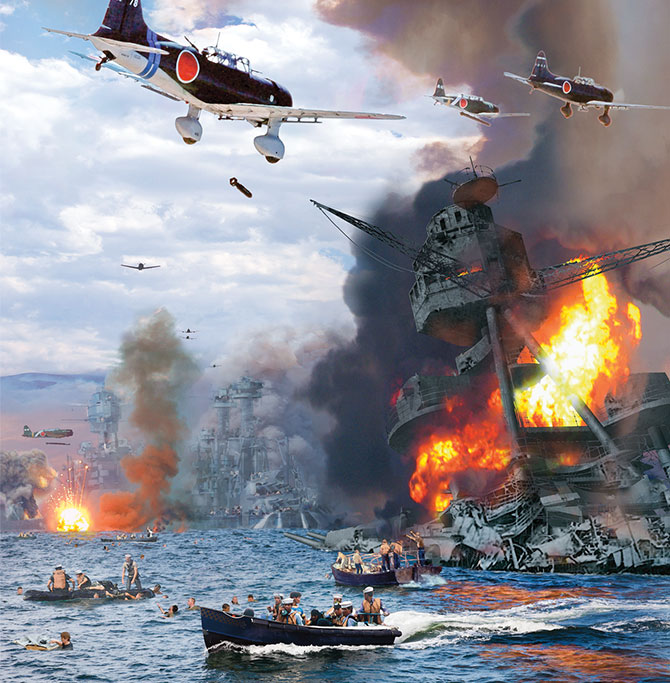
With great secrecy, a Japanese naval task force of 67 ships, including six aircraft carriers, departed its home base in the Kuril Islands on November 26, en route to a rendezvous point 230 miles northwest of the Hawaiian Islands. From there, the six carriers would carry out a two waves of attacks against the unsuspecting US fleet at Pearl Harbor. The first wave was to target the airfields and stationary aircraft as well as the eight battleships the US had docked at Pearl Harbor. Japanese military leaders believed the loss of these ships would be a terrible blow to American morale and naval power and hasten its capitulation. The second wave would target lesser value ships such as cruisers, destroyers, and other stationary targets like dry docks and oil tanks.

The first Japanese aircraft took off from their carriers on December 7, around 6am, heading in a south easterly direction toward Pearl Harbor. Roughly two hours later, Mitsuo Fuchida, the young captain who commanded the first wave, broke radio silence shouting, “Tora, Tora, Tora,” code word to inform the Japanese fleet that they had indeed achieved surprise. Striking hard and fast, Japanese dive bombers destroyed hundreds of US military aircraft neatly arrayed on the ground at the Naval Air Station on Ford Island and the adjoining Wheeler and Hickam fields. At the same time, the eight battleships of the  US fleet were perfect targets for the Japanese pilots. Within 30 minutes, four US battleships— the Arizona, Oklahoma, West Virginia, and California—were sunk and the remaining four badly damaged. The Arizona quickly sank after it was struck eight times by Japanese bombs, one of which hit a forward ammunition magazine blasting the ship into two. The Oklahoma was hit by four torpedoes and capsized. Both the West Virginia and the California would also sink upright in the shallow water of the harbor after multiple bomb and torpedo hits.

As the first wave of attackers were completing their run, a second wave hit the US fleet around 8:50 am but it was much less successful than the first. The second wave inflicted more destruction on the already badly damaged battleships and sank several lesser value light cruisers, destroyers and minelayers. However, the second wave failed to destroy critical fleet infrastructure, like the submarine base,oil storage depots, and dry docks that would allow the US to recover more quickly. Moreover, the Japanese failed to destroy the three US aircraft carriers of the Pacific Fleet which had been sent to sea on maneuvers days earlier. 

Total US personnel loses that day included just over 2400 killed, almost half of whom were trapped in the USS Arizona and another 1,200 wounded. All eight battleships that were present were either sunk or heavily damaged as well as 13 other smaller ships. However, all but the Arizona and Oklahoma were eventually repaired and returned to service years later in the war. The US also lost almost 400 aircraft. In comparison, Japanese loses were minuscule: 29 aircraft an and 5 midget submarines. Damage to the US Pacific Fleet was severe but not the unequivocal knock out blow Japanese military planners sought.
Japanese Rear Admiral Chuichi Hara best summed up the results by saying, “We won a great tactical victory at Pearl Harbor and thereby lost the war.”

On December 8, at 12:30 p.m., Roosevelt addressed a joint session of Congress and, via radio, the nation in which he spoke his immortal words. The Senate followed with a near unanimous declaration of war against Japan. Three days later Nazi Germany and Fascist Italy declared war on the United States in solidarity with Japan. The United States now found itself in the middle of another world war.

The attack on Pearl Harbor immediately united a divided nation. Public opinion had been moving towards support for entering the war during 1941, but considerable opposition remained until the attack. Overnight, Americans united against the Empire of Japan in response to calls to “Remember Pearl Harbor. Within 30 days of the attack on Pearl Harbor, over 130,000 men would enlist for military service. Many of these men would have their chance at revenge six months later at the Battle of Midway where the US inflicted a crushing defeat on the Japanese Navy, changing the trajectory of the war in the Pacific in its favor.
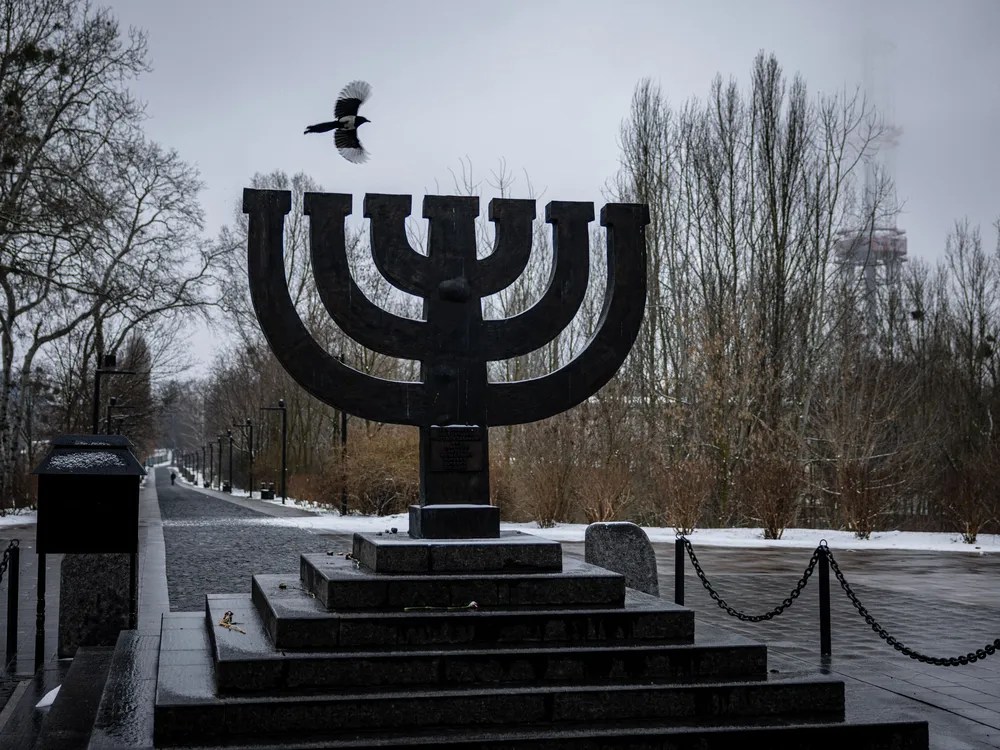



Tragedy at Babi Yar, Ukraine, September 29-30, 1941

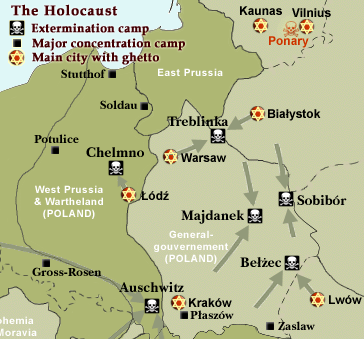
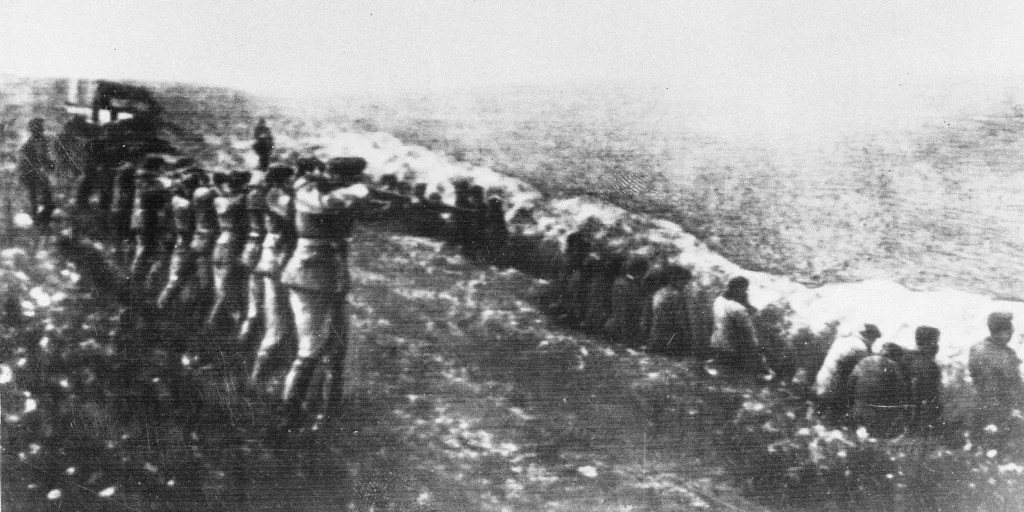
On September 29-30, 1941, the Nazis carried out a mass execution of over 33,000 Soviet Jews at the Babi Yar ravine just outside of Kyiv, Ukraine. The Jews were told they were being relocated and were marched in small groups to the outskirts of the city. There they were stripped naked, their possessions confiscated, and machine-gunned into the ravine by mobile killing squads associated with the Nazi SS called Einsatzgrupen and some Ukrainian auxiliary police. It was one of the largest mass executions of World War II and the apex of the “Bullet Holocaust,” the period before 1942 when the Nazis transitioned to a more systematic approach to exterminating Europe’s Jews using poison gas and “death camps” such as Auschwitz in occupied Poland. 

The Babi Yar Memorial Complex outside Kyiv

Nazi Germany invaded the Soviet Union on June 22, 1941 and as the German Wehrmacht advanced deeper into the USSR a wave of executions followed in its wake. In places such as Lithuania, Latvia, Belarus, Moldova and Ukraine, Jews were rounded up and summarily shot by the Einsatzgrupen and local anti-Semites, all in accordance with Adolf Hitler’s racial ideology of creating Lebensraum, or “living space” for the 1000-year German Reich. 

The Nazis seized Kyiv, the capital of the Ukrainian Soviet Socialist Republic, on September 19 and the Einsatzgrupen units were ordered  to exterminate all Jews and Soviet commissars found there.  By the time Germans reached Kyiv in mid-September 1941, about 100,000 of the city’s prewar Jewish population of 160,000 already had fled or joined the Soviet military to fight the invasion. Those that remained were largely women, children, the elderly, and the infirm. During the first week of the German occupation of Kyiv, two major explosions rocked the city, destroying the military headquarters of the German Army Group South and killing a large number of German soldiers. Although the explosions were caused by mines left by retreating Soviet soldiers, the Germans used the sabotage as a pretext to murder those Jews who still remained in Kyiv. On September 26 the German Army and the SS concluded that Kyiv’s Jewish population wouldn’t be confined in a ghetto, but instead annihilated at Babi Yar.  Two days later, Nazi authorities in Kyiv ordered all Jewish residents to appear the next morning at an intersection in the city’s Lukianivka district, with all their personal documents, money and valuables and warm clothing. They were then marched through the city to Babi Yar where they were told to undress and lined up and shot. Infants were taken from their parents’ arms and thrown into the ravine.

Einsatzgruppen Executing Ukraine’s Jews at Babi Yar

In late 1941, SS head Heinrich Himmler witnessed an Einsatzgruppen mass execution first-hand and concluded that shooting Jews was too costly, inefficient, and exerted too much stress on his men. In November Himmler decided a transition should be made away from mass shootings to the use of poison gas, especially with women and children. Experiments with the use of Zyklon B, a cyanide-based gas, had been in effect since September as well as mobile gas vans to murder mentally ill patients.  However, the gas vans were not popular with the Einsatzkommandos, because removing the dead bodies from the van and burying them was a horrible ordeal. On January 20, 1942, Himmler and numerous other Nazi officials involved in implementing the “Final Solution” met in the Berlin suburb of Wannsee to formalize plans for the total eradication of Europe’s 11 million Jews. Here it was decided that the Einsatzgruppen Mobil killing units would be replaced by permanent killing centers at   Auschwitz, Belzec, Chelmno, Majdanek, Sobibor, Treblinka, in occupied Poland.

August 23, 1939: The Molotov- von Ribbentrop Pact

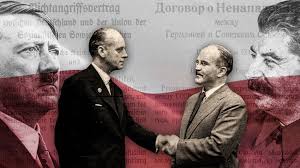
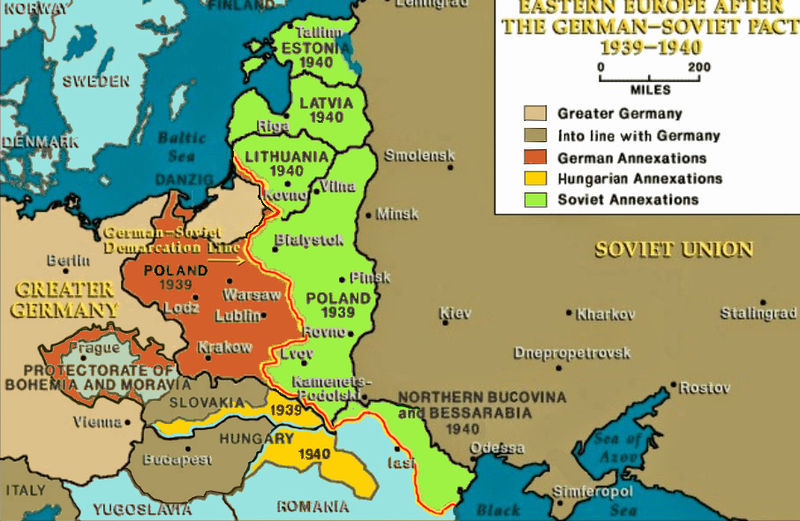
On August 23, 1939, Soviet Foreign Minister Vyacheslav Molotov and German Foreign Minister Joachim von Ribbentrop signed the notorious Nazi-Soviet Non-Aggression Pact paving the way for Hitler to invade Poland and precipitating what would become World War II. Under the terms of the agreement, Nazi Germany and the Soviet Union agreed to refrain from any military aggression against each other for a period of ten years. The agreement also included a secret protocol partitioning Poland and dividing Central and Eastern Europe into “spheres of influence.” The pact was a cynical gambit between two seemingly implacable ideological foes that allowed Hitler to invade Poland without fear of becoming caught up in a two-front war. For Soviet leader Josef Stalin it was a calculated gamble to delay an almost inevitable German attack on the Soviet Union and regain territories lost during the Russian Revolution, Civil War, and the 1920 Polish- Soviet War.

German tanks and aircraft brutally attacked Poland in blitzkrieg fashion on September 1, 1939, crushing all resistance from the brave but antiquated Polish military. On September 17, the Soviet Red Army entered Poland from the East, as stipulated in the Molotov-Von Ribbentrop Pact, effectively partitioning Poland out of existence. Stalin would justify the entrance of Soviet troops into Poland as a necessary security measure to protect Poland’s Belarusian and Ukrainian minorities. However, Stalin held more insidious ambitions. Hundreds of NKVD secret police officials followed in the footsteps of the Red Army. Their mission was to organize sham referenda in which the Belarusian and Ukrainian minorities of eastern Poland would petition to join the Soviet Union and root out any opposition to Soviet rule.  By November, the Soviet Union annexed all Polish territory it occupied. Some 13.5 million Polish citizens suddenly became Soviet subjects following bogus referenda conducted in an atmosphere of terror and intimidation. The NKVD subsequently carried out a campaign of political violence and repression targeting Polish authority figures, such as military officers, police and priests for arrests and execution. Hundreds of thousands of people would be deported from eastern Poland to Siberia and other remote parts of the Soviet Union between 1939 and 1941.

The Soviets would repeat a similar script the following summer regarding the three Baltic States of Lithuania, Latvia, and Estonia. According to the terms of the Molotov-von Ribbentrop Pact the Baltic States were consigned to a Soviet sphere of influence. These three states had been reluctant components of the Russian Empire prior to World War I but emerged from its wreckage as independent states afterward. In the fall of 1939, Stalin coerced the Baltic States into signing mutual assistance treaties with the USSR after invading Poland from the East. These treaties allowed the Soviets to establish military bases in these countries and deploy up to 30,000 troops in each state. Moscow claimed that a Soviet military presence was necessary to protect Lithuania, Latvia, and Estonia from attacks by Nazi Germany. In June 1940, Stalin falsely accused the Baltic States of engaging in anti-Soviet conspiracies and issued an ultimatum to Lithuania demanding that additional Soviet troops be allowed to enter Lithuania and that a new pro-Soviet Lithuanian government be formed. Similar ultimatums were issued to Latvia and Estonia within days. The Red Army subsequently occupied Lithuania on 15 June, Latvia on 16 June, and Estonia on 17 June.

Over the next month, NKVD operatives poured into the Baltic States and began preparations for bogus elections to form new pro-Soviet governments. Between July 21-23, these new puppet governments declared themselves Soviet Socialist Republics and issued a “request” to be incorporated into the USSR. On August 3, Lithuania became the first Baltic State to be absorbed into the Soviet Union followed by Latvia and Estonia. Much like eastern Poland, the Baltic States were subject to an extreme policy of Sovietization, including arrests, executions and mass deportations. These terror tactics continued into the post-war period as agriculture in the Baltic States was collectivized and resistance to Soviet rule increased. More than 300,000 people from Estonia, Latvia and Lithuania would be deported to remote areas of the Soviet Union by the 1950s. Following the end of World War II, the Red Army waged a decade long counterinsurgency against Lithuanian partisans known as the “Forrest Brothers,” resisting Sovietization.

Stalin’s final territorial conquests as part of Molotov-von Ribbentrop were the Romanian provinces of Bessarabia (modern day Moldova) and Northern Bukovina (part of Ukraine). Throughout the 19th century ownership of Bessarabia shifted back and forth between the Russian and Ottoman Empires in a series of wars. In January 1918, Romanian military forces marched into Bessarabia, seizing the province from the Bolsheviks amidst the chaos of the Russian Civil War. The Bolsheviks never forgot the Romanians perfidy. On 26 June 1940, Soviet Foreign Minister Molotov sent an ultimatum to the Romanian government demanding the evacuation of the Romanian military and civil administration from Bessarabia and the northern part of Bukovina or risk way with the Soviet Union. Reluctant to give in to Soviet demands, the Romanians turned to their Nazi allies in Berlin for advice and protection. Berlin advised Bucharest to appease the Soviets and on June 28 Soviet military forces began entering Bessarabia unopposed. One month later the Moldavian Soviet Socialist Republic was proclaimed on August 2, 1940.

The Soviets consistently defended Stalin’s decision to sign a non-aggression pact with Hitler as a correct and necessary measure to ensure the security of the Soviet Union, given the suspect nature of the security guarantees Great Britain and France were offering. For years the Soviets also denied the existence of any secret protocols in the Molotov-von Ribbentrop Pact and claimed that the Baltic States were incorporated into the Soviet Union at their own request. The United States never officially recognized the Soviet annexation of the Baltic States and for years up until the collapse of the Soviet Union, there were Lithuanian, Latvian and Estonian embassies on 16th street in Washington DC.

In August 1989,  Soviet leader Mikhail Gorbachev finally acknowledged the existence of the Molotov-Von Ribbentrop Pact’s secret protocols and that Nazi Germany and the Soviet Union illegally divided up parts of Eastern Europe into spheres of influence before the start of World War II. It was an ill-conceived plan intended to placate the Baltic Republics and quell their growing demands for greater autonomy and independence.  However it did little of the sort because Gorbachev stopped short of admitting that the Baltic States were forcibly incorporated into the Soviet Union. On August 23, 1989, the 50th anniversary of the pact, over one million people created a 400 mile human chain linking Estonia, Latvia and Lithuania in a symbol of solidarity and a call for a restoration of their independence and statehood. 

Russian President Putin has subsequently walked back Gorbachev’s admission, amidst an overall down turn in relations with the West since 2014. Putin has denounced what he considers Western attempts to rewrite history by transferring blame for unleashing World War II from the Nazis to the Soviet Union. Putin has defended the pact as a necessary realpolitik choice made by Stalin under challenging circumstances while rehashing old Soviet disinformation that the Baltic States joined the Soviet Union of their own free will. Lastly, he has tried to recast Poland not as an innocent victim of Nazi-Soviet treachery but as the architect of many of its misfortunes, noting that Poland illegally annexed Czechoslovakian territory following the Munich Conference.

.


The Lidice Massacre, June 10, 1942

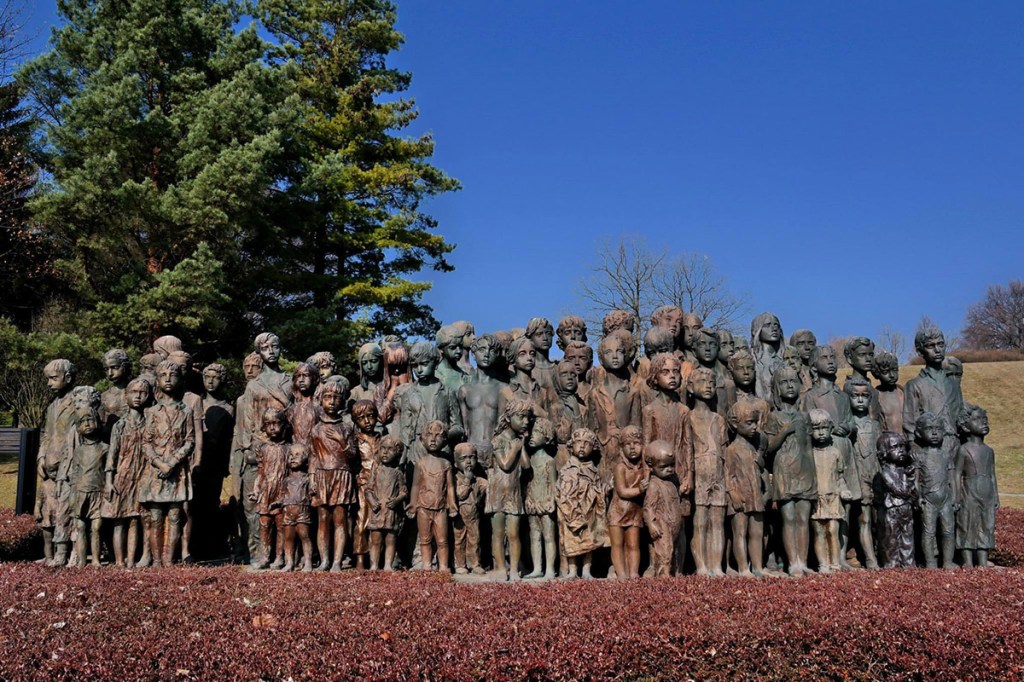
On June 10, 1942, the entire Czechoslovakian village of Lidice was wiped from from the face of the earth in retaliation for the assassination of SS leader Reinhard Heydrich by the Czech underground three weeks earlier. All 172 men and boys over the age of 16 were shot and killed. The women of the village were all sent to the Ravensbruck concentration camp where most died. Ninety young children were sent to the concentration camp at Gneisenau, with some later taken to Nazi orphanages if they were German looking. The Nazis then proceeded to raze the village until not a trace of it remained. All homes were destroyed, trees were chopped down, animals were killed, and even the cemetery was demolished. Soon, all that remained of Lidice was an empty field. It was as if it never existed.

A memorial to the murdered children of Lidice

Adolf Hitler personally ordered the destruction of Lidice. One account claims that Hitler randomly pointed to a village on a map  as the target of his vengeance and Lidice was the unfortunate victim. Other more likely accounts, claim that Lidice was selected because the village  had harbored and aided Heydrich’s assassins. 

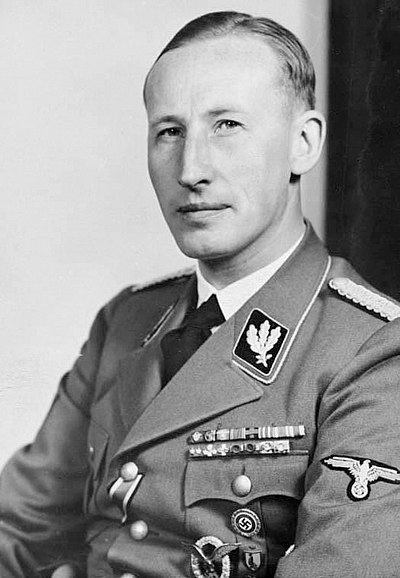
Heydrich, who organized the Kristalnacht attacks against German Jews in pre-war Germany and was the primary architects of the Final Solution, was probably one of the most barbarous and heinous of all the Nazis, demonstrating clear sociopathic tendencies, even by Nazi standards. In addition, to serving as the head of the SS, Heydrich was also acting as “Reichsprotektor,” or Governor, of what the Nazis called the protectorate of Bohemia and Moravia. The Nazis had occupied Czechoslovakia since April 1939. In 1940, they carved out the independent puppet state of Slovakia and absorbed the remaining Czech lands into the Greater German Reich.

Heydrich was one of Hitler’s favorite lieutenants and was sent to Prague near the end of September 1941 and tasked with suppressing rising anti-German sentiment and keeping up production quotas of Czech motors and arms that were “extremely important to the German war effort.  Heydrich’s methods were brutal. Within two months of arriving, Heydrich established Protectorate special courts, which sentenced 342 people to be executed. Another 1,200 citizens were handed over to the Gestapo for imprisonment. A large number of Czechs were used as forced labor to support the German war effort while Heydrich set out to erase all signs of Czech  national  identity. Heydrich told his staff, “We will Germanize the Czech vermin.” To this end, he set in motion a multi-faceted plan. Heydrich ordered teams of doctors and technicians to conduct racial blood tests to determine which Czechoslovakians were “capable of becoming Germans.” At the same time, he sought to systematically dismantle Czechoslovakian culture and history and replace it with a Germanized version. Heydrich was very clear about his eventual goal: “This entire area will one day be definitely German, and the Czechs have nothing to expect here.” Eventually up to two-thirds of the populace were to be either deported to Russia or exterminated after Nazi Germany won the war.

Operation Anthropoid

In 1942, the Nazi occupation of Czechoslovakia was beginning to seem like it would last forever. The Czech government in exile in London was determined to kill Heydrich and end his brutal assault upon the Czech nation. Together with the British Special Operations Executive (SOE) they devised Operation Anthropoid.

In December 1941, two soldiers from the Czechoslovak army in exile, one Czech, Jan Kubis, and one Slovak, Jozef Gabcik, secretly parachuted into the former Czechoslovakia intending to kill Heydrich. Several plans had been under consideration but were deemed impractical. Eventually they decided on a plan to assassinate him as he was being driven to work.

Left: Jan Kubis, Right Jozef Gabcik

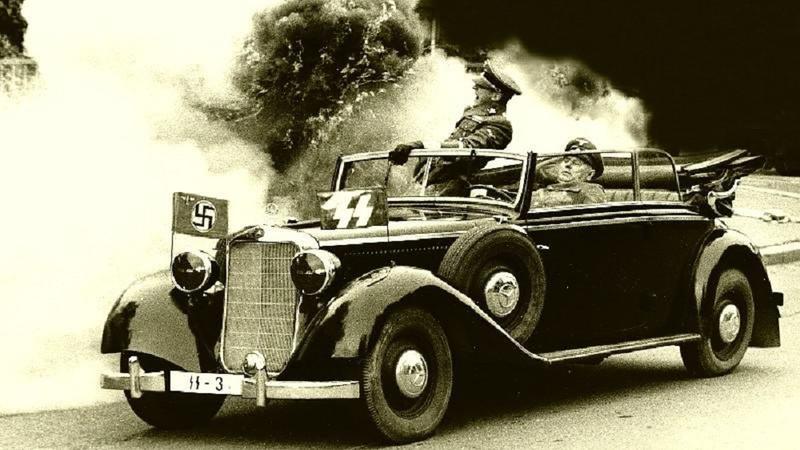
At 10:30 on 27 May 1942, Heydrich and his driver set off on their daily commute to Prague Castle in the center of the city. It was a nine mile journey that included a very sharp turn that required vehicles to slow down in order to safely navigate it. Here Kubis and Gabcik planned to ambush Heydrich. As Heydrich’s vehicle approached the turn and slowed down as expected, Gabčík, dropped his raincoat and raised his Sten submachine gun and, at close range attempted to shoot Heydrich, but the gun jammed. As the car passed, Heydrich made an ultimately fatal error; instead of ordering his driver to accelerate, he stood up and drew his Luger pistol yelling at the driver to halt.

As the Mercedes braked in front of him, Kubiš, who was not spotted by Heydrich or Klein, threw a modified explosive at the car; he misjudged his throw. Instead of landing inside the car, it landed against the rear wheel. Nonetheless, the bomb severely wounded Heydrich. Both the wounded Heydrich and his driver leaped from their vehicle a chasing after their would-be assassins. The driver ran towards Kubiš, who was also staggered by the explosion, but he recovered in time to jump on his bicycle and pedal away. Heydrich was now engaged in a shootout with Gabcik but he suddenly collapsed from the pain of his wounds allowing Gabcik to escape. Heydrich would succumb to his wounds on June 4.

Kubiš, Gabcik, and several other Czech partisans were eventually tracked down to the Saints Cyril and Methodius Cathedral in Prague. 750 SS soldiers descended on the Cathedral where a massive firefight ensued as the men hunkered down in the crypt and the prayer loft of the Cathedral. The Nazis were unable to take the men alive, and the standoff resulted in the deaths of them all, by both suicide and injuries sustained from the firefight.


It

The Miracle at Dunkirk, May 26-June 4, 1940

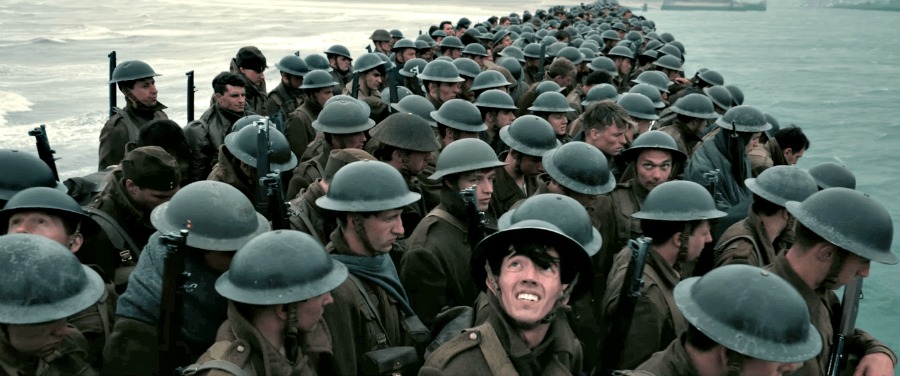
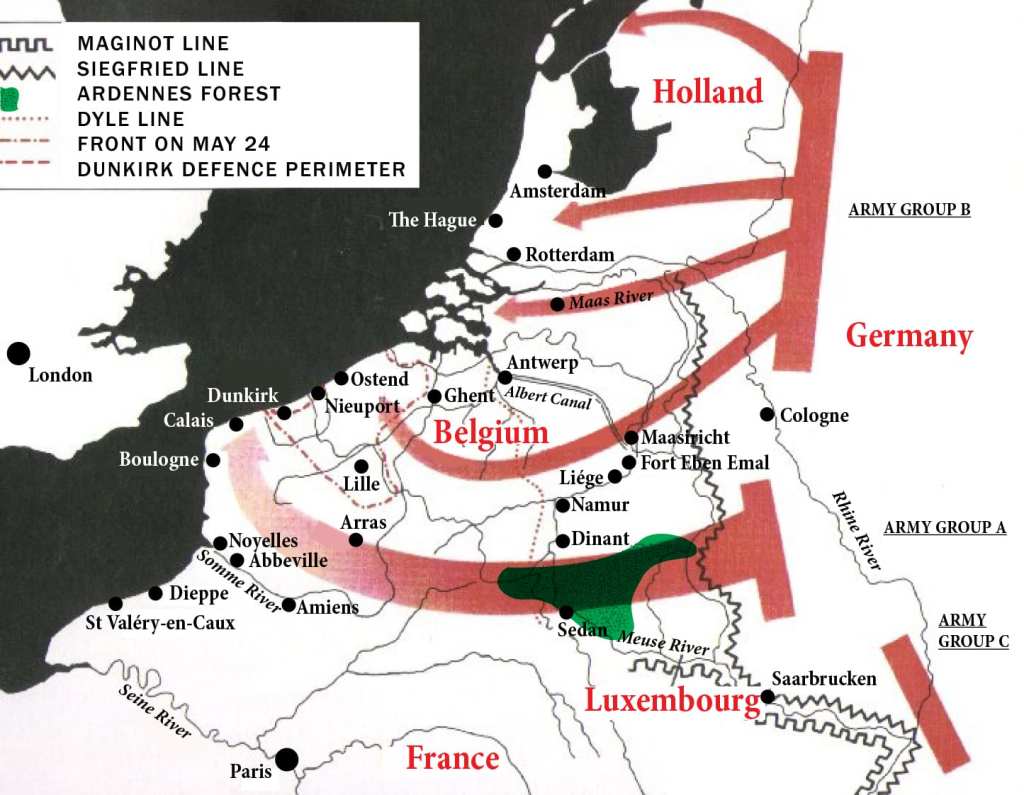
On May 26, 1940, Great Britain commenced Operation Dynamo, the evacuation of over 300,000 British, French, and Belgian soldiers from the beaches and harbor of the coastal French town of Dunkirk. These soldiers were isolated and trapped by the German Army during the six week battle for France. Facing what newly appointed Prime Minister Churchill called a “colossal military disaster,” the Royal Navy along with every private small craft that could be pressed into service safely evacuated these forces back to Great Britain over the course of the next nine days and under the constant threat of German Luftwaffe. 

At the outset, Churchill and the rest of British command expected that the evacuation from Dunkirk could rescue only around 45,000 men at most. But the success of Operation Dynamo exceeded all expectations. On May 29, more than 47,000 British troops were returned; more than 53,000, including the first French troops, made it out on May 30. By the time the evacuations ended some 198,000 British and 140,000 French troops would manage to get off the beaches at Dunkirk—a total of some 338,000 men. 

Germany had hoped defeat at Dunkirk would lead Britain to negotiate a speedy exit from the conflict. Instead, the “Miracle at Dunkirk” became a rallying cry for the duration of the war, and an iconic symbol of the British spirit. It would also ensure that Great Britain would survive to fight Nazi Germany another day. 

On June 4, Churchill addressed a proud British nation advising caution not to assign the attributes of a victory to this rescue. He warned in a speech that “Wars are not won by evacuations.” In the same speech, however, he delivered a stirring statement of the British resolve that would serve the nation well over the next five grueling years of warfare, “We] shall not flag or fail. We shall go on to the end, we shall fight in France, we shall fight on the seas and oceans, we shall fight with growing confidence and growing strength in the air, we shall defend our Island, whatever the cost may be, we shall fight on the beaches, we shall fight on the landing grounds, we shall fight in the fields and in the streets, we shall fight in the hills; we shall never surrender.”

Two months later, the Nazis would begin the Battle of Britain, the first major military campaign fought entirely by air forces. Isolated and alone following France’s surrender, Great Britain would continue to bravely resist Nazi Germany on its own until Hitler ordered the invasion of the Soviet Union on June 22, 1941.