The Arc of History: A Blog

End of an Error: The Soviet Withdrawal from Afghanistan

On February 15, 1989, Lt. General Boris Gromov, Commander of the Soviet 40th Army, crossed over the Amu Darya River from Afghanistan into the Uzbekistan completing the Soviet withdrawal from Afghanistan. The almost ten year Soviet occupation, which began on December 24, 1979 would leave scars on both countries. For the Soviet Union, Afghanistan was a quagmire; one that undermined public faith and confidence in the Soviet system and leadership, hastened an end to the Cold War, and eventually brought about the dissolution of the USSR. For Afghanistan, it was a traumatic event that plunged the country into almost 40 years of constant war and state failure. For the United States, the Soviet invasion of Afghanistan would put in motion a chain of events that would ultimately lead to the tragedy of September 11, 2001.
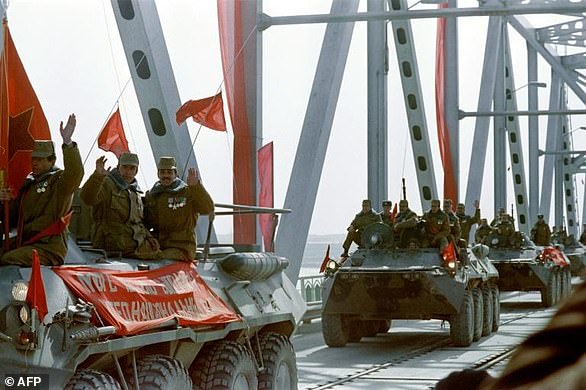
Soviet troops returning home from Afghanistan in February 1989 across the Friendship Bridge


Prelude to a Catastrophe

The Soviet decision to invade Afghanistan was not one taken lightly by the Kremlin and was made only after months of debate and discussion. It was the predictable, if not unavoidable result of growing Soviet involvement in Afghan internal affairs over several years and powerful security and ideological concerns. 

The Soviet Union enjoyed a long history of friendly cooperation with Afghanistan under King Mohammed Zahir Shah. It was the first country to recognize Afghanistan’s independence in 1919 and became Afghanistan’s main source of military and economic assistance in the post-World War II period. From 1956-77, the Soviet Union and its allies trained over 4,000 Afghan officers and delivered more than $600 million worth of military supplies. In the same period, the USSR also gave Afghanistan grants or credit lines totaling more than $1.3 billion, a sum which was exceeded in the Middle East and South Asia areas only by grants given to Egypt, India and Syria. Nonetheless, for nearly two decades the KGB also secretly funded and nurtured communist leadership networks at Kabul University and in the Afghan Army, training and indoctrinating 3,725 military personnel in the Soviet Union.

In 1973, the king was overthrown in a bloody coup orchestrated by his cousin Mohammad Daud Khan. Daud’s reign, however, would prove short-lived. In April 1978, he was ousted in a coup led by the Afghan Communists and elements of the military, which proceeded to proclaim a new Marxist Leninist state, the Peoples’ Democratic Republic of Afghanistan (PDRA). The Saur Revolution, as it became known, would usher in a period of prolonged upheaval and instability that ultimately dragged Moscow deeper and deeper into the proverbial quagmire.

The USSR welcomed the establishment of the PDRA even though it enjoyed cooperative relations with Afghanistan’s previous leaders. Nevertheless, the Peoples’ Democratic Party of Afghanistan (PDPA)—the Communists—was sharply divided into two rival factions, which did not bode well for the stability of the new Peoples’ Republic. The first faction, the Khalq, was led by Nur Muhammad Taraki and Hafizullah Amin and consisted largely of ethnic Pashtuns from the poorer cross-sections of Afghanistan.  As committed Marxist-Leninists, Taraki and Amin sought to transform Afghanistan from a feudal nation into a Communist one as rapidly as possible. The other faction, the Parcham, led by Babrak Karmal, tended to be made up of Afghanistan’s ethnic minorities. The Parcham called for a gentler approach, arguing that Afghanistan was simply not ready for Communism and would not be for some time. Many Soviet diplomats and advisers concurred with the Parcham’s more measured approach, worried that an aggressive implementation of Communist reforms would provoke a rebellion within Afghanistan’s deeply conservative and Muslim society.
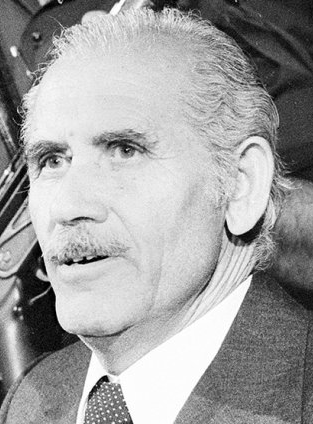
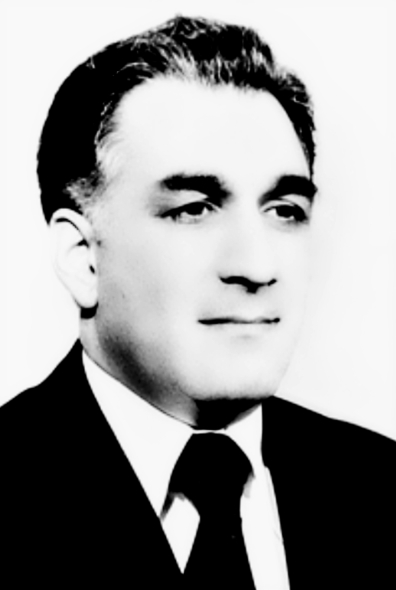
Immediately after coming to power, the Khalqis began to purge the Parchami faction, and instituted a Soviet-style program of modernizing reforms, including land reform and female literacy campaigns, which provoked the violent, conservative, Muslim backlash that Moscow predicted. On March, 15, 1979, a violent anti-government uprising occurred in the city of Herat.  The government dispatched the 17th Army Division to quell the uprising but the unit mutinied and joined the uprising. Desperate, the Afghan government appealed to the Kremlin to intervene and restore order, as stipulated in the December 1978 Soviet-Friendship Treaty. The Afghan request prompted an emergency meeting of the Soviet Politburo two days later to consider a response. In accordance with the Brezhnev Doctrine, which proclaimed the irreversibility of Communist regimes, Soviet Foreign Minister Gromyko argued that “under no circumstances may [the USSR] lose Afghanistan.” However, there was little appetite amongst the Soviet military for an intervention at time and the appeal was rebuffed. Soviet Premier Alexei Kosygin responded to the Afghans, “We carefully studied all aspects of this action and came to the conclusion that if our troops were introduced, the situation in your country would not only not improve, but would worsen. One cannot deny that our troops would have to fight not only with foreign aggressors, but also with a certain number of your people. And people do not forgive such things.” 

The Afghan government eventually suppressed the uprising in Herat without major Soviet assistance. However the death toll was a staggering 25,000 dead, which included 20 Soviet advisers caught up in the unrest. The revolt served as an alarm bell for Moscow and a reminder of the fragility of the Afghan Communist government. After Herat, the Soviets were convinced that neither Taraki nor Amin could control the deteriorating situation alone. Veteran diplomat Vasily Safronchuk was sent to Kabul to persuade Taraki and Amin to ease the pace of reform and broaden support for the regime by bringing non-Communists into the government. However, his advice fell on deaf ears in Kabul. In August, Moscow sent General Ivan Pavlovsky, the commander of the 1968 invasion of Czechoslovakia, to Afghanistan, ostensibly to provide recommendations on how to counter the growing insurgency but also to assess the situation for a possible military intervention. At the end of August, the Soviets also increased their on-ground advisors to 5000 and delivered large quantities of tanks and helicopter gunships to Bagram and Shindand airbases.

From Hell No to All In

What follows next is the story of how the Soviet leadership went from a categorical refusal to send military forces to suppress the the revolt in Herat and bolster their Afghan Marxist-Leninist clients, to the deployment of 80,000 troops to Afghanistan, nine months later to stabilize the country. Unlike the earlier decision in March, which was made by the entire fifteen-member Politburo, the decision to intervene militarily in December was driven ultimately by four men: Foreign Minister Gromyko, KGB Director Yuri Andropov, Defense Minister Dmitri Ustinov, and chief party ideologue Mikhail Suslov.

By the fall of 1979, the situation in Afghanistan had gone from bad to worse. The Afghan communists continued to ram through unpopular reforms at breakneck speed that only increased armed opposition in the countryside. At the same time, rivalries inside the Communist government only further destabilized the situation. Amin, who had tenuously co-existed with Taraki, used the Herat uprising to consolidate his power and lay the groundwork to eliminate his rival. At the end of March, Amin became Prime Minister. In July he assumed the duties of Defense Minister as well and began to purge the cabinet of Taraki loyalists. The Soviets were closely monitoring Amin’s accumulation of power with grave concern. Moscow had come to view Amin as the main obstacle to peace and stability in Afghanistan and clearly preferred Taraki. In early September, Taraki was summoned to the Kremlin and given explicit direction from Soviet leader Leonid Brezhnev to get rid of Amin.

Left: Soviet Foreign Minister Andrei Gromyko; Center: Afghan President Nur Muhammad Taraki; Soviet General Secretary Leonid Brezhnev. The Kremlin was angered that Amin had not only toppled Taraki who had its backing, but had him killed.

On September 14, Taraki invited Amin, to a meeting at the presidential palace. It was supposed to be an ambush on Amin, orchestrated by Taraki’s Soviet advisers, but Amin was tipped off about the trap as he arrived. After a short but bloody shoot out, Amin escaped unharmed but more ruthless from the experience. As acting Defense Minister, Amin returned later that day with an Army contingent and placed Taraki under house arrest. He subsequently had Taraki executed on October 9, much to the shock of the Soviet leadership. News of Taraki’s execution deeply dismayed Brezhnev, who had personally assured the Afghan leader of his support and protection. “What a scum this Amin is,” Brezhnev is alleged to have remarked. Brezhnev’s strong reaction and sense of personal insult gave strong impetus to continuing discussions about the prospect of removing Amin.

Amin’s power grab only exacerbated Soviet apprehensions that the situation in Afghanistan was spiraling out of control. Taraki’s execution demonstrated a complete disregard for Moscow’s wishes and showed that he was unresponsive to Soviet counsel. Resistance to the government was also growing more violent as Islamic opposition fighters, the Mujahideen, declared a jihad against the Communists. Pakistani military assistance to the Mujahideen only further destabilized the situation. The Soviets feared that the government in Kabul would collapse dealing a crushing blow to their prestige and give rise to an anti-Soviet, Islamist Afghanistan on their southern border. However, one factor above all may have tilted the Soviet decision-making calculus toward a full scale military intervention to oust Amin and stabilize the situation.

The Afghan Mujahideen

As Amin showed a greater willingness to buck the Soviets while he consolidated power, he also began to reach out to the United States about improving relations. Amin almost certainly knew that his arrest and subsequent execution of Taraki were not well received in Moscow and that he probably needed a hedge against over dependence on the Soviet Union. On October 27, 1979, Amin met with acting American Chargé d’Affaires Archer K. Blood to discuss a possible rapprochement. Over the course of a forty minute meeting, Amin stressed his personal commitment to improving U.S.-Afghan relations, expressing his deep affection for the U.S. which he acquired during his time spent in the country as a student. He denied that Afghanistan was a Soviet puppet and declared that he could never sacrifice Afghan independence to any foreign demands, including from the Soviets. Blood came away from the meeting impressed by Amin and optimistic that he was truly interested in improving bilateral relations. Nevertheless, the United States still viewed Amin as a dangerous tyrant and Blood urged caution going forward citing a list of contentious issue in the relationship that would need to be addressed first. Amin was still held at least partly responsible for the murder of U.S. Ambassador Adolf Dubbs who was abducted at gunpoint in the middle of Kabul and killed in a botched rescue effort.

News of the meeting between Amin and Blood was met with alarm in Moscow. The Soviets had increasingly viewed Amin as a danger to stability inside Afghanistan.  They now worried that he was seeking a Geo-political realignment, much like Egyptian President Anwar Sadat’s expulsion of the Soviet military in 1972, with equally negative repercussions for Moscow’s regional influence and security interests. Two days after the meeting, Soviet Foreign Minister Gromyko, KGB Director Yuri Andropov, and Defense Minister Dmitri Ustinov sent a report to the Central Committee warning that there were disturbing signs that the new Afghan leadership intended to conduct a “more balanced policy” in relation to the Western powers. They further speculated that the United States was warming to the possibility of an improvement in relations with Kabul and a whole sale Afghan Geo-political realignment based on their contacts with Amin. The KGB concluded that the CIA had begun to work with Amin to manipulate Afghanistan’s relationship with the Soviet Union. KGB officers on the ground in Afghanistan then convinced their superiors in Moscow that drastic measures were needed to save the Afghan revolution. Amin needed to be eliminated or at a minimum removed from office.
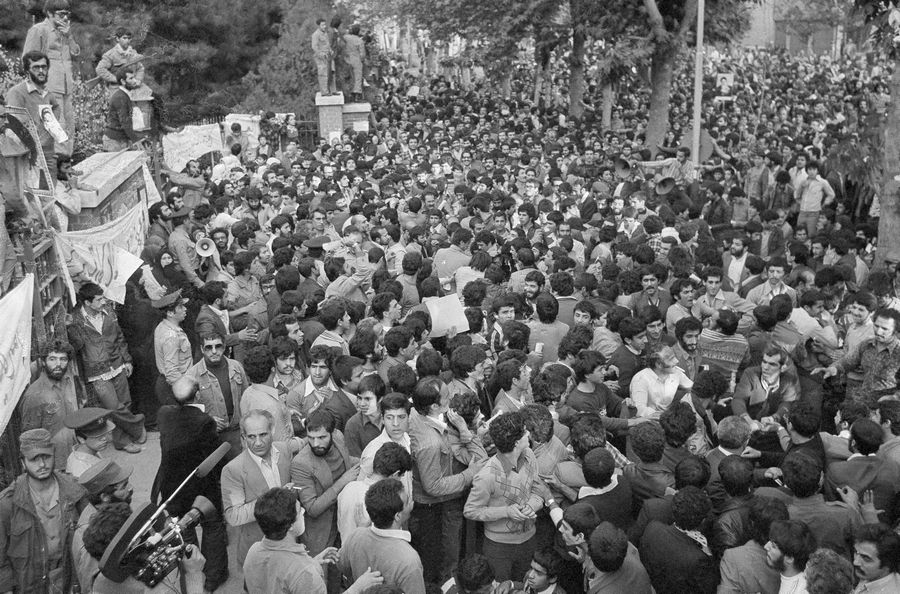
A mob of Iranian students take over the U.S. Embassy in Tehran in November 1979.

In the collective mind of the Soviet security apparatus, Afghanistan was a natural target for the U.S.  In January 1979, the Iranian revolution had forced the abdication of long-time American ally Shah Mohammad Reza Pahlavi.  The advent of a hostile regime led by Ayatollah Ruhollah Khomeini was a devastating blow to U.S. power and influence in the region and its prestige around the world. Moscow worried that Washington would try to recoup some of its lost influence through Afghanistan and more importantly find a replacement location for the highly secret intelligence collection sites it had maintained in Iran to track Soviet military activities.

At the same time, the Mujahideen insurgency in the countryside continued to grow with the Afghan army repeatedly proving itself ineffective, despite the increased Soviet involvement in guiding Afghan combat operations and logistics. Mutinies were spreading throughout the Army. In mid-October, the entire 7th Infantry Division, which was led by Taraki loyalists, revolted and launched an attack on the capital. After several days of heavy fighting, the mutiny was finally suppressed but it was clear the regime was divided and struggling to defend itself. The government in Kabul now controlled at most only 25 percent of the country.

By the end of November 1979, the prevailing view amongst the Soviet leadership was that Amin needed to be replaced because of his disloyalty and ineffectiveness. Soviet officials were making it known on the diplomatic circuit that, even though the USSR continued to provide weapons, equipment and advisors to the existing regime, Moscow was trying to come up with an alternative leader. On December 4, Andropov wrote Brezhnev with a solution. He had been contacted by exiled Afghan communists, including former Parcham faction head Babrak Karmal, who had “worked out a plan for opposing Amin and for creating ‘new’ party and state organs” and requested assistance. With Karmal now waiting in the wings, the question now became how and when to get rid of Amin.

On December 8,  Brezhnev hosted a small group meeting of key Politburo members— KGB Director Yuri Andropov, Defense Minister Dmitri Ustinov, Foreign Minister Andrei Gromyko, and chief Party ideologist Mikhail Suslov— to review the situation in Afghanistan and determine next steps. These four men had come to dominate Soviet foreign policy especially as Brezhnev grew more ill and incapacitated. Leading the discussion, Andropov expressed reservations about Amin’s loyalty, his contacts with the United States, and his inability to curb the growing insurgency and anti-Soviet sentiment. Ustinov followed next warning that the deteriorating situation threatened the security of the Soviet Union’s southern border. Moreover, an Afghanistan more closely aligned with the United States could become a forward operating base for U.S. military forces including Pershing II missiles. The group tentatively agreed to direct the KGB to remove Amin and replace him with the Babrak Karmal. They also agree to send an undetermined number of Soviet troops to Afghanistan for the same purpose. These decisions were perfunctorily ratified by the larger Politburo on December 12, with Prime Minister Alexei Kosygin, who consistently opposed the idea of an invasion, noticeably absent.
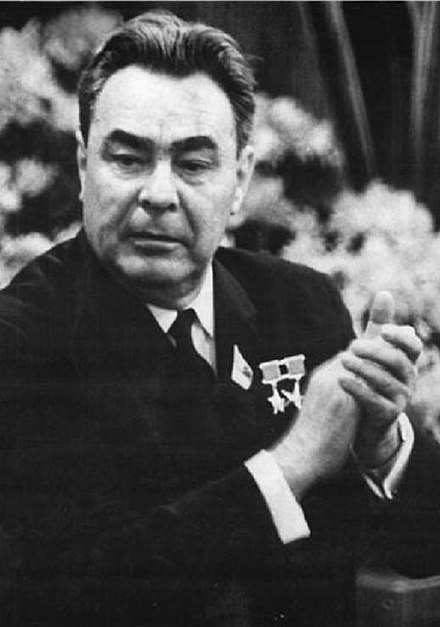
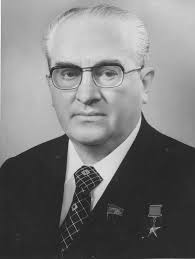
Defense Minister Ustinov informed Chief of the General Staff, Nikolai Ogarkov on December 10 that a decision had been made to send Soviet troops to Afghanistan and directed him to plan for a 70,000-80,000 man deployment. The General Staff had been planning for such a contingency since the Herat uprising and had been surreptitiously deploying military forces to Afghanistan and along its borders for weeks and months. Ogarkov and his deputy, General of the Army Sergei Akhromeev, however, were much less enthusiastic about the mission than Ustinov. Ogarkov argued that 80,000 troops were not enough for the mission. The 1968 invasion of Czechoslovakia, a country with more favorable terrain, required 500,000 troops. He further warned that the Afghan people never tolerated foreign intervention and that they risked turning the entire Muslim world against the Soviet Union. Ustinov overruled Ogarkov’s concerns sternly reminding him that his job was not to teach the Politburo its business but to carry out its orders.

On December 13, the KGB attempted to assassinate Amin by having one of his Soviet cooks slip poison into his favorite drink, Coca-Cola. However, the carbonation of the soda rendered the poison harmless allowing Amin to escape relatively unharmed. A couple of weeks later, the KGB attempted to poison his food again but the Soviet Embassy in Afghanistan, unaware of the plot, sent doctors to save him. The failure of the KGB assassination attempts left Moscow with few options other than military force to eliminate Amin.

The Die is Cast

Late in the evening of 24 December, units of the 103rd and 105th Airborne Divisions landed at Kabul airport and the military airfield at Bagram in the initial phase of what would become the Soviet invasion of Afghanistan. Over the next several days, waves of AN-22 and AN-24 military transport aircraft surged into Kabul and points South to include Shindad and Kandahar, carrying additional military forces, supplies and equipment. Engineers laid floating pontoon bridges across the Amu Darya near Termez and on Christmas Day Soviet tanks began to roll into Afghanistan. For months, Amin had been pressing Moscow to deploy additional military forces to help the Afghan Army defeat the Mujahideen insurgents in the countryside. So when these military forces suddenly began to arrive on Christmas Eve there was little immediate alarm or suspicion.

By the 27th the Soviets had assembled sufficient forces to control Kabul and began fanning out into the city, securing key communication nodes and the main ministries. On the evening of December 27, 700 special operators from the KGB Grom and Zenit groups, the 345th Independent Guards Airborne Regiment, and the 154th Separate Spetsnasz Detachment dressed in Afghan Amy uniforms attacked the Tajberg Palace. After about an hour of heavy fighting against Afghan National Army forces and the Presidential Guard inside and around the palace the battle ended with Amin’s body in a pool of blood. The next morning Radio Kabul announced, in Russian, that Amin had been tried and shot as an enemy of the people. By the end of December Babrak Karmal would be installed as President of Afghanistan while 80,000 Soviet troops occupied the country.

The Quagmire Begins

The Soviet invasion was intended to be a short and straight forward operation, similar to Hungary in 1956 and Czechoslovakia in 1968. Enter with overwhelming force, eliminate the problem individual or individuals and declare victory. And that is what Brezhnev seemed to have in mind. By the end of January 1980 Brezhnev considered the Afghanistan matter closed and ordered Soviet military forces home. However Andropov, Ustinov and Gromyko argued that withdrawing would be a serious mistake. Amin may have been eliminated but Karmal would need time to consolidate his power and stabilize the country. Soviet military forces should remain until the Afghan government was strengthened, they argued in a report to Brezhnev. Moreover, pulling out too soon would prompt the Afghans and others to question the Soviet Union’s reliability as a partner.

Mujahideen fighters use a “Stinger” missile to take down a Soviet helicopter gunship

The rest of the story as they say is history. Amin’s death removed a major complicating factor for Moscow in Afghanistan but did little to curb the growing insurgency. In fact, the Soviet invasion only served to strengthen and expand the ranks of the Mujahideen resistance. Over the next nine years, the Soviets would find themselves bogged down in a guerrilla war against a determined and resilient Islamic insurgency, aided and abetted by covert military assistance from the United States. In the end Ogarkov’s predictions proved tragically correct. The Afghan people refused to accept a foreign occupation and the invasion only turned a large part of the Muslim world against the Soviet Union.

Soviet President And Secretary General of the Communist Party of the Soviet Union, Mikhail S. Gorbachev

By the mid-1980s the Soviet public began to sour on what came to be seen as a never ending conflict. In March 1985, a new generation of Soviet leader, Mikhail Gorbachev, took power determined to revive the stagnating Soviet economy and to introduce new thinking into Soviet foreign policy. Gorbachev worried about the conflict in Afghanistan. At a Politburo meeting on October 17, 1985, he read letters from Soviet citizens expressing growing dissatisfaction with the war in Afghanistan—including “mothers’ grief over the dead and the crippled” and “heart-wrenching descriptions of funerals.” Gorbachev told the Politburo “If we don’t change approaches [to evacuate Afghanistan], we will be fighting there for another 20 or 30 years.” On April 14, 1988, the Soviets signed the Geneva Accords in which they promised to withdraw from Afghanistan. Less than a year later, the last Red Army units crossed the Termez Bridge into the Soviet Union, ending what Gorbachev had referred to as a “bleeding wound.”

Muscovites carry the portraits of young Soviet soldiers who fell in Afghanistan. The Soviets withdrew from the country 30 years ago.

As Marx argued in his essay, The Eighteenth Brumaire of Louis Napoleon, history repeats itself, first time as tragedy, second time as farce. The Soviet Union invaded Afghanistan seeking to eliminate one man, Hafizullah Amin, and tried to impose a foreign ideology, communism, on a largely tribal based society. It ultimately failed. The United States invaded Afghanistan, largely to eliminate one man, Osama bin Laden and also tried to impose a foreign ideology, democracy, on a tribal based society. After almost 20 years it’s not clear that the United States has been anymore successful.
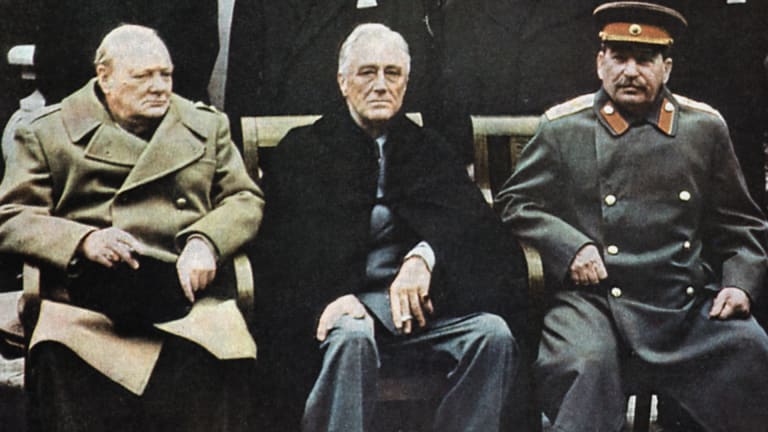
Yalta, February 1945: The Beginning of the Cold War

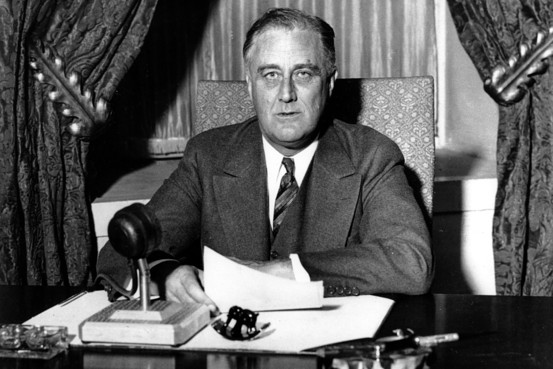
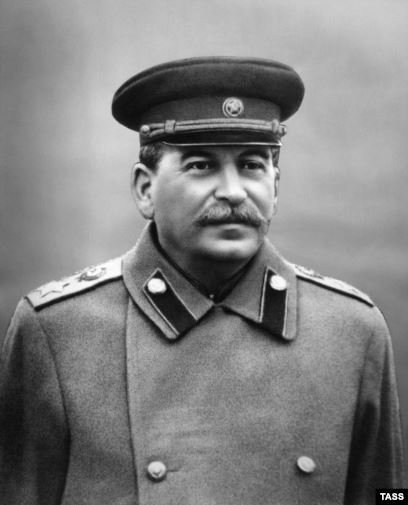
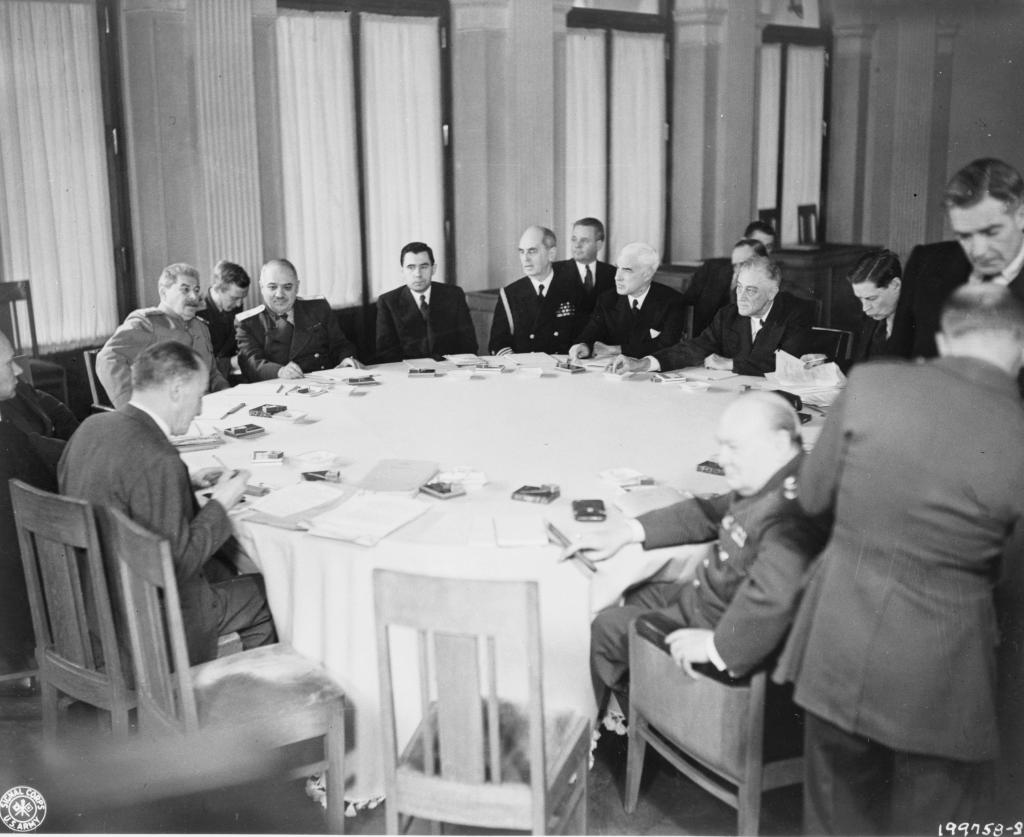
On February 4, 1945, United States President Franklin Roosevelt, British Prime Minister Winston Churchill, and Soviet leader Josef Stalin gathered at the Soviet seaside resort of Yalta to hammer out a post-war settlement for Europe and address other pending issues including the war in the Pacific. Code named ARGONAUT, the conference spanned eight days and was the final time the “Big Three” would meet together. Roosevelt would die from a brain hemorrhage in April 1945 while a war weary British public would vote Churchill out of office in the July 1945 elections. The Conference also marked the high-tide of allied cooperation and a gradual unraveling of the wartime alliance soon followed as a clash of ideologies and competing post-war political interests gained preeminence. In the decades, that followed, the word “Yalta,” much like “Munich” would become synonymous with appeasement and capitulation.

The Beginning of the End

By September 1944, if not sooner, it had become increasingly apparent that it was no longer a case of if Nazi Germany would be defeated but when.  The Soviet victory at Stalingrad in February 1943 had turned the tide of the war blunting any further German advances Eastward. The vaunted Nazi Wehrmacht would spend the remainder of the war on the defensive. A powerful Soviet counteroffensive, Operation Bagration, forced the Nazis to fall back westward and the Red Army was on the outskirts of Warsaw by the beginning of August 1944. In the West, the June amphibious landings at Normandy established a US, British, and Canadian foothold in France and by the end of August Paris would be liberated and the combined US, British, and Canadian armies poised to enter Germany.

In the Pacific, the United States continued to make steady and almost inevitable progress against Japan but at great cost. By the end of June 1944, U.S. Marines had taken the strategically important island of Saipan but at the cost of over 13,000 casualties. The capture of Saipan would allow the United States to launch B-29 bomber strikes on the Japanese mainland but the ferocity of the Japanese resistance, 29,000 killed in action including 5,000 suicide attacks, served as a harbinger of what a U.S. invasion of the Japanese homeland might encounter. Estimates of the time suggested that such an operation could last a year and result in upwards of one million U.S. casualties.

With the defeat of Nazi Germany growing more likely, President Roosevelt called for a conference of the Big Three in November 1944 to address numerous post-war issues and to enlist Soviet assistance in the war against Japan. The previous year, Roosevelt, Churchill, and Stalin met in Tehran where the United States and Great Britain committed to opening a long-awaited second front in France and Stalin agreed in principle to declare war against Japan after Nazi Germany’s defeat. After much debate, Roosevelt and Churchill agreed to meet Stalin in early February 1945 at Yalta on the Crimean Peninsula in the Soviet Union, despite warnings from Roosevelt’s physicians that such a long and onerous trip could kill the weakening president.

The Conference Begins

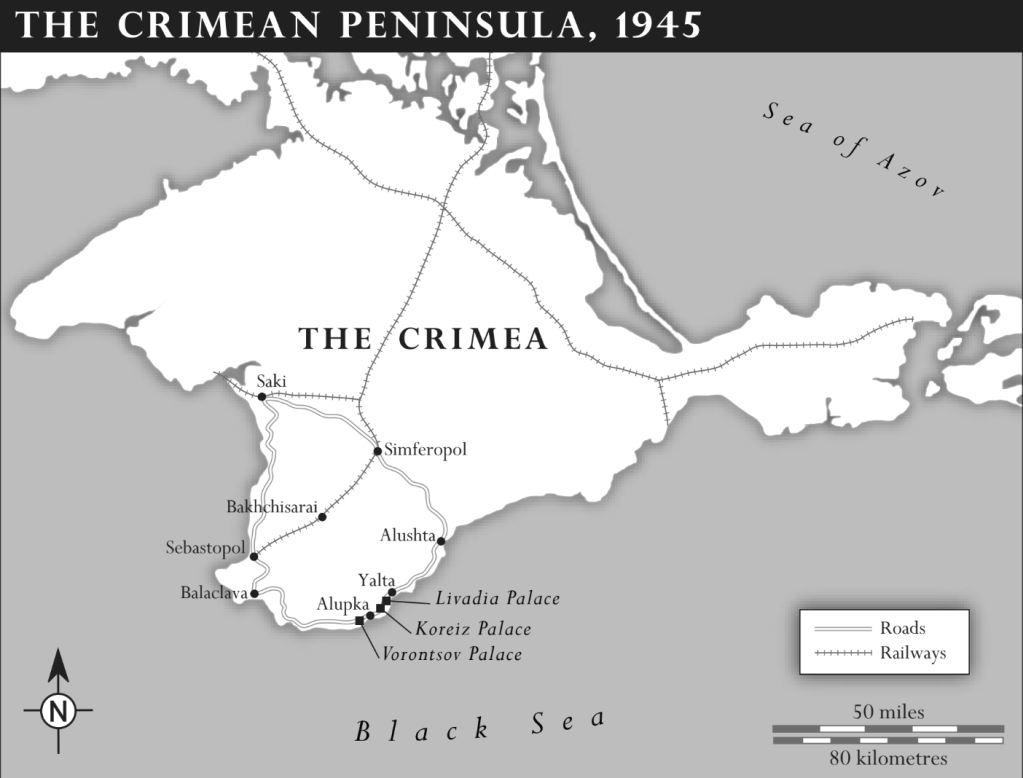
Located near the tip of the Crimean Peninsula in the Ukrainian Soviet Socialist Republic, the conference was held at the Livadia Palace overlooking the Black Sea. Once the summer retreat of Czar Nicholas II, it would become ground zero for negotiations that would decide the future of post-war Europe.  

All three leaders arrived at the conference with competing agendas. For Roosevelt, securing Soviet entrance into the war against Japan was a top priority. Roosevelt worried U.S. casualties at Saipan and increasing Japanese suicide attacks in the Pacific were signs of things to come should the US attempt an invasion of the Japanese homeland. These apprehensions were reinforced later that month at the battle of Iwo Jima, where the US would suffer another 25,000 casualties. Roosevelt also wanted Stalin’s support for his idea of a United Nations organization that would maintain peace and stability and prevent another world war. 

Stalin’s goals were more cynical and single minded. Beyond ensuring that Germany would never rise again to threaten the Soviet Union and securing an agreement on reparations, he had two main aims. He wanted Allied recognition of the territory that he seized from Poland and Romania in 1940 as part of the Molotov-Von-Ribbentrop Pact and of a Soviet sphere of influence over Eastern Europe. As Stalin told one of his Yugoslav communist allies, “This war is not as in the past; whoever occupies a territory also imposes on it his own social system. Everyone imposes his own system as far as his army can reach.”

Churchill’s aims for the conference centered primarily on preserving Britain’s colonial empire, preventing Soviet domination of Europe and ensuring that Germany would never again pose a threat to European peace and stability. Churchill recognized early on, much like Stalin, that the further the Red Army advanced West, the greater the influence the Soviet Union would wield over post-war Europe. He also worried that Roosevelt, desperate for a Soviet declaration of war on Japan, would be too eager to placate Stalin with other concessions in Europe. Churchill hoped to create a bulwark of strong democratic-capitalist states in Europe to contain the spread of Soviet communism and ensure that Britain was not left alone to face the Soviets in Europe. As such, Churchill would lobby hard for France to be given a position on the Allied Control Commission and a zone of German occupation against Stalin’s objections. He also would strongly oppose Soviet demands for reparations from Germany, mindful of the failures of the Versailles Treaty which had left Germany embittered, economically destitute, politically susceptible to extremism, and resentful of the international community.

The Post-War Order Takes Shape

Over the course of seven days the Big Three would hammer out a number of agreements that would serve as the framework for a post-war peace. The allies agreed that once Germany was defeated, it would be divided into four zones of occupation; the US, Great Britain, the USSR, and France would each control a zone. The German capital of Berlin was also divided in similar fashion. Initially, Stalin balked at giving France responsibility for a zone of occupation because of its surrender in 1940 but eventually relented after it was agreed that a French zone would be carved out of the US and British zones. On the issue of reparations, Stalin demanded $20 billion in reparations from Germany, half of this sum to be destined for the Soviet Union. Churchill rejected this amount while Roosevelt accepted the sum as a basis for future discussion. The three leaders agreed to the creation of a commission to study the issue further. 

The second day of the conference

On other issues, Roosevelt achieved his primary objective of securing Stalin’s promise to enter the war against Japan three months after Germany’s defeat. In return, Roosevelt acceded to Stalin’s demands including the annexation of South Sakhalin Island and the Kurile Islands and several other concessions that would allow Moscow a sphere of influence in Manchuria following Japan’s surrender.  Stalin also accepted Roosevelt’s plan for a United Nations organization but only after the three leaders agreed that all permanent members of the organization’s Security Council would hold veto power.

The Intractable Problem of Poland

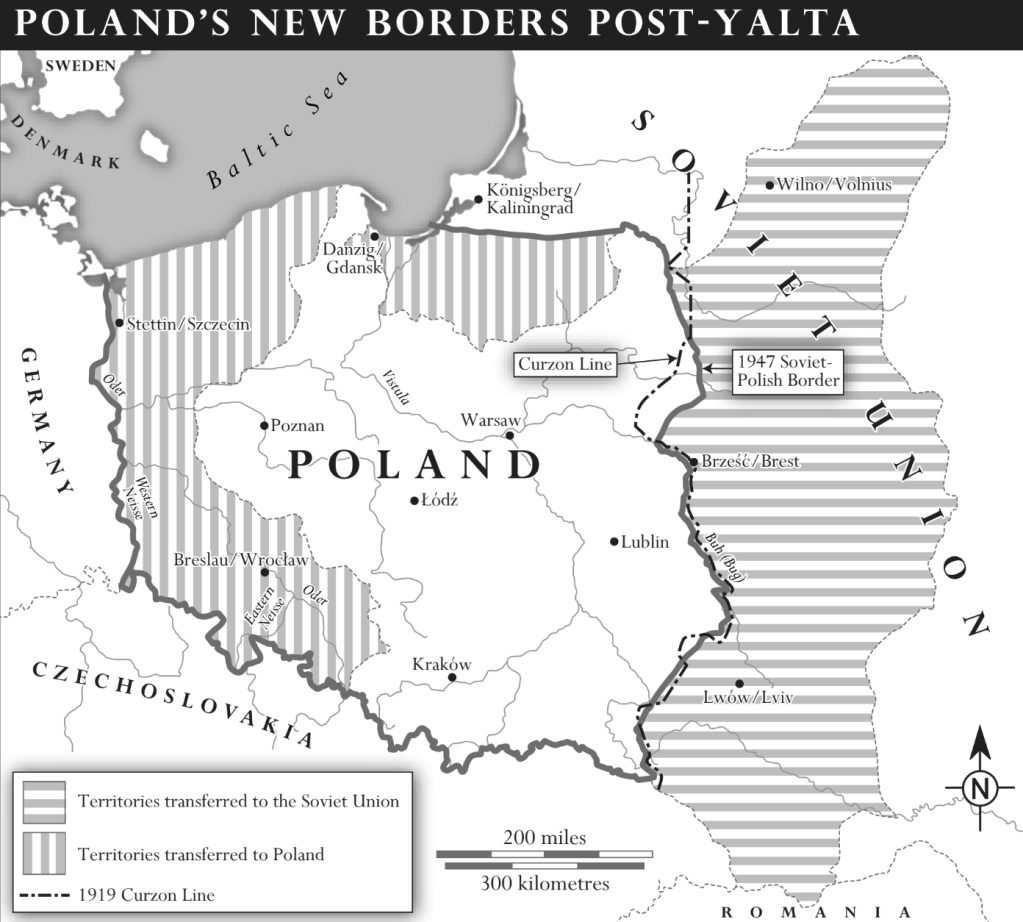
No other issue would prove more acrimonious and contribute more to the unraveling of the war time alliance than the question of Poland. Churchill first broached the subject on the third day of the conference, February 6, and it soon became evident that whatever flexibility and goodwill that helped to resolve the earlier issues had disappeared.  At its core, the Polish problem was about borders and what kind of government Poland would have after the war. More specifically, would Poland become a free and democratic state with its pre-war borders intact or a truncated, Soviet controlled puppet, under communist rule? The argument over Poland’s border’s was largely moot. Roosevelt and Churchill, in principal, had conceded to Stalin’s demands at the 1943 Tehran Conference. However, on the composition of Poland’s post-war government Roosevelt and Churchill battled for Poland’s right to self-determination employing all kinds of stratagems and arguments but in the end they secured only paper promises that they lacked the means to enforce.

All three leaders had a vested interest in the outcome of the Polish question. However, where Poland ranked on their hierarchy of concerns and the leverage they could wield to bring about a favorable outcome varied considerably. The Soviets arguably had the most at stake in Poland and the fact that the Red Army was stretched across Polish territory gave Stalin the most leverage. For Stalin, Polish self determination was incompatible with Soviet security. “Throughout history, Poland has been the corridor through which the enemy has passed into Russia. Poland is a question of life and death for Russia,” he argued. In Stalin’s mind there could be no security without control over Poland and the rest of Eastern Europe and control meant the establishment of Communist-dominated regimes beholden to Moscow.

It was clear from early on that Stalin had designs on Poland and that almost all Soviet actions regarding Poland were aimed at establishing their control and eliminating any opposition. In 1940, Stalin secretly executed over 22,000 Polish military officers and intelligentsia taken captive during the attack on Poland the previous year, demonstrating his malign intentions toward Poland. In July 1944, the Soviets stood up a pro-Soviet, Polish communist government in Lublin in opposition to the Western recognized London-based Polish government in exile. The next month, the Red Army sat idly by on the outskirts of Warsaw allowing the Nazis to brutally crush an uprising by forces loyal to the Polish government in exile, despite allied pleas to come to their aid. With over 250,000 anti-Communist Poles killed in he uprising there were to few to left to challenge the communists in Lublin. For Stalin, Poland was a closed question. It’s fate was already decided by the advance of the Red Army and there was no need to renegotiate or discuss what had already been won. Moreover, Stalin believed that the Soviet Union was fully justified in unilaterally deciding Poland’s fate because the United States and Britain had done so with France and Italy earlier with no input from Moscow.

History of the Warsaw Uprising

For Churchill, the question of Poland’s post-war government was of both symbolic and practical importance. It was the Nazi invasion of Poland on September 1, 1939 that was the casus belli for both Britain and France to declare war on Germany. Britain went to war so “that Poland should be free and sovereign,” Churchill argued. Britain’s only interest, he added was “one of honor because Britain drew the sword for Poland against Hitler’s brutal attack.” Having already consented to Stalin’s Polish land grab, Churchill insisted on guarantees that the Poles themselves would be allowed to determine the composition of their government. “Poland must be mistress in her own house and captain of her own soul,” he declared. This required a dissolution of the pro-Soviet Lublin government and new free elections, neither of which Stalin was prepared to accept.

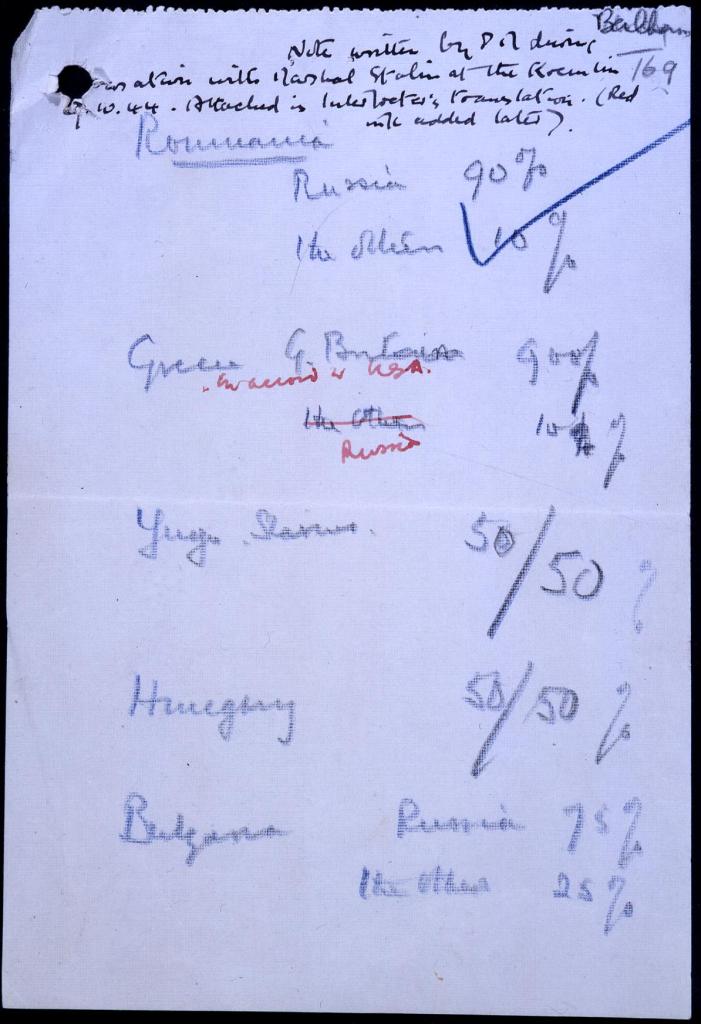
Despite his eloquent and impassioned plea for Polish self-determination, Churchill was a realist. He knew that as long as the Red Army occupied Poland and the rest of Eastern Europe there was little that he or Roosevelt could do to prevent Soviet domination of the region. Churchill had lobbied Roosevelt in 1943 for a military operation in the Balkans instead of the Normandy landings in large part to curb the Red Army’s advance into the region. Unable to persuade Roosevelt, Churchill turned to diplomacy to try and limit the spread of Soviet influence. On October 9, 1944, in Moscow, Churchill and Stalin reached a notorious “spheres of influence” agreement in which the two leaders cynically divided up the Balkans. According to Churchill, he suggested that the Soviets should have 90% influence in Romania and 75% in Bulgaria. Great Britain would control the other 10% and 25% respectively. Conversely, the British would have 90% in Greece (a strategically crucial country for British imperial communications in the Mediterranean Sea). Britain and the Soviet Union would share dominance both in Hungary and Yugoslavia. Churchill wrote this proposal on a piece of paper which he pushed across to Stalin, who ticked it off and passed it back in agreement. This “percentage agreement” was never formalized but it did demonstrate to Stalin that Churchill understood the weak hand he was playing and that he was prepared to be ruthlessly pragmatic about the fate of Eastern Europe.

The original “Percentages Agreement” divvying up spheres of influence in Balkans

Roosevelt shared Churchill’s apprehensions about the Soviet domination of Eastern Europe but he also saw Poland as a no-win situation. The Soviets had the upper hand. They had the advantages of power and proximity and he was reluctant to risk losing their cooperation in the war against Japan or support for his United Nations concept in a clash he was destined to lose. Roosevelt approached the Polish issue very carefully at the conference, avoiding the emotional outbursts that Churchill was sometimes prone to while calibrating his language to avoid alienating Stalin. In his opening remarks on the Polish question, Roosevelt addressed the less thorny issue of Poland’s borders first and suggested Stalin return the city of Lviv to the Poles, claiming such magnanimity would have a salutary effect on further discussions. Stalin was unmoved. That evening, he sent a note to Stalin explaining that the United States could never recognize the Lublin government while implying that how the Soviet Union handled the Polish question would impact cooperation in the post-war period. Roosevelt seemed to hope that the momentum of wartime alliance, and the prospect of a cooperative and amicable post-war relationship would appeal to Stalin as much as it appealed to him. He clearly misjudged Stalin.

Game Over

After almost five days of painstaking argument and debate over Poland, Roosevelt and Churchill finally were forced to acknowledge the inevitable, that there was little they could do short of war to prevent Soviet domination of Eastern Europe. In the end, both men conceded that the Soviet installed Communist government would form the basis of a new provisional government of national unity. They tried to constrain Stalin and gloss over their abandonment of the legitimate Polish government-in-exile in London by insisting that the government be augmented to include representatives from other parties and that free elections to choose a successor government would be held as soon as possible. They also made a last ditch effort to try and assure at least a modicum of freedom for Eastern Europe with the Declaration on Liberated Europe.  Yet, in the end these stratagems all failed to hamstring Stalin because they were all lacked detail, were subject to multiple interpretations, and had no enforcement mechanisms or means to hold him accountable. Roosevelt’s Chief of Staff, Admiral William Leahy put it best, “This [agreement on Poland] is so elastic that the Russians can stretch it all the way from Yalta to Washington without ever technically breaking it,”

Stalin and the Soviet installed Polish Committee of National Liberation

As both Roosevelt and Churchill returned home from the conference, they were each sadly aware of how little they had achieved for Poland but tried to put the best possible spin on things. Both men came under fire from domestic critics for carving up Poland and passively accepting Soviet domination of Eastern Europe as they framed the Polish outcome as the best possible under the circumstances. As one of Roosevelt’s most senior advisors remarked, “it was not a question of what we would let the Russians do, but what we could get the Russians to do.”

The agreements reached at Yalta met with a mixed reception among the small number of experienced Russia hands at the State Department. Charles Bohlen, who helped open the first U.S. embassy in the Soviet Union in 1934, headed the department’s East European Division and acted as Roosevelt’s interpreter at Yalta, felt that the agreements reached were “realistic compromises.” Bohlen believed that while Roosevelt and Churchill had made many concessions on Poland there was still a chance for a genuinely democratic Polish government if the agreements were carried out.

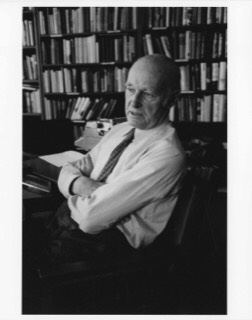
George Kennan

George Kennan, who was the deputy chief of mission in Moscow and who would later become one of the chief architects of the U.S. containment policy toward the Soviet Union, was much less optimistic. In a memorandum written a few months before Yalta, Kennan painted a rather gloomy assessment of future Soviet relations with the West. He thought the idea that Stalin was someone the United States could cut reasonable deals with was absurd and that there was little hope for post-war cooperation with the Soviet Union because of Moscow’s determination to dominate Eastern Europe. 

Kennan would prove more accurate in his assessment. Within a month’s time, Roosevelt and Churchill realized that Stalin would not honour his promise of free elections for Poland. Reports of wholesale deportations and liquidations of opposition Poles by the Soviets began to emerge. Near the end of March, Ambassador to the USSR Averell Harriman, Kennan’s boss, cabled Roosevelt that “we must come clearly to realize that the Soviet program is the establishment of totalitarianism, ending personal liberty and democracy as we know it.” Roosevelt soon began to admit that his view of Stalin had been excessively optimistic and that Stalin was not a man of his word. “Averell is right.”We can’t do business with Stalin,” Roosevelt lamented. “He has broken every one of the promises he made at Yalta.”

A monument in Warsaw commemorating the Soviet deportations

As the realization of Stalin’s duplicity set in, both Roosevelt and Churchill both began to show a new willingness to consider harsher policies toward the Soviet Union. For Roosevelt, it was too late. He would pass away on April 12. Churchill, however, directed the British Chiefs of Staff to develop secret military plans to enforce the Yalta agreements and drive the Soviets out of Poland which would would become known as Operation Unthinkable. After a month of planning the British Chief of Army Staff on June 9, 1945, predictably concluded: “It would be beyond our power to win a quick but limited success and we would be committed to a protracted war against heavy odds.” In fact, theBritish military leadership believed it would take 45 Anglo-American divisions, several divisions of Poles and 100,000 rearmed Germans. In little over a month, Churchill surprisingly would be voted out of office, replaced by a Labour government under Clement Attlee.

The Cold War Begins

A little over a year after Yalta, Churchill delivered his famous speech at a small American college in Missouri where he uttered the famous line, “From Stettin in the Baltic to Trieste in the Adriatic, an iron curtain has descended across the Continent.” Churchill’s speech has traditionally been viewed as the beginning of the Cold War, the titanic 45 year struggle for ideological supremacy between the United States and its democratic allies and the Soviet Union and its communist satellites. However, the seeds were clearly planted at the Yalta conference and germinated with Stalin’s duplicity and Roosevelt and Churchill’s quick realization that he was not a man of his word.

In the years following the conference, both Roosevelt and Churchill’s reputations took a hit as the word Yalta became synonymous with betrayal and abandonment. Critics argue that Roosevelt and Churchill were too quick and willing to appease Stalin. Could things have turned out differently? Probably not.

Sun Tzu wrote that every battle is won before it is even fought and the fate of Poland had been pretty much decided long before Roosevelt and Churchill went to Yalta in February, 1945. The Red Army was in full control of the country. The Polish resistance loyal to the government in exile in London was decimated. The Lublin Committee, now transformed into the Provisional Government, was issuing decrees and seeing them carried out. Its legitimacy continued to be questioned in London and Washington. But it would have taken a great deal more leverage than Roosevelt and Churchill possessed, or could reasonably be expected to apply, in order to alter the fundamental situation. The Russians had the double advantage of proximity and power. An argument can be made that Roosevelt should have set aside his earlier reluctance to engage in post-war negotiations before Germany was defeated and should have raised these issues earlier at the 1943 Tehran Conference. At that point he might have had more leverage over the Soviets. The Red Army would not have been in control of Poland yet and he could have conditioned Lend Lease Aid to Soviet support for free elections. In the end, Roosevelt was not going to jeopardize the war time alliance for post war issues when the outcome of the war was still somewhat in doubt. Moreover, it is far from certain that any threats short of military force would have deterred Stalin.

.


Stalingrad: Turning Point in the East

On February 2, 1943, the German 6th Army surrendered at the battle of Stalingrad bringing an end to the five-month long battle that would ultimately prove to be the turning point of the war. The Wehrmacht would advance no further east and after Stalingrad would find itself on the defensive all the way up to the fall of Berlin in May 1945. Germany’s defeat shattered its military reputation for invincibility and dealt a devastating blow to German morale. Conversely, victory at Stalingrad bolstered the morale of the Red Army which had been on its heels for the better part of almost two years as well as confidence in the Soviet leadership. More Soviet soldiers died in this five-month contest than Americans died in the entire war.

Hitler’s June 21, 1941 invasion of the Soviet Union, codenamed Operation Barbarossa, came as a shock to Soviet leader Josef Stalin, in particular the lightening like advance of the Wehrmacht as it drove deep into Soviet territory encircling entire army groups and major cities that were ill-prepared for the Nazi attack. Stalin had been warned of an expected German attack on the Soviet Union but refused to believe the information. 

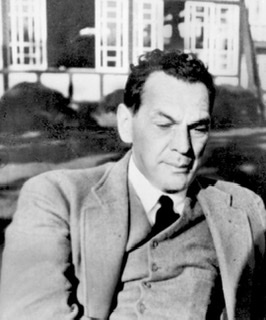
Stalin’s Spy: Richard Sorge

On May 12, 1941, Richard Sorge, a Soviet military intelligence operative working undercover in Tokyo learned from his sources inside the German embassy that 170 German divisions would attack all across the Soviet frontier on June 20. He relayed the information back to Moscow but Stalin refused to believe and questioned its accuracy. The two dictators had agreed to a non-aggression pact in August of 1939. Stalin harbored no illusions that Germany would eventually attack the USSR. However, Stalin believed that a German attack was at least a year off, that the Nazis were still dependent on the Soviet Union for war-making natural resources, and that Sorge’s information was a British deception intended to drag Moscow into the war against Hitler.

The German attack was a complete success. Major cities like Kyiv and Minsk had fallen to the Nazis with ease and by the first week of December the Wehrmacht was only 30 kilometers from the gates of Moscow. However, as the weather became bitterly cold, the German offensive ground to a halt, and was pushed back 200 km by a determined Soviet counteroffensive. The full onset of winter, one of the coldest and most brutal on record, prohibited any further offensive operations.

In May 1942, the Nazis resumed the offensive but turned their focus of attention south toward the Caucasian oil fields and the city of Stalingrad. Stalingrad was a large industrial city that was critical to the Soviet war effort while the seizure of the oil fields would deprive the Soviets of critical resources. Hitler also attached enormous symbolic and propaganda importance to the city that bore Stalin’s name, believing that it’s capture would deal a huge psychological blow to the Soviet war effort.  

The initial German attack in the south went well. The Red Army had been caught off guard once again expecting a renewed German push to take Moscow. Within two weeks the industrial city of Kharkhiv had fallen and the Wehrmacht advanced more than 300 miles.  By early August, the Sixth Army under General Friedrich von Paulus began to advance towards the city of Stalingrad. By August 23 the Germans were in the suburbs, where fighting turned ferocious. Bombed into rubble by German aircraft and artillery, the city became a vast landscape of rubble and burnt ruins, impassable to tanks and an ideal terrain for defenders as the outnumbered Soviet armies fell back into the city. 
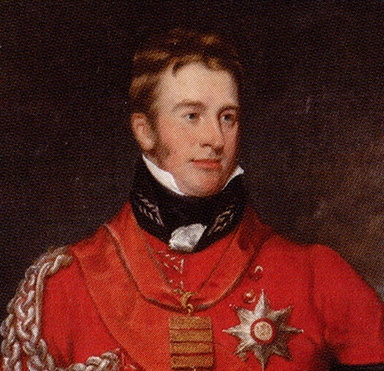
Friedrich Von Paulus, commander of the German 6th Army

By September both the Germans and Soviets were rushing reinforcements to the city as the battle gradually descended into grim hand to hand fighting and small unit actions. Stalin gathered all available troops to the east bank of the Volga, some from as far away as Siberia. However, the Soviets could only reinforce and resupply their forces by dangerous crossings of the Volga river which came under constant attack from German dive bombers and artillery. Inside the city discipline and morale within the Red Army was rapidly disintegrating. Under pressure from above, the commander of Soviet forces in the city, General Vasily Chuikov, resorted to extreme and desperate measures to restore order and discipline. Officers, commissars, and enlisted men were shot on sight for cowardice. 

In late September, the Germans held most of Stalingrad and the Red Army was pushed back to within a few hundred meters of the west bank of the Volga river but continued to tenaciously hold its ground. As Chuikov’s 62nd Army fought desperately to maintain its toeholds, Red Army generals Georgy Zhukov and Aleksandr Vasilevsky began to see an opportunity. The Germans, for all of their apparent might, were overextended. In many spots to the north and south of the city, the German lines were being held by inferior Romanian, Hungarian or Italian units, lacking adequate anti-armor capabilities.

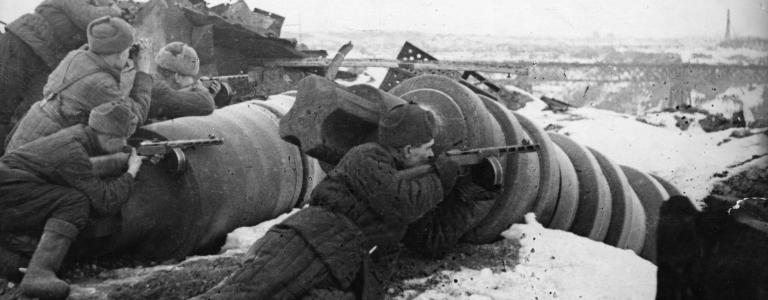
Street fighting at Stalingrad

The Soviet High Command had begun planning for a massive counterattack code named Operation Uranus. The plan called for two massive mechanized drives launched from the north and the south of the city, with the goal of cutting through the units protecting the German flanks and linking up, effectively surrounding the German Sixth Army in the city and cutting it off from its supply lines. Zhukov had quietly redirected large amounts of reinforcement and supplies to the flanks unnoticed that were originally intended for Chuikov’s 62nd Army. For roughly a month and a half, Chuikov’s men fought desperately against the German onslaught enduring constant attacks from German aircraft and artillery. Places like the Stalingrad Tractor Factory and the Red October Steel Factory would become the scenes of brutal small unit fighting that would be memorialized as places of great honor and tragedy.

On November 19 the Soviet’s launched their counter attack striking the Romanian 3rd Army in the North, which crumbled in the face of a massive Soviet armor attack.  The next morning the Soviets attacked the Romanian 4th Army, south of Stalingrad. In a replay of the previous day’s events, the Romanians were routed. Von Paulus, the commander of the German 6th Army, quickly understood what the Soviets were trying to achieve and the gravity of the situation. He contemplated a retreat to escape before the Soviet trap completely closed but was ordered by Hitler to stand his ground at all cost. Herman Goering, head of the German air force, vowed that his vaunted Luftwaffe would be able to resupply the 6th Army.

Two days later, both pincers of the Soviet counterattack would link up, cutting off the Sixth Army from the rest of the Wehrmacht. Operation Uranus had worked perfectly, the 6th Army was completely encircled. A week earlier, the Germans believed they were on the verge of a glorious victory, mopping up the last pockets of a dying resistance.  Now the entire tide of the battle had changed. They were the ones trapped and on the verge of defeat. 

Hitler’s priority now shifted to breaking the encirclement and rescuing the 200,000 plus German soldiers and their allies trapped by the Red Army.  Field Marshal Erich von Manstein, one of Germany’s most able commanders, was directed to plan and lead an operation to break through to the beleaguered 6th Army. On December 12, Manstein initiated Operation Winter Tempest. After some initial success, the German attack ran out of steam and by the end of December was beaten back. With hopes of a break out fading and Luftwaffe resupply flights having ceased, prospects for the survival of the men of the 6th Army became increasingly bleak. 

As conditions deteriorated further, Hitler ordered his men to fight to the death. On January 30, Hitler promoted Von Paulus to the rank of field marshal. It was his fervent hope was that Von Paulus not allow himself to be taken alive since no German field marshal had ever surrendered. Instead, von Paulus and his staff surrendered on January 31, along with 90,000 troops still under his command. On February 2 the remainder of the 6th Army capitulated bringing to an end the saga of Stalingrad.

Reversal of Fortune: The Battle of Cowpens

On January 17, 1781, a combined force of Continental Regulars, dragoons, and militia, under General Daniel Morgan decisively defeated a British Army at the crucial Battle of Cowpens in the backcountry of South Carolina. It was a decisive victory that would boost American morale after the British capture of Charleston and the disastrous defeat at the battle of Camden. It also put in motion a series of events that would push the Redcoats northward culminating in their final defeat at Yorktown and the establishment of American independence.

The British Move South

After their crushing defeat at Saratoga in 1777 and the entry of the French into the war, the British faced the unsavory prospect of becoming bogged down in an increasingly costly war. To hasten a favorable end to the conflict, the British redirected their focus to the southern colonies. The rebellion was always the strongest in the New England and Mid-Atlantic colonies and the British Secretary of State for the American Department, Lord George Germain, believed that Great Britain could expand the war into the south with greater success and less cost by taking advantage of the large number of loyalists there.

In December 1778, the British seized Savannah, Georgia and eight months later repulsed a combined Franco-American effort to retake the city. After re-asserting their authority over Georgia, the British turned their attention to South Carolina. In May 1780, the British captured Charleston and 5,000 American soldiers after a six week siege. Seeking to roll back British gains, the Continental Congress dispatched General Horatio Gates, “the hero of Saratoga,” to command the remaining American military forces in the South, against the recommendation of General George Washington. Gates suffered a humiliating defeat in August at the battle of Camden, where he rapidly fled from the battlefield, leaving his subordinates behind to be taken prisoner.

The Battle of Camden

The British did indeed find strong support from loyalists in the cities and population centers of South Carolina like Charleston and Georgetown but they didn’t anticipate the strong resistance they encountered in the backcountry. In the wake of Gates’ defeat at Camden, irregular bands of militia fighters under men like Francis Marion, Thomas Sumter and Andrew Pickens emerged, engaging in hit and run tactics against loyalist and British military forces. In October 1780, General Washington appointed his most capable subordinate General Nathanael Greene, to replace Gates. Greene inherited what for all intents and purposes was a skeleton army and quickly set about trying to replenish its ranks. He placed key men as leaders in several states to secure supplies of all kinds and new recruits. He finally arrived in North Carolina to take command of his hastily formed army in December 1780.

War in the Backcountry

Greene made a bold decision to divide his small army into two.  He sent a combined force of 300 Continental regulars and 700 militia under General Daniel Morgan to the western part of South Carolina where a brutal civil war was being fought between patriot and loyalist militias. Morgan, a brilliant tactician was tasked with hampering British operations in the backcountry and to bolster patriot morale. Believing that Morgan’s army was planning to attack the strategically important Fort Ninety Six, held by loyalist forces, British commander General Cornwallis sent the brash and despised cavalryman, Lieutenant Colonel Banastre Tarleton and his 1,100 Dragoons to destroy Morgan. Tarleton and his men were widely reviled. Shortly after the fall of Charleston, Tarleton and his men allegedly butchered a contingent of American soldiers under Colonel Abraham Buford who were trying to surrender at the Battle of Waxhaws. The incident would become known as “Bufford’s Massacre” and the subject of an intensive propaganda campaign by the Continental Army to bolster recruitment and incite resentment against the British.

British advance scouts located Morgan’s army on January 12, 1781 and Tarleton’s Dragoons doggedly hunted down the Americans. Morgan, ever the shrewd commander, continued to dodge a major engagement with the British until he could find favorable ground. On January 16, Morgan decided to make a stand at the Cowpens, a well-known crossroads and frontier pasturing ground.

Aware that the British were closing in, Morgan anticipated that Tarleton would conduct a frontal assault on his army the following day and proceeded to set a trap for the overly aggressive cavalry commander. He carefully positioned his forces into three progressively stronger defensive lines. The first consisted of select sharpshooters from Georgia and the Carolinas. Militia under Andrew Pickens constituted the second line. Continental Regulars from Maryland and Delaware made up the third and final line. That evening, Morgan explained the plan to his men. He wanted the militia to fire two shots before retreating and reforming behind the regulars. Morgan hoped his first two lines would slow and deplete Tarleton’s advance before his Contintenals dealt the decisive blow, a double envelopment.


Morgan Springs his Trap

The following day the battle went very much as Morgan had planned. Just before sunrise, Tarleton’s advance guard emerged from the woods in front of the American position and, as expected, he ordered the small group of Dragoons to drive the American skirmishers back. Shielded by trees and other natural obstacles, the American sharpshooters picked off a number of Tarleton’s Dragoons forcing them to retreat. Upping the ante, Tarleton deployed his infantry forward to clear out the skirmishers , who then fell back and joined the second line of militia as planned. The infantry pressed forward and ran into Morgan’s second line consisting of Andrew Pickens’ militia. From there, the Americans, delivered two deadly volleys, thinning the British ranks, before retreating.

After driving back two successive lines of militia, Tarleton believed the Americans to be in full retreat. In the hope of delivering a coup de grace, Tarleton sent forward the 17th Dragoons in a mounted charge. Watching the cavalry advance, Morgan ordered his own dragoons, under Lt. Col. William Washington to meet the attack. Washington and his men charged forward and beat back the British horsemen.

Tarleton finally committed his reserves and sent the 71st Highlanders forward. Instead of facing more militia, they encountered a third and final line composed of Continental Regulars from Maryland and Delaware, who were some of the best trained and most disciplined soldiers in the entire Continental Army. They unleashed a powerful volley which brought the enemy advance to a grinding halt. Morgan subsequently launched a counterattack. In a double envelopment, the Continentals slammed in Tarleton’s center with bayonets while Pickens’ militia and Washington’s horsemen struck the British flanks simultaneously. Tarleton’s line crumbled and what was left of his command fled from the field. The battle was over in less than an hour. It was a complete victory for the Americans. British losses were staggering: 110 dead, over 200 wounded and 500 captured. Morgan lost only 12 killed and 60 wounded.

The Marylanders overrun the British 7th Regiment of Foot (The Royal Fusiliers).

Aftermath

The Battle of Cowpens proved to be a turning point in the War for Independence in the south, one that would eventually lead to Cornwallis’ surrender ten months later at Yorktown. In the months following the battle, Greene and Cornwallis’ armies clashed in a number of battles in which the Americans were driven from the field but only at great cost to the British. Greene best summed up this dynamic declaring, “We fight, get beat, rise, and fight again.”  Greene’s strategy of “bleeding” the British would culminate in the Battle of Guilford Courthouse where Cornwallis was victorious but only at the expense of one-third of his force and some of his best officers. Watching his army wither away, Cornwallis opted to withdraw to his supply base at Wilmington to rest and refit. With his army still not in a condition to engage Greene by the middle of April, Cornwallis decided to shift his operations and began moving north to Virginia, a decision that would eventually lead to his demise at Yorktown.


Soviet Disunion: Lithuania January 1991

On January 13, 1991, Soviet military forces, brutally killed 13 Lithuanian protestors and injured over 700 others in Vilnius, in an effort to quash Lithuania’s independence movement and to restore full Soviet authority over the rebellious Soviet Socialist Republic. The crackdown in Lithuania would be repeated in neighboring Latvia in the ensuing weeks and herald a counterattack by Soviet hardliners to rein in the nationalist impulses and centrifugal forces unleashed by Soviet President Gorbachev’s Perestroika and Glasnost reforms. This hardline backlash would culminate in the failed August 1991 coup that would eventually lead to the collapse of the USSR. 

The collapse of communist regimes in the fall of the previous year, served as an inspiration for many of the non-Russian Soviet Socialist Republics that had long chaffed under Soviet rule, especially the Baltic States who were forcibly annexed by the Soviets in 1940. In March 1990, the Soviet Socialist Republic of Lithuania, under nationalist leader Vytautas Landsbergis, boldly challenged Soviet authority by declaring its sovereignty and independence from Moscow. Neither Moscow nor the West recognized Vilnius’ declaration, and the Kremlin embarked on a subtle campaign of economic coercion and psychological operations to bring Lithuania back into line.

Gorbachev imposed an economic blockade on the Lithuanian Republic, which led to a rise in inflation and a shortage of goods and energy supplies, and undermined faith and confidence in the Lithuanian leadership.  In early January, Lithuania was forced to sharply increase prices. Soviet authorities used these actions to foment unrest and opposition to Lithuanian authorities and to create a pretext for military intervention. Internationally, it was favorable timing for a military intervention because the world was distracted by Saddam Hussein’s occupation of Kuwait and the impending U.S. military action to oust him.

In early January, Soviet authorities organized a rally in front of the Supreme Council of Lithuania. Protesters tried to storm the parliament building but were driven away by unarmed security forces using water cannons. Despite a Supreme Council vote the same day to halt price increases, the scale of protests and provocations backed by the pro-Soviet Lithuanian Communist Party increased. During a radio and television address, Landsbergis called upon independence supporters to gather around and protect the main governmental and infrastructural buildings.

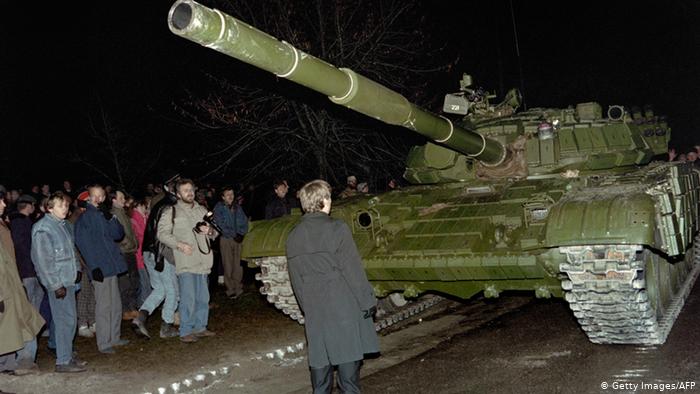
Lithuanian Protestors blocking a Soviet tank

On January 8-9, the Kremlin began to dispatch crack military forces to Lithuania, including the 76th Guards Airborne Division and the elite ALPHA counterterrorism unit explaining these deployments were needed to ensure constitutional order and the effectiveness of laws of the Lithuanian SSR and the Soviet Union. On the 10th, Gorbachev addressed the Lithuanian leadership, demanding a restoration of the constitution of the USSR in Lithuania and the revocation of all anti-constitutional laws. He also warned that military intervention could be possible within days. When Lithuanian officials asked for Moscow’s guarantee not to send armed troops, Gorbachev did not reply.

The following day, Soviet military forces sprang into action seizing critical buildings, transportation nodes, and means of communication. That evening, the pro-Soviet Lithuanian Communist Party announced the creation of the “National Salvation Committee of Lithuanian SSR” and claimed to be the only legitimate government in Lithuania. Overnight, Deputy Minister of Defense of the Soviet Union, General Vladislav Achalov, arrived in Lithuania and took control of all military operations. On the other side independence supporters from all over Lithuania started to encircle the main strategic buildings: the Supreme Council, the Radio and Television Committee, the Vilnius TV Tower and the main telephone exchange to prevent the military from seizing these important locations.

What transpired on the next day and what would become known as “Bloody Sunday” would decisively shape not only the outcome of this standoff but the deconstruction of the USSR over the next eight months. Early on the 13th, Soviet tanks and armored personnel carriers departed their bases and headed to the Vilnius TV Tower and the main telephone exchange. Upon arrival in the vicinity of the TV tower, tanks start to fire blank rounds to intimidate and disperse the protestors defending the tower. Failing in that effort, tanks and soldiers encircled the TV tower firing live ammunition overhead and into civilian crowds gathered around the building. Tanks and armored personnel carriers drove straight through the lines of people. Fourteen people were killed in the attack, most of them shot and two crushed by tanks.

Soviet tanks trampling Lithuanian protestors

Fifty miles west of the Lithuanian capital a small television station in the Lithuanian city of Kaunas was broadcasting news and video of the crackdown to the West. News of the brutal murder of innocent Lithuanians prompted strong condemnation from the Europeans and outrage inside the rest of the USSR. The United States’ reaction was more tempered. The United States was preoccupied with the imminent onset of Operation Desert Storm against Iraq and there were concerns that sharp public criticism of Gorbachev risked complicating these impending military operations. President George H.W. Bush denounced the incident, but was notably careful not to criticize Gorbachev directly, instead directing his remarks at “Soviet leaders.”

Inside the USSR, there was anger and apprehension. More than 100,000 protestors gathered in Moscow to denounce the military’s actions in Lithuania. A spokesman for then Russian President, Boris Yeltsin, prophetically warned, “ I do not exclude the possibility that Russia could be next, although perhaps Georgia would preceede us.” The spokesman, Pavel Voshchanov, was correct that there would be more crackdowns. He was just wrong about the next target. In less than two weeks, similar events would play out in neighboring Latvia.

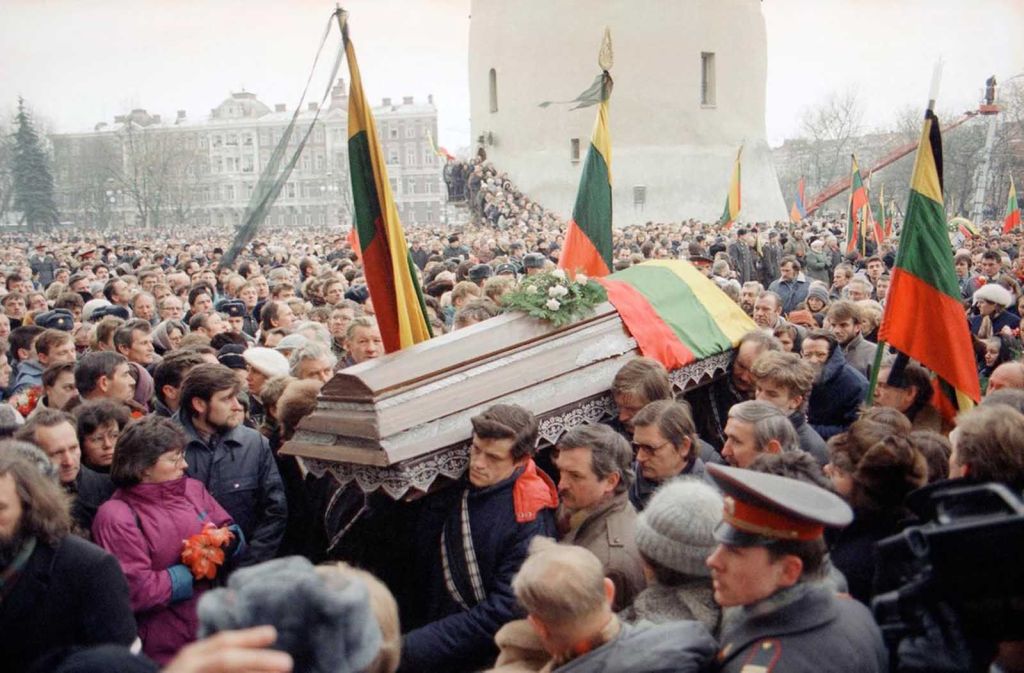
National funeral for the Lithuanian martyrs killed by Soviet troops

I remember these events distinctly. I just returned to Georgetown after Christmas break and was getting ready for the start of my second semester of graduate school. The world was on edge because of tensions in the Persian Gulf but for those of us Soviet watchers this crackdown was a wake-up call. Since at least December 1988, when Gorbachev announced at the UN, the Soviets would unilaterally cut its military by 500,000 men, we had seen largely a continuing positive trend in how the Soviets conducted themselves in the world. In February 1989 the Soviets pulled out of Afghanistan and later in the fall Gorbachev essentially renounced the Brezhnev Doctrine and allowed the communist regimes in Eastern Europe to be overthrown. The events in Lithuania were a reminder that there were still hardline forces that would fight tooth and nail to put the nationalist  genie back in the bottle and preserve the USSR. Little did we know at the time this was the first step in the dissolution of the USSR.

Charles Sumner’s Ghost

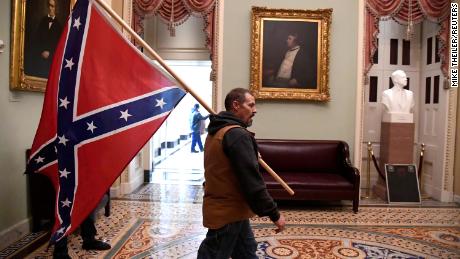
There are so many images that have emerged from last week’s insurrection at the Capitol that are distasteful, un-American, and just downright frightening. One image, in particular, continues to haunt me and has burned a lasting picture in my mind. That image is this picture. A Confederate Flag being paraded around the Capitol more than 160 after the Civil War ended with the defeat of the Confederacy.

A supporter of President Donald Trump carries a Confederate battle flag on the second floor of the U.S. Capitol near the entrance to the Senate after breaching security defenses, in Washington, U.S., January 6, 2021

The mere presence of the Confederate flag in the hallowed halls of the Capitol alone is an abomination.  The context  of its appearance, as part of a violent attack, is a mockery of the 365,000 dead Union soldiers, let alone the hundred of thousands that were maimed and injured, who sacrificed their lives to ensure that the Confederacy would never triumph.  If you live in Virginia, as I do, is hard no to be cognizant of those facts. The hundred or so miles separating Washington DC and Richmond is some of the bloodiest terrain in our country. Places like Fredericksburg, the Wilderness, and Cold Harbor are a forever reminder of the human cost that have been made in order to save what President Lincoln called the last  best hope on earth.

At the same time, there is something else so disturbing in this picture. A story that is not immediately observable to the casual eye but one that a friend of mine astutely pointed out. The picture in the background is a portrait of Massachusetts Senator Charles Sumner. In May 1856, Sumner was beaten within an inch of his life with a cane by Congressman Preston Brooks of South Carolina after he delivered a stinging anti-slavery speech on the floor of the Senate.

Sumner was the junior Senator from the Bay State and a strong abolitionist Republican. He fancied himself as a great orator along the lines of Cicero but for many, even within the Republican Party, he was a bit of a blowhard. In May 1856, the country was being torn apart over the issue of extending slavery and the Kansas territory had become ground zero.  The Kansas-Nebraska Act, which was passed  two years earlier, stipulated that the people of the two territories themselves should decide whether to enter the Union as a free or slave state, effectively repealing the Missouri Compromise of 1820. Abolitionist settlers and pro-slavery Border Ruffians from neighboring Missouri pored into the state fueling a low grade civil war.

Massachusetts Senator Charles Sumner

A day after pro-slavery partisans sacked the abolitionist stronghold of Lawrence Kansas, Sumner gave a speech on the floor of the Senate entitled “Crimes Against Kansas,” in which he identified two main culprits Senator Stephen Douglass of Illinois and Senator Andrew Butler of South Carolina. Sumner attacked both men but reserved his sharpest and most insulting commentary for Butler.  Mocking the South Carolina senator’s stance as a man of chivalry, the Massachusetts senator charged him with taking “a mistress . . . who, though ugly to others, is always lovely to him; though polluted in the sight of the world, is chaste in his sight—I mean,” added Sumner, “the harlot, Slavery.” 

Butler, who was an older man 60 years of age, was not present when Sumner made his remarks. However, his younger kinsman, Congressman Preston Brooks heard the remarks and was outraged. Brooks contemplated challenging Sumner to a duel to defend the honor of his relative but instead chose a more insidious option.  Shortly after the Senate had adjourned for the day, Brooks entered the Senate chamber, where Sumner quietly was working and proceeded to smash Sumner over the head repeatedly with his metal topped cane. Sumner rose and futilely tried to protect himself before collapsing to the floor. Bleeding profusely, Sumner was carried away.  Brooks walked calmly out of the chamber without being detained by the stunned onlookers.

When word spread of Brooks’ heinous act, he was hailed as a hero by his constituents who mailed him walking sticks to replace the cane he broke attacking Sumner. Brooks  escaped any accountability for his actions. He survived a House censure resolution and even though he resigned he was immediately re-elected. Sumner recovered slowly and returned to the Senate, where he served another 18 years but his health was never quite the same. 

As I look at this picture of the Confederate flag with Sumner’s portrait in the background I am reminded that there must be accountability for last week’s violence and the perpetrators who despoiled the hallowed halls of the Capitol must not be allowed to become heroes and celebrities.  Somewhere, Charles Sumner is rolling in his grave!

The Republic Secured: Andrew Jackson and the Battle of New Orleans

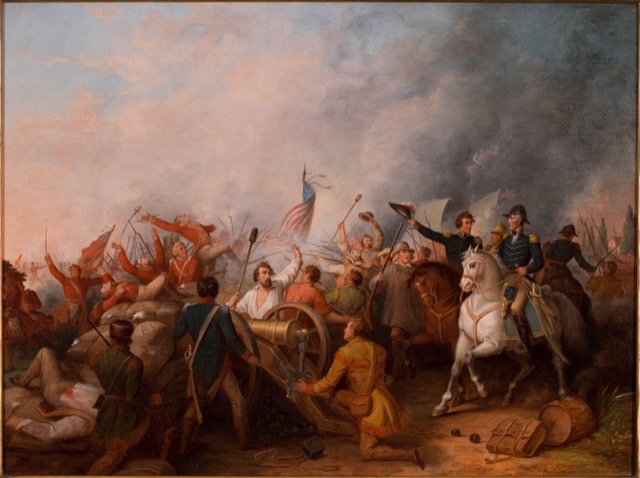
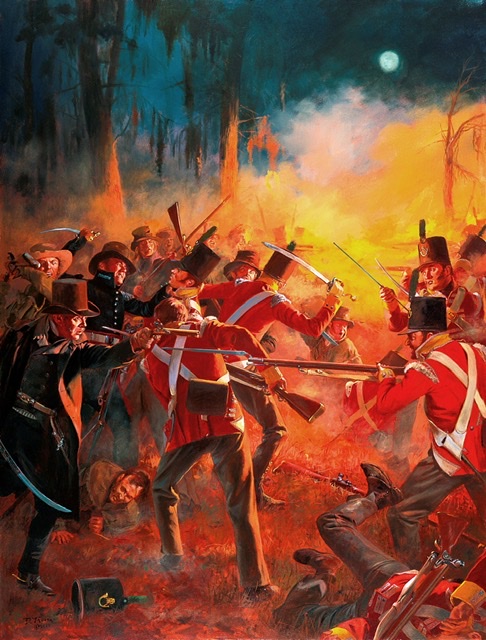
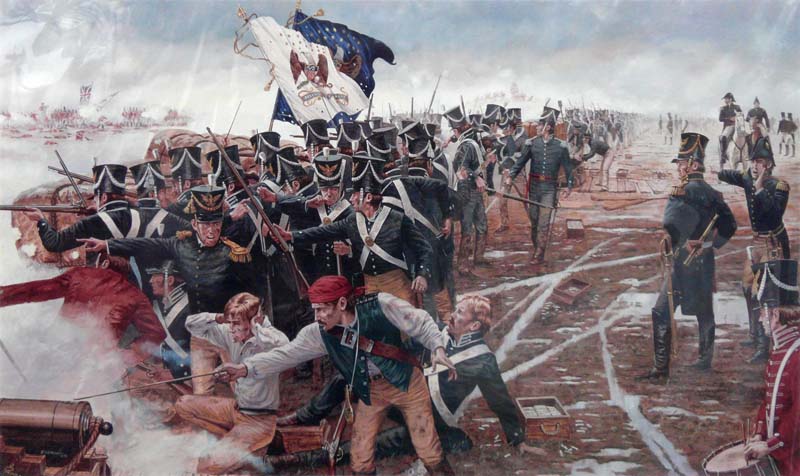
On January 8, 1815, a rag-tag collection of U.S. soldiers, marines, militia, merchants and business men and a contingent of pirates defeated a superior British army in a most lop-sided fashion at the battle of New Orleans bolstering national pride, preserving the sovereignty and territorial integrity of the young republic and thrusting Andrew Jackson into national prominence. The unfortunate tragedy was that the battle occurred eighteen days after American and British negotiators signed a peace treaty in Belgium ending the War of 1812 but word had not yet reached North America.  The battle, however, was more than just a pointless coda or epilogue to an unpopular war. It served to shape the future course of American history. If the British had won the battle and occupied New Orleans, it is likely they would have abrogated the treaty and insisted on territorial concessions from the Louisiana territory, stymying American expansion westward. The victory also shaped how America viewed the war and itself. It allowed the young nation to forget how close it came to military defeat, financial bankruptcy, and dissolution of the union, instead ushering in a period of optimism, national unity, institution building and internal improvements aimed at fostering increased trade and economic prosperity.

The United States declared war against Great Britain in June of 1812 but the British, for the most part, approached the unwanted conflict with a mix of patience and restraint, devoting most of their attention and resources to the struggle against Napoleonic France. The defeat of Napoleon in the Spring of 1814, however, allowed the British to refocus much of their effort on their American foe. That summer, a British army of 7,500 battle-tested veterans under General Robert Ross arrived in the Chesapeake Bay threatening both Washington and Baltimore. In August, the British routed a hastily assembled American force at the Battle of Bladensburg and that same night proceeded to burn Washington DC. Two weeks later, the British carried out a combined land and naval attack on Baltimore but were repulsed at Fort Mc Henry and forced to retreat.

Major General Andrew Jackson

As the British troops departed the Chesapeake Bay, there was a great deal of uncertainty on both sides about what would happen next. Peace talks had begun in Belgium in August and the British had hoped that that the burning of Washington and the capture of Baltimore would force the Americans to sue for peace on terms favorable to Great Britain. However things did not go as planned. There was also growing pressure in London to end the war as soon as possible because of the financial strain that decades of continuing conflicts were placing on the British treasury. Despite this pressure, British war hawks decided to look South. Unable to capture Baltimore, they would attack the city of New Orleans. Situated on the Mississippi River, New Orleans was the crown jewel of the Louisiana purchase in 1803 and a prosperous port. If Great Britain could seize New Orleans it would gain control over the Mississippi river and much of the trade that depended on it. It would also give the British strong leverage to press the Americans to hand over the Louisiana territory as part of any peace treaty.

Almost three months after their defeat at Baltimore, a fleet of sixty British warships carrying almost 15,000 soldiers, sailors and marines arrived some 60 miles east of New Orleans, on December 8. Word of the fleet’s arrival confirmed what American planners had been anticipating since at least mid-November. Secretary of War James Monroe put Major General Andrew Jackson in charge of organizing New Orleans’ defenses. Jackson was a controversial and somewhat divisive figure. Know as “Old Hickory” because of his toughness and determination, he was also rash and quick tempered, which earned him both friends and foe alike. Moreover, his friendship with Aaron Burr, who was tried and acquitted of treason in 1807, did not endear him to the Madison Administration. Nonetheless, Jackson had proven himself an effective and more than capable military leader at a time where others were failing quite miserably. He spent much of the previous year battling a hostile faction of the Creek Indians, allied to the British, called the “Red Sticks” and harassing British operations along the Gulf Coast. Jackson eventually defeated the Red Sticks, forcing the Creeks to cede 23 million acres to the young republic while driving the British from Pensacola in Spanish controlled Florida.

Upon arriving in New Orleans, Jackson soon began to familiarize himself with the local terrain and to assemble an army to defend against the impending British attack. He declared martial law, which was extremely unpopular with the public, and ordered every available weapon and able-bodied man around to come to the defense of the city. His force grew into a 4,500-strong patchwork of army regulars, Tennessee and Kentucky militiamen, free blacks, New Orleans aristocrats and Choctaw tribesmen. After some hesitation, he even accepted help from Jean Lafitte and his band of pirates who would provide much needed supplies and critical skills that would be crucial to the outcome of the battle.

Although the appearance of the British fleet was a clear signal that they were intent on attacking New Orleans, there was still a great deal of ambiguity as to which direction the attack would come. Jackson thought the attack would most likely come overland from the North where there would be fewer geographical and logistical challenges. However, in an effort to maintain some element of surprise, the British decided to attack from the south, despite the more difficult terrain. On the morning of December 23, British infantry landed just below New Orleans and began to move north through nearby bayous and swamps toward the city.

British movements in the Gulf of Mexico

As American scouts learned of the British movements, they quickly sent word back to Jackson that a British advance guard of over 2,000 troops was less than 10 miles from the city. Jackson, however, wasn’t sure that these movements weren’t anything more than a feint. Nonetheless, in his typical fashion, he made a decisive decision. Turning to his aides Jackson declared, “Gentlemen, the British are below and we must fight them tonight.” Jackson quickly assembled 2,100 of his men and moved out to meet the British threat, vowing that no British soldier would enter the city unless it was over his dead body.

That evening Jackson and his troops struck the unsuspecting British in a brutal but inconclusive attack that would become known as “The Night Battle.” Scores of vicious little firefights, many hand to hand, erupted all across the field in the pitch black night while a slow moving fog rolled in further hampering command and control. The attack would last more than four hours with Jackson’s motley band giving the British veterans all they could handle. One British lieutenant later wrote, “We fought with the savage ferocity of bull-dogs.” With his men exhausted and running low on ammunition, Jackson called off the attack around midnight and ordered his troops to fall back two miles north to the Rodriguez Canal located near Chalmette Plantation along the Mississippi River. American casualties totaled 24 killed, 115 wounded, and 74 missing, while the British reported their losses as 46 killed, 167 wounded, and 64 missing. Amongst the hardest hit of the American units was a rifle company composed primarily of New Orleans lawyers and merchants.

The Night Battle of December 23, 1814.

The outcome of the Night Battle was inconclusive but it had visibly shaken the British. British commander Major General John Keane abandoned his plan to attack New Orleans the following day. Jackson must have gathered a formidable army with large reserves, otherwise he never would have carried out such a reckless nighttime attack, Keane surmised.

Conversely, Jackson considered renewing the attack the next day. However, after learning that the British were being reinforced and digging in, he opted to improve his defenses instead. Employing slave labor, he turned the Rodriguez canal into defensive trench and built a seven foot tall line of breastworks consisting of earthen ramparts reinforced by timber and large cotton bales covered in mud. Behind these ramparts, Jackson deployed his artillery. These fortifications were christened “Line Jackson” and a posed a formidable defense, stretching three-quarters of a mile from the east bank of the Mississippi River to a large Cyprus swamp. Jackson also began to build defensive positions on the west bank of the Mississippi River to guard against a British flanking maneuver. Here the Americans would make their stand.

Christmas day brought a shake up in the British high command. Major General Edward Pakenham, brother-in-law to the Duke of Wellington, arrived to take command of the British army from General Keane. Pakenham distinguished himself fighting against Napoleon in the Peninsular campaign and was well respected among ranks. He really wasn’t interested in serving in the American war, but in October 1814 was selected to take command of the army following the death of its original commander, Major-General Robert Ross, near Baltimore. Pakenham had hoped to rendezvous with the fleet before the army went ashore but adverse winds delayed his arrival till mid-December.

Upon his arrival, Pakenham immediately was disturbed by what he found. Keane’s failure to advance left the British Army trapped on a three-quarters of a mile wide isthmus, wedged between the Mississippi on its left and and a virtually impassable swamp on the right. These geographical obstacles limited the army’s maneuvering room and made it more vulnerable to American artillery and rifle fire. By this time, the campaign advanced so far on both sides that there was little Pakenham could do in terms of changing strategy, naval and army placements. Nevertheless, Pakenham’s concerns, were counterbalanced by his low opinion of Jackson’s men, whom he derisively referred to as “dirty shirts,” and his unwavering confidence that they would crumble before the might of British regulars.

Major General Edward Pakenham

Pakenham moved the entire 8,000 man British Army forward to the Chalmette Plantation on December 27 and over the next several days carried out a number of probing attacks that were beaten back. Penned in by geographical obstacles and left with few other options, Pakenham began planning for a direct assault on the American line. He would cross the Mississippi River downstream with a strong force and overwhelm Jackson’s thin line of defenders on the river bank opposite the Rodriguez Canal. From there, these troops would open an enfilading fire on Jackson’s line with the captured artillery. Meanwhile, several columns of heavy infantry would conduct a frontal assault seeking to punch a hole in Jackson’s line. Conceptually, it was a reasonably thought out plan. However, like most plans the devil was in the execution.

The British launched their attack just before sunrise on January 8 but things began to go awry from the outset. Over night, the navy was able to transfer only half of the appropriated 1400 troops across the river because of unexpected difficulties. Moreover, the forces that did reach the other side were significantly behind schedule after landing further down river because of strong currents. At daybreak they were still four miles from their objective which should have already been taken. Pakenham patiently waited for sounds of battle from across the river but none were forthcoming. Further complicating matters on the other side, the ladders and fascines needed to scale the American fortifications had been misplaced. Around 4 o’clock the British commander told an aide, “I will wait my plans no longer.” With daybreak quickly approaching, Pakenham issued orders to begin the assault.

The British plan was to send two columns against the Jackson’s position. The left column, the Third Brigade, led by British Major General John Keane, included elements of the 95th Rifles, the 7th Regiment of Foot (Royal Fusiliers), the 93rd Foot (Sutherland Highlanders), and the 1st West India Regiment. Keane’s brigade was to play a largely diversionary role, attacking along the extreme right of the American position. It was hoped that the column’s advance along the river bank would protect it from the Americans’ artillery and rifle fire until they could get close enough to charge the enemy works. The main attack was targeted against the American center-left at the far eastern portion of the field near the edge of the cypress swamp. This column, the 2nd Brigade, was led by General Samuel Gibbs, Pakenham’s deputy and included the 44th Regiment of Foot (East Essex), the 4th Foot (King’s Own), and the 21st Foot (Royal Scots Fusiliers). Light troops, including units of the 95th Foot (Rifles) advanced through the swamp itself to protect the right flank of the main attack. The 44th Regiment was to lead the column, carrying ladders and fascines to bridge the canal and scale the rampart. A third brigade, commanded by General John Lambert, constituted a reserve.

A single Congreve rocket signaled the beginning of the attack and the British troops stepped forward toward the American line with resolve and determination. These were veteran soldiers, the best of the best, who fought all across Europe and defeated Napoleon. Nevertheless there was a grim resignation about them, that in storming the American fortifications, many were unlikely to survive the day. Colonel Robert Dale, commander of the famed 93rd Highlander regiment, reportedly gave his watch and a letter to the regimental physician. “Give these to my wife,” he somberly declared, “I shall die at the head of my regiment.”

Initially, the British advance was hidden by the early morning darkness and a dense fog. Nevertheless, Jackson and his men knew the British were coming. They loaded their artillery and muskets and patiently waited secure behind their protective wall. As the sun began to rise and the fog burned away, American artillery and riflemen now had clear sight lines of the entire landscape in front of them. American artillery, especially the batteries manned by Lafite’s pirates, were deadly accurate, cutting gaping holes in the British formation, sending both men and materials flying in the air. As the British continued to draw closer, their ranks were cut down by musket fire.

The U.S. 44th Infantry takes aim at their British foe.

The main British thrust on the right was struggling against the entrenched Americans. Gibbs’ brigade was being decimated by the Kentucky and Tennessee militia who were deadly accurate with their muskets. Three to four deep behind their protective wall, the Americans were able to keep up a constant and withering fire, largely shielded from British muskets and artillery. One surviving British officer later claimed that the American line looked like a row of fiery furnaces. Approaching the canal, the attack began to falter. The 21st and 44th regiments were disintegrating rapidly under a hail of grapeshot and musket fire. Gibbs tried to rally his troops but without the necessary ladders and fascines, the remaining forces started to fall back in panic. He later would fall mortally wounded, pierced by four musket balls, about 20 yards from the wall.

With the attack on the right quickly collapsing, Pakenham ordered Keane to send the famed 93rd Highlanders to come to the aid of Gibbs’ brigade. Led by Keane himself, the 900 man tartan clad regiment marched diagonally across the field coming under a storm of musket and artillery fire. The Highlanders took gruesome losses as they struggled across the muddy open field. Their commander, Colonel Robert Dale fell dead as he predicted. His body riddled by grapeshot. After making contact with the remainder of Gibbs’ brigade, Keane also fell seriously wounded. He was shot through the neck and groin, and had to be taken from the field. About a 100 yards out from the American fortifications the regiment paused confused. Leaderless and with its ranks significantly diminished, the regiment was uncertain as whether to press on or fall back.

Watching Gibbs’ brigade disintegrate and the Highlanders wavering under the deadly American fire, Pakenham rode forward to try and rally his men. “Shame! Shame!” the general called out to his fleeing soldiers. “Recollect that you are British soldiers. Forward gentlemen, forward,” he shouted. Suddenly, a burst of grapeshot shattered his left knee and killed the horse from under him. Struggling to his feet, Pakenham was wounded a second time in his right arm before more grapeshot tore through his spine. As he was carried from the field, Pakenham’s last words before he died reportedly were to order Lambert’s reserves forward.

British forces enjoyed more success on their left where a battalion of light infantry captured an under strength redoubt at the extreme right of the American line. However they proved unable to hold their prize. Driving out the defenders in ferocious hand to hand combat, the battalion commander, Lieutenant Colonel Robert Rennie climbed to the top of the redoubt and shouted, “The enemy’s works are ours!” Within minutes Rennie was struck dead by a musket ball as the 7th U.S. Infantry counter attacked and drove the few remaining British forces back across the field.

Rennie’s attack on the U.S. redoubt

Across the river, British Colonel William Thornton and his 700 troops who were supposed to begin their attack much earlier were finally engaging the Americans. Thornton’s men first encountered an advanced American outpost manned by about 200 hungry and poorly armed Kentucky militia who put up little resistance and fled. Pressing forward, the British approached the main American defensive line about a mile up river. The American defenses on this side of the river were far less formidable than the other side, consisting of only a waist high dirt wall and a shallow ditch. There were also far fewer defenders to man the entire line resulting in gaps between the various units. Thornton organized his troops and stormed the American line causing panic and confusion and sending the American forces, scurrying in retreat. The British captured 12 cannons but luckily they were spiked before they could be turned on Jackson’s men across the river. Nevertheless, Thornton’s success proved too little too late to prevent the slaughter on the opposite bank.

With Pakenham dead, and both Generals Gibbs and Keane gravely wounded, command of the British Army passed to Major General John Lambert. Lambert and his brigade of reserves moved forward to assess the rapidly deteriorating situation. Lambert, examining the carnage across the field determined the situation was unsalvageable. Of the three thousand troops in the main British advance, two-thirds lay dead or dying on the field. Lambert ordered the remaining British forces to fall back and advanced his brigade to cover their retreat. The battle was over. The British army lingered in Louisiana for the next several days, but its remaining officers knew that any chance of taking the New Orleans had passed. After an abortive naval attack on nearby Fort St. Philip, the British boarded their ships and sailed back into the Gulf of Mexico.

The battle of New Orleans is remarkable for both its brevity and its casualties. In little over 30 minutes, the British lost 285 killed and 1265 wounded. In addition, 484 were taken prisoner. Many of whom pretended to be dead, surrendering once the shooting stopped. Of the wounded, at least half were “permanently disabled” which meant the the loss of a limb. American losses were minuscule in comparison. Jackson’s men, behind their protective wall, had lost only 13 men killed, 30 wounded, and 19 missing or captured. Future President James Monroe would later praise Jackson by saying, “History records no example of so glorious a victory obtained with so little bloodshed on the part of the victorious.” 


Washington’s Winter Gamble

In the cold night air of December 25, 1776, General George Washington and his rag tag Continental Army crossed the icy Delaware River and surprised 1500 of King George’s Hessian mercenaries at Trenton, scoring a much needed victory after a string of disastrous defeats earlier in the year.

By the end of 1776, the Continental Army was in bad straits. The year began with great promise. In March, the Continentals drove the British out of Boston and on July 4, the thirteen colonies declared their independence. However, a series of disastrous defeats in and around New York City forced Washington to flee the city and retreat all across New Jersey to Pennsylvania, putting the whole revolution in doubt. Moreover, the enlistments of many of the Continental soldiers were set to expire at the end of the year. Washington needed a bold move to keep his Amy together and restore faith and confidence in the revolutionary enterprise.

After much contemplation and consideration of alternatives, Washington decided he would cross the Delaware River and carry out a surprise attack on the Hessian garrison at Trenton while they were celebrating Christmas. Washington’s plan required the crossing to begin as soon as it was dark enough to hide his army’s movements on the river. However, most of the troops did not reach the crossing point until about 6 pm, about ninety minutes after sunset, putting the operation behind schedule. Moreover, the weather was growing progressively worse, turning from drizzle to rain to sleet and snow.

Washington with the Virginians crossing the Delaware

Washington was among the first of the troops to cross, going with Virginia troops. During the crossing, several men fell overboard but no one died. By 3 am all of his forces and artillery—2400 men in all— were across the river in New Jersey. Around 4 am Washington’s Army began their March toward Trenton. Many of the troops did not have boots and wore rags around their feet in the snow but Washington rode up and down the column urging his men to persevere.

Behind schedule because of the storm, the Americans arrived on the outskirts of Trenton around daybreak on the 26th. Washington split his force into two columns. One, commanded by Nathaniel Greene attacked from the north, while a second under John Sullivan advanced from the west to cut the line of retreat. The Hessians were completely surprised. They attempted to rally but their commander Colonel Johan Rall was fatally wounded and they quickly surrendered. Hessian casualties included 22 killed, 92 wounded, 918 captured. Four hundred would manage to escape. The Americans suffered two frozen to death and five wounded.

Hessian mercenaries

Washington had won a much needed victory. The army that the British thought was all but defeated had destroyed a major garrison with very light casualties, capturing critical supplies in the process. Recognizing he could not hold Trenton, Washington slipped back across the river to Pennsylvania. However, over the next ten days Washington would cross and recross the Delaware again fighting a delaying action at the Battle of the Assunpink and winning another stunning victory at the Battle of Princeton before settling down for winter at Morristown.

Fire Along the Rappahannock: The Battle of Fredericksburg

On December 13, 1862, the Army of the Potomac under Major General Ambrose Burnside conducted a direct frontal assault on entrenched Confederate positions in the Virginian town of Fredericksburg in what would become one of the most lopsided defeats in the civil war.

Early November of 1862 was a dark time in Washington. Almost two months since the Army of the Potomac turned back the Confederate invasion of the North at the battle of Antietam, President Lincoln remained haunted by the missed opportunity to destroy the rebel army in one decisive battle. Lincoln put his trust in army commander Major General George B. McClellan twice, only to be disappointed by the general’s excessive caution and annoyed by his repeated insolence. On November 7, Lincoln relieved McClellan of his command once and for all turning to Major General Ambrose Burnside as his successor. Burnside clearly was not McClellan’s equal in terms military skill and even he himself thought he was ill-suited for the job. Nonetheless, his greatest selling point was that he was generally well liked by most of his peers, something that could not be said about the rest of the Union general officer corps. Lincoln now had himself a new army commander, one who was more cooperative and congenial if not less capable.

Lincoln urged Burnside to carry out a late fall offensive against the rebels before winter set in, hoping to prevent the Northern public from losing confidence in his administration and the war effort. Stuck behind the Rappahannock river, Burnside intended to conduct a pontoon crossing of the river and rapidly move towards Richmond before the Confederates could get between him and the rebel capital.

Major General Ambrose Burnside

Burnside began moving his forces toward the river on 15 November but his plans began to go awry almost immediately. The pontoons he hoped to use to affect the crossing were delayed and did not arrive for almost another month. Confederate commander General Robert E. Lee expected that Burnside would beat him across the Raphanock  and was prepared to engage the Union army further South. However, when it became clear that Burnside was delayed he directed his army to Fredericksburg.   Lee moved Major General James Longstreet’s corps toward Fredericksburg from Culpeper while Major General Thomas J. “Stonewall” Jackson’s men followed from the Shenandoah Valley.

The pontoons that Burnside was expecting had finally arrived and the Union army made preparations to cross the river on 11 December. Burnside originally planned to cross the river at a location south of town but intelligence reporting convinced him that the rebels had anticipate his move and were gathering forces in the area to oppose the crossing. Instead, Burnside decided to cross the river immediately in town where only a Mississippi regiment was thought to be occupying Fredericksburg

Union engineers began to assemble the pontoon bridges shortly before  dawn on 11 December. The engineers immediately came under fire from Mississippi and Florida sharpshooters hiding in the town buildings along the river.  In response, Union artillery pounded the city. When the bombardment failed to drive the Confederates back, Burnside sent the 7th Michigan and 19th Massachusetts Infantry regiments across the river in pontoon boats to secure a small bridgehead and rout the sharpshooters. Union forces advanced up the narrow streets and alleys of Fredericksburg but continued to take casualties from well hidden Confederate sharpshooters. Darkness and the arrival of fresh Union troops compelled the Confederates to withdraw to the heights West of town, but they had bought the Army of Northern Virginia precious time to prepare for the main Union assault that was soon to come.

Union forces clearing the rebel sharpshooters from Caroline street

Burnside spent the next day moving the remainder of his army across the river. He issued attack orders early on the morning of December 13. His plan was simple. The Union left, under Major General William Franklin would strike Stonewall Jackson’s corps just south of town. On the Union right, the Major General Edwin Sumner’s II Corps would cross almost a thousand yards of open fields and attack General Longstreet’s corps which was deployed on a series of five hills west of town known as Mayre’s Heights. There they hunkered down behind a stonewall and a sunken road posing an even more formidable challenge for Sumner’s men.

The Slaughter Pens

In the morning fog on December 13, Franklin ordered a single corps, Maj. Gen. Joseph Reynolds’ 1st Corps, to move into place south of the city along the railroad. After adjusting his lines, Reynolds had the Confederate line heavily shelled for an hour, though with little effect or response from Jackson, who had ordered his gunners to hold their fire until the Federal infantry advanced. As the Union soldiers approached Jackson’s line for a more direct attack, the Confederates responded, pushing them back. An artillery duel ensued, with Union guns now landing hits on their targets. In the early afternoon, Reynolds ordered his two remaining infantry divisions to approach the Confederate line, where they found a hole in the line left by Jackson, who wrongly assumed the terrain—swampy woodland—was impassable. Finding the advantage in attacking the Confederates, Union major general George Meade began to roll up the Confederate lines. Jackson ordered his reserves to counterattack, while Meade sent word to Brig. Gen. David Birney for reinforcements that would never come; Birney refused to coordinate efforts with Meade. Left unsupported and facing an overwhelming onslaught, Meade retreated, with the Confederates pushing their advantage. The area of intense fighting would become known as the Slaughter Pens. By late afternoon, Jackson had readjusted his lines and tried to goad the Union into attacking, but Meade refused to respond. With darkness approaching, the battle south of Fredericksburg came to an end.

The battle to the north, with Longstreet on Marye’s Heights and Sumner emerging from the city streets, was even less successful for the Union. Sumner’s men had to cross about half a mile of open ground that included a mill race (a trench five feet deep, 15 feet wide, and filled with three feet of water) before approaching a stone wall, behind which Longstreet had his men entrenched, with artillery on the heights behind them. As the fog lifted and artillery booms from the battle downriver were heard, Sumner began ordering wave after wave of divisions to advance toward Marye’s Heights. Throughout the day, the Union divisions advanced and were cut down by Confederate artillery and gunfire. Late in the day, the 9th Corps of Maj. Gen. Joseph “Fighting Joe” Hooker’s Grand Division attempted to flank the sunken road but only succeeded in adding more blue-clad casualties to the heaps that lay in the fields.

The Irish Brigade coming under heavy fire attacking Mayre’s Heights

That night, a Confederate soldier from South Carolina, Richard Kirkland, risked his life to take water and warm clothing over the stone wall to the wounded and dying of the enemy; the “Angel of Marye’s Heights” is an enduring symbol of humanitarianism. Kirkland would be killed at the Battle of Chickamauga the following autumn.

Burnside intended to renew the frontal assaults the next morning, but the commanders of his three grand divisions convinced him not to. The following two days were filled with the misery and suffering of the wounded between the two lines. The night of December 15, Burnside retreated to winter camp in Stafford County.

The battle was an undeniable disaster for the Union army and only served fo further depress Union morale heading into the winter. Union casualties at Fredericksburg almost reached 13,000 troops. Confederate losses were less than 5500.

The Divine Victory at Lepanto

Throughout the 16th and 17th centuries the Ottoman Turks terrified European Christendom on both the land and on the sea. The  Turkish conquest of Constantinople in 1453 marked the collapse of the Byzantine Empire  and opened the gates of Europe to the Ottoman scourge. The refusal of Western Christendom to come to the assistance of their Eastern brethren also revealed the vulnerability of a Europe beset by religious conflict. Fast forward more than a 100 years later and Christian Europe—now divided between Catholics and Protestants—once again faced an existential threat from the Ottoman Turks but this time from the high seas. On October 7, 1571, an assembly of Catholic nations and city states, known as the Holy League, defeated the Ottoman navy in epic fashion off the coast of Southwestern Greece in the battle of Lepanto. The battle of Lepanto is the largest naval battle of the Renaissance involving over 500 ships. It is also the last major naval engagement fought primarily between rowing vessels.

The battle of Lepanto October 7, 1571


The Growing Ottoman Menace

After the fall of Constantinople, the Ottoman Empire steadily increased its holdings across the Mediterranean and Southeastern Europe. By the mid-16th century,  the Ottomans had expanded as far North as Budapest. Europeans were too distracted by conflict amongst themselves to rally and blunt the Ottoman advance. The Ottomans also pioneered advances, in shipbuilding, gunnery, and naval tactics, emerging as the dominant naval power in the Mediterranean by this time. The Ottomans controlled lucrative trade routes in he Mediterranean Sea and Turkish galleys roamed the sea with impunity. Raiding parties routinely landed along the coast of Spain, France, and Italy for the purpose of capturing slaves. Males would be forced into bondage as galley slaves while females were sent to harems in the East.

And the Pope Cast his Arms Abroad

From the Vatican, Pope Pius V watched the growth of Ottoman power and might in the Mediterranean with grave concern. The continued enslavement of his flock certainly troubled the Pope but what was more likely in the forefront of his mind was the inevitable question of when would the Ottomans directly attack Italy and the Vatican itself, especially as the Europeans continued to fight amongst themselves.

For five years, the Pope sought to create an alliance of Roman Catholic states to push back against the Ottoman menace. However, there was little consensus among these states which were preoccupied with other challenges. France and the Hapsburgs were preoccupied with the challenges of the Protestant Reformation. Great Britain was in he process of rejecting Catholicism and forming its own state church. Spain was eager to participate, viewing the Pope’s proposal as a means of asserting its power and influence, but it’s state coffers were practically empty. Venice, the most powerful Catholic maritime power in the Mediterranean, preferred to avoid conflict with Ottomans so as not to jeopardize their lucrative trade routes. It was also concerned about growing Spanish influence on the Italian peninsula. Nonetheless, the Pope refused to give up hope of drawing Venice and the smaller Italian states into an alliance with Spain.

Pope Pius V and Don Juan

The situation changed dramatically in the Spring of 1571. The previous summer, the Ottomans declared war on Venice and invaded Cyprus, after Venice refused to voluntarily handover the island to the Turks. In May 1571, Pope Pius V, Philip II of Spain and the Venetians agreed to put aside their differences and combine forces in the form of a Holy League. They hastily assembled a vast Christian armada of more than 200 ships, 40,000 sailors and 20,000 troops led by Philip II’s half-brother Don Juan of Austria. In the summer of 1571, the fleet set sail to lift the siege of Cyprus. When Don Juan learned of the fall of the last Venetian stronghold on that island he headed for the Gulf of Patras where the Ottoman fleet was being refit.

As the forces of Christianity and Islam inched closer to an epic battle the outcome was far from certain. Each side possessed distinct advantages and disadvantages. In terms of sheer numbers, the Ottomans outnumbered the Holy League fleet in ships and manpower. The Ottoman fleet consisted of roughly 300 ships. These vessels were manned by 37,000 oarsmen and sailors and carried approximately 34,000 soldiers. In contrast, the Holy League fleet consisted of 206 ships, crewed by 40,000 oarsmen and sailors, carrying only 20,000 soldiers. Nonetheless, the Christian fleet enjoyed a clear advantage in terms of firepower. The Holy League ships had a total of 1,815 cannons. The Turks had only 750 with insufficient ammunition. Moreover, the Holy League troops were armed with muskets and arquebuses while the Ottomans continued to rely on their feared composite bowmen. The Holy League’s advantage in firepower would prove decisive in the forthcoming battle.

The Holy League also believed that they had the Blessed Mother Mary on their side against the heathen Turks. Pope Pius asked Christians throughout Europe to pray the Rosary, seeking the intercession of the Blessed Mother with her Son for a Christian victory. The Pope also ordered churches to conduct continuous periods of Eucharistic adoration and ordered the Rosary Confraternities in Rome to organize processions during which the Rosary was prayed. The faithful of Europe were all fervently praying at the same time for the same purpose: to save Christianity.

A Battle for the Ages

The Holy League fleet entered the Gulf of Patras early on the morning of 7 October and it spotters quickly identified their Ottoman adversaries far off in the distance. Both sides were determined to give battle that day and began the necessary preparations as they moved to close the distance between them. The Ottomans, under Ali Pasha, had their ships arrayed in the form of a crescent and proceeded to advance West with the wind at their backs. The Holy League found itself in the less enviable position of heading East into the wind and it was uncertain whether the fleet would be able to form a battle line before the Ottomans engaged. Miraculously and unexpectedly, the wind completely reversed directions as if there was a divine intervention, and it was now the Holy League with the advantage.

Don Juan, divided his command into four squadrons. On the left, he placed the soft-spoken but fierce-fighting Venetian Agostino Barbarigo. Juan led the central squadron, supported by the Venetian Admiral Sebastiano Veniero and the papal commander, Marc Antonio Colonna. On the right, Genoese Admiral Gian Andrea Doria was placed in command. Juan also prudently created a reserve squadron, under the command of the Spaniard, Marquis de Santa Cruz, the Holy League’s most respected admiral. At the head of each of his front squadrons, he placed two Venetian galleasses—larger, heavily armed ships, with higher sides that were difficult to board— to break up the Turkish attack.

By nine o’clock the two lines were fifteen miles apart and closing fast. The men of each side steeled themselves for the forthcoming battle. Priests bearing large crucifixes administered the Sacrament and heard final confessions. The Holy League’s battle standard, a gift from the Pope was unfurled and men up and down the battle line cheered as they saw the giant blue banner bearing an image of the crucified Jesus Christ. In the Ottoman fleet gongs and drums blared while the sacred banner with Allah’s name stitched in gold calligraphy was raised.

Around 10 am, the battle commenced. The Holy League drew first blood as four Venetian galleasses opened fire, sinking several Turkish galleys. As the two fleets drew closer, more cannons erupted, arrows rained on the Christians, and Spanish arquebuses spat back balls of lead at the Turks.  The first direct engagement between the two fleets occurred on the Christian left, where the faster Turkish galleys tried to outflank the Catholic fleet, but were driven back against Scropha Point. Amidst the melee, ships rammed one another with the decks of the tangled galleys serving as a floating battleground for hand to hand combat. Here the soldiers of the Holy League, mostly armed with arquebuses and muskets, were able to decimate the Turkish archers.  During the course of the battle, the commander of the Holy League squadron Admiral Agostino Barbarigo fell with an arrow through the eye. His Ottoman counterpart, Mahomet Sirocco, was killed in action and beheaded by one of Barbarigo’s Venetian soldiers. Ill-prepared and out-gunned, the Ottoman galleys began to sink below the waters or were taken by the Holy League as prizes. By early afternoon, the Catholic left had emerged victorious.

In the center the fighting was even more fierce and desperate. Both the Ottomans and the Holy League placed the preponderance of their ships in the center of their line. It is also where the two fleet commanders Don Juan and Ali Pasha deployed their flagships. Usually, the flagships would stand off from the heat of battle, but not this time; both supreme commanders set a hard course for each other. Ali Pasha’s Sultana gained the initial advantage by ramming into the Real. Don Juan grappled the two ships together and boarded. Instantly, a dozen Turkish ships closed in behind Ali Pasha, supplying him with thousands of janissaries. The janissaries had almost taken the Real before the Papal flagship, the Capitana, under Marcantonio Colonna, appeared alongside and mounted a counterattack. The surging Catholic forces drove back the Ottoman janissaries in what had become an infantry battle fought across ships’ decks. The entire crew of the Sultana was killed, including Ali Pasha himself, who was beheaded and had his head foisted on a pike for all to see. The banner of the Holy League was raised on the captured ship, breaking the morale of the Turkish galleys nearby. After two hours of fighting, the Turks were beaten left and center although fighting continued for another two hours.

Ottoman forces attacking on the Holy Leagues right had one last chance to steal a victory out of defeat. The Turkish commander Uluch Ali feigned a flanking maneuver leading the Holy League ships to shift their positions creating a gap between the Catholic right and center. Many Ottoman galleys penetrated the gap, inflicting heavy casualties on the Maltese contingent that bore the brunt of the attack. However, disaster was averted by the timely intervention of the Holy League reserve squadron that drove back the Turks and closed the gap.

By 4 PM, the battle was over. The Ottomans lost 187 ships sunk or captured. Human losses reached around 20,000 killed, wounded, and captured. During the course of battle, about 12,000 Christian slaves were liberated from the Turkish galleys. Holy League loses were more modest, including 13 ships and 7500 killed, wounded and captured.

Aftermath

Lepanto was a decisive victory for the Holy League, one that stopped Ottomans’ expansion into the Mediterranean confirming the de facto division of the Mediterranean into an eastern half under Ottoman control and a western half under the Hapsburgs and their Italian allies. It also showed that the previously unstoppable Turks could be beaten.

The Holy League collapsed in 1573, consumed by political infighting and the Ottomans quickly rebuilt their fleet within six months. By 1572, about six months after the defeat, more than 150 galleys, 8 galleasses, and in total 250 ships had been built, including eight of the largest capital ships ever seen in the Mediterranean. With this new fleet the Ottoman Empire was able to reassert its supremacy in the Eastern Mediterranean but it no longer posed the same threat to the Western Mediterranean it once did.

Word of the great naval victory at Lepanto reached the Vatican on October 22. People were jubilant, Church bells rang and joyful praise was given to the Blessed Mother for her intercession. Soon the pope added a feast day, Our Lady of Victory, as an obligatory memorial to the Church calendar, celebrated every October 7. The victory at Lepanto and the intercession of the Blessed Mother garnered from the faithful praying the rosary, would thus be perpetuated in Catholic memory. The name of the feast changed over the centuries and became known by the current title, Our Lady of the Holy Rosary.